Even advanced writers mix up affect vs. effect, and it’s easy to see why. When a professional email says “this will effect our timeline” or “the negative affect on sales,” readers often notice the error. Written text moves more slowly than speech, and that means word-choice mistakes are more visible on the page than they would ever be in conversation. This word pair shows up in exactly the contexts where precision matters: budget updates, quarterly reports, and the kinds of formal documents your manager or hiring manager will actually read closely.
By the end of this lesson, you’ll know the rule that covers the vast majority of situations, recognize the two exceptions, and have two memory tools you can run in seconds even under deadline pressure. This is part of Your Daily American’s focus on professional English vocabulary, the confusing word pairs that matter most in high-stakes writing. One rule first, then the edge cases, then real sentences you can model.
The one rule that covers almost every case
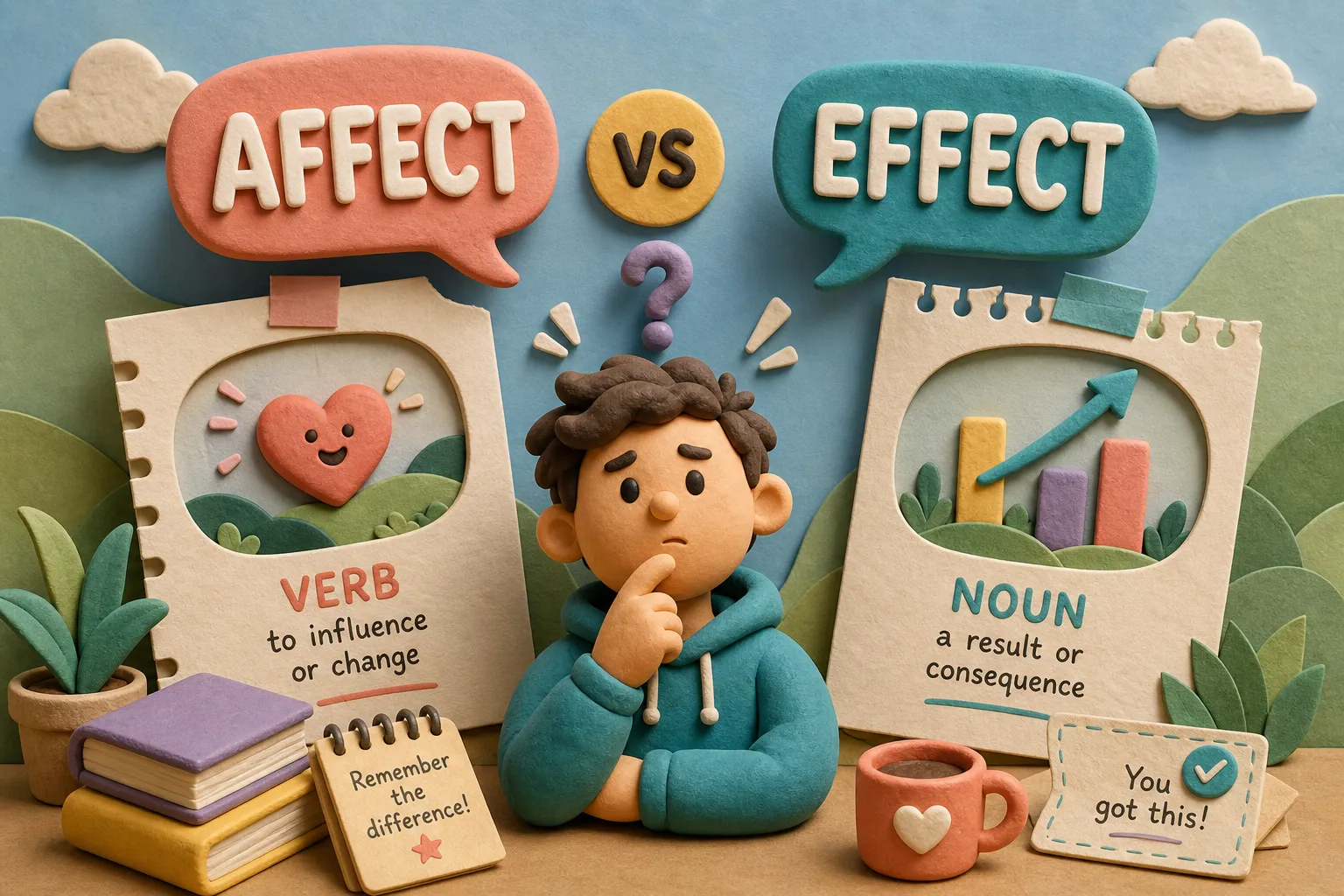
Affect is the verb. It means to have an impact on, to influence, or to change something that already exists. Merriam-Webster defines it as “to act on and cause a change in.” The key signal: if you can replace your word with “influence” and the sentence still makes sense, you want “affect.”
Look at this sentence: “The budget cuts ___ employee morale.” Try swapping in “influence”: “The budget cuts influence employee morale.” That works. So the correct word is “affect”: “The budget cuts affect employee morale.”
Effect is the noun. It names the result, outcome, or consequence that follows after something acts on something else. Merriam-Webster defines it as “a change that results when something is done or happens.” The key signal: if you can put “the” in front of your word, or swap it for “result,” you want “effect.”
Same situation, now looking for the noun slot: “The ___ of the budget cuts was low morale.” Swap in “result”: “The result of the budget cuts was low morale.” That works. So the correct word is “effect”: “The effect of the budget cuts was low morale.”
A fast substitution test anyone can run
Before you write either word, ask yourself two quick questions. First: can I replace this with “influence”? If yes, use “affect.” Second: can I replace this with “result”? If yes, use “effect.” Run this test on the two sentences below and you’ll see exactly how it works.
- “Poor sleep affects your concentration.” (Can you say “poor sleep influences your concentration”? Yes. Use “affect.”)
- “Poor sleep has a serious effect on concentration.” (Note: “result” is a diagnostic stand-in here, you’d naturally say “effect” or “resulted in decreased concentration,” but the substitution confirms you’re in noun territory. Use “effect.”)
The test works because it forces you to identify the grammatical role before you choose the word. Once that habit is in place, hesitation disappears.
What affect vs. effect looks like in real American contexts
In professional emails and written reports
These are the situations where the wrong word is most visible. Errors that slip past in casual speech tend to stand out on the page. Here are three sentences that model correct usage in typical workplace writing.
- “This vendor delay will affect our Q3 delivery timeline by approximately two weeks.”
- “The main effect of the policy change is a reduction in overtime costs.”
- “Rising material costs have already affected our profit margin this quarter, and the full effect won’t be clear until the end of the year.”
Notice that third sentence: both words appear together. Native speakers do this naturally. When you write both words correctly in the same sentence, you demonstrate real command of the distinction, not just a lucky guess.
In presentations and formal spoken English
Native speakers often use both words in the same presentation sentence as a rhetorical device, moving from the noun (the outcome) to the verb (what caused it) or vice versa. A strong example: “Before I discuss the effects of the new policy, I want to show you how it affected our team directly.” Recognize this pattern, and you can use it yourself to sound both fluent and precise.
Another common presentation sentence: “The research confirms that remote work affects productivity differently depending on role, and the effects vary by department.” The verb/noun distinction doesn’t change because you’re speaking out loud. The rule holds in every register.
In everyday American conversation
The same rule applies at the coffee machine or in a casual hallway exchange. Two short dialogue examples:
- Coworker A: “Does the new schedule affect you?” / Coworker B: “Yeah, the biggest effect for me is the commute.”
- “I don’t think the weather is going to affect turnout much.” / “Maybe not, but the effect on parking is going to be bad.”
The verb/noun split is consistent whether you’re texting a colleague or presenting to a board. That’s what makes this rule worth internalizing completely.
Two mnemonics that make affect vs. effect stick
RAVEN: a mnemonic that’s easy to retrieve under pressure
RAVEN stands for Remember Affect Verb Effect Noun. That’s it. Before you write either word, pause and run through RAVEN as a mental checklist: is the function in your sentence a verb or a noun? Once you’ve answered that, RAVEN tells you which word to use.
Note: RAVEN is widely used in source-evaluation contexts with a different meaning, but as a personal recall device for affect vs. effect, it’s a practical fit, the letters map cleanly onto the rule. Think of it as your own mental shorthand rather than an official grammar term. It works especially well if you process English as a second language under time pressure: the acronym gives you something concrete to reach for instead of second-guessing yourself. After a few weeks of deliberate use, you won’t need to think about it at all. For more ideas on mnemonic techniques you can actually use in class or at your desk, see this resource on mnemonic devices for instruction.
The A-E mental image trick
Think of A for Action: “affect” is the action happening to something, the verb doing the work. Think of E for End result: “effect” is the end result, the thing left behind after the action is done.
Pair this with a concrete image. Picture a hammer striking a nail. The hammer swinging is the “affect”, the verb, the action. The dent left in the wood is the “effect”, the noun, the result you can see and measure. Hold that image and you have an anchor for both words at the same time: two words, one visual, stored together so they’re easier to retrieve when you’re writing fast. Your Daily American’s How to Learn English with Anki retention guides explore this kind of dual-anchor technique further if you want to apply it to other confusing word pairs.
The two exceptions that are actually worth knowing
Effect used as a verb: formal and specific
“Effect” can function as a verb in formal English, but only with one precise meaning: to bring something entirely new into existence, to cause something to happen from scratch. The key collocation is “to effect change.” You’ll also see “to effect a solution,” “to effect reform,” and “to effect improvements.”
Two examples from formal writing: “The board effected a major restructuring that reshaped the entire organization.” And: “She was determined to effect real change in the education system, not just propose incremental adjustments.” Notice the distinction from “affect” as a verb: affect means to influence something that already exists; effect as a verb means to cause something new to come into being. You’ll encounter this mostly in formal reports, legal documents, and leadership writing. It’s rarely needed in everyday speech, so don’t worry about it until you see it. For guidance on this kind of usage question from a major style authority, see the Chicago Manual of Style FAQ on usage.
Affect used as a noun: primarily a clinical term
“Affect” appears as a noun in psychology and psychiatry, where it refers to an observable emotional state. You’ll see it in sentences like “The patient displayed flat affect” or “Positive affect is associated with better health outcomes.” This is technical vocabulary used by clinicians, researchers, and academic psychologists, it’s rare outside those domains and essentially absent from business emails or casual American conversation.
Unless you work in a clinical or research setting, you won’t need this form in your professional writing or daily conversation. File it as awareness, not something to practice. If you do work in those fields and want a deeper look at how affect functions in clinical research, consult discipline-specific literature or summaries that discuss affect in clinical contexts.
Catching your own mistakes before you send or speak
The most common ESL patterns behind this error
Both words sound nearly identical in fast American speech. “Affect” is pronounced /əˈfɛkt/, with a schwa in the first syllable. “Effect” is /ɪˈfɛkt/ in careful speech, but in natural conversation that first vowel often reduces toward a schwa too, making the words almost indistinguishable by ear. That’s why this mistake lives in writing: you can’t rely on sound to sort them out. For a deeper look at word stress and how vowel reduction changes perception in American English, see Word Stress in American English: A Complete Guide, Your Daily American.
For Spanish, Portuguese, and French speakers, there’s an additional pull. These languages have cognate verb families, Spanish “efectuar,” Portuguese “efetuar,” French “effectuer”, all meaning roughly “to carry out” or “to execute.” That pattern can lead learners to treat “effect” as a verb in English, when English uses “affect” for that function. If Spanish or Portuguese is your first language, watch specifically for this transfer error in your own writing. If you’re focused on common pronunciation and word-choice pitfalls faced by learners, you may also find our piece English Words Non-Native Speakers Mispronounce Most Often, Your Daily American useful.
Affect vs. effect: a two-second self-check for any sentence
Step one: identify the function you need. Are you describing something acting on something else (a verb), or naming a result (a noun)? Step two: run the substitution test, try “influence” for the verb slot and “result” for the noun slot. Step three: if you’re still uncertain, run RAVEN. Remember Affect Verb Effect Noun.
Once this sequence is internalized, it genuinely takes two seconds. Repeat it enough times and it becomes second nature, you’re no longer consciously thinking about the rule. You’re just writing the right word.
Going deeper on tricky word pairs
“Affect vs. effect” is one of dozens of confusing word pairs that show up repeatedly in professional American English. “Principal vs. principle” and “complement vs. compliment” follow the same pattern: two words that look and sound similar but carry completely different meanings and grammatical roles. Getting them right consistently separates writing that sounds fluent from writing that sounds careful but slightly off. For a practical walkthrough of other commonly confused words and straightforward tips, check this guide to commonly confused words.
Your Daily American’s professional English resources and vocabulary retention guides are built specifically around high-stakes word pairs like these. The approach mirrors the dual-anchor technique above: teach the meaning, show it in context, provide a retrieval tool, and practice until the correct choice feels natural. If you want to work through more pairs at the same level, that’s exactly where to go next.
What to take with you
The two-word takeaway: affect is the verb (it influences something), and effect is the noun (it names the result). That rule handles the vast majority of situations you’ll face in professional writing and everyday conversation.
Your two tools are the substitution test (influence or result?) and RAVEN (Remember Affect Verb Effect Noun). Both are fast, both work under pressure, and both get more reliable every time you use them. The exceptions, “effect” as a formal verb and “affect” as a psychology noun, are real but rare. You’ll recognize them when you see them, and you won’t need them in most professional contexts.
Here’s your try-it-yourself prompt: write two sentences about something happening at your job or in your life right now, “affect” in one, “effect” in the other. Then run RAVEN on both before you finish.
That single practice pass will do more to lock this in than re-reading the rule five more times. You now have a clearer handle on this word pair than most writers ever develop.