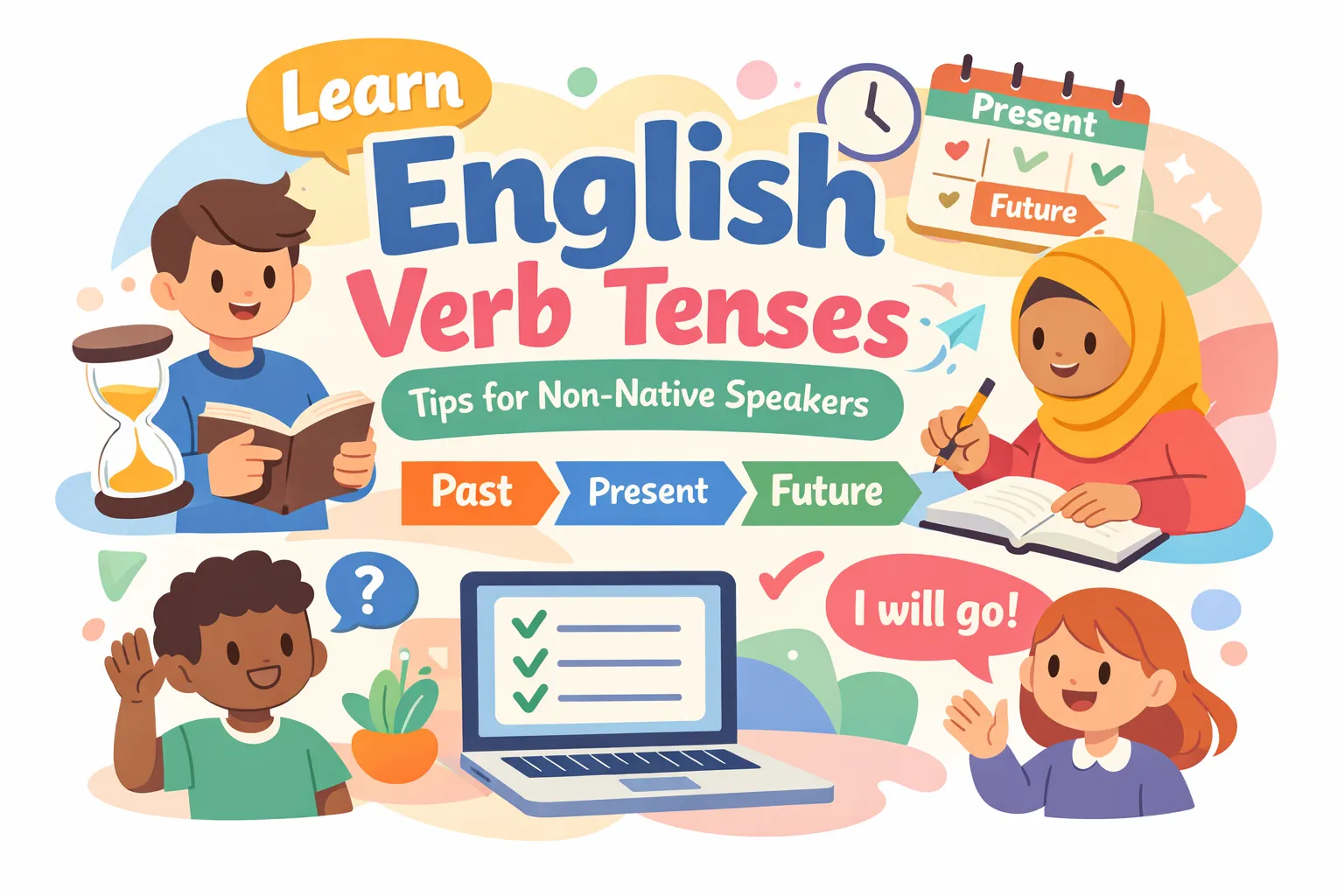
Many learners at the intermediate level are comfortable with the present simple and past simple. The other 10 tenses, though? That’s where things tend to get confusing fast. This guide will explain the 12 English verb tenses clearly, using American English examples you can actually picture and apply right away. Whether you’re studying for work, travel, or want to stop second-guessing yourself mid-sentence, keep this page handy.
Each tense gets its grammatical structure (affirmative, negative, question), its primary uses, example sentences from everyday American contexts, and a note on the most common mistake ESL speakers make with it. At Your Daily American, these same tenses appear in context-rich American content, so you can study the structure here and then see it working in real usage.
How to Explain the 12 English Verb Tenses Clearly: The 3×4 System
English organizes time into three frames: past, present, and future. Every tense belongs to one of them, and the time frame tells you when something happens. Within each time frame, there are four aspects: simple, continuous, perfect, and perfect continuous. The aspect tells you how an action relates to time. Is it a completed fact? An ongoing process? Something finished before another moment? The combination of 3 time frames and 4 aspects gives you exactly 12 tenses, and once you see that map, nothing feels random anymore.
The 4 Present Tenses Explained Clearly: Structures, Uses, and Examples
Present simple and present continuous
Present simple structure: Subject + base verb (add -s/es for he/she/it). Negative: do/does + not + base verb. Question: Do/Does + subject + base verb? Use this tense for habits, routines, general truths, and scheduled events. This is also where verb conjugation in English is most straightforward, making it the best starting point for learners.
- She checks her email every morning before the team meeting.
- He does not drink coffee after 3 PM.
- Do you work from home on Fridays?
Common mistake: Using present continuous for habits. Generally, use simple present for habits and routines; present continuous works for temporary or limited-duration habits (“I’m checking my email every day this week”). “I check my email every day” is the standard form for an established routine.
Present continuous structure: Subject + am/is/are + verb-ing. Negative: am/is/are + not + verb-ing. Question: Am/Is/Are + subject + verb-ing? Use this for actions happening right now, temporary situations, and near-future arrangements.
- We are reviewing the contract right now.
- She is not attending the 2 PM call today.
- Are you working on the quarterly report this week?
Common mistake: Using it with stative verbs. “I am knowing the answer” is wrong. “I know the answer” is correct. Verbs like know, believe, want, and understand describe states, not actions, so they stay in simple form.
Present perfect and present perfect continuous
Present perfect structure: Subject + have/has + past participle. Negative: have/has + not + past participle. Question: Have/Has + subject + past participle? Use this for past actions with present relevance, life experiences, and actions in an unfinished time period.
- I have already sent the invoice to the client.
- She has not finished the onboarding process yet.
- Have you ever attended a leadership workshop in the U.S.?
Common mistake: Using past simple for experiences that connect to now. “I visited Chicago” without a time reference misses the present relevance. “I have visited Chicago” works better when the experience itself is the point.
Present perfect continuous structure: Subject + have/has + been + verb-ing. Negative: have/has + not + been + verb-ing. Question: Have/Has + subject + been + verb-ing? Use this for actions that started in the past and are still happening, or recent ongoing activity with visible results.
- I have been waiting for the callback for two hours.
- He has not been sleeping well since the product launch.
- How long have you been working at this company?
Common mistake: Confusing it with present perfect. Present perfect focuses on completion or result. Present perfect continuous focuses on duration and the ongoing process itself. For a clear comparison of present perfect simple and continuous forms and uses, see this resource from the British Council: present perfect simple and continuous.
The 4 Past Tenses Explained Clearly: Structures, Uses, and Examples
Past simple and past continuous
Past simple structure: Subject + past form (V2/ed). Negative: did + not + base verb. Question: Did + subject + base verb? Use this for completed actions at a specific past time and past habits or states.
- The team finished the pitch deck last night.
- She did not attend the conference in Austin.
- Did you send that follow-up email to the client?
Common mistake: Using present perfect when a specific past time is mentioned. “I have called him yesterday” is wrong. “I called him yesterday” is correct. Any specific time word (yesterday, last week, in 2020) locks you into past simple.
Past continuous structure: Subject + was/were + verb-ing. Negative: was/were + not + verb-ing. Question: Was/Were + subject + verb-ing? Use this for ongoing past actions, background situations, and interrupted actions paired with past simple.
- I was preparing the slides when my laptop crashed.
- They were not expecting that question during the presentation.
- Were you working from the New York office last month?
Common mistake: Using past simple for the background action. “I prepared the slides when my laptop crashed” changes the meaning entirely. Past continuous sets the scene; past simple delivers the interruption.
Past perfect and past perfect continuous
Past perfect structure: Subject + had + past participle. Negative: had + not + past participle. Question: Had + subject + past participle? Use this when one past action was completed before another past action or time.
- By the time the manager arrived, the team had already reviewed the numbers.
- She had not submitted her application before the deadline closed.
- Had you ever used Slack before you joined this company?
Common mistake: Using past simple for both actions in a sequence. “When I arrived, she left” is technically possible but ambiguous. “When I arrived, she had already left” is clearer about what came first.
Past perfect continuous structure: Subject + had + been + verb-ing. Negative: had + not + been + verb-ing. Question: Had + subject + been + verb-ing? Use this for an ongoing past action happening before another past moment, especially when duration matters.
- She had been working on that proposal for three weeks before they canceled the project.
- He had not been feeling well before he finally went to urgent care.
- How long had you been studying English before you moved to the U.S.?
Common mistake: Confusing it with past perfect. Past perfect focuses on a completed action before another past moment. Past perfect continuous emphasizes the duration of an ongoing action leading up to that point.
The 4 Future Tenses: Structures, Uses, and Examples
Future simple and future continuous
Future simple structure: Subject + will + base verb. Negative: will + not + base verb. Question: Will + subject + base verb? Use this for predictions, spontaneous decisions, promises, and general future facts.
- I will send you the report by end of day.
- She will not be available on Monday morning.
- Will you be joining the all-hands call next week?
Common mistake: Using “will” for fixed plans or arrangements. “I will have a meeting at 3 PM” is less natural than “I have a meeting at 3 PM” for a scheduled event. Save “will” for decisions made in the moment or predictions.
Future continuous structure: Subject + will + be + verb-ing. Negative: will + not + be + verb-ing. Question: Will + subject + be + verb-ing? Use this for actions that will be in progress at a specific future moment, and for polite questions about someone’s plans.
- At 9 AM tomorrow, I will be presenting to the board.
- She will not be traveling during the holidays this year.
- Will you be using the conference room this afternoon?
Common mistake: Mixing up future continuous with future simple when tone matters. “Will you come to the meeting?” is a direct request. “Will you be coming to the meeting?” is softer and less imposing, a distinction worth knowing in professional American English. For more on choosing the most important tenses and where to focus your study, see this overview from EF English Live: the most important tenses in English.
Future perfect and future perfect continuous
Future perfect structure: Subject + will + have + past participle. Negative: will + not + have + past participle. Question: Will + subject + have + past participle? Use this for actions that will be completed before a specific future time or event.
- By Friday, I will have reviewed all the candidate profiles.
- She will not have finished the audit before the client call.
- Will you have completed the onboarding by next Monday?
Common mistake: Forgetting “have” in the structure. “I will finished by Friday” is wrong. “I will have finished by Friday” is correct. The word “have” is the piece most learners drop under pressure.
Future perfect continuous structure: Subject + will + have + been + verb-ing. Negative: will + not + have + been + verb-ing. Question: Will + subject + have + been + verb-ing? Use this for ongoing actions up to a specific future point, when you want to emphasize duration.
- By December, she will have been leading this team for two years.
- I will have been waiting for this promotion for over a year by the time they announce it.
- How long will you have been living in the U.S. by the end of this year?
The most common tense mistakes ESL speakers make
Present perfect vs. past simple: one of the most frequent mix-ups
This is among the errors that appear most often in spoken and written English. The mistake looks like this: “I have seen that movie last week.” The rule is straightforward. If you mention a specific past time (yesterday, last week, in 2020), always use past simple. Present perfect is for actions where the time is either unfinished or not mentioned.
- Wrong: “I have seen that movie last week.” Right: “I saw that movie last week.”
- Right: “I have seen that movie before.” (no specific time mentioned)
- “Did you eat lunch?” asks about a finished period. “Have you eaten lunch?” asks about today, which is still open.
Past perfect vs. past simple, and future tense errors
Use had + past participle only when you need to show that one past action happened before another. If the sequence is already clear from context or connectors, past simple works fine. “She finished the report. Then she sent it.” needs no past perfect. “She had already finished the report when the manager asked for it” uses past perfect because the timeline needs to be explicit.
For future tense choices, use “will” for spontaneous decisions and predictions. Use present continuous for fixed arrangements. “I will help you with that” is a spontaneous offer made in the moment. “I am meeting the client at 10 AM” is a pre-arranged plan. Getting this contrast right makes your professional English sound noticeably more natural.
Signal words at a glance: your tense identification toolkit
These signal words are starting clues, not absolute rules. Context always matters. When you see a signal word, use it to narrow down your options, then confirm with the overall meaning of the sentence. For a compact visual chart of all 12 tenses and their forms, this Magoosh guide is an excellent quick reference: 12 English verb tenses with tables.
| Tense | Key Signal Words |
|---|---|
| Present Simple | always, usually, often, every day/week/month, never, on Mondays |
| Present Continuous | right now, at the moment, currently, today, this week |
| Present Perfect | ever, never, just, already, yet, so far, recently, this year |
| Present Perfect Continuous | for, since, all day, lately, how long |
| Past Simple | yesterday, last week/month/year, ago, in [year], when |
| Past Continuous | while, when (interruption), at that time, all day yesterday |
| Past Perfect | before, after, already (before a past point), by the time, when |
| Past Perfect Continuous | for, since, before (with duration), by the time |
| Future Simple | tomorrow, next week, soon, in the future, someday |
| Future Continuous | at this time tomorrow, all next week, at [specific future time] |
| Future Perfect | by [future time], by the time, before [future event], in two days |
| Future Perfect Continuous | for, since, by the time (with duration to future point) |
Now put the tenses to work
Understanding all 12 tenses isn’t about memorizing rules in isolation. It’s about recognizing how each tense expresses a specific relationship between time and action. Once you internalize the 3×4 system, choosing the right tense becomes a natural reflex rather than a mental calculation. The key is pairing structured study with exposure to real usage.
At Your Daily American, every article and lesson demonstrates these tenses in natural Everyday American English contexts, for example, you’ll see present perfect woven into a workplace email exactly where Americans reach for it. That kind of situated exposure is what makes grammar stick beyond the reference page.
If you want one more quick reference on verb forms and common usage tips, Grammarly’s overview of verb tenses is practical and learner-friendly. Pair that kind of structured guide with real conversations and articles: study one unfamiliar tense each week, then look for it in real conversations. That’s how grammar stops being theory and starts becoming fluency.