Canvas vs. canvass is one of those word pairs that trips up even advanced English learners, and plenty of native speakers, too. Picture this: you’re writing a sentence about a political volunteer who spends her Saturday knocking on doors in her neighborhood. You type the word, then stop. Is it “She was canvasing the district” or “canvassing”? And wait, is that even the same word as the fabric painters stretch over a frame? Two words, one pronunciation, completely different meanings. That’s exactly the kind of trap that stops people mid-sentence.
By the end of this lesson, you’ll know how to choose the right spelling every time and write the correct verb forms with confidence. You’ll also pick up a memory trick that makes the decision automatic. This is the kind of word pair that causes real confusion in emails, essays, and professional writing, and getting it right will immediately sharpen how you come across on the page.
What “canvas” means in American English
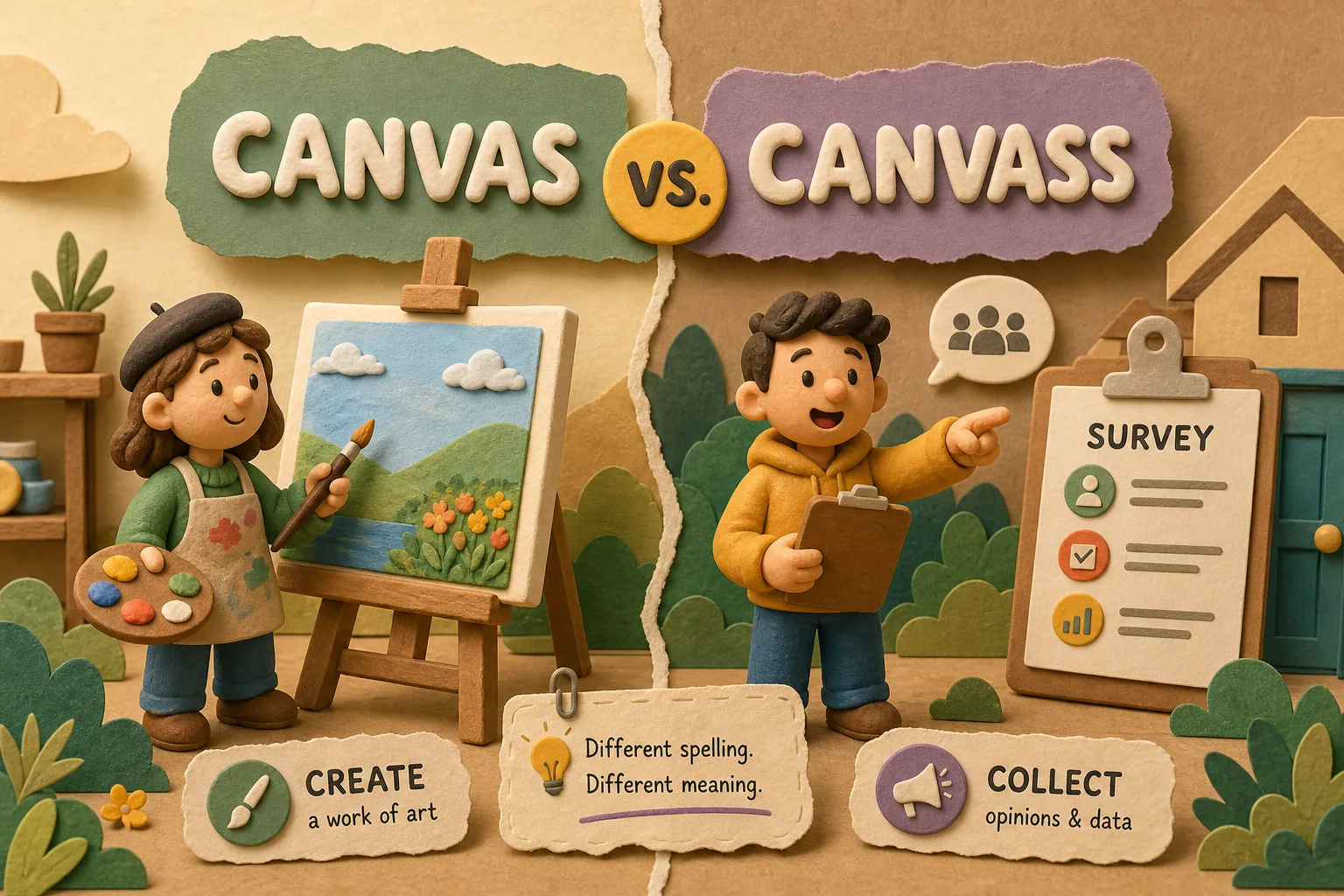
Canvas is a noun. It names a thing: a strong, heavy, rough woven fabric originally made from hemp. In everyday American life, you’ll find canvas in tents, sails, sneakers, tote bags, and backpacks. The word has been in English since the 14th century, and it’s one of those sturdy, practical words that shows up across many different settings.
In art, canvas refers specifically to the surface a painter works on, whether that’s a stretched piece of fabric over a wooden frame or a finished painting on that surface. “The museum displayed three large canvases by a local artist.” “She primed the canvas before applying the first layer of paint.” The boxing world uses the word too: the floor of a boxing ring is called the canvas, so when a fighter gets knocked down, announcers say he “hit the canvas.”
One figurative use you’ll encounter constantly in American speech is “a blank canvas.” This phrase describes any open opportunity or fresh start. “Moving to a new city felt like a blank canvas.” “The company’s rebrand gave the design team a blank canvas to work with.” You’ll hear it in job interviews, motivational talks, and casual conversations. It always uses canvas with one S, and once you recognize it, you’ll start noticing it everywhere.
What “canvass” means in American English
Canvass is a verb. It means to go through an area, contact people systematically, and gather opinions, votes, or support. The double S is your signal that this word describes an action, not a thing. Think of it as organized outreach: you’re not just asking one person, you’re working through a list, a neighborhood, or a group in a deliberate, methodical way.
The most common place Americans encounter this word is during election season. Campaign volunteers canvass neighborhoods by knocking on doors, talking to residents, and recording how they plan to vote. “The volunteers canvassed three precincts before noon.” “She spent the weekend canvassing for her local city council candidate.” If you follow American news or political dramas, you’ve almost certainly heard canvass used in exactly this context.
Political canvassing
Political canvassing is highly structured. Volunteers are typically assigned specific blocks or precincts, given a script, and asked to record responses in a tracking system. The goal is broad, systematic outreach, which is precisely what the word canvass captures. One S would imply the fabric; two S’s signal the action.
Nonpolitical canvassing
Canvass isn’t limited to politics. An HR manager canvasses employees before rolling out a new workplace policy. A product team canvasses customers to learn what features they actually want. “The company canvassed over 200 users before finalizing the app’s redesign.” Anywhere someone is actively and systematically gathering input from a group, canvass is the right word. There is also a rare noun form, “a canvass of public opinion”, but the verb is by far the most common use, so that’s where to focus your energy.
Canvas vs. canvass in real American contexts
Seeing both words in action, side by side, is the fastest way to build the kind of instinct that makes the right choice feel obvious rather than forced.
Imagine a local campaign office on a Saturday morning. A volunteer walks in and is handed a printed list of addresses. Her team leader tells her, “You’ll be canvassing the north end of the district today.” She spends the morning knocking on doors, talking to residents, and recording their responses. Later, back at the office, she helps hang a banner the team painted on a large piece of canvas. Two different words, two different things, the same afternoon.
Here’s another side-by-side scenario. An art student arrives in class, pulls out a fresh canvas, and starts sketching the outline of her composition. Across town, an HR director sends an email to the entire staff: “We’re conducting a company canvass about our remote work policy. Please share your feedback by Friday.” The art student handles a material. The HR director runs a process. Context makes the correct word obvious almost every time, and mixing them up sends a confusing signal to any American reader who notices.
Memory tricks to get it right every time
Rules help, but a strong memory trick works faster under pressure, especially mid-sentence when you don’t have time to think through the logic. Here are two techniques worth keeping in your back pocket.
The double-S rule: Canvass has two S’s, and so does “solicit,” which is the core meaning of the word. If you’re writing about an action, asking people, seeking votes, surveying a group, reach for the double S. If you’re writing about a thing, the fabric, the painting, the floor of a boxing ring, stick with one S. Say it to yourself: “She painted on canvas (thing, one S). He canvassed the block (action, double S).” That single comparison is enough to lock in the pattern for most learners.
For a visual reinforcement, picture two people standing at a front door, side by side. Two S’s, two people, a conversation in progress. That image represents canvassing. A canvas, by contrast, is just one flat surface, alone, waiting to be painted. Pairing a vivid image with a word’s meaning is one of the most reliable ways to move vocabulary from short-term recall to long-term use, which is why Your Daily American builds its word-pair lessons around real usage contexts rather than abstract rules.
The verb forms of “canvass” and common spelling traps
Knowing the base word is only half the job. You also need to write the inflected forms correctly, and this is where many learners, and plenty of native speakers, make mistakes.
The standard verb forms are:
- Past tense: canvassed, “They canvassed the entire neighborhood last Saturday.”
- Present participle: canvassing, “She is canvassing a new district this weekend.”
- Agent noun: canvasser, “He works as a canvasser for a nonprofit environmental group.”
The most common trap is dropping one S: writing “canvased” instead of “canvassed,” or “canvasing” instead of “canvassing.” That missing letter produces a form that looks like a past tense of canvas used as a verb, which has no standard meaning in American English. It’s a small error that signals a big confusion, so train yourself to double-check those S’s whenever you write any inflected form.
The plurals can also look alarming if you haven’t seen them before, so here’s a clear comparison. The plural of the noun canvas is canvases: “Three large canvases hung in the gallery.” The third-person singular present tense of the verb canvass is canvasses: “She canvasses a new precinct every weekend.” They look different, they serve different grammatical roles, and once you recognize that, the forms become predictable rather than confusing. The noun adds -es for its plural; the verb adds -es for its third-person singular, following normal English patterns.
Try it yourself
The core canvas vs. canvass distinction comes down to this: canvas is a noun for a physical material or surface; canvass is a verb for seeking out opinions, votes, or feedback. One names a thing, the other describes an action, and the double S is the spelling cue that tells you which is which.
Test yourself with these fill-in-the-blank prompts. Choose canvas or canvass (or one of their forms) for each sentence:
- The campaign team _____ the entire district in one afternoon.
- She bought a large _____ to start her new painting.
- Before the vote, every volunteer was assigned a block to _____.
Answers: (1) canvassed, (2) canvas, (3) canvass. If you got all three right, you’ve already internalized the distinction. If one tripped you up, revisit the memory trick section and try writing a sentence of your own for each word. That kind of active practice is what moves a word from your “I know the rule” shelf to your “I just know it” shelf, which is exactly where you want it.
Once you understand the canvas vs. canvass meaning difference, the pair stops being a source of doubt and becomes a quick, confident choice. Word pairs like these are everywhere in American English, and they get easier with regular exposure to real, contextualized language. If you want more lessons like this one, with examples pulled from actual American conversations and writing, explore what Your Daily American has to offer. Each word pair you master makes the next one a little easier to lock in.