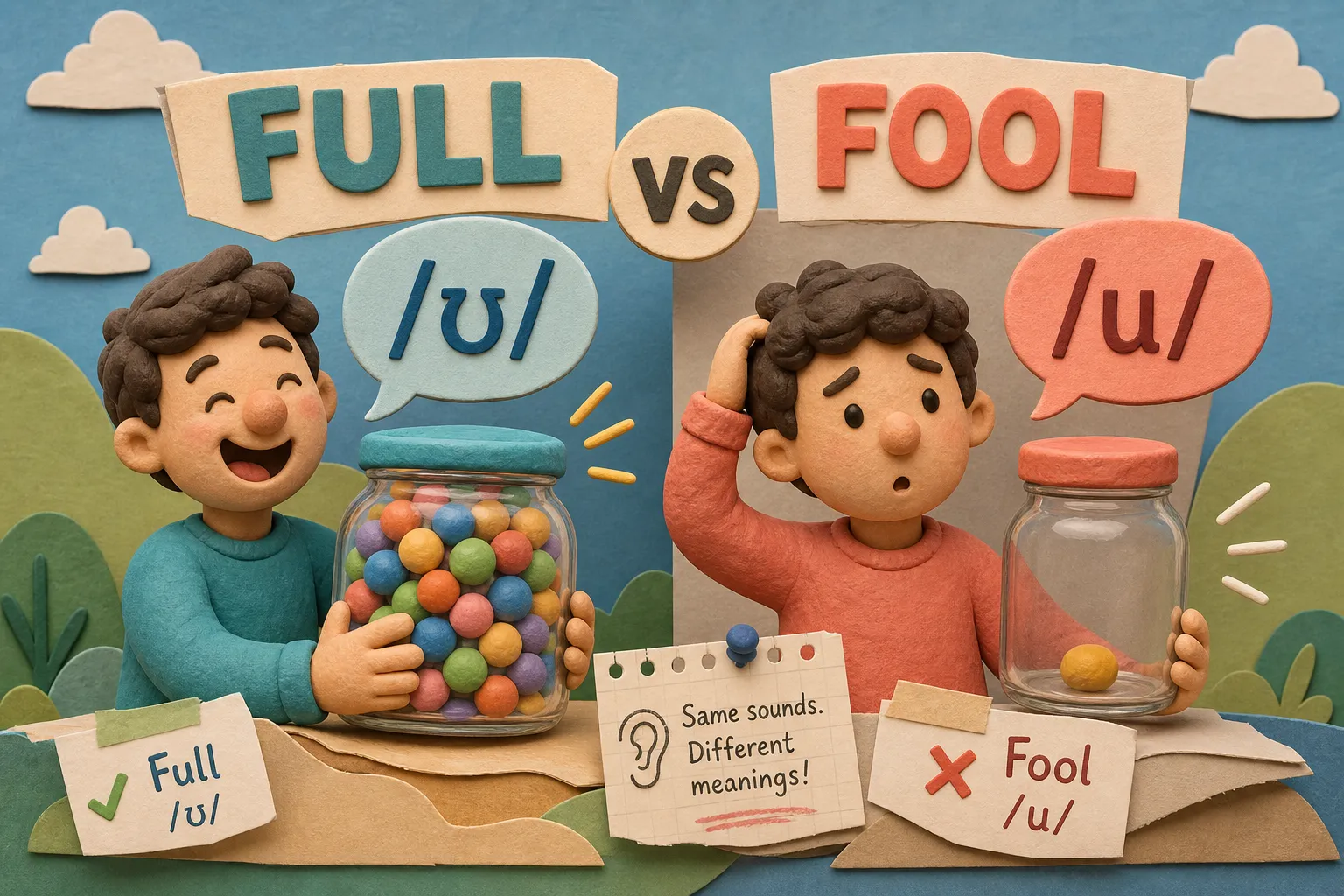
Full vs. fool: these two words both use “oo” in their spelling, but they carry completely different vowels. Mixing them up changes your meaning instantly. Tell someone the glass is full, and it lands correctly. Call someone a fool when you meant full, and the conversation takes a sharp turn.
By the end of this lesson, you’ll be able to hear the difference between these two sounds, feel the physical contrast in your own mouth, and practice both in real sentences. The goal is not just knowing the rule, but owning the sounds. This full vs. fool vowel contrast trips up learners from Spanish, Portuguese, Mandarin, and many other language backgrounds, because neither /ʊ/ nor /uː/ maps neatly onto familiar vowels from those languages. Once you understand what’s actually happening in your mouth, the contrast clicks fast.
This is also the kind of foundational vowel work that pays off across your entire pronunciation. The /ʊ/ vs. /uː/ distinction shows up constantly in everyday American speech, and training your ear here sharpens your listening well beyond these two words.
Full vs. Fool: What Actually Separates These Two Vowels
“Full” is transcribed in IPA as /fʊl/. “Fool” is /fuːl/ in British English and typically /ful/ in General American, where vowel length isn’t marked phonemically. The difference is not just length: it’s vowel quality, specifically the distinction between a lax vowel (/ʊ/) and a tense vowel (/uː/).
Lax means relaxed. Your tongue, lips, and jaw do less work. Tense means the opposite: your articulators move to a more extreme position and hold it. /ʊ/ is the lax version, and /uː/ is the tense version of roughly the same back-of-the-mouth position. That’s why they sound similar to untrained ears but feel different once you know where to pay attention.
Spelling won’t help you here. Both words use “oo,” but so do “book,” “moon,” “good,” and “food,” all of which land in different vowel categories. Dozens of everyday words carry /ʊ/ without an “oo” in sight: put, push, pull, could, would. Relying on spelling to guess vowel quality is a losing strategy in English. The skill to build is recognizing vowel families by ear and by feel, not by letter patterns.
In General American and in Received Pronunciation (standard British), both dialects maintain this contrast clearly. GA tends to mark the difference more through vowel quality than through length, while RP makes the duration contrast a bit more noticeable. Either way, native speakers hear these as two distinct sounds.
How to Shape Each Sound with Your Mouth
The Relaxed Position for /ʊ/ (as in “full”)
Here’s what your articulators do for /ʊ/. Your tongue moves toward the back of your mouth, raised but not pressing hard against the roof, it sits in a mid-high position, not straining upward. Your lips stay gently rounded and soft, not pushed forward. Your jaw drops slightly, more open than you’d expect for a “high” vowel. The whole setup is loose. Think of it as the relaxed version of a back rounded vowel.
A simple phonetic anchor: think of the vowel in “book” and hold it for a moment. That’s /ʊ/. The IPA symbol itself (ʊ) looks a bit like a relaxed lowercase “u,” which is a useful memory hook. If you want a quick visual reference for American English symbols, consult an American English IPA chart to see where these vowels sit in relation to others.
The Tighter Position for /uː/ (as in “fool”)
For /uː/, everything engages more. Your tongue rises high and back, pressing closer to the soft palate than it does for /ʊ/. Your lips round more firmly and push slightly forward, almost like the beginning of a whistle. Your jaw closes nearly shut, noticeably more than for the /ʊ/ position. This is the more effortful, sustained version of the back rounded position.
Simple phonetic anchor: think “oo” as in “moon” or “soup,” held with clear tension. The IPA /uː/ with its length mark signals exactly that: more duration, more muscular engagement. For visual diagrams and a focused look at the vowels of American English, the article on the vowels of American English is a helpful supplement.
Full vs. Fool, A Feel-It Drill
Say “book” slowly, hold the vowel, and notice how soft everything feels. Now say “boo” and hold that vowel. Feel how your lips push forward and your tongue lifts higher. That exact shift, from “book” to “boo”, is the same physical difference between “full” and “fool.” Try it: book, boo, book, boo. Then: full, fool, full, fool.
Place a finger near your lips as you do this. For /ʊ/, your lips barely move outward. For /uː/, you’ll feel them round and push forward. That physical cue is your built-in self-check tool.
Minimal Pairs That Make the Contrast Impossible to Miss
Minimal pairs are words that differ by exactly one sound. They’re the most direct way to train your ear on a specific contrast, because every other variable stays the same. Here are the core pairs to work with for full vs. fool pronunciation:
- full /fʊl/ vs. fool /fuːl/
- pull /pʊl/ vs. pool /puːl/
- foot /fʊt/ vs. food /fuːd/
- could /kʊd/ vs. cooed /kuːd/
- look /lʊk/ vs. Luke /luːk/
- wood /wʊd/ vs. wooed /wuːd/
- should /ʃʊd/ vs. shooed /ʃuːd/
- put /pʊt/ vs. “poot” (practice item)
To use this list: say the /ʊ/ word, pause two seconds, then say the /uː/ word. Then reverse the order. Slow is fine at first. You’re building a mental category, not a speed skill. You can also check reliable dictionary entries like “fool” on Merriam‑Webster for confirmation of pronunciation and stress.
Training Your Ear Before Your Mouth
In most cases, learners who practice listening discrimination before attempting production build a more stable contrast faster. Read both words of a pair aloud, record yourself, and listen back. If both words sound identical in the recording, your tongue isn’t traveling far enough between the two positions. That’s the most honest feedback you can get.
The sequence that works: hear it clearly, identify it reliably, then produce it. The ear trains the mouth, not the other way around. Once you can catch the contrast in someone else’s speech, your own production follows much more quickly.
Mistakes That Keep Learners Stuck on These Two Sounds
Over-Rounding “Full” into “Fool”
This is the most common error. Learners notice lip rounding in “full” and push too hard, producing something closer to /uː/. The fix: anchor /ʊ/ with the word “book.” Say “book, full, book, full” in a steady rhythm until the vowel feels consistent across both words. “Book” is your reference point every time you feel uncertain about /ʊ/.
Cutting “Fool” Short So It Sounds Like “Full”
The second error runs in the opposite direction. Learners produce /uː/ with insufficient tension and duration, and it collapses back into /ʊ/. Fix this by anchoring “fool” to the word “moon.” Say “moon, fool, moon, fool.” Both carry the same /uː/ vowel, so matching the quality of “moon” pulls “fool” into the right position.
Trusting the Spelling
This habit keeps learners confused longer than any other. “Could,” “good,” “look,” and “push” all carry /ʊ/ despite different spelling patterns. There is no consistent rule. Learn sound families, not letter patterns. Use word groups as anchors: book, cook, look, took, full, pull, push, put. These all share /ʊ/ regardless of how they’re spelled, and knowing them as a group gives you a reliable mental category to test against.
Practice Sentences and Drills to Lock In Both Sounds
Sentence-Level Practice
Working at the sentence level forces you to move between the two vowels in real time, which is much closer to what speaking actually requires. Read each of these aloud, slowly at first:
- “The pool is full.” (/uː/ then /ʊ/)
- “Look at that fool.” (/ʊ/ then /uː/)
- “Could you move to the other room?” (multiple vowel contrasts)
- “She should use the new book.” (both vowel types in one sentence)
- “The cook put food in a cool bowl.” (dense mixed practice)
Don’t rush through these. Accuracy comes first, speed comes later. Once you can say each sentence with a clear distinction between /ʊ/ and /uː/, push the pace toward natural conversational speed.
The Connected Speech Benchmark Drill
One sentence does a lot of work here: “The room is full of fools.” It forces you to produce /uː/ in “room” and “fools,” then /ʊ/ in “full,” in natural connected speech. Say it slowly three times, then at full conversational speed. Notice whether “full” and “fools” still feel distinct. If they start to blur at speed, slow down and rebuild from the physical feel-it drill.
Building This into Daily Practice
Pick two minimal pairs from the list. Say each word five times in a short sentence, then move on with your day. Targeted vowel practice works best in small, frequent doses rather than long, infrequent sessions. Your ear needs repeated exposure over several days before the contrast feels automatic.
What to Take Away from This Lesson
In short: the full vs. fool contrast is a vowel quality question, not a spelling one. /ʊ/ is lax, relatively short, and relaxed. Your tongue sits mid-high and back, lips softly rounded, jaw slightly open. /uː/ is tense, longer, and more effortful: tongue high and back, lips firmly rounded, jaw nearly closed. The difference is real and physical, and once you feel it, you won’t confuse the two again.
The sequence that gets you there: hear it clearly in minimal pairs, feel it through the physical drill, practice it in sentences, then use the benchmark drill in connected speech. Repeat that cycle over several days and the contrast becomes intuitive. Your ear catches up quickly once you know what to listen for.
Start right now with the feel-it drill: book, boo, book, boo, full, fool. Come back to the practice sentences once a day for a week. By day three or four, the full vs. fool difference starts to feel obvious rather than subtle. For more sound guides and connected-speech lessons built around real American English conversations, Pronunciation & Listening is where to go next, see also Word Stress in American English: A Complete Guide and How to Pronounce TH in American English (θ and ð): Full Guide for related lessons.