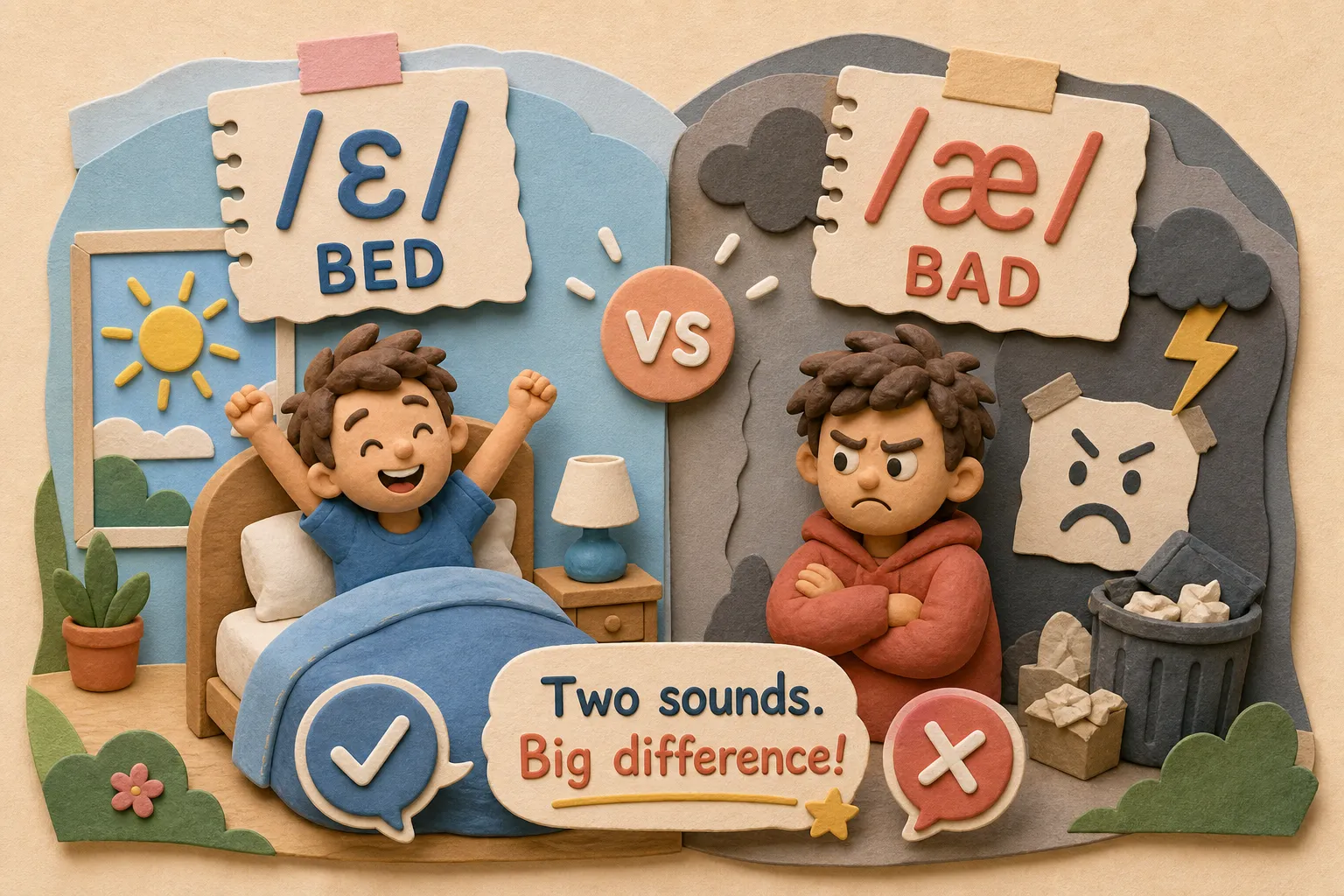
Bed vs bad: by the end of this lesson, you’ll be able to hear, feel, and reliably reproduce the difference between two of the most commonly confused vowels in American English, /ɛ/ as in bed and /æ/ as in bad. You’ll know exactly what your jaw and tongue should be doing for each sound, and you’ll have a repeatable drill sequence you can run on your own.
Here’s how real the stakes are: a learner asks a store employee where to find “bed sheets” and gets a confused look, because their vowel landed somewhere between /ɛ/ and /æ/, and the listener’s brain filed it under neither. This contrast shows up dozens of times a day in real American English. It lives in words like head, men, set, ten, left, and every one of those has a /æ/ counterpart that changes meaning completely.
At Your Daily American, this vowel pair trips up intermediate learners more than almost any other front vowel contrast, and the fix is faster than you’d expect. This article covers the physical mechanics of each sound, a hands-on jaw test, L1-specific pitfalls by native language, and a step-by-step minimal-pair drill you can use starting today.
Bed vs Bad, What Actually Separates These Two Vowel Sounds
The difference between /ɛ/ and /æ/ is not a mystery. It’s physical, measurable, and learnable once you know exactly where each vowel lives in your mouth. Two physical anchors account for virtually everything, and once your body knows them, your ear follows.
Bed vs Bad: The Tongue and Jaw Position for Each Sound
/ɛ/ (“bed”) is a mid-front vowel. IPA: /bɛd/. Phonetic respelling: “behd.” Your tongue sits at mid-height, neither high nor low. Your jaw opens only slightly, and your lips are unrounded and relaxed. Think of it as a comfortable middle-ground position: not reaching up like in /iː/ (“bead”), not dropping down like in /æ/.
/æ/ (“bad”) is a near-low front vowel. IPA: /bæd/. Phonetic respelling: “baad” (hold that “aa” open). Your tongue body drops lower than for /ɛ/. Your jaw opens noticeably wider, and your lips are slightly spread. Everything in your mouth is more open and downward compared to /ɛ/. The main physical difference is jaw height and tongue drop; everything else follows from that single movement.
A Simple Mental Map of Where These Sounds Live
Picture a vertical ladder of front vowels. At the very top sits /iː/ as in “bead.” One rung below that is /ɪ/ as in “bid.” Then comes /ɛ/ as in “bed,” sitting in the middle. And near the bottom of the front vowel space, more open than any of the others, sits /æ/ as in “bad.” When your jaw drops, your vowel moves down that ladder. When your jaw stays closed, it stays high.
In acoustic terms, /æ/ has a noticeably higher first formant (F1) than /ɛ/. In plain English, that means /æ/ resonates more openly in your vocal tract, which is exactly why it sounds “wider” or more open to native-speaker ears. You don’t need to memorize the technical details, just understand that a more open jaw produces a lower, wider sound, and that’s /æ/. Recent articulatory dynamics research supports the idea that jaw and tongue configuration drive these measurable acoustic differences.
How to Feel the Difference Right Now
You don’t need a recording studio or a teacher in the room to check your vowels. Two simple exercises will give you immediate physical feedback.
The Jaw-Drop Test
Place two fingers lightly under your chin, right where your jaw hinges. Say “bed” slowly. Notice how little your chin drops. Now say “bad” and feel the difference. Your chin should fall noticeably more, about as much as it does when a doctor asks you to say “ah.” For /æ/, your jaw drop should match that open “ah” feeling. For /ɛ/, your jaw stays much more relaxed and still.
Repeat the cycle several times: “bed… bad… bed… bad.” Keep your fingers under your chin and pay attention only to the physical sensation at first. Don’t worry about whether it sounds right yet. Train the feeling before you train the sound. Once your chin is reliably dropping more on “bad” than on “bed,” your vowels are already separating.
Using a Mirror to Lock in Each Position
Stand in front of a mirror and alternate the pair slowly: “bed… bad… bed… bad.” For /ɛ/, your lips should look neutral and relaxed, your mouth only slightly open. For /æ/, you should see a wider, more open oral shape, with a slight spread to the lips. The visual gap between the two positions is real and visible. If you can’t see a difference in the mirror, your jaw isn’t moving enough on /æ/.
For even better feedback, record a short video of yourself from the front and play it back. Compare your jaw height on “bed” versus “bad.” Then find a native-speaker video model online and do the same comparison. The difference should be clearly visible on both. If your two vowels look identical in the video, go back to the jaw-drop exercise and exaggerate the /æ/ drop until your mirror shows a clear contrast.
Why This Contrast Trips Up Learners from Specific Language Backgrounds
Your native language shapes how your brain categorizes vowel sounds. If your L1 doesn’t have a /æ/ vs. /ɛ/ split, your ear will initially treat both sounds as “close enough” to the same thing. Here’s what that looks like by language group, and how to fix it.
Spanish speakers don’t have a separate /æ/ in their vowel inventory. Both /æ/ and /ɛ/ tend to get mapped onto a single familiar open-front space. The fix is to train the height difference consciously and physically. Exaggerate the jaw drop for /æ/ in your early practice until the muscle memory is automatic. Once your body knows the two positions, your ear will start hearing them as distinct.
Mandarin speakers often confuse /æ/ and /ɛ/ in both directions, misidentifying each as the other in both listening and speaking. A three-step descending drill works well here: start with /iː/, drop to /ɛ/, then drop further to /æ/. This ladder approach anchors each position relative to the ones around it and gives your ear a structured framework instead of just two floating sounds.
Korean speakers face a specific challenge: a recent vowel merger in Korean has reduced the perceptual salience of /ɛ/ as a separate category. If you’re a Korean learner, don’t rely on how long the vowel sounds. Length is not the cue in English. Focus entirely on vowel quality: tongue height and the degree of jaw opening. Korean learners also benefit from explicit feedback that shifts attention away from duration and onto the spectral “feel” of each vowel.
Japanese speakers have a five-vowel system, so both /æ/ and /ɛ/ get pulled toward the nearest Japanese category. Because Japanese vowels are steady and even in length, Japanese learners sometimes use duration as a cue for English vowels, which doesn’t work. Practice minimal pairs with identical word length and make vowel quality the only variable your ear is tracking.
Across all language backgrounds, the most common error is collapsing both vowels into a mid-open sound that sits between the two targets. A few learners overcorrect and stretch /æ/ so far open that “bad” starts sounding like “baahd.” The goal is contrast, not exaggeration. Native General American speakers produce these as clearly distinct, but not theatrical. A wider jaw for /æ/. A relaxed jaw for /ɛ/. That’s all you need. Perceptual-training studies also show that targeted listening tasks speed up this learning process; see research on L2 perceptual learning and training methods for more detail (perceptual training evidence).
Your Minimal-Pair Drill Sequence
This is where you do the actual work. Read each pair out loud, use the carrier sentences, and follow the protocol below.
Core Word Pairs to Practice
- bed /bɛd/ “behd”, I sleep in a bed. → bad /bæd/ “baad”, That was a bad idea.
- head /hɛd/ “hehd”, My head hurts. → had /hæd/ “haad”, She had a great time.
- set /sɛt/ “seht”, We set a time for the meeting. → sat /sæt/ “saat”, He sat by the window.
- ten /tɛn/ “tehn”, We need ten copies. → tan /tæn/ “taan”, She got a tan this summer.
- men /mɛn/ “mehn”, Three men walked in. → man /mæn/ “maan”, He’s a kind man.
The Drill Protocol
- Find a native-speaker audio model for each pair. Search YouTube for “bed bad minimal pair pronunciation.” Several short practice videos are available for free. Listen to each pair two or three times before you speak.
- Repeat each word in isolation, three times slowly: “bed… bed… bed.” Feel your jaw position. Then do the same for “bad… bad… bad.” Feel the jaw drop increase.
- Alternate the pair out loud with a short pause between: “bed, bad, bed, bad.” Keep your fingers under your chin if it helps you track the movement.
- Use each word in its carrier sentence at natural conversational speed. This is the step that locks the vowel into real-world speech rather than isolated drill mode.
- Record yourself reading the full list: bed, bad, head, had, set, sat, ten, tan, men, man. Play it back and listen for a clear jaw-drop difference on the /æ/ words.
Structured training approaches, specifically the differences between identification and discrimination tasks, have measurable effects on how quickly learners form new vowel categories, so follow the protocol rather than mixing steps randomly for best results (controlled training research).
Don’t rush to step 4 until steps 2 and 3 feel physically distinct, not just aurally different. Your body needs to know the difference before your speech can produce it consistently under real conversational pressure.
How to Know If You’re Getting It Right
Practice only helps when you’re practicing the right thing. Here’s how to self-monitor so you don’t drill the same error into muscle memory.
The Recording Self-Check
Record yourself reading the full word list from the drill above. Play it back at 0.75x speed. Ask yourself two questions: Do the /æ/ words sound noticeably more open than the /ɛ/ words? And could a native speaker listening to your recording sort those words into two clear piles, /ɛ/ column and /æ/ column, without any labels from you? That last question is your benchmark. If the answer is yes, your contrast is working. If the two columns sound the same, you need more jaw drop on the /æ/ words.
A Note on Regional Variation
For learners targeting General American English, the clear open/mid contrast shown in this lesson is the standard goal. Keep in mind, though, that some regional accents shift /æ/ in ways that can sound surprising. In the Northern Cities Vowel Shift (Chicago, Detroit, Buffalo), the vowel in “bad” can move upward and sound closer to /ɛ/. In some Southern dialects, “bad” may be raised toward something like [eə]. If you’re watching American TV or movies and a vowel sounds off, a regional accent is very likely the explanation; see more on North American English regional phonology for examples. Your own production target remains clear: open jaw for /æ/, relaxed jaw for /ɛ/.
If you want to explore another common American pronunciation feature, check out The American R: Why It Sounds So Different, Your Daily American for an accessible explanation of rhoticity and its effects on connected speech.
Pinpointing Your Pronunciation Gaps and Moving Forward
The /ɛ/ vs. /æ/ contrast is one of the most common stumbling blocks in American English vowels, but it’s rarely the only one. Other front vowel contrasts, like /ɪ/ vs /iː/ (as in “bit” vs. “beat”) and /ʌ/ vs. /æ/ (as in “cut” vs. “cat”), often need attention too, and which ones trip you up most depends heavily on your native language.
Your Daily American’s Pronunciation & Listening, Your Daily American guides cover American sounds systematically, including connected speech, vowel reduction, word stress, and the rhythm features that give American speech its native-speaker feel, not just isolated vowel drills. Once you’ve locked in the /ɛ/ vs. /æ/ contrast, there’s a clear next step in your vowel work rather than a guess about what to practice next.
Before drilling more sounds at random, it’s worth knowing your actual level and your specific weak spots. Your Daily American offers a free proficiency test that is CEFR-aligned and covers reading, listening, writing, and speaking. It gives you a personalized result and a concrete action plan. If pronunciation is your main gap, the test will surface that, and you’ll know whether to keep working on vowel contrasts, connected speech, or something else entirely. That way your practice time targets the right things instead of covering ground you’ve already mastered.
Putting It All Together
Two physical anchors. That’s what separates /ɛ/ from /æ/. Mid jaw for /ɛ/ (“bed”). Open jaw for /æ/ (“bad”). Everything else, the tongue drop, the lip spread, the acoustic resonance, follows automatically from that single difference in jaw height.
Run the bed vs bad minimal-pair drill once a day for a week. Keep your fingers under your chin during the first few sessions. Record yourself and check that your two columns sound clearly different. This one contrast, once genuinely locked in, clears up misunderstandings across dozens of everyday words, and the physical habit builds faster than most learners expect.
When you’re ready to see the full picture of where your spoken English stands, take the free proficiency test at Your Daily American. You’ll get a clear result, a breakdown of your strengths and gaps, and a direction for what to work on next. Your vowels are already getting better. Keep going.