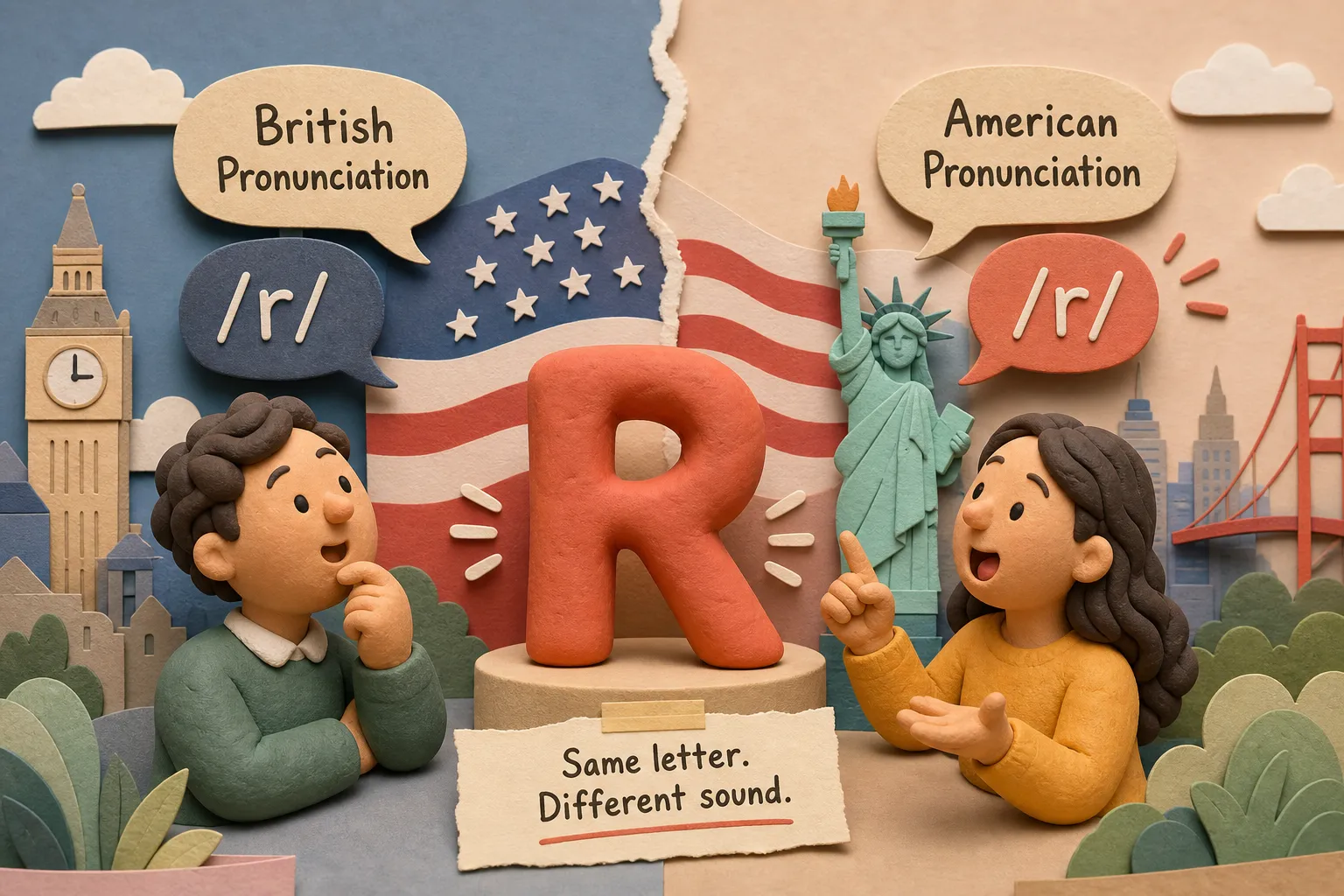
The American R, why it sounds so different from any R you’ve encountered before, starts with something most pronunciation guides never mention: you’re not just learning a new position for your tongue. You’re learning an entirely new acoustic event. You practice, you listen, you try again, and “right” still comes out as “wight.” Or maybe it sounds closer to “light.” The frustrating part isn’t effort; it’s that nobody has explained what the American R actually is as a physical event in your mouth. It’s not about trying harder. It’s about understanding what you’re aiming for.
At Your Daily American, the R is one of the most-asked-about sounds in our pronunciation guides, and for good reason. It’s genuinely unusual. By the end of this lesson, you’ll understand why this sound differs so sharply from the R in your first language, how to produce it using one of two physical techniques, and which drills fix the specific errors your background is most likely causing.
Why the American R has an acoustic fingerprint other languages don’t
Every vowel you produce has multiple resonance frequencies, called formants. Linguists label them F1, F2, and F3, from lowest to highest. The American R does something striking to F3: it pulls it dramatically downward, sometimes to the point where F3 nearly converges with F2. That drop creates what phoneticians call r-coloring, and it’s the acoustic signature of rhoticity. You hear it as a dark, hollow quality, like the sound is resonating inside a cave.
Non-rhotic English accents, such as the traditional Boston “pahk the cah” or the classic London accent, simply don’t produce that F3 drop in post-vocalic position. The R letter is there in the spelling, but the acoustic fingerprint is absent. When American speakers say “car,” that low F3 stretches across the entire vowel. That sustained r-coloring is what gives General American its unmistakable quality to ears trained on other accents.
A quick history of rhoticity
English was originally rhotic everywhere; speakers pronounced the R in every position. The R-dropping change emerged in England during the 18th century and became the southern British prestige standard by the early 19th century. North American settlers had largely arrived before that shift took hold, so most American English stayed rhotic. That historical gap helps explain why the American R feels unfamiliar to learners from languages with uvular or alveolar R sounds, you’re hearing the result of centuries of divergence, not just a regional quirk.
For you as a learner, the practical implication is this: the American /ɹ/ (its IPA symbol) is acoustically distinctive in a way that sets it apart from the rhotics of languages such as Spanish, French, and Portuguese. Those languages’ R sounds don’t produce the same dramatic F3 lowering, which means the articulatory and acoustic targets you’re aiming for are genuinely different from anything your first language has trained you to do.
The two physical techniques for making the American R
Here’s something even many English teachers don’t know: there is no single correct tongue position for the American R. Linguists have confirmed two main methods, and native speakers use both without any awareness of which they’re doing. Both techniques achieve the same low-F3 acoustic result. Your job is to find the one that feels stable for you.
The bunched R: tongue body up, tip stays down
In the bunched R, the middle-back portion of the tongue rises toward the palate without touching it. The tongue tip stays low, resting near or behind the lower teeth. This is the opposite of what most learners try first. The constriction comes from the body of the tongue, not the tip. Pair this with gentle lip rounding: let the lips protrude slightly, as if you’re about to say “oo” but less extreme. That rounding reinforces the hollow acoustic quality. The jaw stays moderately open, not clenched. For a technical description of the bunched/molar R, see bunched/molar R.
The retroflex R: tip curls back
In the retroflex R, the tongue tip lifts and curls backward toward the hard palate without touching it. The tongue body is lower than in the bunched version. This is the method most teachers describe when they say “curl your tongue back,” and it’s the one many learners attempt first. The key detail: the tip aims toward the hard palate, not the alveolar ridge (that bony bump just behind your upper front teeth). Retroflex /ɹ/ normally does not involve firm contact with the alveolar ridge, if you feel firm tip contact, you may be producing an alveolar tap, a trill, or a lateral sound rather than an English approximant /ɹ/.
Lip rounding supports both techniques, particularly in prevocalic position. Without slight lip protrusion, even a correctly placed tongue can produce something that sounds slightly off. Think of the rounding as the finishing layer that seals the acoustic target. Note that post-vocalic /r/ often involves reduced rounding, so don’t overdo it at the end of words like “car” or “better.” A Spanish /r/ (an alveolar tap or trill produced with the tongue tip hitting the ridge) and a French /ʁ/ (a uvular fricative produced in the throat) use neither this palatal constriction nor this lip-rounding combination. That’s precisely why those sounds feel so different from the American /ɹ/. For data on the labial gesture and its role in English R, see Loose Lips and Tongue Tips: The Central Role of the R‑typical Labial Gesture in Anglo English.
Why your first language is working against you
Most learners aren’t making random errors. Their first language is systematically pulling the tongue toward a familiar sound. Identifying your specific pattern makes practice significantly faster.
Spanish and Portuguese speakers: the trill and tap trap
Spanish has two R sounds: an alveolar tap /ɾ/ (a single flick of the tongue tip against the ridge, as in “pero”) and an alveolar trill /r/ (rapid multiple taps, as in “perro”). Both involve the tongue tip touching the alveolar ridge, exactly the opposite of the American /ɹ/, where the tip stays away from any surface. Post-vocalic R is a particular challenge. Spanish alveolar taps and trills don’t produce the same low-F3 rhotic coloring as American /ɹ/, so in words like “car” or “teacher,” Spanish speakers may produce weaker rhoticization or substitute other segments in English post-vocalic position.
Brazilian Portuguese speakers face an additional layer of difficulty. The most common R in Brazilian Portuguese is a velar or uvular sound produced in the back of the throat, acoustically and physically very distant from the American palatal approximant. If you speak Brazilian Portuguese, your instinct will likely push the sound toward the throat. The American R needs to happen much further forward, with a completely different tongue configuration.
French speakers: the uvular habit
French /ʁ/ is produced with the back of the tongue approaching the uvula, creating friction or vibration deep in the throat. The American /ɹ/ produces no friction and no vibration. French speakers often report that the American R feels like “nothing is happening,” and that’s actually a useful cue. The American R is much quieter and more vowel-like than the French one. If you feel friction or buzzing, you’re too far back.
The two substitutions almost every learner makes
Across all first-language backgrounds, two errors appear most consistently. The first is substituting /w/ for /r/: the lips round too aggressively and create a glide instead of an approximant, so “right” becomes “wight.” The second is substituting /l/ for /r/: the tongue tip goes to the alveolar ridge, which is correct for /l/ but wrong for /r/, so “rice” becomes “lice.” This second error is particularly common among speakers of East Asian languages, where a similar alveolar sound covers both phonemes. For more examples of common mispronunciations by non-native speakers, see English Words Non-Native Speakers Mispronounce Most Often.
A guided walkthrough: finding your American R for the first time
Try the bunched technique first. Relax your jaw slightly open. Let the tongue tip rest near or behind your lower teeth. Now raise the back and middle of your tongue toward the roof of your mouth without touching it. Round your lips gently, just slightly forward. Sustain the sound: “rrrrrr.” Listen for a hollow, dark quality.
If it sounds like /w/, reduce the lip rounding. If it sounds like /l/, actively drop the tongue tip away from the alveolar ridge and keep it there. If bunched doesn’t click for you, try the retroflex approach. Start with lips slightly rounded. Lift your tongue tip and curl it backward, aiming for the hard palate without making contact. The body of your tongue should feel lower than it does when you say /l/ or /n/. Sustain: “rrrrrr.” Then add vowels without changing the tongue position: “ra, ree, roo, ro, raw.” The tongue shape should stay stable as the vowel changes. That stability is the skill you’re building.
Targeted exercises for your specific R errors
Speech-language pathologists consistently find that generic repetition doesn’t fix articulation errors. What works is pairing each error with a specific, targeted drill.
Minimal pairs and isolation drills for substitution errors
If you produce /w/ for /r/, use minimal pairs with a mirror: “right/white,” “red/wed,” “rain/wane.” Watch your lips. The American R uses a slight forward protrusion; the /w/ uses a tighter, rounder shape. The goal is to find the exact point where lip rounding supports the R without tipping into /w/.
If you produce /l/ for /r/, the single most important cue is “tongue tip away from the roof.” Practice holding the isolated /r/ sound for five full seconds, actively confirming that your tip is not touching anything. Then move to syllables: r, ra, red, bread, “every day I read.” Build the sequence in one session, from isolated sound to connected speech. The isolation-to-syllable approach is especially effective because it trains the muscle memory of the new tongue position before layering in the complexity of words.
Shadowing and connected speech practice
The American R creates r-coloring that extends through vowels, not just at a single moment. In words like “bird,” “better,” and “her,” the entire vowel carries that low-F3 quality. Many learners can produce a solid isolated /r/ but lose it in connected speech, where the tongue defaults back to familiar territory. Shadowing is a well-supported drill for this carryover problem, alongside minimal pairs, articulatory practice, and visual feedback. Choose a 30-second clip of clear American speech: a news anchor, a podcast host, any fluent speaker. Listen once, then repeat simultaneously, focusing only on R sounds. Run through the clip three times in a row.
Your Daily American’s pronunciation guides walk through this exact shadowing drill with written and audio examples organized by sound pattern. If you’re not sure how your overall pronunciation measures up, the How to Improve Your American English Pronunciation Like a Native article includes a free proficiency test on the site that offers a baseline score across reading, listening, and speaking, paired with a personalized action plan so you know exactly where to direct your energy.
How to know when your American R sounds right
Vague advice like “keep practicing” isn’t useful. Here are three concrete signs that your R is working:
- The sound feels hollow or resonant rather than buzzy or fricative, no friction, no vibration in the throat.
- Your R in post-vocalic position (in words like “car,” “better,” and “her”) sounds equally colored throughout the vowel, not just tagged on at the end.
- Native speakers stop asking you to repeat words that contain R.
That third sign is the real-world confirmation that matters most. One quick note on regional variation: General American, the accent of most U.S. news media and the standard taught in most ESL programs, is fully rhotic. Eastern New England and traditional New York City accents are famously non-rhotic, so “car” may sound like “cah” in those dialects. For ESL learners, General American rhoticity is the clearest and most practical target. It’s consistent, widely understood, and the standard against which your /r/ will be judged in professional settings across the country. For a clear overview of these differences, see Rhoticity in British and American English.
Start with one sound, ten minutes, and real consistency
The American R sounds so different because it combines a unique palatal tongue shape, gentle lip rounding, and an acoustic signature, that dramatic F3 lowering, that most other languages simply don’t produce. It’s not harder than other sounds; it’s just unfamiliar in a very specific way. Once you understand what you’re physically aiming for, the path becomes clear. Acoustic research on how formants shift for rhotic sounds can help you understand the goal from a measurable perspective; see an example of acoustic studies on formants.
You have two valid techniques: bunched and retroflex. Try both. Keep whichever feels stable. Then use the isolation-to-syllable drill from the exercises above today. Hold your /r/ in isolation, add vowels, build to words, and eventually run the shadowing drill on real American speech. That sequence, done consistently over days and weeks, is exactly how fluency in this sound actually builds.
Return to Your Daily American’s pronunciation section to work systematically through American sounds, and use the free proficiency test as your benchmark. Track your R. The goal is the moment it becomes automatic, when you stop managing it and it just happens.