You say DEH-zert and your American coworker looks confused. You meant the dry, sandy landscape, but the stress you placed made it sound like you said duh-ZURT, which means to abandon someone. One word, two meanings, one stressed syllable separating them. That’s what word stress in American English actually does: it can change meaning entirely and strongly affects how native speakers perceive your fluency and how quickly they understand you. This guide walks through the core rules of American English word stress, what stress is, how to predict it in most words, and how to practice until it becomes automatic.
By the end, you’ll know exactly what stress is, how to predict it in most American English words, and how to practice so it stops being something you consciously calculate and becomes something you simply do. At Your Daily American, we treat pronunciation work like this as foundational, because real fluency isn’t just about knowing what to say. It’s about knowing how to say it the way a native speaker would.
What word stress in American English does to a syllable
Before you can apply any rules, you need to understand what stress physically is. Many learners know it exists but have no clear sense of what makes a syllable stressed, so they guess. That guessing is what we’re replacing here.
A stressed syllable does three things at once: it’s louder, longer, and spoken at a higher pitch than the syllables around it. In American English, it also carries a full, clear vowel sound. Unstressed syllables, by contrast, often collapse into a weak /ə/ sound called the schwa. Take the word banana: /bəˈnænə/, or buh-NAN-uh. The middle syllable is the loudest, longest, and clearest. The first and last syllables barely register as distinct vowels.
Longer words carry both primary and secondary stress. Primary stress (marked ˈ in IPA) is the loudest, most prominent syllable in the word. Secondary stress (marked ˌ) is a lighter emphasis, noticeable but weaker. Take elevator: /ˈɛl.ɪˌveɪ.tər/, or EL-ih-VAY-ter. Both EL and VAY carry stress, but EL is the primary. Getting this hierarchy right is what separates speech that sounds natural from speech that sounds slightly off even when every word is technically correct.
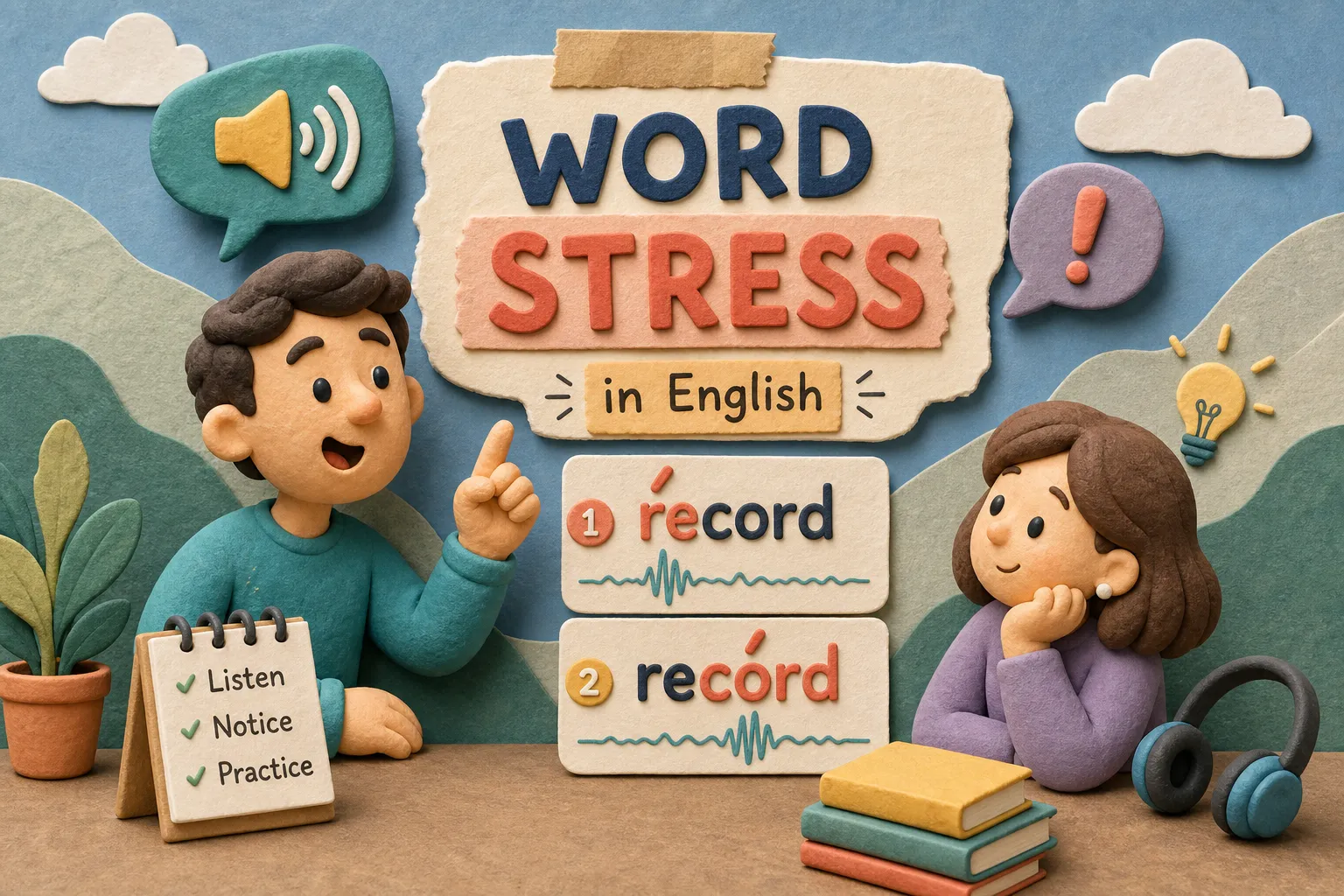
Misplacing stress doesn’t just sound foreign. It can make a native speaker hear a completely different word. Say reCORD when you mean the noun, and your listener mentally processes a verb. The conversation stalls. This is why stress is a meaning-making tool, not just a pronunciation nicety.
American English word stress: core rules for two-syllable words
Two-syllable words are everywhere in everyday English. This category has clear, teachable patterns that will immediately improve how you sound, so it’s worth building into your ear before moving on to longer words.
Most two-syllable nouns and adjectives in American English carry primary stress on the first syllable. Table is TAY-bul, not tay-BUL. Doctor is DOK-ter. Happy is HA-pee. Clever is KLEH-ver. If your native language tends toward end-stress patterns, as is the case in French or Portuguese, your instinct will pull you toward the second syllable. That’s a predictable transfer pattern, not a random mistake, and recognizing it means you can correct it deliberately.
Two-syllable verbs
Two-syllable verbs flip this rule. Most carry stress on the second syllable: relax → ruh-LAKS, decide → duh-SYD, begin → buh-GIN, repeat → ruh-PEET. This one rule alone covers a large portion of two-syllable English vocabulary, so getting it into your ear is worth dedicated practice time.
Compound nouns
Compound nouns follow their own pattern: primary stress lands on the first element. BLACKbird, HOMEwork, FOOTball, SUNburn. The key distinction is between a compound noun and an adjective-plus-noun phrase. BLACKbird (a specific type of bird) stresses the first word; a black BIRD (any bird that happens to be black) stresses the noun. Intermediate learners frequently blur this distinction, and fixing it makes a noticeable difference in how natural you sound.
How suffixes guide stress patterns in American English
Once a word has three or more syllables, the noun/verb rule becomes less reliable on its own. Suffixes fill that gap, learn the main categories and longer words become much more predictable.
Several common suffixes pull primary stress to the syllable directly before them:
- -tion / -sion: creAtion /kriˈeɪ.ʃən/ → krih-AY-shun; deCIsion /dɪˈsɪʒ.ən/ → dih-SIH-zhun; muSIcian /mjuˈzɪʃ.ən/ → myoo-ZIH-shun
- -ic / -ical: geoGRAPhic /ˌdʒi.oʊˈɡræf.ɪk/ → jee-oh-GRAF-ik; ecoNOMic → eh-kuh-NOM-ik; draMATic → druh-MAT-ik
- -ity / -ety: eLECtricity → ih-LEK-trih-sih-tee; posSIbility → pah-sih-BIL-ih-tee; soCIety → suh-SY-ih-tee
- -graphy / -logy / -nomy: stress lands two syllables before the ending. phoTOgraphy → fuh-TOG-ruh-fee; biOLogy → by-OL-uh-jee; eCONomy → ih-KON-uh-mee
Stress-bearing suffixes
A second group of suffixes carry the primary stress themselves: -ee, -eer, -oon, -esque. EmployEE, engiNEER, balLOON, groTESQUE. You encounter these constantly in professional settings, since words like employee, volunteer, and career all follow this pattern.
Stress-neutral suffixes
The most reassuring category is stress-neutral suffixes: -ment, -ful, -less, -hood, -dom. These leave the base word’s stress exactly where it was. enJOYment, CAREless, BEAUtiful, NEIGHborhood. When you add these endings, there’s nothing to recalculate. The word behaves just like its root.
When the same word changes meaning with stress
A significant number of American English words function as either a noun or a verb depending entirely on where you place the stress, and this is the category most learners remember longest. Nouns take first-syllable stress; verbs take second-syllable stress.
Here are six pairs worth memorizing right now, with IPA and phonetic respellings:
- REcord /ˈrɛkərd/ → REK-erd (noun) / reCORD /rɪˈkɔrd/ → rih-KORD (verb)
- PREsent /ˈprɛzənt/ → PREH-zent (noun) / preSENT /prɪˈzɛnt/ → prih-ZENT (verb)
- PERmit /ˈpɜrmɪt/ → PUR-mit (noun) / perMIT /pɚˈmɪt/ → pur-MIT (verb)
- INcrease /ˈɪnkriːs/ → IN-krees (noun) / inCREASE /ɪnˈkriːs/ → in-KREES (verb)
- OBject /ˈɑbdʒɛkt/ → OB-jekt (noun) / obJECT /əbˈdʒɛkt/ → ub-JEKT (verb)
- REfuse /ˈrɛfjuːs/ → REF-yoos (noun) / reFUSE /rɪˈfjuːz/ → rih-FYOOZ (verb)
To see why this matters in real communication, compare these two sentences: “We keep a REcord of every client call” versus “I’ll reCORD the meeting for the team.” The spelling is identical. Only the stress tells your listener which word you’re using. Native speakers don’t mentally flag the two forms as the same word said differently, they hear them as two separate words. Use the wrong stress and the sentence registers as confusion, not accent.
How to find stress placement in any dictionary
Many learners skip the IPA entry in dictionaries entirely because they don’t know how to read it. Once you learn two symbols, most standard dictionaries and pronunciation tools become reliable resources for American English word stress.
The symbol ˈ marks primary stress and appears directly before the stressed syllable. The symbol ˌ marks secondary stress the same way. Take communication: /kəˌmjuː.nɪˈkeɪ.ʃən/, or kuh-MYOO-nih-KAY-shun. The ˈ before keɪ tells you that’s the loudest syllable. The ˌ before mjuː tells you that one gets a lighter emphasis. Syllables with no mark are weak and often reduce to schwa.
For American English specifically, Merriam-Webster is your most reliable tool. It marks stress using the same system and focuses on American pronunciation by default. Cambridge Dictionary is also useful because it shows both British and American IPA side by side, always click the “US” pronunciation button to hear American stress patterns.
The practical habit to build: every time you learn a new word, look it up, read the IPA, identify the primary stress mark, and say the word aloud three times before you write it in your notes. That small step encodes stress from the start rather than letting a wrong pattern settle in first. If you want a quick reference on the broader concept of stress in language, see the stress (linguistics) overview.
Practice methods that lock stress into muscle memory
Understanding the rules is only the starting point. Automating them through deliberate practice is how you actually change how you speak, and that gap between knowing and doing is where most learners stall.
The most effective technique for word stress is to hear the pattern clearly before you try to produce it. Use shadowing: play a sentence, pause it, then repeat it immediately, matching the rhythm and stress exactly. During practice, exaggerate the stressed syllable more than feels natural. Make it a little louder, longer, and higher than you would in a real conversation. Then dial it back. This trains your speech muscles to find the peak position naturally without conscious effort.
Vocabulary grouping and spaced repetition
For vocabulary study, group words by stress pattern rather than by topic or alphabet. Put all your DA-da words together, all your da-DA words together, all your DA-da-da words together. Review each group at increasing intervals: the same day, the next day, three days later, one week, then two weeks. This approach applies the spaced repetition principle directly to stress patterns, a technique well-supported by memory research.
Also, mark stress in your vocabulary notes from day one using bold or capital letters. Write important as im-POR-tant every single time, not as a flat string of letters. The way you write a word shapes the way you say it.
At Your Daily American, the Pronunciation and Listening section covers exactly this territory: American sounds, connected speech, vowel reduction, and stress patterns, all built for real learners rather than phonetics students. If you want to identify your specific gaps before you start, the free proficiency test is the right place to begin. It covers reading, listening, writing, and speaking, then gives you a personalized result so you can focus your practice where it matters most.
Three things to take with you
Stress is largely predictable. Most two-syllable nouns and adjectives stress the first syllable; most two-syllable verbs stress the second. Suffixes like -tion, -ic, and -ity usually pull stress to the syllable before them, while -ee and -eer carry it themselves. Longer words follow patterns you can learn and apply, not a random lottery you have to memorize one word at a time.
Misplaced stress changes meaning. The stress-shift pairs deserve genuine attention because native speakers hear REcord and reCORD as two different words entirely. For example, saying “I need a reCORD” when you mean the noun can send your listener in the wrong direction before you’ve finished the sentence. Getting these right isn’t a finishing touch on your pronunciation; it’s a core communication skill. For focused drills, you can pair this approach with targeted stress practice exercises that emphasize the noun/verb contrast.
The fastest path to automation is deliberate, exaggerated imitation combined with spaced repetition, not passive listening. Start with five stress-shift pairs today. Look each one up in Merriam-Webster, read the IPA, say each form aloud in a complete sentence, and add them to a spaced repetition list. That’s where fluency actually happens. When you’re ready for a full picture of where your American English pronunciation stands, take the free proficiency test at How to Improve Your American English Pronunciation Like a Native and let the results guide your next step, your complete roadmap for mastering word stress in American English starts there.