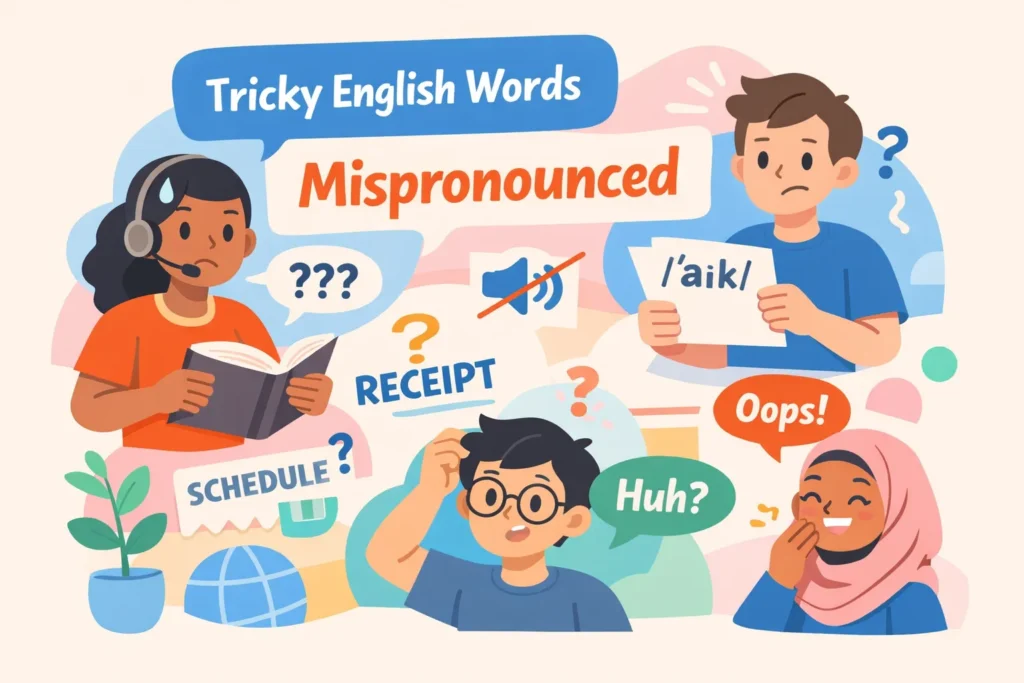
How can I improve my American English pronunciation to sound more like a native speaker? It’s a question many learners reach after years of study, grammar solid, vocabulary strong, yet something still feels off in real conversations. The problem usually isn’t vocabulary. It’s the layer of American English pronunciation that traditional ESL courses never covered: the phonetics, rhythm, and connected speech patterns that make someone sound like they actually live here, not just studied here. If that gap sounds familiar, you’re not failing. You’re just missing pieces that most textbooks never taught.
Closing that gap requires understanding what’s actually breaking down, then practicing the right things in the right order. This article gives you specific American English pronunciation tips, a realistic weekly routine, and tools to track real progress.
Why your accent sounds “off” even when your grammar is right
Before you fix something, you need to understand what’s actually breaking down. Grammar errors get noticed, but accent issues work differently. They create a subtle friction that makes listeners work a little harder to follow you, even when every word you say is technically correct.
The phonetic gap between textbook English and General American
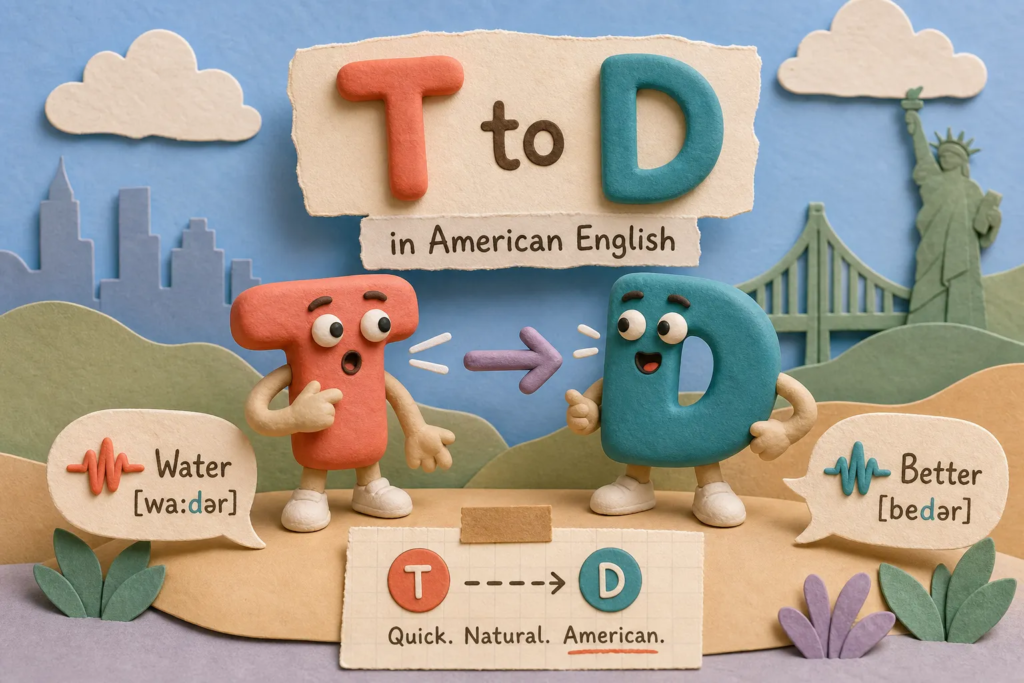
General American (GA) is the accent widely heard on national news broadcasts, in Hollywood films, and in many professional settings across the United States. It’s rhotic, meaning speakers pronounce the /r/ sound fully in words like “car” and “better.” It also features the flapped /t/, where the /t/ in words like “water,” “city,” and “butter” sounds closer to a soft /d/. Many non-native speakers never encounter this because textbooks present a crisp, fully articulated version of English, one that real Americans rarely use in daily conversation.
Non-native speakers tend to produce sounds with full, precise consonants. Americans reduce and connect them. That mismatch is what creates the “too formal” or “slightly robotic” effect that many learners describe feeling in their own speech. The sounds are right, but the delivery signals that you learned English from a page, not from people.
Rhythm and stress: the “music” of American speech
American English is stress-timed, not syllable-timed. Not every syllable gets equal weight. Stressed syllables are long and clear; unstressed syllables get compressed or swallowed almost entirely. The phrase “I’m going to” becomes “I’m gonna” in natural speech. “Want to” becomes “wanna.” “Don’t know” becomes “dunno.” This isn’t slang or laziness, it’s the standard rhythm of everyday American speech.
When non-native speakers give equal weight to every syllable, the result sounds choppy or overly formal, even when every word is correct. Learning to compress unstressed syllables is one of the fastest ways to shift how natural your English sounds to American ears.
How can I improve my American English pronunciation? Start with the sounds that matter most
Not all pronunciation errors carry the same weight. Some sounds create a strong non-native signal the moment a listener hears them. Targeting these first gives you the fastest return on your practice time.
Consonants that signal non-native speech right away
The American /r/, the TH sounds (/θ/ and /ð/), and the flapped /t/ cause the most immediate non-native signal. The American /r/ is retroflex, meaning your tongue curls slightly back. Most non-native speakers either drop the /r/ or use a tapped or trilled version from their native language. For TH sounds, speakers from many language backgrounds substitute /s/ or /z/ for /θ/, so “think” becomes “sink”, and /d/ for /ð/, so “this” becomes “dis.” For the flapped /t/, the fix is straightforward: in words like “butter,” “water,” and “better,” let the /t/ soften to sound almost like a quick /d/.
Each of these has a clear physical correction. For /r/, keep your tongue tip from touching the roof of your mouth and let it float back slightly. For TH, push your tongue gently between your teeth and release air (/θ/) or add voice (/ð/). These feel strange at first, but muscle memory builds with repetition.
Vowels that require the most attention for accent reduction
The three vowels that trip up many learners are /æ/ (as in “cat,” “bad,” “man”), the schwa /ə/ in unstressed syllables, and the /eɪ/ movement vowel (as in “say” and “late”). The /æ/ requires an open jaw and a slightly tense tongue position. The schwa is the opposite: completely relaxed, like a quick “uh.” The /eɪ/ is a glide that moves from /e/ toward /ɪ/, not a flat held sound.
Minimal pairs are your most effective drill for these vowels. Practice pairs like “cat/cot,” “bad/bud,” “think/sink,” and “light/right” to train your ear to hear the difference before you can produce it consistently. Record yourself doing these drills and compare directly to a native speaker. That one-second feedback loop catches errors your ear misses in real time. For extra guidance on challenging English sounds, see how to pronounce the most difficult English sounds correctly.
How shadowing trains your ear and your mouth at the same time
Shadowing is a well-supported pronunciation technique that independent learners can use for free, and it may be the single most efficient method available for building natural rhythm and intonation.
What shadowing actually is (and why it works)
Shadowing means listening to a short clip of natural American speech and repeating it simultaneously, matching the speaker’s speed, rhythm, stress, and intonation. This isn’t simply repeating after a pause. The simultaneous element is what makes it effective. A study from National Taiwan University found that shadowing significantly improved learners’ intonation, fluency, word pronunciation, and overall pronunciation scores, with pre-test averages rising from 61.82 to 90.85. The mechanism is straightforward: when you shadow, your speech muscles replicate patterns your ear is absorbing in real time. That’s how phonetic habits form at a physical level, not just a cognitive one.
The key difference between shadowing and simple imitation is that shadowing forces your brain to process rhythm and intonation as a complete system, not word by word. That’s why it’s particularly effective for American intonation and connected speech patterns.
A simple shadowing routine to start today
Short, daily practice outperforms long, occasional sessions, research on distributed learning consistently supports this. Ten focused minutes every day compounds faster than an hour once a week. Here’s a repeatable structure:
- Choose a 30 to 60 second clip of natural American speech: a podcast, a news segment, or a casual conversation video.
- Listen twice without speaking. Focus on the rhythm, not just the words. Notice which syllables are stressed and which ones disappear.
- Play the clip again and shadow simultaneously, matching the speaker’s tone and pace as closely as you can.
- Record yourself during step three, then play it back. Compare one specific feature per session: intonation, stress pattern, or a target sound like the flapped /t/.
The recording step is non-negotiable. Your brain filters out your own errors in real time, this is a well-documented aspect of speech perception, and playing back a recording removes that filter. A common experience: you feel confident during the shadowing, then hear the recording and notice your /r/ still sounds like a /v/. That gap is exactly what the recording reveals.
For practical examples and additional shadowing exercises, check these English shadowing tips.
Connected speech: the layer most learners never practice
If pronunciation is the skeleton of natural American English, connected speech is the muscle that makes it move. This is what separates someone who sounds textbook-correct from someone who sounds like they actually live here.
What connected speech actually means in everyday American English
Connected speech has three main features. Linking means words flow together so that a phrase like “turn it off” sounds like “turn-nit-off.” Reduction means unstressed function words shrink: “and” becomes “n,” “to” becomes “tuh,” “want to” becomes “wanna.” Flapping means the /t/ between two vowels softens to a /d/-like sound. These patterns combine constantly in real conversation.
Everyday examples make this concrete. “I don’t know” becomes “I dunno.” “What do you want?” becomes “Whatdya want?” “Going to” becomes “gonna.” None of this is informal speech reserved for casual settings. Americans use these reductions in meetings, on phone calls, and in presentations. When you speak with fully articulated words and no reductions, you sound correct but not natural, and native speakers register the difference immediately.
How to practice connected speech patterns deliberately
Start with high-frequency phrases, not isolated words. Phrases like “I’ll take a look,” “let me know,” and “sounds good to me” are used dozens of times a day by American speakers, and they all contain linking and reduction patterns worth learning. Practice by reading sentences aloud and consciously linking every word to the next, as if the whole sentence were one long word. Use real audio from natural conversations, not pedagogical recordings designed to be clear and slow.
That’s the same philosophy behind About, Your Daily American. Rather than handing you a word list and leaving you to guess how it sounds in practice, the platform teaches complete phrases in context, the way they’d actually come up in a coffee shop, a job interview, or a team meeting, with connected speech patterns and cultural meaning already built in.
A weekly pronunciation practice routine that actually sticks
Scattered practice produces scattered results. A structured daily routine, even a short one, compounds into real improvement over weeks. Learners who break practice into short daily sessions tend to see measurable changes within 2 to 4 weeks, with more substantial accent reduction by the 3-month mark.
What a sustainable weekly schedule looks like
Aim for 20 to 30 minutes of focused practice daily rather than long, irregular sessions. A daily structure that works:
- 5 minutes: Vowel warm-up, practice /æ/, /ə/, and /eɪ/ with minimal pairs.
- 10 minutes: Minimal pair drills targeting your two or three priority sounds.
- 10 minutes: Shadowing using a fresh clip from a podcast or video.
- 5 minutes: Record yourself speaking freely and review one specific feature.
Each week, introduce one new target sound or connected speech pattern so your focus stays sharp rather than spreading too thin. For more structured plans and exercises, see Study Tips & Methods, Your Daily American.
Tracking progress and staying motivated through the process
At the 4-week mark, you should notice cleaner production of 3 to 5 target sounds and a much sharper awareness of your own speech patterns. You’ll start catching your own errors in real time, which is itself a significant skill. At the 8-week mark, connected speech should begin to feel natural in practiced phrases, and listeners should ask you to repeat yourself less often. Record a 60-second speaking sample every week using the same prompt, describing your weekend or explaining your job works well. Playing week 1 next to week 8 makes progress visible in a way that daily practice can’t.
The goal isn’t a perfect American accent. It’s clear, natural-sounding American English that listeners understand without effort. That’s a realistic, achievable target with consistent daily practice. If you’re wondering about timelines for accent reduction more broadly, see a complete timeline guide to how long accent reduction takes.
How Your Daily American helps you sound like you actually live here
Many traditional pronunciation resources teach sounds in isolation: drill the /r/, drill the TH, repeat. That’s a useful starting point, but it misses the full picture. Pronunciation in real life never happens in isolation. It happens inside phrases, in specific situations, with specific cultural expectations attached.
Real phrases, real pronunciation, and real cultural context
Your Daily American is built around exactly this gap. The platform doesn’t teach phonetic symbols alone or hand you a list of vocabulary words. It teaches the phrases Americans actually use, in grocery stores, work meetings, doctor’s offices, and casual conversations, with the natural rhythm, connected speech, and cultural context that textbooks leave out. That means you’re picking up pronunciation, intonation, and meaning all at once, in the context where you’ll actually need them.
Building native-like fluency through situational practice
Content on Study Tips & Methods, Your Daily American is organized around real-life scenarios, from ordering coffee to leading a team meeting, the exact settings where pronunciation matters most. You get exposure to natural American intonation, reduced forms, and the cultural context that shapes how phrases land. American accent training built around isolated drills will only take you so far. What makes the difference is hearing and practicing the language in context, with the rhythm and cultural grounding to make it stick. That’s what Your Daily American is designed to deliver.
Ten minutes a day: the habit that changes how you sound
If you’ve been asking yourself how to improve your American English pronunciation to sound more like a native speaker, the answer isn’t a single breakthrough, it’s a series of small, consistent habits applied to the right targets. Phonetics, connected speech, rhythm, and shadowing. Grammar accuracy is already in your toolkit. What you’re adding now is the layer that makes your English feel alive rather than merely correct.
Small daily habits compound faster than most learners expect. The timeline is real: 2 to 4 weeks for noticeable sound improvements, 3 months for meaningful accent reduction, and continued refinement beyond that. The goal isn’t to erase your accent. It’s to communicate clearly and confidently in any American setting, so the people you’re talking to focus on what you’re saying, not how you’re saying it.
Start with one shadowing session today, pick a 30-second podcast clip and record yourself alongside it. Choose one connected speech pattern this week, like “I dunno” or “gonna,” and use it deliberately in practice. Blog, Your Daily American is where you keep building from here, with every lesson grounded in the English Americans actually speak.