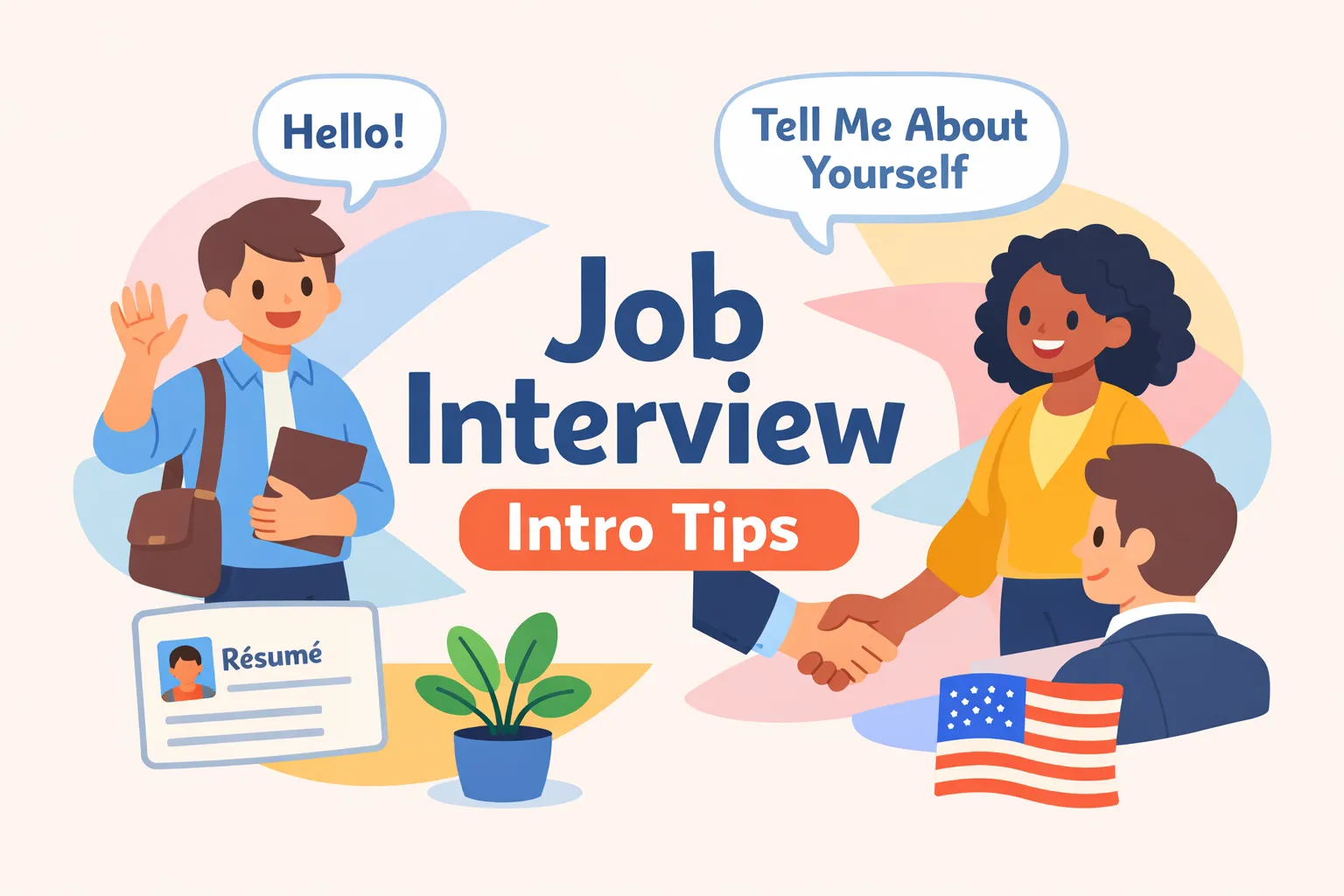
The interviewer leans forward, smiles, and says: “So, tell me about yourself.” And just like that, many candidates freeze, ramble, or start reciting their resume from the top. This moment is far from small talk. It’s an important early test of how you communicate in professional American English, and it shapes the tone for everything that follows. This guide shows you exactly how to introduce yourself in an American job interview, with a proven formula, six ready-to-use scripts, and the cultural awareness to deliver your answer with confidence.
U.S. interviewers use this opening to evaluate your communication skills, your clarity under pressure, and your ability to tell a focused story about yourself. There’s a specific structure they expect, and once you know it, this question becomes one of the easiest to answer well. At Your Daily American, this is exactly the kind of high-stakes, real-world professional scenario we build lessons around, because textbook drills won’t prepare you for a moment like this.
By the end of this article, you’ll have a clear formula, six ready-to-use scripts for different career levels, the cultural awareness to deliver your intro with confidence, and the four mistakes you need to avoid. Here’s exactly how to do it.
What interviewers are actually evaluating in those first 60 seconds
When an interviewer says “tell me about yourself,” they’re not asking you to summarize your resume. They’re watching how you think, how you prioritize information, and whether you communicate the way someone in this role needs to communicate. Think of it as a preview of how you’ll perform in meetings and client-facing conversations.
What “tell me about yourself” is really asking
Interviewers are listening for how relevant your background is to the role and whether you can filter information under pressure. They’re also noticing how naturally you operate in professional English. A strong answer signals preparation and self-awareness. A weak one, even from a highly qualified candidate, creates immediate doubt about fit.
The 60-to-90-Second Standard
The target zone is 60 to 90 seconds. At a natural speaking pace of around 150 words per minute, that’s roughly 150 to 225 words. Under 45 seconds reads as underdeveloped. Over two minutes is a red flag, even if everything you say is accurate and relevant. Most career coaches advise staying well under two minutes. Time your response before the interview, not during it. For additional guidance on pacing and answer length, see Indeed’s advice on how long interview answers should be.
How to Introduce Yourself in an American Job Interview: The Formula
The most widely recognized structure for a self-introduction in American interviews is the past-present-future framework. It gives the interviewer a clean narrative arc: where you’ve been, where you are now, and where you’re headed. That structure signals preparation, and it makes your answer easy to follow.
Present: start with your current role and a key result
Open with your name, current position, and one concrete achievement. Specificity matters here. A number, an outcome, or a clear result immediately signals credibility. “I currently lead the digital marketing team at a mid-sized SaaS company, where we grew organic traffic by 40% over 18 months” lands far stronger than a vague role description. One strong result beats a list of responsibilities every time.
Past: select what’s relevant, not everything
This section is not a life summary. Choose two or three experiences or skills that connect directly to the role you’re interviewing for, then stop. Think of it as editing, not listing. If you’re applying for a project management role, highlight the times you coordinated cross-functional teams, not every job you’ve held since graduation. The interviewer will ask follow-up questions. Your job here is to make them want to.
Future: show why this role, at this company
Close the loop by connecting your career direction to the specific opportunity in front of you. This is where your company research pays off. “I’m excited about this role because your team’s work in renewable energy aligns with the direction I’ve been building toward for the last three years” is specific, genuine, and memorable. A generic closing like “I’m looking for new challenges” tells the interviewer nothing useful.
Tone and cultural adjustments that make a real difference
If you come from a culture where composure signals professionalism, this section is worth reading carefully. American interview culture has specific expectations around energy, directness, and self-promotion that differ significantly from many other professional environments. Understanding these differences is just as important as knowing the right words to say.
Enthusiasm is expected, not optional
U.S. hiring managers regularly note that candidates who display genuine excitement about a role stand out, and not just because of their qualifications. For candidates from cultures where restraint signals competence, this can feel unnatural at first. In American interviews, enthusiasm reads as motivation and engagement, not as unprofessionalism. A direct phrase swap helps: replace “I have experience in this area” with “I’m genuinely excited about this kind of work.” Replace “I believe I am qualified” with “I’m confident I can bring real value to this team.” The shift in energy is immediate. For additional practical pointers on answering this opening effectively, Tufts alumni and friends offer a helpful guide on how to answer ‘tell me about yourself’.
Direct self-promotion is a skill, not arrogance
Many international candidates feel cultural hesitation around talking up their own achievements. In U.S. interviews, stating your accomplishments clearly and confidently is expected, full stop. The key is to use result-focused language rather than opinion-based language. “I led a campaign that increased conversions by 18%” is specific and factual. “I’m very good at marketing” is vague and easy to ignore. Frame your wins around what happened, and let the results speak for themselves.
Six ready-to-use self-introduction scripts by career level
These scripts are starting points, not scripts to memorize word for word. Personalize each one with your own results and connect it to the specific role. The numbers used in each example are illustrative placeholders, replace them with your own accurate figures. Scripts are organized by career level with two examples each.
Entry-level scripts: lead with education and momentum
Script 1 (Engineering/Tech): “Hi, I’m Alex Rivera. I just finished my Bachelor’s in Computer Science at Georgia Tech, where I interned at a logistics startup and built a data pipeline that cut reporting time by 30%. I’m strong in Python and SQL, and I’m looking to bring those skills into a team where I can grow fast. I’m really excited about what your engineering team is doing with real-time analytics.”
Script 2 (Marketing/Business): “Hi, I’m Priya Menon. I’m graduating this May with a degree in Marketing from UT Austin. During my internship, I managed our social media calendar and helped launch a campaign that increased engagement by 25% in six weeks. I’m excited to move into a full-time role where I can keep building on that momentum, and your team’s approach to content strategy is exactly what I’ve been looking for.”
Mid-level scripts: lead with impact, not just experience
Script 3 (Technical role): “Hi, I’m Jordan Lee. I’m a software engineer with four years of experience in product development. Right now I’m at a fintech company where I’ve led design reviews that reduced our build cycle by 20%. Before that, I worked at a healthcare startup building HIPAA-compliant data systems. I’m looking for a senior individual contributor role where I can take on more architectural responsibility, and this position fits that direction exactly.”
Script 4 (Finance/Business): “Hello, I’m Drew Morales. I’ve been a financial analyst for five years, currently managing a portfolio of top-tier clients at a regional bank. Last year, I led a risk assessment project that reduced our exposure by 15%. Before that, I spent two years at a consulting firm working with mid-size healthcare companies. I’m ready to move into a role with broader strategic scope, and what your team is doing in corporate finance is a strong match.”
Senior-level scripts: lead with scope and strategic thinking
Script 5 (Senior technical/engineering): “Hi, I’m Taylor Kim. I’m a senior engineer with 12 years in aerospace and automotive, where I’ve managed full product lifecycles from concept to launch. Most recently, I led a team that redesigned a chassis system and delivered it three months ahead of schedule, saving roughly $500,000 in production costs. I’m looking for a leadership role where I can drive both technical innovation and team development, and this position checks both boxes.”
Script 6 (Leadership/Management): “Hello, I’m Morgan Ellis. I’ve spent 11 years leading marketing teams in consumer goods, most recently as Director of Marketing at a national brand. I oversaw a campaign expansion that grew our market share by 30% over two years, and I’ve built and managed teams of up to 18 people. I’m looking for a VP-level opportunity where I can shape strategy at a larger scale, and your company’s growth trajectory is exactly what I want to be part of.”
Common mistakes that kill a strong first impression
Even well-prepared candidates make these errors. The good news is that each one has a clear fix once you know what to look for.
Reciting your resume instead of telling a story
Reading off job titles and company names in order feels robotic and fails to create a human connection. The interviewer already has your resume. What they want is a narrative that helps them understand who you are and why you’re here. Pick two or three career highlights and build a brief, focused story around them, a concise highlight reel tailored to the role you’re applying for.
Sharing personal details that don’t serve the role
Hobbies, family background, where you grew up, what you studied in high school: none of this belongs in a professional self-introduction unless it directly explains your career motivation. Keep the focus on what’s professionally relevant. If a personal detail genuinely connects to your career path, one sentence is enough. Otherwise, leave it out entirely.
Rambling without a clear endpoint
Talking past 90 seconds without a natural closing line is one of the most common and damaging mistakes candidates make. You need an exit. Two strong options: “That’s the short version. I’m genuinely excited to learn more about how I can contribute here.” Or: “I’d love to dig into the specifics of the role. What are the biggest priorities for your team right now?” Both close your intro cleanly and hand the conversation back to the interviewer.
How to practice your intro until it sounds natural
Reading a script once is not practice. Delivery matters as much as content, and for non-native English speakers especially, the difference between a rehearsed answer and a natural-sounding one comes entirely from how many times you’ve said it out loud in real English.
Time yourself, then refine
Record a voice note of your full intro and listen back. Check the total time, listen for filler words like “um” or “you know,” and notice where your pacing speeds up from nerves. Speaking too fast is one of the clearest signs of anxiety, and it makes you harder to understand. Repeat the recording until the delivery feels conversational rather than recited. Practice several times, until it sounds natural, not memorized. For concrete phrasing and example exercises you can use while refining delivery, see JobTestPrep’s guidance on self-introduction for interview.
Use real practice scenarios, not just mirror sessions
Your Daily American’s professional English lessons include role-play scenarios built specifically for high-stakes situations: job interview introductions, workplace small talk, performance review conversations, and first-day exchanges. Practicing your interview intro in context, alongside other professional English scenarios, builds the kind of fluency that holds up under pressure. An intro that sounds natural at home but falls apart in a real room hasn’t been practiced enough in real conditions. You can explore these lessons directly at Your Daily American, Your Daily American.
Frequently Asked Questions
How long should my self-introduction be in a U.S. interview?
Aim for 60 to 90 seconds, which is roughly 150 to 225 words at a normal speaking pace. Anything under 45 seconds can feel underdeveloped, and going past two minutes risks losing the interviewer’s attention.
Should I mention personal details in my intro?
Only if a personal detail directly explains your career motivation, and even then, keep it to one sentence. Hobbies, family background, and hometown rarely add value to a professional self-introduction.
What’s the best structure for a 30-second interview pitch?
If you need a quick 30-second pitch, common in networking or speed interviews, strip the formula down to: your current role, your strongest result, and one sentence connecting you to the opportunity. Lead with impact and close with direction.
Is it okay to talk about my accomplishments in a U.S. interview?
Absolutely. In American interview culture, stating your achievements clearly and confidently is expected. Use result-focused language (“I led a project that increased revenue by 20%”) rather than vague self-assessment (“I’m good at this”).
How is a U.S. job interview introduction different from other countries?
American interview culture places a higher value on enthusiasm, directness, and quantified results than many other professional cultures. Composure can read as disengagement. Expressing genuine excitement about the role is a strength, not an overstep. For additional practical examples and tips on self-introductions, Indeed’s self-introduction tips are a useful reference.
Can I use the same self-introduction for every interview?
Use it as a template, not a fixed script. The structure stays the same, but the “future” section, where you explain why this role at this company, should be customized every time. Generic closings are one of the easiest ways to lose an interviewer’s interest.
Putting it all together
A strong self-introduction in an American job interview follows a clear structure: present, past, future. It lands in 60 to 90 seconds, uses confident and specific language, and adapts to the directness and enthusiasm that American professional culture expects. Your intro is not just an answer to one question, it sets the tone for the entire conversation that follows.
The six scripts above are starting points. Swap in your own results, connect each script to the specific role you’re applying for, and make sure your closing line hands the conversation back to the interviewer. The formula is simple. The practice is the variable.
The more you rehearse this as a spoken introduction in real English contexts, the more natural it becomes. That’s exactly what About, Your Daily American is built for: practical, situational fluency developed through real professional scenarios and real American phrases. You can also use spaced-repetition study tools to lock in phrasing, see our guide How to Learn English with Anki, and you’ll walk into that room ready to make a strong first impression from the very first sentence.