Imagine this: you spend a whole week studying English phrasal verbs. You feel good about your progress. Then, three days later, you are in a meeting. The perfect phrase is in your head, but you cannot say it. This is not a motivation problem. It is a memory problem. And the right study system can fix it.
Do you want to learn English with Anki? This guide explains everything, step by step. By the end, you will know how to:
- Set up your deck
- Write cards that help you remember new vocabulary
- Choose review settings that build a daily habit
- Pick the right English vocabulary for your cards
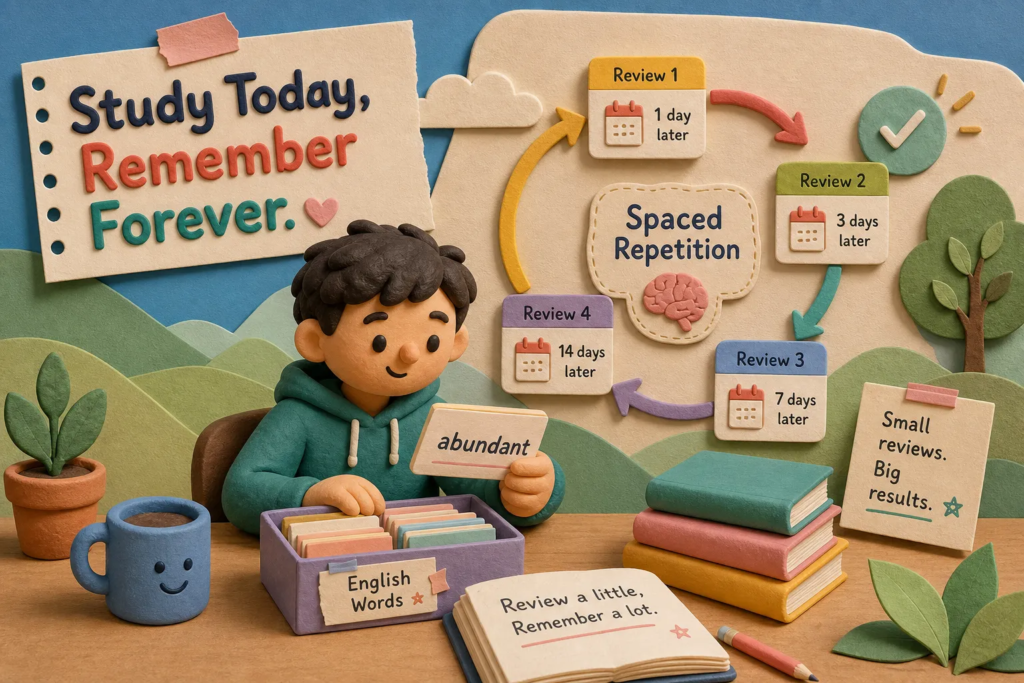
Anki uses spaced repetition (a system that reviews words just before you forget them). Each word comes back at the right moment, so it stays in your memory. Research shows that spaced repetition is one of the best methods for long-term vocabulary memory. It is a useful tool for intermediate learners.
Why Anki is built for vocabulary that sticks
Your brain is very efficient. If you do not see a piece of information for a while, your brain starts to remove it. It needs space for things you actually use. This is called the forgetting curve (the speed at which we forget new information). It explains why reading a vocabulary list on Sunday does not mean you will remember it on Friday. The information feels strong right after you study it. Then it slowly disappears.
Think of it like watering a plant. Water it too early, and you waste your effort. Water it too late, and the plant is already dead. Anki waters the plant at the right moment — just before the word leaves your memory.
That is the main idea behind Anki. Research supports it: spaced review keeps information in your memory longer than studying everything at once (also called cramming) or reading the same list many times. You can read more about the evidence behind spaced repetition in this review of learning techniques and retention.
Some vocabulary apps review every word on a fixed schedule. They show you each word at the same time, even if you know it perfectly or forgot it completely. Anki works in a smarter way. It changes the schedule based on your answers. Words you know come back after longer breaks. Words you find difficult come back sooner. The result: you spend your review time on the words you need, not the ones you already know well.
Every review uses active recall (pulling the word from your memory). You do not just see the word on the screen, you have to produce it yourself. (This works best with question-and-answer or cloze cards, where you do not see the answer before you try to remember it.). You can read more about the evidence behind spaced repetition in this review of learning techniques and retention.
Setting up your Anki deck for English vocabulary
Start with the Anki desktop version. Anki is free on Mac, Windows, and Linux. The desktop app gives you full control. You can change your settings, design your card templates, and manage your cards as your deck grows. AnkiDroid (for Android) and AnkiMobile (for iPhone) are great for daily reviews when you are away from your computer. But build and organize your cards on the desktop.
Sync is simple. Create a free AnkiWeb account. Your cards and progress will sync between all your devices. The reviews you do on your phone in the morning are already saved when you open the desktop app at night.
Anki deck setup: how to organize your cards
Most Anki guides recommend the same approach. Keep one main deck for your language study. Use tags to sort your cards by theme or skill. This is simpler than creating many separate decks. Tags like “phrasal-verbs,” “professional,” “idioms,” or “B2” help you study specific topics. You do not have to manage many decks.
Do you want to practice one topic a lot? Anki has a feature called a filtered deck (a temporary deck built from one tag). It lets you focus on a topic for a session, then return to your normal review schedule. The goal is a clear structure. You should always know what you are reviewing and why.
Writing Anki flashcards that actually help you remember vocabulary
The most important rule for writing cards is simple: one card tests one thing. “What does ‘bring up’ mean in a meeting?” is a strong card. “Explain phrasal verbs with ‘bring'” is a weak card. The weak card is unclear and hard to answer. Anki also cannot schedule it well, because there is no clear right or wrong answer. For more detailed card-writing advice, see this Anki flashcard best practices.
Here is a clear example.
Weak card
Front: “bring up, bring in, bring around”
Back: definitions for all three.
Strong card
Front: “What phrasal verb means to introduce a topic in a discussion?”
Back: “bring up.”
Split complex ideas into separate cards. If a card feels too full, it probably is.
Anki card templates: cloze format for context
Cloze cards (fill-in-the-blank cards) work very well for vocabulary in context. Instead of a question, you fill in a blank in a real sentence:
“She {{c1::brought up}} the budget issue right before the meeting ended.”
This tests your memory inside a real sentence. It is closer to how you will use the phrase in real life. One rule: each cloze should still test one thing. If you have two blanks for two different phrases, make two cards.
Most learners forget one important detail: add a context note on the back of the card. For example: “Bring up — used when you politely introduce a topic in a meeting or conversation.” This tells you not just what the phrase means, but when to use it.
For idioms and phrasal verbs, a definition alone is not enough. These expressions have a level of formality and a context that a translation cannot fully show. Add a short example sentence or a usage note on the back of the card. Most language teachers recommend this. It improves both memory and real-world use. If you want to learn more about cloze cards, this cloze deletion guide explains the options and trade-offs.
Review settings that ESL learners should actually use
Start with 5 to 10 new cards per day. Your review load grows fast. 10 new cards today can become 30 or more reviews in a few days. If you start with 30 or 40 new cards in your first week, your review queue will grow very fast. That is the moment when most people quit.
Consistency is more important than volume. Ten cards every day for a month gives you 300 cards in a healthy review schedule. One hundred cards in a single weekend gives you a backlog (a large pile of reviews waiting for you). You will have a bad experience with a system that works very well when you use it correctly.
Spaced repetition software settings worth knowing
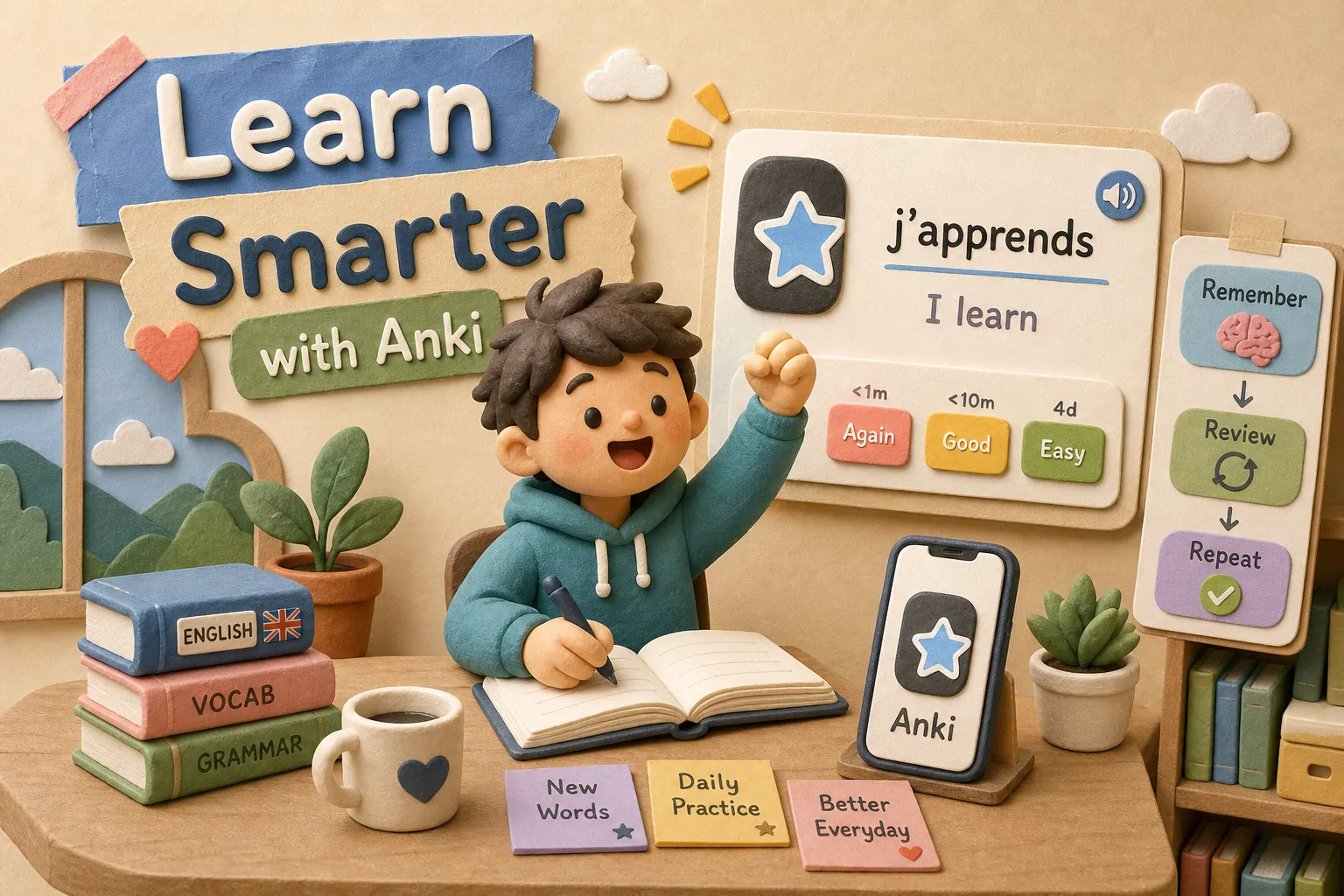
Keep the answer buttons simple. Use “Again” and “Good” for most reviews.
- Again means you did not remember the word. Anki will show it again sooner.
- Good means you remembered it. Anki will wait longer before the next review.
That is the main feedback system.
Be careful with the “Easy” button. When you press “Easy,” Anki waits much longer before the next review. This sounds nice in the moment, but you may forget the word before it comes back. Use “Easy” only for words you have known for a long time, not for cards you remember today by luck. For specific settings designed for language learners, see this guide on the best Anki settings for language learning.
What vocabulary to actually put in your Anki deck
Not every English word is worth a card. For intermediate learners, the best return comes from common, conversational vocabulary. This includes:
- Core phrasal verbs (like “bring up,” “figure out,” “look into”)
- Common collocations (words that often go together, like “make a decision” or “take a break”)
- Workplace communication phrases
- Everyday expressions that native speakers use naturally
Rare, specialized words are low priority. Focus your time on the common vocabulary first.
For most learners, the harder problem is not Anki itself. It is knowing which phrases are worth memorizing. When you take vocabulary from random sources, you have to guess what is useful. A structured source removes that problem.
If you use a resource like Your Daily American, the vocabulary is already organized for you by context:
- Everyday phrasal verbs
- Conversational idioms
- Professional communication phrases
- Expressions from how American English is actually spoken
You add the spaced repetition system on top of material that is already prepared for real life.
The process is simple: study a lesson or phrase set, choose the expressions you want to remember, and turn them into Anki cards the same day. Your goal might be a job interview or a normal conversation with coworkers. Either way, you are filling your deck with vocabulary that native speakers really use.
Anki tips and tricks: mistakes that stop it from working
The most common mistake is adding too many cards too fast. It feels productive in week one. By week two, you have over 200 daily reviews. You start pressing “Good” on everything just to finish them. This breaks the whole system. Set a daily limit of 5 to 10 new cards. Keep this limit for the first month. Your review load stays small, and the system works as it should.
The second mistake is making cards that only teach recognition (understanding a word when you hear or read it) but not production (using the word yourself). A card that says “bring up = mention” helps you understand the phrase in a movie. But it does not help you use “bring up” when you speak. The fix is always the same: add a real example sentence or a context note to the back of the card. Even one sentence in context improves your memory. It also helps you use the phrase with confidence when you need it.
The third mistake is skipping days and then trying to catch up in long study sessions. If you miss three days of reviews, you have a backlog. When you try to clear it all at once, you lose focus and your memory suffers. Treat Anki like brushing your teeth: same time, same length, every day. It is a small commitment. Over weeks and months, it builds into real fluency. For a strong opinion on avoiding common mistakes and organizing your deck for the long term, this guide to using Anki correctly is a useful read.
Your first five cards
You now have a full Anki tutorial. You know:
- Why the system works
- How to set up your deck
- How to write cards that help you remember
- Which settings to use
- Where to find useful English vocabulary
- How to avoid the mistakes that stop Anki from working
Effective learning with Anki is not about adding thousands of cards. It is about adding the right cards, reviewing them every day, and letting the spaced repetition software handle the schedule.
Ready to learn with Anki? Start here. Find five phrasal verbs or expressions from something you read or heard this week: a podcast, a show, a work call. Make one card for each expression. Use the format from this guide:
- a clear question or cloze on the front
- a short example sentence and a context note on the back
Then do your first review session today. Five cards. One session. One habit started.