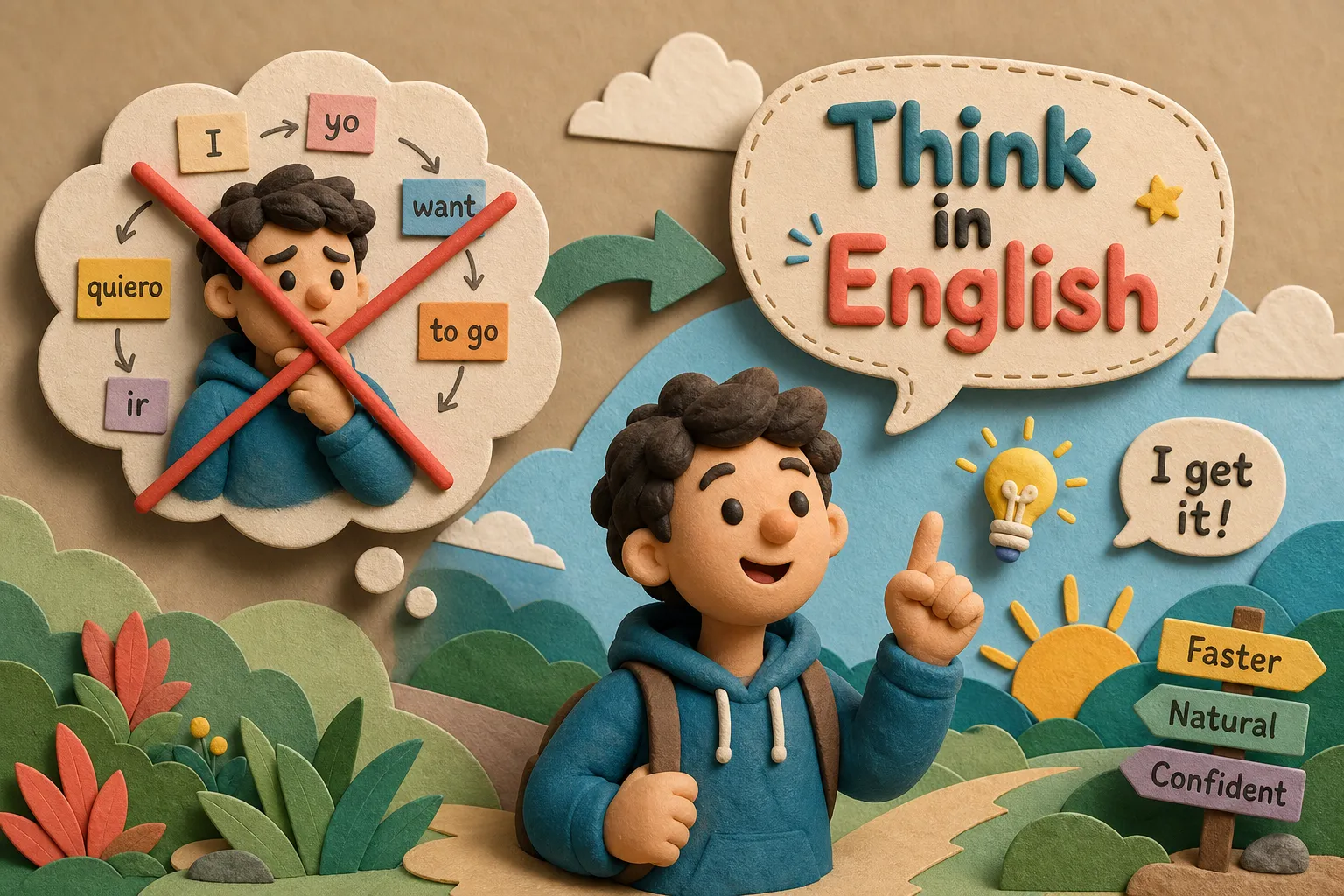
You know the moment. Someone asks you a question in English, and before a single word leaves your mouth, your brain is already working in your native language: forming the thought, searching for translations, rebuilding the sentence piece by piece, and hoping nothing gets lost along the way. By the time you speak, the confidence is already half gone. If you want to learn how to think in English, breaking that cycle is where everything starts. This is the translation trap, and it is a major barrier between knowing English and actually using it with ease.
The good news is that thinking directly in English is a trainable skill, not a talent you either have or don’t. This article gives you a concrete plan: specific exercises with time estimates, realistic timelines based on your current level, and a daily routine you can start today. No theory overload. Just a clear, practical path to building your English inner voice.
Why Your Brain Keeps Defaulting to Translation
Translation is not a bad habit. It is a survival strategy your brain learned when you first started studying English. When you encounter a new language, the brain maps new words back to familiar concepts in your native language for fast, reliable retrieval. That strategy worked well as a beginner. The problem is that it became automatic, and now it kicks in even when you don’t need it.
Your brain defaults to what is efficient, not what is ideal. Until English has enough neural pathways built through repeated use, your first language stays the dominant route. Studies on bilingual language processing show that lower-proficiency learners tend to activate native-language representations even when processing English, while higher-proficiency speakers access meaning more directly. The gap between those two states closes through deliberate, frequent practice, not through time alone. For a deeper look at the neuroscience behind bilingual processing, see research on bilingual language processing.
Thinking in English doesn’t happen as a sudden switch. It builds in stages: first single words, then short phrases, then full narration and self-talk. Expecting fluency overnight is a common demotivator. Expecting a gradual progression, supported by daily practice, is what actually produces results.
The Vocabulary Floor You Need Before the Exercises Click
Before you start the exercises below, it helps to know where you stand. Language acquisition benchmarks generally place around 1,000 to 2,000 high-frequency words as the floor for forming very simple thoughts in English without constant translation. At around 3,000 to 5,000 words, most learners can begin thinking in phrases and short sentences fairly comfortably. In CEFR terms, A1 corresponds to roughly 1,000 words, A2 to about 2,000, and B1 to around 3,000 words. That B1 threshold is roughly the level where the shift from translating to thinking most often begins. For a practical discussion of word-count thresholds, see how many words you should know.
That said, you do not need to hit 5,000 words before you start practicing. Even at the 1,000-word level, the exercises in the next section begin building the habit. What matters more than total word count is how automatic your vocabulary retrieval is. A word you have to search for is a word that triggers translation. A word you retrieve instantly is one that supports real-time thinking.
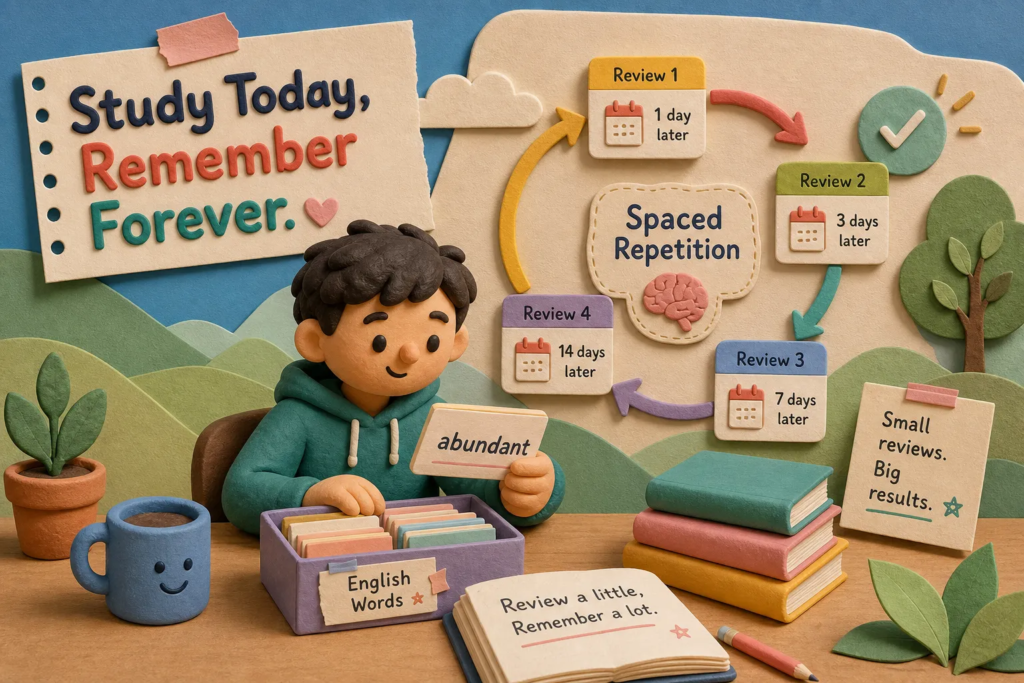
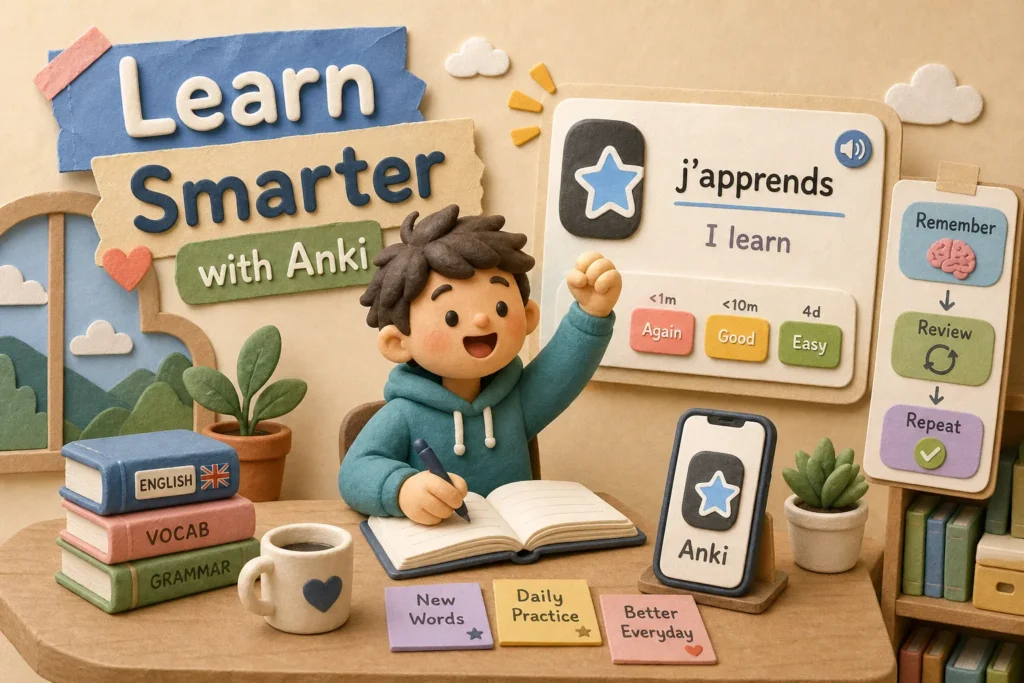
This is why chunks matter more than isolated words. Knowing the phrase “I need to figure this out” as a single retrievable unit is more valuable than knowing “figure,” “out,” and “need” separately. The brain processes stored chunks far faster than it builds sentences from scratch. Spaced repetition is a highly effective way to move vocabulary from passive recognition into the fast active recall that thinking in English requires. If you want a deeper look at how spaced repetition works and how to build it into your study routine, the How to Learn English with Anki covers this in detail.
How to Think in English: Five Exercises That Build the Habit
These exercises are ordered by complexity. Start with the first one, get comfortable with it before moving on, then layer in the rest over your first two weeks. “Comfortable” means you can do the exercise without straining for words or losing the thread of your thoughts.
1. Object labeling and environment narration (1 to 3 minutes, 2 to 3 times a day)
Look around wherever you are right now and silently name everything in English. The mug. The window. The desk lamp. Once naming feels easy, add verbs and simple observations: “The coffee is getting cold. My phone is face-down on the table. The window is open.” This is the entry point for building an English inner voice, and it works even at the beginner level because you control the vocabulary completely.
The next layer is routine narration: mentally describe what you’re doing during everyday activities. While brushing your teeth, think “I’m rinsing. The water is cold. I need to buy toothpaste.” While cooking, narrate the steps. These real-life scenarios make the practice stick because you’re anchoring English to moments you already live through every day.
2. Inner monologue practice (3 to 5 minutes, once or twice daily)
When you catch yourself thinking something in your native language, pause and think it again in English. “I’m tired. I should make coffee. I don’t want to check my email yet.” One substitution at a time, your native-language self-talk gradually gets replaced by an English version. This is exactly how the English inner voice gets built: not all at once, but phrase by phrase.
Add an evening review habit to this. Spend three to five minutes at the end of the day mentally narrating what happened: what you did, what felt good, what you want to do tomorrow. Keep sentences simple at first. The goal is fluency of thought, not grammatical perfection.
3. Conversation simulation (3 to 5 minutes, daily)
Ask yourself a question in English and answer it. “What would I say if someone asked about my weekend?” “How would I explain what I do for work?” This exercise builds real-time retrieval speed, which is the core skill behind fluent thinking. You’re training the brain to find words and form sentences under a small amount of pressure, which is exactly what happens in real conversations.
4. Picture description (1 to 3 minutes, daily)
Look at a photo, a scene out your window, or even an advertisement, and describe it in English. Focus on what you see: colors, actions, relationships between objects, what might be happening. This forces you to reach for descriptive vocabulary and sentence structure without a prompt or script.
5. English journaling (5 minutes, daily)
Write a few sentences in English about your day, a goal, or anything on your mind. Writing and thinking in English use the same retrieval pathways, so journaling reinforces the inner voice work you’re doing in the other exercises. Keep entries short and honest. Grammar is secondary; fluency of expression is the goal.
How to Think in English: Your Daily Routine from Morning to Night
Consistency matters more than volume. Ten to fifteen minutes of focused daily practice builds automatic thinking faster than two hours once a week. Here is a simple schedule that fits into a real day.
- Morning (2 minutes): Before you get out of bed, think through your day plan in English. “I have a meeting at ten. I need to finish the report. I want to go for a walk after lunch.” Simple, low-pressure, and it starts the day with English already active in your mind.
- Daytime (2 to 3 micro-sessions of 1 to 2 minutes each): Object labeling or action narration during routine activities. During your commute, while making lunch, while waiting for a file to download.
- Evening (3 to 5 minutes): Daily summary or a short journal entry in English. What happened? What did you notice? What do you want to do tomorrow?
Add shadowing as your daily audio anchor. Shadowing means listening to a short clip of natural American English and repeating along, matching the rhythm, stress, and connected speech patterns of the speaker. It’s not just a pronunciation tool. Research shows shadowing supports fluency development and helps train your ear for natural speech rhythm, which makes real-time English processing easier over time. Use content at a comfortable comprehension level so your brain focuses on rhythm and retrieval rather than decoding unfamiliar vocabulary. The The Fastest Way to Become Fluent in American English, Your Daily American is built around exactly this kind of connected-speech practice. For neuroscience perspectives on how shadowing and rhythm impact fluency, see related Frontiers in Human Neuroscience research.
Structured, level-matched input compounds faster than random consumption. That’s why it helps to use organized content tracks that cover everyday conversation, professional English, pronunciation, grammar, and study methods in a logical sequence, where each session builds on the last. Random input leaves gaps; organized input compounds. Your Daily American is built on that principle: when the material you consume every day is matched to your level and your goals, the habit of thinking in English grows faster. See the Blog, Your Daily American for curated learning paths and resources.
How Long It Actually Takes at Your Current Level
There is no universal timeline, but the research gives us a useful framework. Most learners start noticing brief moments of English self-talk within two to four weeks of consistent daily practice. A more stable inner voice, where English thinking feels regular rather than forced, usually develops over one to three months at the intermediate level. A fully natural English inner voice, where translation rarely interrupts, takes longer, often several months of sustained habit, because it depends on deep automaticity, not just repetition.
Here is how it typically breaks down by level. Beginners (A1 to A2) start with single English words and simple labels, then progress to short phrases over several weeks to a few months. Early wins come from object labeling and routine narration. Intermediate learners (B1 to B2) often see the fastest visible progress: with daily practice, English sentence-level self-talk can begin forming within a few weeks, because the vocabulary and grammar foundation is already in place. Advanced learners (C1 and above) typically shift into consistent English thinking within weeks of focused effort, since the main task is reducing the remaining translation reflex rather than building vocabulary.
Many learners overestimate or underestimate their level, which leads to starting with the wrong exercises and the wrong expectations. Your Daily American’s free CEFR-aligned proficiency test measures reading, listening, writing, and speaking, and returns a personalized result with an action plan. Taking it before you commit to a daily routine is a smart first step: it tells you exactly where to start.
The Mistakes That Slow Down English Thinking (and What Actually Fixes Them)
Word-by-word translation is the most common blocker. When you build sentences one word at a time using your native language’s structure, you produce unnatural English and keep the brain dependent on L1. The fix is to learn and practice whole phrases from the start. “I need to make a decision” is not five separate words; it’s one retrievable chunk. Learn it as a unit, use it aloud the same day you encounter it, and your brain starts storing it the right way. For practical drills to stop translating in your head, try techniques like the ones suggested in 5 exercises to stop translating in your head.
Vocabulary gaps are the second major blocker. When you hit an unknown word mid-thought, the brain stalls and falls back to your native language. Context-based vocabulary learning combined with spaced repetition keeps this from happening: words learned in full sentences, with real meaning attached, become retrievable under pressure in a way that memorized lists never do. Stop translating to your native language for every gap; instead, use context clues and move forward.
Grammar overload is the third blocker, and it’s one that surprises a lot of learners. Studying grammar rules as theory keeps the brain in an analytical mode, which is the opposite of automatic thinking. Pattern recognition through real input, extensive reading, listening, and shadowing, builds grammar into your speech naturally. When you hear “she doesn’t know” repeatedly across authentic content, you stop having to consciously apply the rule. That’s how native speakers do it, and it’s how the fastest-improving learners do it too.
Start with Five Minutes Today
The goal of learning how to think in English is not perfection. It’s automaticity: the point where English becomes the brain’s default rather than a conscious effort. Every moment of narrating your morning routine, labeling objects around you, or replaying a conversation through your English inner voice is building exactly that default. The brain becomes what it practices most.
Pick one exercise from the section above and do it right now. Then add one more tomorrow. That is how the English inner voice grows: not through a single breakthrough, but through small, consistent habits that compound over weeks and months.
Try this right now: narrate the next three things you do in English. Don’t worry about grammar. Don’t translate first. Just think. That’s the whole practice, and it’s exactly how you train yourself to think in English for good.