You studied 40 new English words this week. You reviewed the list twice. By Friday, you can recall maybe 10 of them. Before you blame your memory, here’s the truth: your memory is fine. Your timing is not. What you’re missing is the spaced repetition method, a structured approach to reviewing words at precisely the intervals that build lasting memory.
The problem isn’t how much you study. It’s when you review. Many learners go back to their vocabulary lists too soon, when the words are still fresh and effortless, or too late, after the brain has already let them go. A review schedule that targets the exact moment you’re about to forget a word changes that entirely.
By the end of this article, you’ll understand why new English words disappear so fast, how spaced review intervals work in practice, how to build flashcards that stick, and how to choose a tool that fits your life. You’ll also walk away with a simple schedule you can start using today.
Why your brain drops new English words so fast
The forgetting curve: what Ebbinghaus discovered about memory
In the 1880s, psychologist Hermann Ebbinghaus ran a long series of experiments on himself, memorizing and testing nonsense syllables to track exactly how fast memory fades. What he found is now called the forgetting curve. The numbers are sobering: without any review, people retain only about 33% of new information after just one day. By the end of a week, that drops to roughly 25%, and after a month, about 21% (see the exact percentages).
For ESL learners, this plays out in a familiar way. You read a list of phrasal verbs, understand all of them clearly in the moment, and then lose most of them overnight. Not because you’re bad at English. Memory research points to passive decay and a lack of consolidation, without spaced review, the brain treats new information as low-priority and lets it fade.
Why studying more doesn’t solve it
The instinct is to review the same words three or four more times on the same day. That approach, called massed practice or cramming, doesn’t build lasting memory. It feels productive because the words are right there, easy to recall. That ease is exactly the problem.
Repetitions packed closely together tend to produce similar short-term scores but significantly weaker retention when tested days later. The brain needs a gap between exposures to consolidate the memory. More time on the same day doesn’t provide that gap. This is why spaced practice, spreading reviews across increasing intervals, consistently outperforms cramming on delayed tests.
How the spaced repetition method fights forgetting
The spacing effect and why the gap is the point
The spaced repetition method works precisely because some forgetting happens between sessions. When you struggle slightly to retrieve a word, that effort strengthens the memory trace more than reviewing it while it’s still fresh. The difficulty is the mechanism. It’s the same principle as building muscle: you don’t get stronger by lifting without rest. The recovery period is where the real adaptation happens.
The spacing effect is one of the most replicated findings in memory research. Studies comparing spaced and massed groups, including a large-scale review by Cepeda and colleagues, find that both groups often score similarly on immediate tests, but the spaced group pulls ahead significantly when retested days or weeks later. If you test yourself right after cramming, you may score just as well as if you’d spread your reviews out. Come back a week later, though, and the gap becomes obvious. The goal is retention that lasts, not performance that impresses you today and disappears by Monday.
Spaced repetition method: how review intervals work in practice
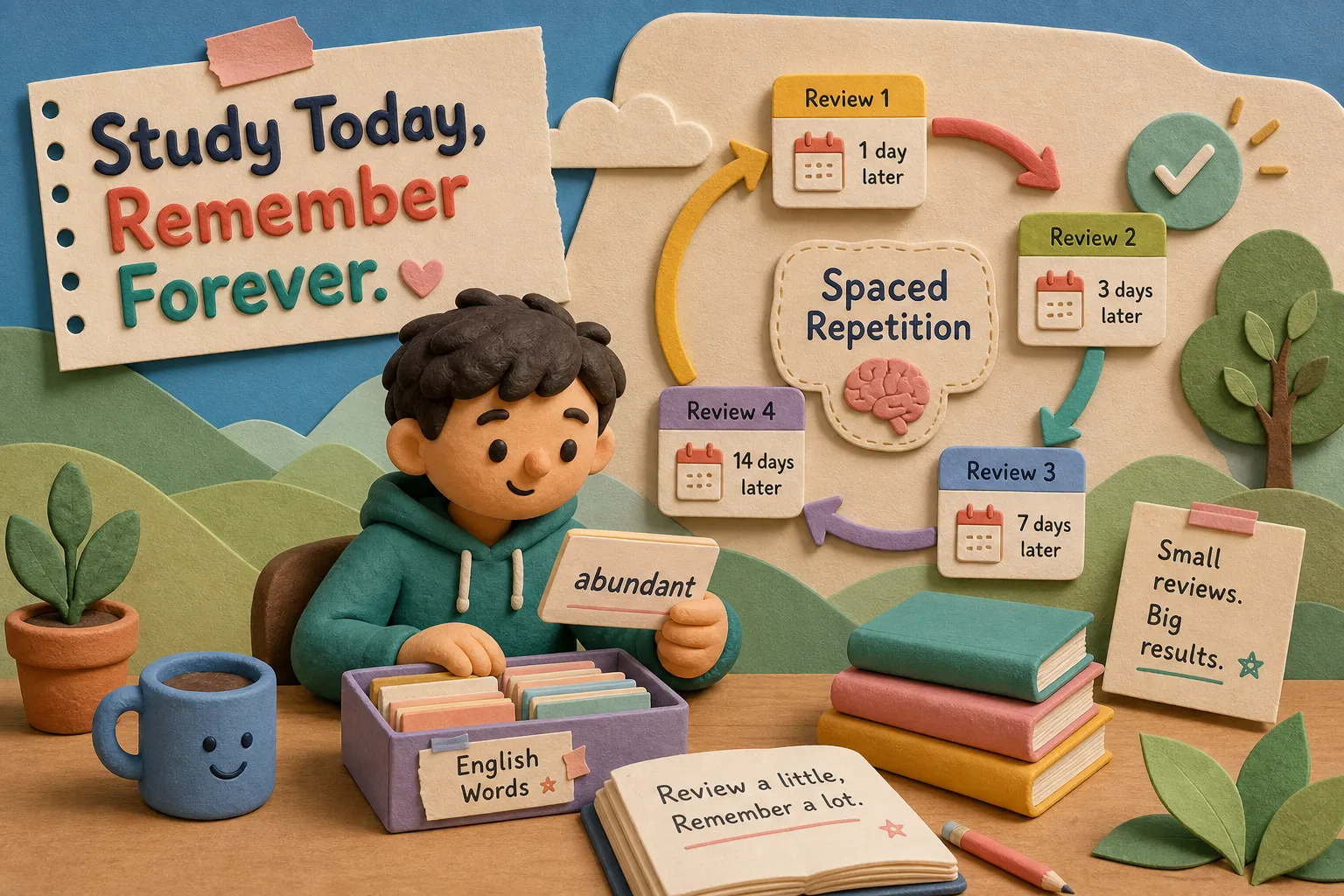
A practical interval schedule for new English vocabulary looks like this: review a word after 1 day, then 3 days, then 7 days, then 14 days, then 30 days. Each successful recall earns a longer gap. If you forget a word at any point, the interval resets and you rebuild from the beginning, though it’s worth noting that algorithmic tools like Anki may handle resets differently depending on your deck settings.
Digital spaced repetition systems (SRS), often called SRS apps, handle this scheduling automatically. Apps like Anki use an algorithm that adjusts each card’s interval based on your recall rating, giving easy words longer gaps and difficult ones shorter gaps. That means you’re never over-reviewing words you already know or under-reviewing the ones that keep slipping away. This kind of automatic flashcard scheduling removes the mental overhead of managing intervals yourself; for a clear primer on the basic principles behind spaced repetition, see this overview of the spaced repetition effect.
Building an English flashcard deck that actually teaches you something
What deserves a card: vocabulary, phrasal verbs, and idioms
Not every English word is worth a flashcard, and a bare vocabulary list makes for weak cards. A strong spaced review deck includes context-rich vocabulary used in full sentences, phrasal verbs paired with realistic dialogue lines, and idioms tied to the situations where a native speaker would actually use them.
The rule is simple: never card a word in isolation. “Give up” sitting alone on a card means almost nothing. “She gave up trying to explain it to him after the third attempt” is a card. Context is what makes a word retrievable in real conversation. Retrieval practice works best when the cue mirrors the way you’ll actually need the word.
How to design cards your future self can answer
One card, one idea. If your card needs the word “and” to describe what it’s testing, split it into two cards. A card that tests multiple things at once is a card you’ll always feel uncertain about, which defeats the whole system. For example, instead of asking about the meaning of “call off” and requesting an example sentence in a single prompt, make one card testing recognition and a separate card testing production.
The most effective format for ESL cards is cloze deletion, fill-in-the-blank. Instead of asking “What does ‘give up’ mean?” write: “She _____ trying after the third attempt.” That blank forces active recall rather than passive recognition. Retrieval practice in this form is what actually builds durable memory. In Anki, you can create a cloze card by selecting the target word in a sentence and using the cloze shortcut (Ctrl+Shift+C on Windows, Command+Shift+C on Mac), which wraps it in the syntax {{c1::give up}} automatically.
Every article on Your Daily American is built around real-life situations, which means the vocabulary, phrasal verbs, and idioms are already in context. Pulling 5 to 7 expressions from one article gives you a complete study deck ready to load. That’s the full loop: read an article, card the expressions, review them on a schedule.
Two tools to run your spaced repetition method
Anki: the digital SRS that adapts to you
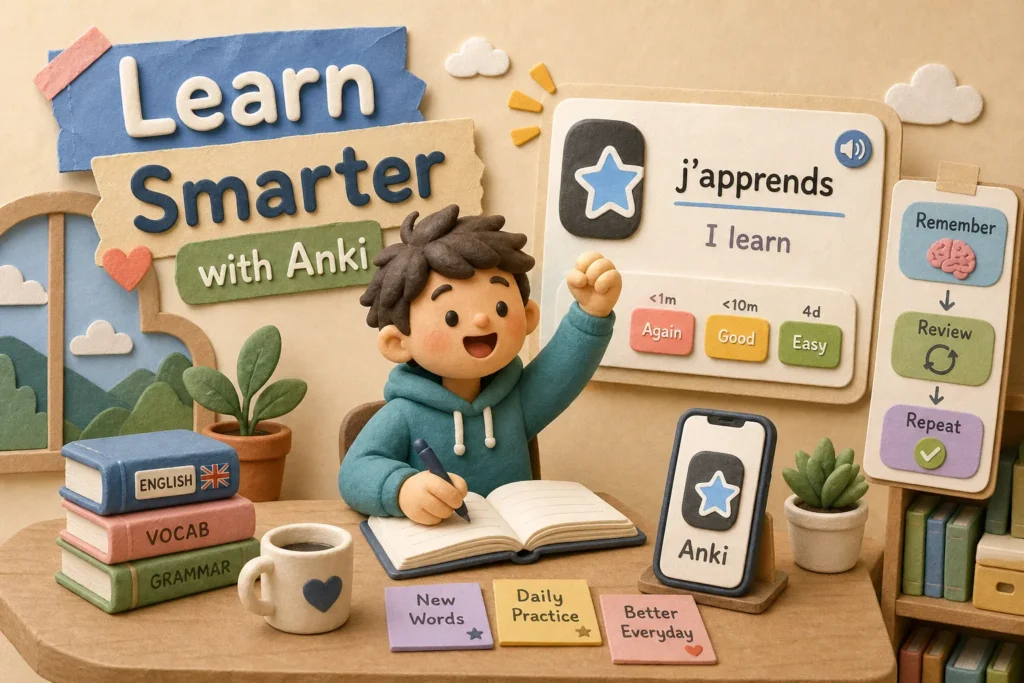
Anki is a free, open-source flashcard app that schedules each card individually based on your recall rating. After every review, you rate the card (Again, Hard, Good, or Easy), and Anki’s algorithm, based on the SM-2 scheduling model, adjusts the next interval accordingly. A card you know well may not appear again for two weeks or more, depending on your settings and past performance. A card you keep missing will come back the next day. Actual intervals vary based on your deck configuration, so it’s worth reviewing Anki’s documentation to understand how the scheduler handles resets.
The practical details: Anki is free on desktop, web, and Android. The iOS app (AnkiMobile) costs $24.99 as a one-time purchase. It supports audio, images, and cloze deletion, making it well-suited for pronunciation cards and dialogue-based ESL content. The honest tradeoff: the setup takes patience. Once your deck is running, Anki tells you exactly what to review each day, no guessing, no wasted time.
The Leitner system: no app, no screen, no excuses
If you prefer something physical, the Leitner system uses three labeled boxes or envelopes: Box 1 (Daily), Box 2 (Every Other Day), Box 3 (Weekly). Every new card starts in Box 1. Get it right, and the card moves up one box. Get it wrong, and it goes back to Box 1. That’s the whole method.
To set it up at home, you need index cards, three small boxes or envelopes, and labels. Write the target word or phrase in a full sentence on one side, with the translation or definition on the other. Review only the box due that day, and keep the schedule consistent.
Choosing between them: use Anki if you study on your phone and want automatic flashcard scheduling with no mental overhead. Use the Leitner system if you want something tactile, screen-free, and simple to explain to yourself in 30 seconds.
Mistakes that quietly kill your review habit
The three card-writing errors that slow your progress
Cards that test multiple things at once are the most common trap. “What does ‘come up with’ mean and give an example?” is two cards, not one. Split it. A card that strips a word from all context pushes learners toward guessing rather than genuine recall and trains the wrong skill entirely.
The third mistake is adding too many new cards at once. Loading 100 words on Monday creates a review avalanche by Thursday that feels impossible to clear. Most practical guides recommend starting with around 5 to 10 new cards per day and scaling up only once your review sessions feel comfortable. At a steady pace, your daily reviews stay manageable and you can actually keep up with the schedule the spaced repetition method builds for you.
The one habit that makes or breaks the whole system
Missed reviews and poor adherence are among the most common reasons the spaced repetition method underperforms in practice. The method depends on timing: review a card a day late, and the interval falls out of sync. Miss several days, and a backlog piles up that discourages you from returning at all.
The fix comes down to a single daily commitment: treat your reviews like brushing your teeth. Ten minutes every morning, before anything else, even on days when you don’t add new cards. The review queue is the priority. New vocabulary is secondary.
Start the clock today
Retaining English vocabulary isn’t about studying harder or logging more hours. It’s about reviewing at the right moment, with active recall, and letting the increasing intervals do the consolidation work for you. That’s what the spaced repetition method delivers when you use it consistently.
Using the spaced repetition method consistently will dramatically increase your long-term retention of vocabulary, but only if the content going into your deck is worth keeping. Your Daily American’s articles are written as focused, situation-based lessons, which means every piece you read is a ready-made study session waiting to be built into cards. Read an article, pull the expressions, add them to your deck, and review on schedule.
Your practice prompt: pick one article you’ve read recently, write 5 cloze cards from it, and load them into your deck or Box 1 today. That’s Day 1. The spaced repetition method takes care of the rest.