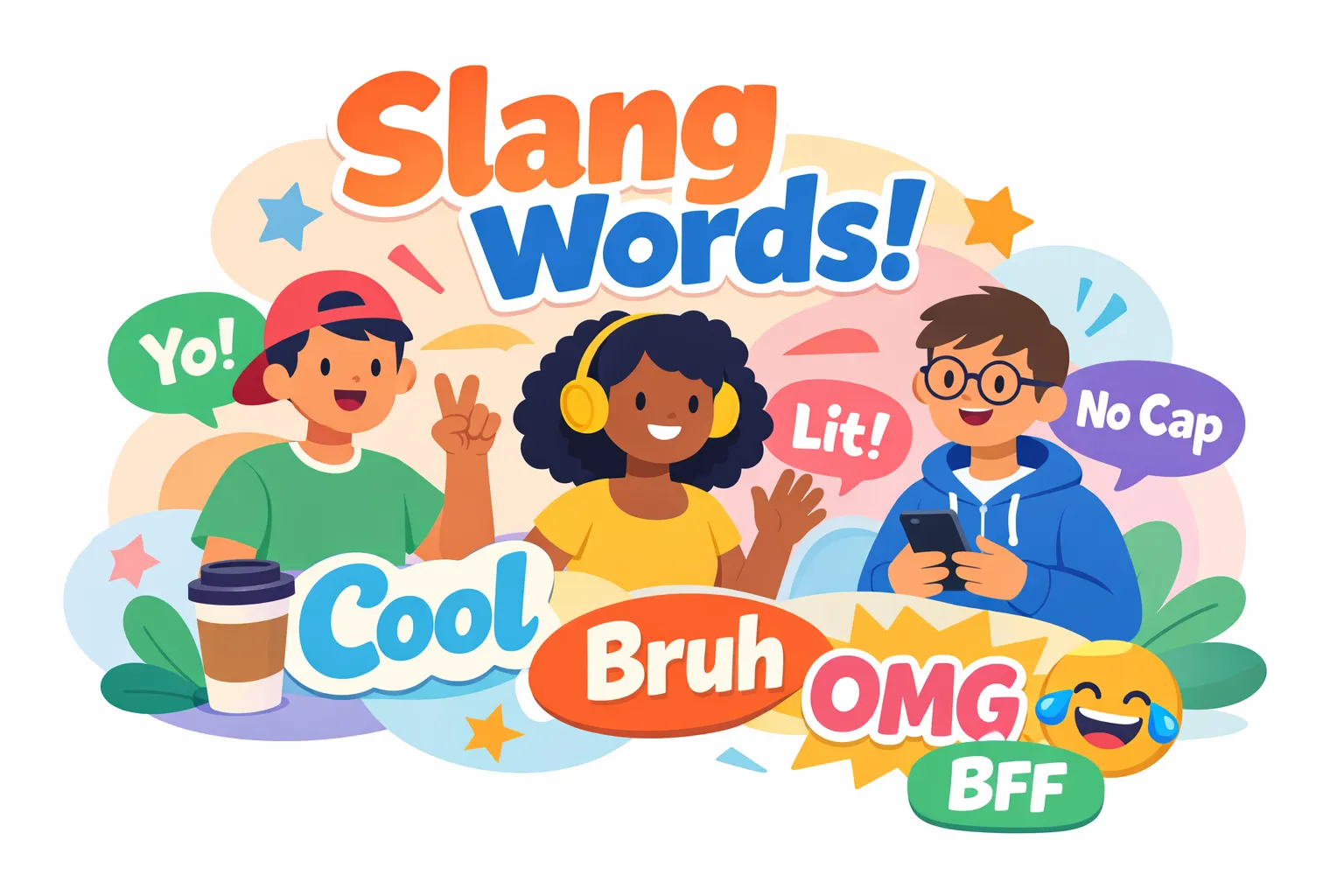
You passed the English test. You understand news anchors, follow American movies without subtitles, and write clean professional emails. Then a coworker says “that’s lowkey fire” and you freeze. Or a new friend texts “don’t ghost me” and you spend two minutes Googling it instead of just replying. The gap isn’t your grammar. It’s the informal American English that many ESL courses simply don’t cover, and this guide is here to fix that. If you want to master the most common American slang words used in daily life, you’re in the right place.
This guide gives you the everyday American slang that actually comes up in conversations, organized by how and when to use each term. You’ll get real example sentences, formality notes, and enough context to know whether a word fits a Friday night group chat or a Monday morning team meeting. This is the English Americans actually speak, not the version written for classrooms.
Why American Slang Trips Up Even Fluent English Speakers
Most ESL learners are taught formal, “correct” English. That version works for academic writing and official documents, but it sounds stiff and robotic in casual American conversation. Compare these two responses to the same situation: “I am not going to do that” versus “No way, that’s not happening.” Both communicate the same refusal. Only one sounds like a real American. Formal English carries the message; informal American English signals that you belong in the conversation.
The other challenge is speed. Social media, especially TikTok, now drives slang adoption faster than any dictionary can track. A word can go from a niche meme to nationwide use in a matter of months, or even weeks in viral cases. Between 2022 and 2025, terms like “rizz,” “brain rot,” “delulu,” and “skibidi” moved from viral videos into everyday speech at a pace that caught even linguists off guard. This means learning individual slang words isn’t enough on its own. You also need to understand how to read context, so when a new term surfaces, you can figure it out from how people around you use it.
Most Common American Slang Words Used in Daily Life: Approval, Reactions, and Good Vibes
The most common American slang words used in daily life very often express approval, excitement, or admiration. These are the words you hear when something goes well, looks impressive, or tastes amazing. Learning them gives you an immediate way to sound natural in positive moments.
Here are the core approval terms with example sentences:
- Fire: Something excellent or impressive. “That playlist is fire, send it to me.” (Casual; more commonly used among younger adults.)
- Lit: Exciting and high-energy. “The party was so lit last night.” (Broadly understood across age groups.)
- Dope: Cool or impressive. “Your presentation was actually dope.” (Best in casual settings; avoid in formal or professional contexts.)
- Bussin’: Exceptionally good, especially for food. “This taco truck is bussin’.” (Gen Z-leaning but widely recognized.)
- Slay: To perform or look exceptionally well. “She slayed that interview.” (Broadly understood; casual.)
- Bomb: Really good. “The coffee here is bomb.” (In use across generations; most common in casual conversation.)
- Snatched: Looking great, especially in terms of style. “Your fit today is snatched.” (Casual; Gen Z-leaning.)
Everyday Reactions You’ll See in Texts and Conversations
A few phrases show up constantly in texting and everyday conversation. “I’m dead” means something is so funny or shocking it’s overwhelming: “He tripped over nothing in front of everyone. I’m dead.” “No cap” means you’re being completely serious: “No cap, that’s the best burger I’ve ever had.” “Bet” is a one-word confirmation or agreement, functioning like “sounds good”: “Meet you at 6?” “Bet.” These three phrases are among the most common American slang words used in daily life, getting comfortable with them will help you follow text conversations and understand the tone your friends are setting.
Everyday Social Slang: People, Relationships, and Situations
American informal English has a rich vocabulary for describing people and the situations they create. Understanding these terms, part of the broader world of everyday American expressions, helps you follow conversations at social events, in group chats, and anywhere Americans talk about each other.
For describing behavior, “salty” means someone is bitter or upset about something: “He’s been salty all week since he didn’t get that promotion.” “Extra” describes someone who is over-the-top or dramatic: “She brought five suitcases for a weekend trip. So extra.” “Shady” signals something suspicious or dishonest: “That deal sounds shady to me.” “Sus,” short for suspicious, works the same way in a more casual context: “His excuse sounds sus.” Note that “simp” and “scrub” carry negative edges and work only in casual conversation with people you know well. Skip them in professional settings entirely.
For social actions, a few verbs are essential. “Ghost” means cutting off all communication suddenly and without explanation: “She ghosted him after the second date.” “Flex” means to show off: “He’s always flexing his new car.” “Vibe” works as both a noun (a feeling or atmosphere) and a verb (to enjoy or connect with something): “This coffee shop has a great vibe” or “I’m vibing with this playlist.”
“Crash” means to sleep somewhere informally: “Can I crash at your place tonight?” And “my bad” is a simple, casual apology: “Oh, my bad, I thought the meeting was at 3.” These US slang verbs and phrases are the building blocks of natural informal speech.
Most Common American Slang Words Used in Daily Life: Gen Z Terms vs. Cross-Generational Vocabulary
Not all informal American English carries the same risk. Some terms are universally understood and welcomed across generations. Others signal youth culture and online fluency, which means they work perfectly in some rooms and land awkwardly in others.
Start here before you venture anywhere near TikTok-adjacent vocabulary. The broadly safe expressions, ones that function as American colloquialisms across nearly all age groups, include:
- cool, awesome, chill
- hang out, my bad, no worries
- sounds good, totally, for sure
- broke (meaning no money), ASAP, ride shotgun
- break the ice, have dibs on
These expressions are commonly understood across many age groups and are lower-risk in mixed-age informal contexts. They’re the smartest ones to master first.
Then there’s the TikTok-driven tier: rizz, skibidi, brain rot, delulu, drip, no cap, periodt, glow up, W (meaning a win), and L (meaning a loss). These are widely recognized and very much alive in 2024, 2025, but they signal youth culture and online fluency. Using terms like “rizz” self-awarely, or simply understanding what they mean when you hear them, is often smarter than forcing them into regular conversation. Be aware that “rizz” peaked around 2022, 2023 and is now edging toward overuse in some circles.
Formality Rules: When to Use Slang and When to Leave It Out
Some informal American expressions have crossed into mainstream use and are accepted in relaxed workplace conversations. “Sounds good,” “my bad,” “no worries,” “totally,” “for sure,” and “I’ll check on that” are all low-stakes, widely understood, and non-offensive. These sit in the “safe casual” zone: informal enough to sound human, but neutral enough that no one will question your professionalism.
Other categories of slang are strictly casual-only or carry serious risks. Vulgar insults are inappropriate in any professional setting, regardless of how casual the office culture seems. Terms with racial or ethnic baggage, including using “ghetto” as a general adjective meaning cheap or inferior, are offensive and should be avoided completely. “Ghetto” as a descriptor erases the word’s historical weight and replaces it with a negative stereotype. Music and film also expose learners to slurs that can feel normalized in those contexts, they aren’t, and using them will cause real harm regardless of intent.
Here’s the practical rule: if you wouldn’t say it in a job interview, don’t use it with your manager. And if a term came from a niche internet meme, assume it belongs in a group chat, not a client email. Register awareness, knowing which words belong in which rooms, is one of the most valuable fluency skills you can build.
Why Slang Never Sticks from a Word List (and What Actually Works)
Reading a slang glossary feels productive in the moment. You see “bussin'” and think, “Got it, means good food.” Then a week later, someone at a restaurant says it and you blank. The brain doesn’t store random lists. It stores patterns, context, and repeated encounters spaced over time. A single exposure to a definition rarely moves a word from your reading vocabulary to your spoken vocabulary.
This is exactly where spaced repetition makes the difference. Instead of seeing “fire” defined once and moving on, spaced repetition re-introduces the word in a sentence context at calculated intervals: today, tomorrow, then several days later, then a week after that. Each review happens just before the brain would forget it, which strengthens the neural pathway and pushes the word into long-term memory. Memory researchers from Ebbinghaus onward have consistently found that this approach produces far better retention than passive rereading, particularly for informal phrases that don’t follow predictable grammar rules.
At Your Daily American, the most common American slang words used in daily life are built into spaced repetition practice packs, so you’re not just reading definitions but actively recalling them in context over time. The difference between “I read a list once” and “I actually use this naturally” comes down to how many times your brain has retrieved the word in a realistic sentence, and that gap closes through structured repetition, not a single study session.
Start Using It, Not Just Knowing It
Understanding what “lowkey fire” means is useful. Knowing that you can say “bet” instead of “sounds good” in a casual text, and using it in the moment without hesitation, is fluency. The goal was never to memorize a glossary. It was to feel confident when American conversation goes informal, which it will, often and quickly.
Mastering the most common American slang words used in daily life isn’t about sounding young or chasing trends. It’s about communicating in the register real Americans use in real situations, and knowing how to shift that register when the room calls for something more professional. That combination, natural in casual settings and polished when it counts, is what separates textbook English from actual American fluency. Head to Your Daily American to start building that active vocabulary with lessons built around the modern American idioms and everyday expressions Americans actually speak.