You’ve studied English for years. You understand movies, read articles, and write emails without breaking a sweat. Then a coworker passes you in the break room and says, “Hey, how’s it going?” and your brain completely freezes. Grammar isn’t the problem. The problem is that you don’t have the right small talk phrases loaded and ready. You’re reaching for words that aren’t there yet.
That gap between knowing English and actually speaking it in real-time is exactly what Your Daily American is built to close. Real fluency comes from learning the phrases Americans actually say, not textbook scripts. This article gives you 25 of those phrases, organized by where they show up in a conversation: openers, transitions, setting-specific lines, and exits. Pronunciation notes and cultural context are included throughout so you understand how and when to use each one.
Small talk phrases: Greetings and openers that actually start conversations
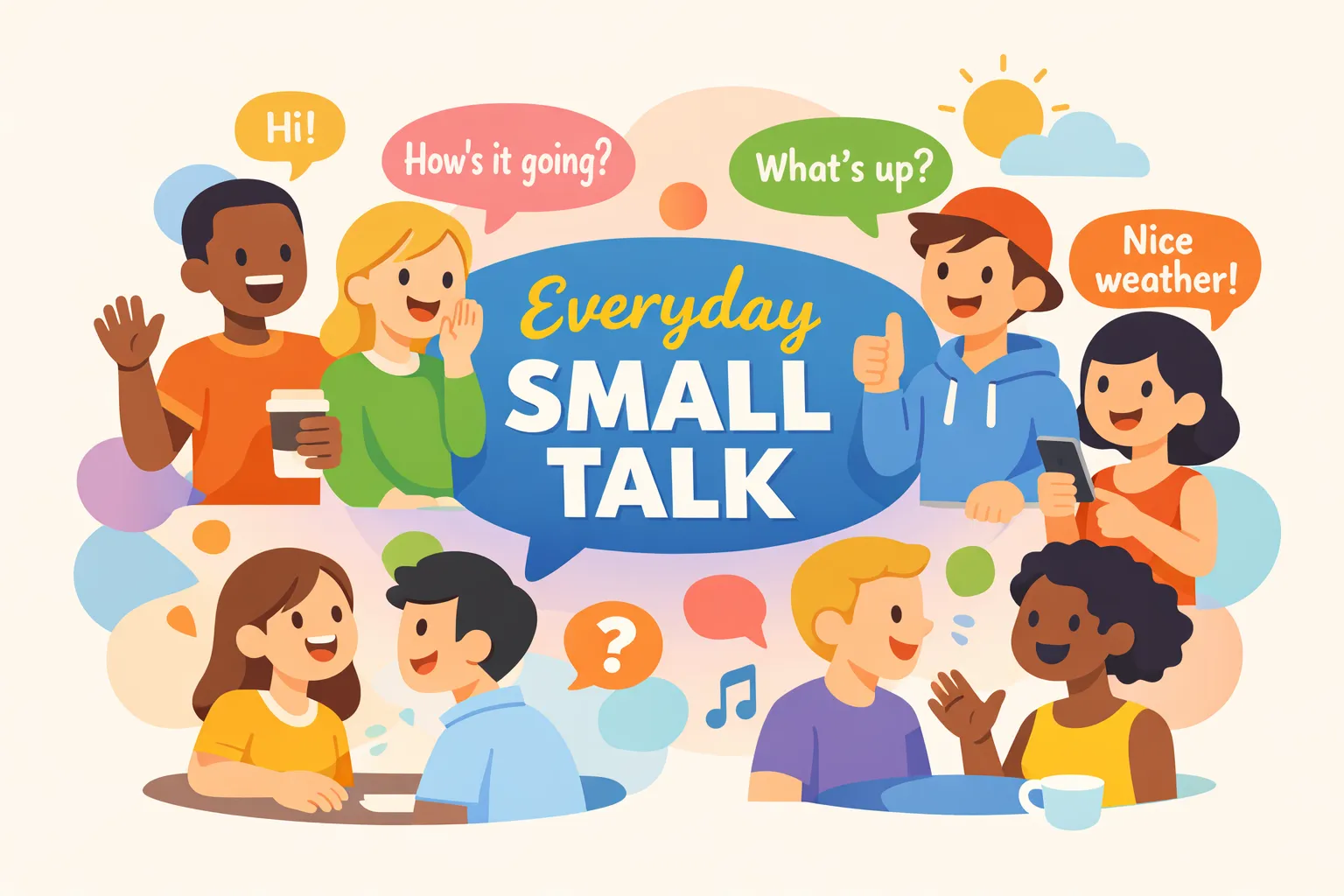
Most textbooks teach you “Hello, how are you?” and stop there. Real Americans don’t talk like that. In daily life, the most common openers are casual, fast, and almost ritualistic in how they work. Here are the small talk examples you’ll hear most:
- “How’s it going?”
- “What’s up?”
- “Hey, long time no see!”
- “You been busy lately?”
- “How was your weekend?”
- “What’s new with you?”
- “How ya been?”
- “What’s going on?”
These phrases function as social signals more than literal questions. When someone says “How’s it going?” in passing, they’re not asking for a full update. They’re saying, “I see you, I’m friendly.” The standard response is short: “Good, you?” or “Not bad, you?” Then you bounce it back. Knowing this removes an enormous amount of pressure.
In natural spoken American English, these phrases sound nothing like they’re spelled. “How’s it going?” collapses into something close to “Howzit goin’?” and “What are you up to?” sounds more like “Whaddya up to?” These aren’t sloppy pronunciations; they’re normal connected speech patterns called reductions and linking. The faster and more relaxed the conversation, the more you’ll hear them. Train your ear to recognize them, and eventually your mouth will follow.
One cultural rule worth knowing immediately: “How are you?” is a greeting in American English, not a wellness check. The expected answer is “Good, thanks” or “Not bad.” If you launch into a genuine personal update, people get caught off guard. It’s one of the most common culture gaps for new learners, and once you understand it, openers stop feeling so confusing.
Transition small talk phrases that keep chit-chat moving
A good opener gets you in the door. Transition phrases keep the conversation from dying after the first exchange. Americans use these naturally to show they’re listening and to signal they want to keep talking. Here are some of the most useful ones:
- “Oh really?”
- “No way!”
- “That’s so funny you say that…”
- “How did that go?”
- “Tell me more about that.”
- “What do you mean?”
- “That’s wild.”
These short responses signal warmth and engagement without committing to a deep discussion. They’re what turn a 10-second hallway exchange into an actual two-minute conversation. You don’t need to share anything about yourself; just respond to what the other person said and ask one follow-up question.
When you need to shift topics without it feeling abrupt, Americans use natural pivot phrases: “So anyway…”, “Speaking of which…”, “Oh, that reminds me…”, and “By the way…” Each one signals a gentle change of direction. The tone matters here. Americans say these with a slightly rising, warm inflection, not flat or clipped. That rising tone communicates “we’re moving on” in a way that feels friendly, not dismissive.
Icebreaker phrases for specific settings: work, networking, and social
The right opener depends on where you are. In professional settings, generic questions like “So what do you do?” often produce one-word answers and dead ends. These ESL small talk expressions invite a real response:
- “What team are you on?”
- “How long have you been with the company?”
- “What’s keeping you busy these days?”
- “Have you been to this kind of event before?”
- “What’s the most interesting project you’re working on right now?”
These work because they open a door instead of asking someone to label themselves. With networking openers, the aim isn’t to gather information, it’s to get a person talking. Once they’re talking, all you have to do is listen and follow up.
In casual social settings like parties or neighborhood encounters, the bar is even lower. “How do you know [the host]?”, “Have you tried the food here?”, and “Is this your first time here?” all work because they’re tied to the shared situation you’re already in. Even the classic weather comment works: “Crazy weather lately, right?” It’s low-stakes, universally relatable, and gives both people an easy yes to agree on. The goal in casual settings is simply to find one shared point of connection.
For additional ideas on practical conversation openers that work in many contexts, see this collection of conversation starters and this guide to work conversation starters, which are both helpful when you’re choosing an opener for a meeting or networking event.
Safe topics and what to steer clear of
American small talk has unspoken rules about what’s in bounds and what’s not. The safe zones are wide: weekend plans, weather, food and restaurants, local sports, recent TV shows, and work in a general sense (“Been super busy lately”). With polite small talk topics, the point isn’t to share opinions, it’s to find common ground. Keep things light, relatable, and easy to agree with.
The topics to avoid in casual settings are politics, religion, money, and personal questions about relationships, weight, or family status. These aren’t just awkward; they signal a boundary violation in American culture. Questions like “Why aren’t you married yet?” or “What do you make?” land badly even between friendly acquaintances. Save those for people you know well.
“Where are you from?” also deserves a note. Asked warmly and in context, it’s fine. But asked immediately after meeting someone, especially based on appearance or accent, it can imply the person doesn’t quite belong here. A softer alternative: “Did you grow up around here?” or “Are you from this area originally?” It covers the same curiosity without the othering undertone. Keeping this distinction in mind will give you much more confidence when navigating that question in either direction.
For a practical list of small-talk questions you can practice in low-stakes settings, this small-talk questions guide has quick prompts you can try out.
How to exit without it getting weird
Americans almost always close a conversation before walking away. Ending abruptly or just drifting off reads as rude, even if you don’t mean it that way. These exit phrases give you a clean, friendly way out:
- “Well, it was great catching up!”
- “I’ll let you get back to it.”
- “I should go grab a coffee before the meeting.”
- “We’ll have to catch up more soon!”
- “It was great meeting you!”
- “Alright, I’ll talk to you later!”
Notice the pattern: each exit includes something positive before the departure. You’re not just leaving, you’re signaling that the conversation was good and that you value the person’s time. That’s what makes it feel gracious instead of rushed.
Tone and body language carry these phrases. Exit lines in American English are delivered with a slightly warm, upbeat tone, not flat, not rushed. A small smile, a brief wave, or a nod rounds it off. For ESL learners, knowing the physical cues that go with the words is just as important as knowing the words themselves. The full package is what reads as natural.
How to make these phrases actually come out in real conversation
There’s a real difference between recognizing a phrase and producing it under pressure. When a conversation starts fast, your brain defaults to whatever it has practiced most recently, not what you studied once in a list. This is why reading through phrases once doesn’t translate to real-time fluency. You need a system.
Spaced repetition is one of the most effective methods for moving phrases from short-term to long-term memory. The core idea is simple: you review a phrase right before you’d forget it, which strengthens retention each time. Tools like Anki let you build flashcard decks with custom review intervals, and you can create a deck from the small talk phrases in this article today. Your Daily American takes this further by organizing American English phrases by real-life scenario, casual conversation starters, workplace openers, exit lines, with cultural context already built in. The curation is done for you, so instead of building from scratch, you’re drilling phrases that are already grouped, explained, and ready to use.
A simple daily routine: review five phrases each morning and say each one out loud twice, then look for one natural opportunity to use at least one during the day. That’s less than five minutes, and the consistency is what matters. Small talk fluency doesn’t come from studying harder, it comes from closing the gap between knowing a phrase and saying it without thinking, one day at a time.
Start using these small talk phrases today
American casual conversation follows predictable patterns once you know them. The 25 small talk phrases in this article cover the full arc of a short exchange: how to open it, how to keep it moving, what topics to land on, and how to exit without awkwardness. The cultural and pronunciation notes throughout are what turn a phrase list into actual communication skills.
Reading this once is a solid start. The real shift happens when these phrases become automatic, when “How’s it going?” triggers a confident “Not bad, you?” before you even think about it. That kind of fluency comes from consistent, spaced review over time, not a single study session.
Head over to Your Daily American for more scenario-based American English practice built around exactly this approach. Every lesson is grounded in the phrases Americans actually say, with the context you need to use them confidently, whether you’re grabbing coffee, walking into a meeting, or striking up a conversation at a party.