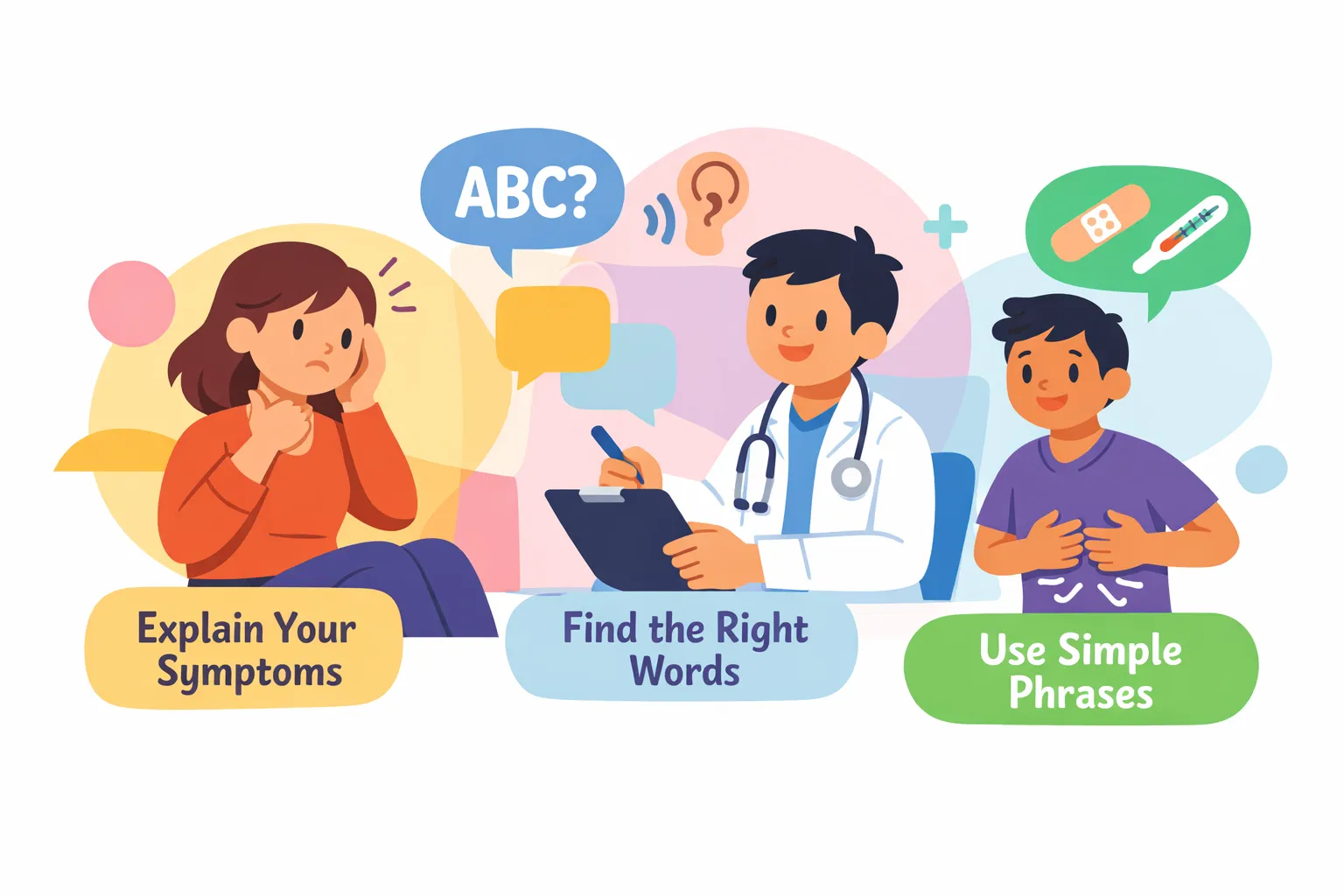
You’re sitting in the exam room. The doctor walks in, looks at you, and asks: “So, what brings you in today?” Your mind goes blank. You know exactly what’s wrong with your body, but the English words won’t come. For many language learners, this is one of the most stressful moments they face, and it has nothing to do with grammar.
If you need to know how to describe symptoms to a doctor in English, this guide gives you the exact structure, vocabulary, and ready-to-use scripts to walk into any clinic or urgent care and communicate clearly. Knowing how to explain your symptoms in English isn’t about being fluent. It’s about being understood when it actually matters. By the end, you’ll have a seven-point framework, a pain vocabulary bank, sample dialogues, and a checklist to fill in before your next visit.
At Your Daily American, we focus on exactly these high-stakes situations because real fluency means you can handle the hard conversations, not just small talk over coffee.
How to Describe Symptoms to a Doctor in English: The 7 Details
Doctors don’t just need to know you “feel bad.” They follow a standard set of questions to build a complete clinical picture before making a diagnosis. This framework is known in medical training as OLD CARTS: Onset, Location, Duration, Character, Aggravating factors, Relieving factors, Timing, and Severity. (Note: Aggravating and Relieving factors are sometimes grouped as a single category, which is why the framework is often summarized as seven key details rather than eight.) Walking in prepared with these seven details can substantially shorten the back-and-forth and help the doctor reach the right answer faster.
When it started and where it is
Onset means when the symptom started and how it began. Use simple past tense with a clear time reference: “It started two days ago, suddenly, after I ate.” “It’s been building up slowly since last week.” Doctors also want to know if it came on all at once or grew gradually, because that difference helps them separate urgent conditions from chronic ones.
Location means exactly where you feel it and whether it moves. Don’t just say “my stomach.” Be as specific as you can: “It’s in my lower right abdomen, and it spreads toward my back.” Two verbs doctors immediately recognize are “spreads” and “radiates.” Use them. “The pain radiates down my left arm” is the kind of detail that quickly conveys important diagnostic information.
How long it lasts, how bad it feels, and what changes it
Duration covers how long each episode lasts and how often it happens: “It comes and goes, about 20 minutes each time.” Severity is usually communicated with the 1-to-10 pain scale. Anchor your number with a real-life impact: “It’s about a 6. Bad enough that I can’t focus at work, but I can still walk around.” This grounding phrase tells the doctor far more than a number alone.
Aggravating and relieving factors are what make the symptom worse or better. These are diagnostic gold. “It gets worse after meals but calms down when I lie flat.” “Moving makes it sharper. Sitting still helps a little.” Timing patterns also matter here: “It only happens at night,” or “It’s worst first thing in the morning.” Those patterns often point directly toward a specific cause.
Words that actually describe what your pain feels like
Saying “it hurts” tells a doctor almost nothing. Pain quality is one of the most useful details you can provide. The right descriptor can help a doctor distinguish between a muscle problem and a nerve problem, and direct the entire diagnostic conversation from there. English has very specific words for this, and they’re not complicated.
For a clinical breakdown of different pain types, see Healthline’s guide to types of pain.
Pain quality vocabulary: sharp, dull, throbbing, and more
Here are the core pain quality words with a sample phrase you can use directly:
- Sharp: A sudden, intense sensation. “I have a sharp pain in my chest when I breathe in.”
- Dull: A low-grade, constant ache. “There’s a dull ache in my lower back that doesn’t go away.”
- Throbbing: A pulsing or pounding feeling. “I have a throbbing headache behind both eyes.”
- Burning: A hot, searing sensation. “I feel a burning sensation in my stomach, especially after eating.”
- Aching: A deep, persistent discomfort. “My knees have been aching for a week, especially after I walk.”
- Shooting: Pain that travels along a path. “It starts in my neck and shoots down my right arm.”
- Cramping: A tight, squeezing feeling. “I’m having cramping pain in my lower abdomen.”
How to rate your pain intensity in plain English
The 1-to-10 scale works best when you add context. A “3” on its own doesn’t tell the doctor much. A “3, mild enough that I can still work but it’s distracting” tells them a lot. For verbal alternatives, use: mild (“It’s uncomfortable but I can ignore it”), moderate (“It interrupts what I’m doing but I can manage”), or severe (“It stops me from doing normal things”). Pairing the number with one real-life impact sentence makes your description precise and actionable.
How to say where it hurts and where it moves
Location is more than naming a body part. Doctors want to know if the pain stays in one spot or travels, and whether it started somewhere else first. This is the kind of detail that separates a routine complaint from something that needs immediate attention.
Basic body part phrases for clinic conversations
You don’t need anatomical terms. Doctors are trained to translate everyday language. Common zones to know: upper abdomen, lower abdomen, lower back, chest, right side, left side, behind the eyes, base of the skull, along the jaw. Worth knowing: Americans often say “my stomach hurts” when they mean general abdominal discomfort. If you want to be more precise, say “my lower abdomen” or “the upper right side of my belly.” Doctors appreciate that specificity, and it often shortens the visit. For standard anatomical terms, see MedlinePlus Appendix A.
Phrases for describing pain that radiates or spreads
Radiating pain is a critical detail, and these phrase templates make it easy to describe. “It starts in my shoulder and shoots down my arm.” “The pain spreads from my lower back to my hip.” “I feel pressure that moves up toward my jaw.” These patterns flag symptoms that doctors listen for carefully, especially in the chest and arm region. Practice saying these out loud before your appointment so the words feel natural when you need them.
Scripts for the four most common complaints
Reading about vocabulary is useful. Using it inside a real conversation makes it stick. These sample dialogues model the complaints most likely to bring you into a clinic, each one chosen to show how the seven details work in a natural exchange. Borrow the patient lines directly.
Headache and fever script
Doctor: What’s going on today?
Patient: I’ve had a bad headache since yesterday morning. It’s throbbing, mostly behind both eyes. I’d say it’s about a 7 out of 10. I also have a mild fever and I feel nauseous. Light bothers me a lot.
Doctor: Does anything make the headache better or worse?
Patient: It gets worse when I stand up quickly. Lying in a dark room helps a little, but it doesn’t go away completely.
Stomach pain, cough, and shortness of breath scripts
Stomach pain:
Doctor: Where exactly is the pain?
Patient: In the lower part of my stomach, especially after meals. It’s a burning feeling, and I’ve also been feeling bloated. It started three days ago.
Cough:
Doctor: Tell me about your cough.
Patient: It’s a dry cough, no mucus. It started about five days ago after I had a cold. My chest feels a little tight when I cough hard.
Shortness of breath:
Doctor: When does the shortness of breath happen?
Patient: Only when I climb stairs or walk fast. At rest I feel fine. It started about a week ago, gradually.
Mistakes that make doctors ask “can you be more specific?”
The errors non-native speakers make during medical visits aren’t usually grammar mistakes. They’re clarity mistakes that slow down the diagnosis. Fixing them takes one simple habit: replace vague words with specific ones.
Vague language and missing the timeline
The most common problem is arriving without a timeline or a sensation word. “I don’t feel well” and “I have pain” give a doctor nowhere to start. Compare these two versions. Before: “I have pain in my stomach.” After: “I’ve had a sharp pain in my lower right side since Tuesday morning, and it gets worse when I move.” The second version tells the doctor the location, the sensation, the onset, the duration, and the aggravating factor, that’s five out of seven details in one sentence. Writing out a brief summary before you go means you won’t have to recall everything under pressure. A handwritten note with the key details is completely acceptable in any American clinic, and many clinicians find a concise written summary genuinely helpful. See research on clinical history taking that highlights the value of clear, concise patient summaries.
Tense errors and direct translations that confuse the picture
Another common issue is switching tenses mid-description, which makes the timeline unclear. Stick to this simple pattern: use simple past for when it started (“It started on Monday”), present perfect for something ongoing (“I’ve been feeling nauseous since yesterday”), and simple present for what’s true right now (“It hurts when I press here”). This keeps your account easy to follow from the first sentence.
Direct translations from Portuguese also produce phrases that sound unnatural and sometimes confusing. “My stomach hurts me” is the classic example. The natural American English version is “I have stomach pain” or “my stomach hurts.” Similarly, “I feel bad of my head” becomes “I have a headache” or “my head is pounding.” Small adjustments like these make your description immediately clear to any American doctor or nurse.
Your pre-appointment checklist and where to keep practicing
Preparing for a clinic visit doesn’t take long. A short written summary using the seven details puts everything the doctor needs in one place, and it means you won’t freeze the moment you walk through the door.
A 7-point symptom checklist you can fill in before you go
Fill this out in writing before your appointment, using the medical phrases in English from this guide:
- When it started: Date, time, sudden or gradual?
- Where it is: Body part, left/right/center, does it spread?
- What it feels like: Sharp, dull, burning, throbbing, cramping?
- How bad it is: 1-10 scale, or mild/moderate/severe, plus real-life impact
- How long each episode lasts: Constant, or comes and goes?
- What makes it worse or better: Movement, food, rest, medication?
- Any other symptoms at the same time: Nausea, fever, fatigue, dizziness?
Where Your Daily American fits into this preparation
Your Daily American includes situational health English lessons built around exactly these real-life conversations. These aren’t textbook dialogues with formal language no American actually uses. They are phrase-by-phrase lessons for clinic visits, urgent care, pharmacy interactions, and follow-up appointments, designed so you’re ready before you walk through the door. Each lesson uses the same scenario-based approach you saw in the scripts above, so you practice the full conversation, not just isolated words.
Health English is one category in a broader library that covers workplace meetings, small talk, professional emails, and everyday errands. The goal is the same across all of it: you get the real phrases Americans use in real situations, organized so you can review them fast and remember them long-term.
You have the words now
Now you know how to describe symptoms to a doctor in English, and you have a clear structure to make it work. The seven details, onset, location, duration, character, severity, aggravating and relieving factors, and timing, give the doctor what they need to help you. Pain vocabulary like sharp, throbbing, burning, and shooting gives them precision. A written checklist prepared before your visit takes the pressure off in the moment.
The next time a doctor says “tell me what’s going on,” you’ll have the words. You’ll know to say “I’ve had a burning pain in my upper right abdomen since Sunday morning, it gets worse after eating, and I’d rate it about a 6 out of 10” instead of “I don’t feel well.” That shift can markedly improve how quickly and clearly the visit goes.
Head over to Your Daily American and explore the health English lesson series. Your next appointment doesn’t have to feel like a test you didn’t study for.