Picture this: you’re in a work meeting and want to ask a question. You start with “How much meetings…” (incorrect) and immediately stop. That doesn’t sound right. So you try again: “How many time do we have left?” (also incorrect). That’s not right either. You stay quiet, and the moment passes. That hesitation, that split second of doubt, is exactly what understanding much vs many can fix.
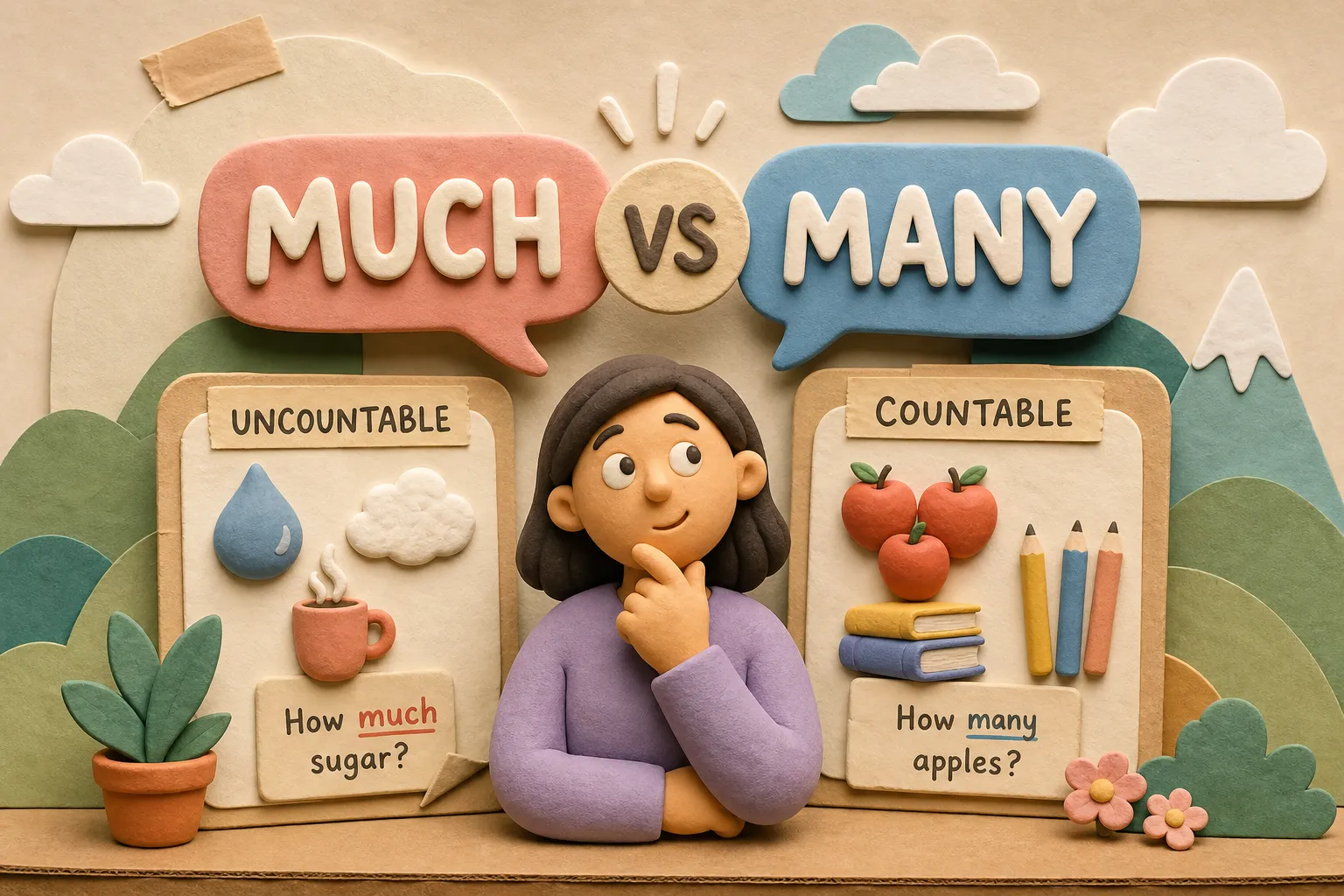
The much vs many difference comes down to one thing: the type of noun that follows. Once you understand it, the guessing stops. The rule hinges on one distinction: countable vs. uncountable nouns. Get that distinction right, and you’ll know which word to reach for every time, in questions, in negatives, and in formal writing. Grammar rules like this one only become automatic when you practice them in real situations, which is exactly how the lessons at Your Daily American are built.
Much vs Many: The One Rule You Need
Everything in this lesson builds on a single idea: the difference between countable and uncountable nouns. Before any grammar terminology, though, let’s make it concrete.
What makes a noun countable
Countable nouns are things you can number one by one. Use the counting test: if you can say “one meeting, two meetings, three meetings,” the noun is countable. Countable nouns include meetings, emails, questions, ideas, coworkers, and reports. With all of these, you use many.
What makes a noun uncountable
Uncountable nouns are treated as a whole mass or substance. You generally can’t put a number directly in front of them, though some nouns can shift between countable and uncountable depending on meaning (more on that below). Think of time, money, information, water, advice, and progress. You can’t say “three informations” or “two progresses.” With these nouns, you use much. They also don’t take a standard plural form.
The counting test in action
Run this mental check before you write or speak: can I put a number in front of this noun? Here’s how it plays out with everyday examples.
- “Three emails” works. Use many emails.
- “Three informations” doesn’t work. Use much information.
- “Two meetings” works. Use many meetings.
- “Two advice” doesn’t work. Use much advice.
- “Four reports” works. Use many reports.
That’s the whole rule. Everything else is just applying it to new nouns.
Much vs Many in Questions
Much and many are where these two words feel most natural in American English, and they’re also the most practical starting point for anyone using English at work.
“How much” in the workplace
“How much” pairs with uncountable nouns. These are the kinds of questions professionals ask every day. “How much time do we have before the call?” “How much work is left on this project?” “How much coffee is in the break room?” In each case, you’re asking about the quantity of something measured as a whole, not counted individually.
“How many” in the workplace
Mirror the same structure with countable nouns and you get “how many.” “How many meetings are left this week?” “How many people are joining the call?” “How many reports did you finish?” Each sentence counts separate, individual things, which is exactly when “many” belongs.
Why questions are a great place to start practicing
Questions give you the clearest practice ground for much vs many because the structure is consistent. “How much” or “how many” directly signals what kind of noun comes next, which makes it easier to build the habit. Start listening for these patterns in real meetings and native conversations. You’ll hear them constantly once you know what to look for.
Negatives, Positive Statements, and When “A Lot Of” Sounds More Natural
Much and many behave differently depending on sentence type, and the difference matters more than most learners expect.
Much and many in negative sentences
Both words are common in negative sentences. “I don’t have much time before the meeting.” “There aren’t many seats left in the conference room.” In negative sentences, both words signal “not a large amount” or “not a large number,” and native speakers use them comfortably here. Negatives are another natural context for practice, right alongside questions.
Why positive statements usually sound different
In everyday American English, positive statements with “much” or “many” can sound stiff or overly formal. “I have many friends” is grammatically correct, but “I have a lot of friends” sounds far more natural in casual conversation. “A lot of” and “lots of” work with both countable and uncountable nouns, which makes them the typical choice in informal affirmative speech. Save “much” and “many” for questions, negatives, and formal written English.
“Too much” vs. “too many”: a quick but important distinction
“Too much” pairs with uncountable nouns. “Too many” pairs with countable nouns. The rule is the same; you’re just adding “too” in front. “There’s too much noise in this office.” “There are too many tabs open on my screen.” “We spent too much time on that agenda item.” “There were too many people on the call to have a real discussion.” Once you apply the counting test, the right choice is obvious every time.
Tricky Nouns That Catch Learners Off Guard
Knowing the rule doesn’t mean every noun is obvious. Some words look countable but aren’t. Others change meaning depending on how they’re used.
The uncountable nouns that feel like they should be countable
These are the classic ESL traps: information, advice, news, furniture, luggage, progress, feedback, knowledge. In standard American English, these are typically uncountable in their basic sense. You can’t say “an information,” “many advices,” or “two furnitures.” The correct workarounds are: “a piece of advice,” “some information,” “much progress,” “a piece of feedback.” Use these unit phrases whenever you need to talk about a specific instance of an uncountable noun.
Learners from Spanish and Portuguese backgrounds run into this especially often, because several of these nouns are countable in those languages. If “informações” is plural in Portuguese, it takes real practice to accept that “information” generally does not take a plural -s in English. Awareness of that gap is the first step to closing it.
The nouns that change meaning depending on how they’re used
Some nouns do double duty, and the much vs many distinction actually reveals which meaning you’re using. Each example below is worth memorizing as a full sentence pair rather than just a rule.
Time: “Much time” refers to duration (uncountable), while “many times” means occasions (countable). Compare: “I don’t have much time” vs. “I’ve told you many times.”
Experience: “Much experience” means accumulated knowledge or skill (uncountable), while “many experiences” refers to individual events (countable). Compare: “She has much experience in negotiations” vs. “She had many experiences living abroad.”
Room: “Much room” means physical space (uncountable), while “rooms” (countable) refers to separate spaces in a building. Compare: “There isn’t much room in the storage area” vs. “The hotel has many rooms.”
Memory Tricks, Common Mistakes, and Smarter Alternatives
The rule is simple. The hard part is building the automatic reflex to apply it before you speak. These tricks help bridge that gap.
Two memory tricks worth keeping
The first one is small but effective: “much” contains a “u,” just like “uncountable.” It’s a simple letter association, and it works as a quick mental check. The second is the counting test from the first section. Before you choose, ask yourself: “Can I put a number directly in front of this noun?” If yes, use “many.” If no, use “much.” Two tools, one rule.
Few, a few, little, and a little: when these fit better
These four words follow the same countable/uncountable pattern as much and many but carry a different emotional weight. “Few” and “little” suggest a disappointingly small amount, almost a shortage. “A few” and “A little” suggest some, with a more positive or neutral tone. The noun pairing rule stays the same: few and a few go with countable nouns; little and a little go with uncountable nouns. “We have few options left” sounds more negative than “we have a few options.” “There’s little time” sounds more urgent than “there’s a little time.” The article “a” carries real meaning here; don’t drop it by accident.
The mistakes to stop making right now
Here are the most common errors with a quick fix for each.
- “Many information” should be “much information.” Information is typically uncountable.
- “Much meetings” should be “many meetings.” Meetings are countable.
- “I have much work to do” sounds formal in everyday speech. Use “I have a lot of work to do” in casual or workplace conversation.
- “She gave me many advices” should be “she gave me a lot of advice” or “a few pieces of advice.”
The goal isn’t to memorize more rules, it’s to catch yourself in the moment and self-correct quickly. That’s the skill that makes grammar feel effortless over time. The grammar and vocabulary guides at Your Daily American are built specifically around real-life practice so that distinctions like this one stick through use, not just through reading.
Bringing It All Together
Go back to that meeting scenario. Now you know exactly what to say. “How much time do we have?” is correct because time is uncountable. “How many meetings are left?” is correct because meetings are countable. Understanding much vs many didn’t require memorizing a long list of exceptions, it required one framework applied consistently.
Three things to take with you: much goes with uncountable nouns, many goes with countable nouns, and in everyday positive statements, “a lot of” usually sounds more natural than either. These are the quantifiers in English that come up in virtually every conversation, so getting them right pays dividends fast. Test yourself right now: take the next five nouns you write or say in English today and run the counting test on each one. That five-minute habit will do more for your fluency than re-reading any grammar explanation.
For learners who want rules like this to stay sharp long after today, Your Daily American offers vocabulary retention guides and grammar lessons built around exactly this kind of real-world application. The lessons are designed so that what you learn in reading becomes something you actually use in speaking. The goal is fluency, not just comprehension, and that gap closes through use. Head over to Your Daily American and make that your next step.