You’re writing a work email and you stop mid-sentence. “We had less attendees this quarter”, or is it “fewer attendees”? You know one of those is wrong, but you’re not sure which. That pause, that tiny moment of doubt, is exactly what this lesson fixes.
By the end of this article, you’ll know the rule that covers most situations, understand the most common exceptions, and have a one-line decision tool you can use on the spot. This is the kind of small grammar distinction that many teachers say separates intermediate English from genuinely fluent English. At Your Daily American, it’s precisely the kind of practical, real-world detail we focus on. Getting it right changes how you come across in professional settings.
The less vs fewer rule that covers most situations
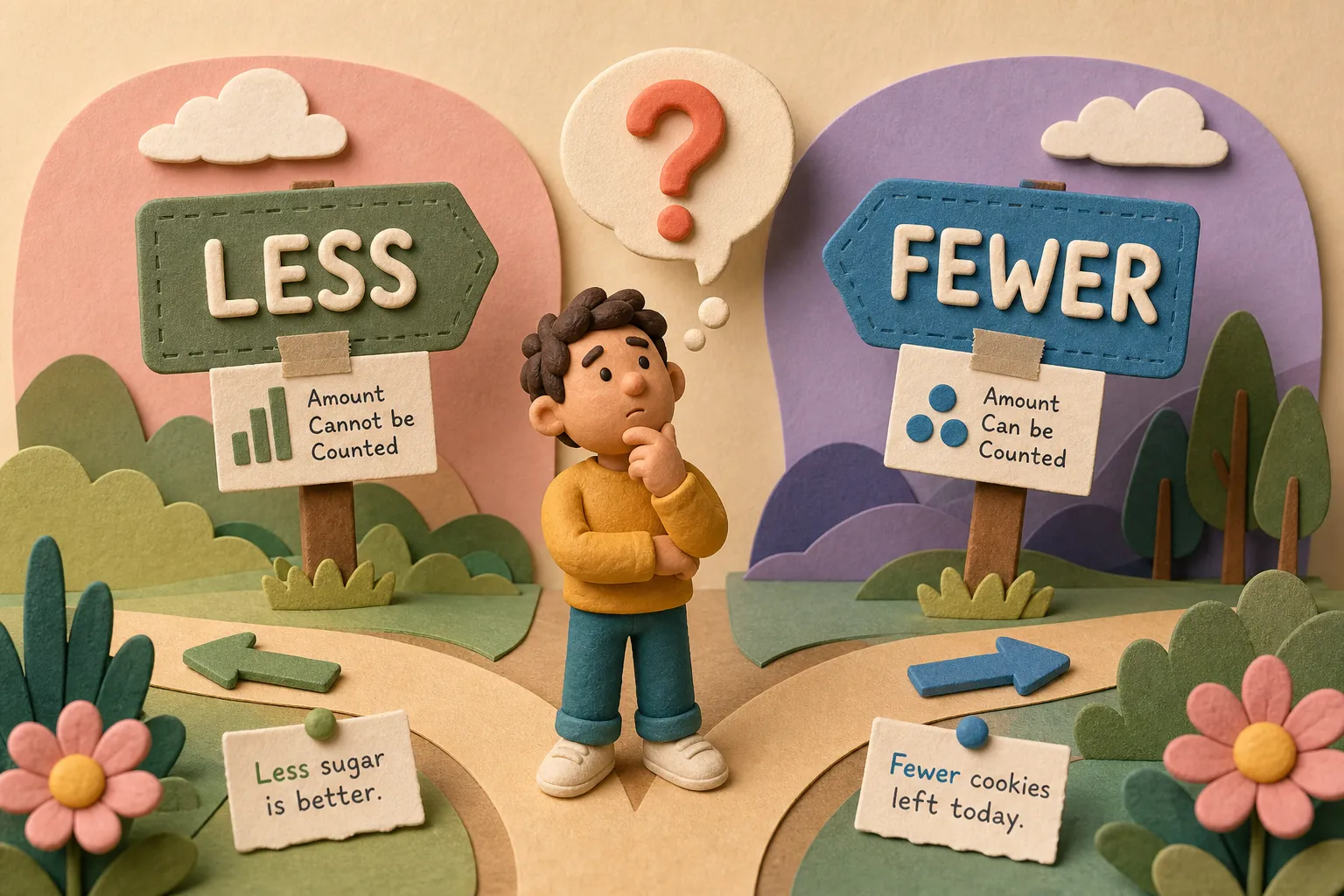
The core distinction comes down to one question: can you count the noun one by one? That’s it. That single test handles the vast majority of situations you’ll face in conversation, emails, and workplace communication.
The “can you count it?” test
If you can count the noun individually, use fewer . If the noun refers to a mass, a bulk, or an abstract amount that you don’t count one by one, use less . Apples: you count them one, two, three. Emails: one, two, three. Coworkers: one, two, three. All of those take fewer . Water, noise, information, stress: you don’t count those individually, they take less .
Fewer with countable nouns: examples in context
Here’s how “fewer” looks in real sentences across different settings. Notice the correct and incorrect versions side by side for the first two:
- Correct: “We had fewer attendees this quarter than last.” / Incorrect: “We had less attendees this quarter than last.”
- Correct: “I received fewer emails on Friday.” / Incorrect: “I received less emails on Friday.”
- “She made fewer mistakes on the second draft.” (casual text or work chat)
- “The project team needs fewer approval steps.” (workplace report)
- “There are fewer options on the new menu.” (everyday conversation)
Less with uncountable nouns: examples in context
Uncountable nouns include both physical substances and abstract concepts. Physical ones like water and sugar are usually easy to identify. The abstract ones, stress, confidence, information, trip up ESL learners most often, because they feel like they should be countable. They’re not.
- “She’s been under less stress since she changed teams.”
- “We have less time than I thought.”
- “The new system requires less effort.”
- “Add less sugar if you want it less sweet.”
- “There’s less traffic on that route after 9 a.m.”
When “less” is correct even with numbers
This is where the rule gets more nuanced, and where confident, advanced learners set themselves apart. There’s a specific set of cases where native speakers commonly use “less” even though numbers are involved: money, time, distance, and weight. The key is that native speakers tend to treat these as a single measured amount, a total, rather than a collection of individual units you’re counting one by one.
Money, prices, and dollar amounts
“Less than $20” is the correct form, not “fewer than $20.” Even though you can technically count dollars, the dollar amount functions as a total, a chunk of value, not a row of individual bills on a table. This holds whether you’re talking about a grocery total, a subscription cost, or a tip. Consider: “She spent less than twenty dollars on lunch.” Saying “fewer than twenty dollars” sounds unusual to most native speakers, because no one is picturing twenty separate dollar bills being subtracted one at a time.
Time, distance, and weight
The same logic applies across these categories. The units, minutes, miles, pounds, don’t make these countable in the grammatical sense; they’re measurements of a continuous quantity. Use these patterns with confidence:
- “The meeting ran less than 30 minutes.” (not “fewer than 30 minutes”)
- “The package weighs less than five pounds.”
- “The office is less than two miles away.”
Think of it this way: you wouldn’t say “a fewer amount of time.” The noun phrase works as a single measured whole, and “less” is the word that fits that frame.
That grocery store checkout sign: “10 items or less” or “10 items or fewer”?
If you’ve spent any time in an American grocery store, you’ve seen a checkout lane sign that reads “10 items or less.” And if you know the countable noun rule, you probably did a double take. Items are countable, so shouldn’t it be “fewer”? The honest answer: yes, and also it’s complicated.
Why the sign says “less” (and why it’s complicated)
Retail signs favor “10 items or less” partly because the phrasing has been standard for so long that it reads as a total basket size rather than a precise count of individual objects. The AP Stylebook notes that “10 items or less” is common and widely accepted in everyday usage. This isn’t a glaring error that marks the store as grammatically careless; it’s an established idiom that most Americans don’t even notice. “Less” with countable nouns in quantity expressions has been documented for centuries in English, which is part of why it stuck, see this University of Michigan article that traces usage and attitudes over time.
What style guides recommend for your own writing
In formal writing, professional emails, reports, and presentations, “fewer” is the safer and more polished choice whenever items are clearly countable. Here’s the practical split: a grocery sign can say “10 items or less” and no one blinks, but a project summary that reads “we completed less deliverables this sprint” will catch the eye of a careful reader. For your own professional writing, stick with “fewer” for countable nouns. Save “or less” for casual speech and signs. If you write for work, you might also find the Professional English, Your Daily American category useful for polishing tone and register in documents and emails.
The errors that stand out in American professional settings
ESL learners commonly err in one direction: using “less” where “fewer” belongs. The most frequent versions are “less people,” “less employees,” “less mistakes,” and “less options.” These feel natural because many languages don’t have a grammatical split between countable and uncountable nouns the way English does, so the distinction simply doesn’t exist as a mental category in your first language. For further quick-reference explanations, see Grammarly’s fewer vs. less guide, which gives clear examples for learners.
“Less people” vs. “fewer people”, and why it matters at work
Look at how this plays out in realistic workplace scenarios:
- Meeting debrief: “We had less people in the room today” → Corrected: “We had fewer people in the room today.”
- Project summary email: “This quarter, less employees requested overtime” → Corrected: “This quarter, fewer employees requested overtime.”
- Presentation slide: “Less options were available to the team” → Corrected: “Fewer options were available to the team.”
None of these errors block communication. People understand you. But in edited writing and formal speech, they signal that the speaker hasn’t fully internalized the distinction, and that matters when you’re aiming for senior roles, client-facing work, or any context where precision counts.
The spoken vs. written register difference
Here’s something worth knowing: native American speakers use “less people” in casual conversation regularly. You’ll hear it in podcasts, in everyday chitchat, and even from educated professionals in informal settings. That’s normal, and it won’t mark you as making a mistake in casual speech. But written professional English, formal presentations, and edited documents frequently use “fewer” for countable nouns. Knowing this register difference is itself a sign of advanced fluency. You’re not just following a rule; you’re understanding when it applies and when casual speech gives you flexibility. For examples and everyday usage notes, check the Everyday American English, Your Daily American section on the site.
Your one-line decision rule and a quick self-check
Here’s the rule, cleaned up and ready to use: if you can count the noun one by one, people, emails, mistakes, options, use fewer ; if it’s a mass, substance, or measured amount like water, time, money, or distance, use less . One sentence. That covers most of what you need.
The decision rule, simplified
The rule: Can you count it one by one? Use fewer . Is it a mass or measured amount? Use less . The main exception: money, time, distance, and weight commonly take less in most idiomatic contexts, even with numbers, because native speakers treat them as measured totals rather than individual items. For a concise reference you can bookmark, see Merriam-Webster’s fewer vs. less guide.
Try it yourself: five quick practice sentences
Fill in the blank with the correct word. The answers and explanations follow.
- There were _____ mistakes in the final report than in the draft.
- The commute takes _____ than 20 minutes from here.
- We need _____ information before we can decide.
- She sent _____ than 10 emails before noon.
- The package must weigh _____ than three pounds to qualify for free shipping.
Answers:
- Fewer mistakes, “mistakes” is countable.
- Less than 20 minutes, time is a measured amount, not individual units.
- Less information, “information” is uncountable.
- Fewer than 10 emails, emails are countable discrete items.
- Less than three pounds, weight is a measured amount.
Putting it all together
The countable/uncountable distinction handles almost every situation you’ll encounter. Countable nouns take “fewer”; mass nouns and measured amounts take “less.” The main exceptions, money, time, distance, and weight, commonly use “less” in idiomatic contexts, even when numbers are involved, because native speakers treat them as measured totals rather than individual items tallied up one by one.
Even native speakers slip on this in casual conversation, and that’s fine. But in writing and in professional settings, getting it right is one of those details that signals real command of the language. It’s the difference between English that’s technically understandable and English that reads as natural and precise.
At Your Daily American, this is the kind of lesson we come back to again and again: practical grammar grounded in how American English is actually used, with real examples and clear rules you can apply right away. Browse the blog for more lessons built exactly this way, covering everything from phrasal verbs to professional email phrases to pronunciation. See more in our Daily Grammar, Your Daily American section for regular short lessons.