You already know the days of the week, the seven day names, and could recite them in your sleep. But then a coworker sends a Slack message that says “Thurs still good?” and for a second, you pause. Or a friend texts “ugh, total hump day energy” on a Wednesday and you’re not sure if that’s a complaint or a joke. The vocabulary isn’t the problem. The cultural layer is.
This is exactly the gap between knowing English and using it the way Americans actually do. Native speakers compress, abbreviate, attach mood, and reach for idioms every time they talk about a day of the week. By the end of this lesson, you’ll know how Americans write and abbreviate day names in real contexts, how those names sound in natural speech, and which expressions signal fluency the moment you use them.
That kind of practical, usage-first English is what Your Daily American is built around: not rules in isolation, but language as it lives in real conversation, scheduling, and workplace life. This lesson is a good example of that approach in action.
Days of the Week: How Americans Shorten Day Names in Texts, Calendars, and Emails
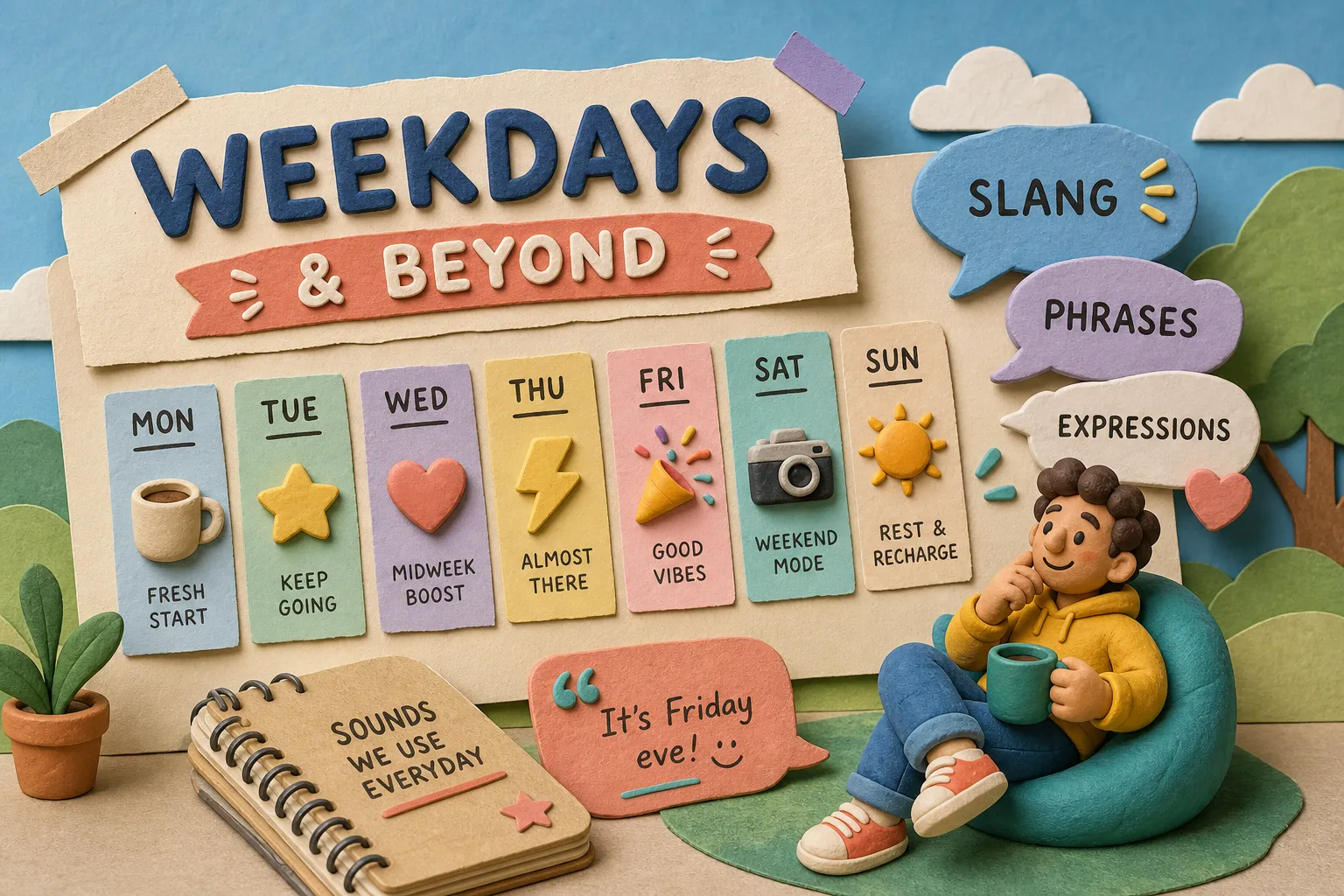
Open any American’s Google Calendar or Outlook and you’ll see the same standard abbreviations: Mon, Tue, Wed, Thu, Fri, Sat, Sun. These three-letter forms are the default in professional tools, meeting invites, and scheduling emails. Some people write “Tues” or “Thurs” with an added letter, and both are perfectly normal. In professional contexts, people often use full day names in formal emails and invitations (e.g., “Thursday, June 12th”), while three-letter abbreviations are the standard in calendar views and meeting invites.
In casual texts and Slack messages, the compression goes even further. Americans routinely write things like “Free Fri?” or “Lunch Sat?”, no subject, no verb, no full day name. These are illustrative of how context does the heavy lifting in casual digital communication. How abbreviated someone writes depends on how well they know you: a quick text to a close colleague might just say “Thurs work?” while an email to a new client would use “Thursday, June 12th.”
One mistake many ESL learners make is writing too formally in casual digital contexts. If a coworker texts you about grabbing coffee and you reply “I am available on Monday at 3PM,” that’s grammatically perfect but socially a little stiff. The more natural response in that context is “Mon @ 3 works!” Matching the register of the person you’re talking to is part of communicating naturally in American English.
The Way Native Speakers Actually Say Days of the Week Out Loud
Isolated, dictionary-style pronunciation is one thing. How day names actually sound inside a real sentence is another. In connected American speech, “on Monday” doesn’t sound like two separate, carefully articulated words. It comes out closer to “on MUN-dee”, with a quick, weak “on” that blends right into the first syllable. The same pattern applies across the week: “on Wednesday” flows as “on WENZ-dee”, and “by Friday” sounds like “by FRY-dee” at natural speed.
Several weekday names commonly trip up English learners, notably Wednesday and Tuesday, and often Thursday, largely because spelling doesn’t match pronunciation.
Wednesday pronunciation
- Wednesday: The “d” is completely silent in American English. The standard pronunciation is /ˈwɛnzdeɪ/, spelled out phonetically as WENZ-day. Many learners say “wed-NES-day” because the letters seem to demand it. They don’t. Drop the first “d” entirely and you’ve got it right.
Tuesday pronunciation
- Tuesday: The spelling suggests “Too-ees-day,” but Americans say /ˈtuːzdeɪ/, closer to TOOZ-day. The “-ue-” collapses into a single smooth sound. If you’re adding extra syllables here, you’re reading the spelling too literally.
A quick self-check: say each day name on its own, then say it inside a full sentence. “Wednesday” alone versus “I have a meeting Wednesday morning.” Notice how the day name compresses in the second version. That compression is what natural American speech sounds like, and training your ear to hear it will help your listening as much as your speaking.
The American Mood Vocabulary Behind Each Day of the Week
Americans assign emotional personalities to the days of the week. These aren’t formal idioms you find in textbooks; they’re the informal, cultural shorthand that comes up in conversation, social media, and workplace small talk constantly. Understanding them moves you from technically correct to genuinely fluent.
The early part of the week carries a specific emotional weight. Monday blues describes the sluggishness and low motivation many Americans feel at the start of the workweek. You’ll hear it used directly: “I’ve got a serious case of the Monday blues today.” It’s a common conversational small-talk topic rather than a complaint people consider inappropriate. By Wednesday, the phrase you’ll hear is hump day. Wednesday sits at the midpoint of the workweek, and the idea is that once you’re over Wednesday’s “hump,” you’re headed downhill toward Friday. “Once we get through hump day, the week flies” is the kind of thing a coworker might say in a hallway conversation.
The end of the week has its own vocabulary. TGIF, meaning “Thank God It’s Friday,” has been documented in American usage since at least the 1940s and remains common in American workplaces today. It marks the emotional transition from work to weekend and is widely recognized and commonly used in casual professional settings. What’s changed is the other end of the weekend: Sunday scaries is a newer expression, especially common among younger Americans, describing the anxiety that creeps in on Sunday evening as Monday looms. You’ll see it all over social media and hear it in casual conversation. “I’ve had the Sunday scaries since 3pm” is a real sentence real Americans say.
Using Day Names Naturally in Scheduling and Workplace Small Talk
Day names appear in professional American English dozens of times a day, and the way you use them signals your fluency level immediately. These are the scheduling phrases Americans actually reach for in practice:
- “Let’s touch base Monday morning.”
- “Are you free Thursday afternoon?”
- “I’m slammed Tuesday, can we push to Wednesday?”
- “Thursday still good?”
Notice something in that list: Americans often drop the word “on” before a day name in conversational speech. “Let’s meet Friday” and “Let’s meet on Friday” are both grammatically correct, but in spoken conversation, omitting “on” sounds more natural and direct. You’ll hear both in workplace settings, but the shorter version is more common when speaking.
Formal vs. casual: full names vs. abbreviations
Formality also shifts how day names appear in writing. A professional email might say “Would you be available on Thursday, June 12th?” A Slack message to a colleague becomes “Thurs work for you?” and a spoken confirmation in a meeting is just “Thursday still good?” Each version is appropriate in its context. The ESL mistake to avoid here is using the most formal version everywhere. Saying “On the day of Friday, I will be available” in a casual text reads as over-translated rather than natural. Keep the register simple and match the level of the conversation you’re in.
Day-Based Idioms That Go Beyond the Calendar
Some American expressions use day names in ways that have nothing to do with what day it actually is. These idioms show up in conversation, at work, and in media, and they’ll confuse you if you take them literally.
“Any given Sunday” is an expression derived from American football culture, referring to the unpredictability of outcomes. The idea is that a team that looks weak can beat a stronger one on any given Sunday. The phrase now travels well outside sports: “In this market, any given Sunday, the situation could flip completely” is something you might hear in a business conversation.
“Black Friday” is the day after Thanksgiving, known as the biggest shopping day of the American year. But the term has expanded: companies now use “Black Friday pricing” or “our Black Friday sale” to describe any steep discount, regardless of timing. Knowing this saves you from confusion when you see it in a September email.
“D-Day” originally referred to the 1944 Normandy invasion, but in American workplace speech it functions as a label for any high-stakes deadline. “Tuesday is my D-Day for this presentation” is a completely natural sentence in a professional setting.
And “Monday-morning quarterback” is one of the most recognizable American workplace idioms. It comes from football: the Monday-morning quarterback is the person who, after watching Sunday’s game results, explains exactly what the coach should have done differently. At work, it describes someone who criticizes a decision only after the outcome is clear. If your team made a call that didn’t pan out and a colleague starts listing all the reasons it was wrong, you’re dealing with a Monday-morning quarterback.
Common Questions About the Days of the Week
Are days of the week for kids taught differently in the US?
Yes, American children often learn the days of the week through songs and rhymes before they can read them. The days sequence is typically taught Monday through Sunday, reinforced with tools like days flashcards and a poster and call-and-response classroom chants. If you want to learn the days in English and make them stick faster, those same techniques work well for adult learners: a simple seven days song or a set of flashcards with both the full name and standard abbreviation can speed up recall noticeably.
Where to Keep Building This Kind of Real-Life English Fluency
The gap between textbook English and American English often lives in exactly this kind of detail: the abbreviations people actually use, the sounds that get compressed in real speech, the mood expressions that make small talk feel natural. Knowing that Wednesday is “WENZ-day” and that “TGIF” is solid workplace small talk isn’t a minor point; it’s the difference between sounding like you studied English and sounding like you use it. For more on how native speakers use dates and short forms in everyday writing, see resources about days of the week, months, and dates in English.
At Your Daily American, the everyday expressions and connected speech guides are built around this exact layer of language. The same principles that explain how “on Monday” sounds in fast speech apply across all of American daily conversation: time, schedules, greetings, workplace phrases, and more. If this lesson clicked for you, there’s a full library of it waiting.
To put this into practice right now: change your phone’s calendar language to English and read your appointments out loud using the scheduling phrases from this article. Say “Thurs @ 2 works” instead of typing it. Use “hump day” or “TGIF” in your next English conversation and notice how people respond. The days of the week are everywhere in American life, which means your practice opportunities are already built into every single day.
The Takeaway
The days of the week are deceptively simple vocabulary. You learned the names a long time ago, but fluency means knowing how Americans compress them in writing, blur them in natural speech, and wrap them in cultural mood. When you can say “Thurs work for you?” without overthinking it, or drop “I’ve got the Monday blues” into a casual conversation at the right moment, you’re not just using vocabulary correctly. You’re using English the way it actually lives.
To recap: use the standard three-letter abbreviations in professional digital contexts, drop “on” before day names in casual spoken scheduling, and pronounce Wednesday as “WENZ-day” and Tuesday as “TOOZ-day.” Beyond that, recognize that TGIF, hump day, Monday blues, and the Sunday scaries are legitimate workplace conversation starters, not just memes. Start noticing how the Americans around you use these expressions, and you’ll find the week itself turns into constant, built-in practice.