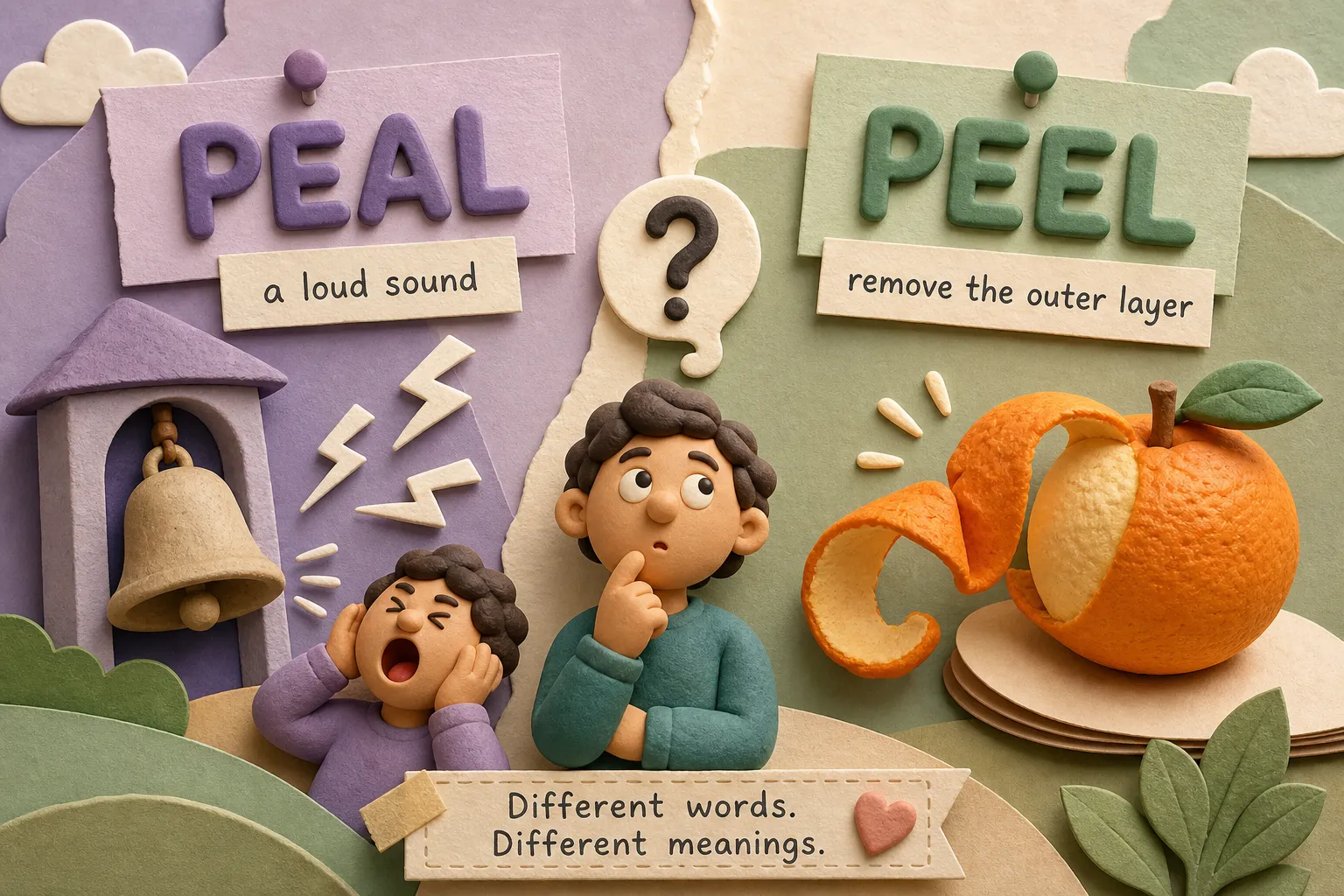
Here is a spelling challenge that trips up many English learners: peal and peel sound completely identical when you say them out loud. Understanding peal vs. peel comes down to spelling, not pronunciation, both words are homophones, sharing the exact same sound (/piːl/) in American English, so the risk shows up only when you sit down to write.
By the end of this lesson, you will know what each word means, how to use it correctly, and how to remember the difference. You will also get two simple memory tricks built right into the spellings. Reading about homophones once helps, but a smarter approach, one covered at the end, will help the difference stick for good.
Peal vs. Peel: Meanings at a Glance
Before diving into the details, here is the short version. Peal is a loud, sustained sound, bells, thunder, laughter. Peel is the outer layer of something, or the act of removing it. They sound the same. They mean completely different things. The sections below break each word down with examples, etymology, and the memory anchors that make the distinction effortless.
What “peal” means: a sound that fills a room
Peal is a word for a loud, sustained, and often repeating sound. The most common examples are bells ringing, a crack of thunder, or an eruption of laughter. The pronunciation is /piːl/, which sounds exactly like the word “peel.” As a noun, peal refers to the sound itself. It can also refer to a full set of tuned bells or a series of bell-ringing patterns used in church music, but most everyday writers use peal simply to describe a powerful sound.
Peal also works as a verb. When something “peals,” it rings out loudly and with force. Here are three example sentences that show both uses clearly:
- “The church bells pealed across the quiet town as the bride walked out.”
- “After his joke landed, peals of laughter filled the whole office.”
- “A peal of thunder shook the windows just after midnight.”
The verb form appears regularly in writing, literature, and news reports describing nature or dramatic events. In many everyday contexts, peal is used as a noun; the verb also appears in writing and reported speech. One sentence worth keeping in mind: “I woke up to the peal of church bells on Sunday morning.” If you are describing any loud, ringing, or booming sound, peal is the word you want. For additional example sentences showing peal in context, see this collection of example sentences for “peal”.
What “peel” means: removing or revealing a layer
Peel works both as a verb and as a noun, and both uses are very common in daily life. As a verb, to peel means to remove the outer layer of something. This happens in two ways: you can peel something by removing its skin yourself (transitive), or something can peel on its own when a layer comes off naturally (intransitive). Here are some examples:
- “She peeled the oranges and put them on the table.”
- “After a week at the beach, his shoulders started to peel.”
- “The old sticker peeled off the laptop easily.”
As a noun, peel refers to the outer skin of a fruit or vegetable, or any thin layer that comes off something. You will hear this word in the kitchen, in recipes, and even in beauty contexts. For example: “Don’t slip on that banana peel.” You might also hear: “Add some lemon peel to the sauce for extra flavor.” Or: “She booked a chemical peel at the spa” (a chemical peel is a skin treatment that removes the top layer of skin).
The key pattern is simple: any time you are talking about skin, a layer, or the act of removing one, peel is your word. A short contrast sentence helps lock this in: “You peel an orange, but you hear a peal of bells.”
Why these two words sound exactly the same
Both peal and peel are pronounced /piːl/. To say it in a simple phonetic way: PEEL (long E sound, then L). Because they are homophones, pronunciation will not distinguish them, the risk is entirely in spelling. The only challenge is choosing the right spelling when you write.
Here is why this kind of error happens. Learners often map one sound to multiple meanings, which can cause spelling errors when it is time to write. Your brain may reach for the more familiar word without pausing on meaning. The most common real-world mistake is writing “a peel of laughter” when the correct phrase is “a peal of laughter.” This error shows up constantly in online writing and comment sections, even from fluent English users. It is a very natural mix-up, and the fix is straightforward once you have the right mental hook. If homophones trip you up more broadly, you may find helpful practice in lessons like Peak vs Peek: How to Use Each Word Correctly, which focuses on a similar pair of confusing words.
Memory Tricks That Actually Work for Peal vs. Peel
The best memory tricks for these two words are built right into their spellings. You do not need to memorize a rule. You just need to look at the letters.
Look at the letters E-A in the middle of “peal.” Think of the word EAr. You use your ears to hear a sound. pEAl = EAr = something you HEAR. Your EArs hear a pEAl of bells. The next time you are not sure which spelling to use for a sound, look for the E-A: if it is a sound you hear, the word has an A in it.
Now look at the double E in “peel.” Two E’s sitting next to each other look like two wide-open EyEs. You use your eyes to see a banana peel or to watch someone peel an apple. pEEl = EyEs = something you SEE (or do). As a small bonus: the word peel traces back to a Latin root meaning “to strip or strike off.” It has always been about the physical act of removing something. That connection to action fits perfectly with the idea of seeing and doing.
Use this two-second self-check before you write: Is this a sound? Use peal. Is this a layer or an action? Use peel. Try writing one sentence for each word in a notebook right now. That small action activates your memory much more reliably than reading alone. If you struggle with distinguishing similar vowel sounds as well, our guide Bed vs Bad: Mastering the /ɛ/ and /æ/ Vowel Sounds can help strengthen your phonetic awareness.
Common Mistakes and Quick Corrections
The most frequent error is “a peel of laughter.” This happens because peel is the more common everyday word. Because “peel” comes to mind so readily in daily life, it often slips in by default even when the intended meaning is a sound. Here is the error and the correction side by side:
- Wrong: “The whole room burst into a peel of laughter.”
- Right: “The whole room burst into a peal of laughter.”
The same error appears with thunder. “A peel of thunder” is wrong. “A peal of thunder” is right. This mix-up appears often enough that it is well documented in spelling and grammar guides, you can read a clear explanation in this Grammarly comparison of peal vs. peel. Many learners find the EAr/EyEs trick effective for catching errors like this quickly; the more you practice, the more automatic it becomes.
When you are unsure which spelling to use, run through this fast two-question checklist:
- Am I describing a sound (bells, thunder, laughter ringing out)? Use peal.
- Am I describing skin, a layer, or the action of removing it? Use peel.
Context makes the answer obvious almost every time. Because homophones share a single sound in memory, it helps to pause and think about the meaning before reaching for a spelling, that brief moment of reflection is usually all it takes.
How to make tricky word pairs like these stick for good
Reading this article today is a great start. But here is something important to know: after reading a new explanation, most learners remember it clearly for a day or two. Without practice, that memory fades. This is called the forgetting curve, the well-documented pattern, first described by psychologist Hermann Ebbinghaus, showing how quickly we lose new information without review. It affects everyone, and it is especially strong with vocabulary that looks or sounds similar to something else.
The most effective solution is spaced repetition, a method where you review information at increasing intervals to move it into long-term memory. After you learn something new, review it after one day, then three days, then a week, then two weeks. Each time you successfully remember it, the gap before the next review grows longer. This process moves vocabulary from short-term to long-term memory much faster than re-reading an article multiple times. For a quick overview of the science behind spaced repetition and vocabulary retention, see this summarized guide on spaced repetition.
At Your Daily American, the study tips and vocabulary guides are built around exactly this approach. After reading a lesson like this one, you can create a simple flashcard pair, “peal” on one side with an example sentence, “peel” on the other with its own example, and review it on a spaced repetition schedule. The study methods section there walks you through practical techniques that fit real schedules, so the difference between confusing word pairs becomes permanent rather than temporary. For step-by-step instructions, check our detailed post: How to Use Spaced Repetition to Never Forget English Words.
Quick recap before you go
Peal is a loud, sustained sound: bells ringing, thunder cracking, laughter bursting out. Peel is the outer skin of something, or the action of removing it. Both words sound identical (/piːl/), which is exactly why they cause so many spelling errors in writing. When deciding between peal vs. peel, the EAr/EyEs trick is the fastest way to land on the right answer every time.
Keep your two memory anchors ready. pEAl contains EAr, so it is the word for sounds you hear. pEEl contains EyEs, so it is the word for things you see or do with your hands. This is an extremely common mix-up, and now you have a clear, simple fix.
Write one sentence using “peal” and one sentence using “peel” right now, before you close this page. Then come back tomorrow and try to recall the difference without looking. That one review the next day is the most powerful thing you can do to make this lesson yours to keep.