You may have seen “sneak peak” pop up on social media before a product launch, or spotted it in a headline that slipped past an editor. The mistake is so common that it almost starts to look right. Almost. “Sneak peek” is the correct phrase, and the mix-up happens because these words sound completely identical when spoken aloud. That’s what makes homophones so tricky: your ears can’t help you. This quick guide on peak vs peek, and their look-alike pique, walks through the difference, correct usage, and easy memory tricks so you never mix them up again.
By the end of this lesson, you’ll know the exact meaning of peek, peak, and pique, where each one belongs in a sentence, and two solid memory tricks so you never second-guess yourself again. This is the kind of vocabulary precision that separates confident writers from everyone else, whether you’re a native speaker or building your American English fluency.
Peak vs Peek: Meanings and Everyday Usage
These three words are homophones: they sound exactly the same in American English (all pronounced like “peek”), but they carry completely different meanings and fit into sentences in different ways. Getting them straight starts with understanding each one on its own terms.
Peek meaning: a quick or secretive look
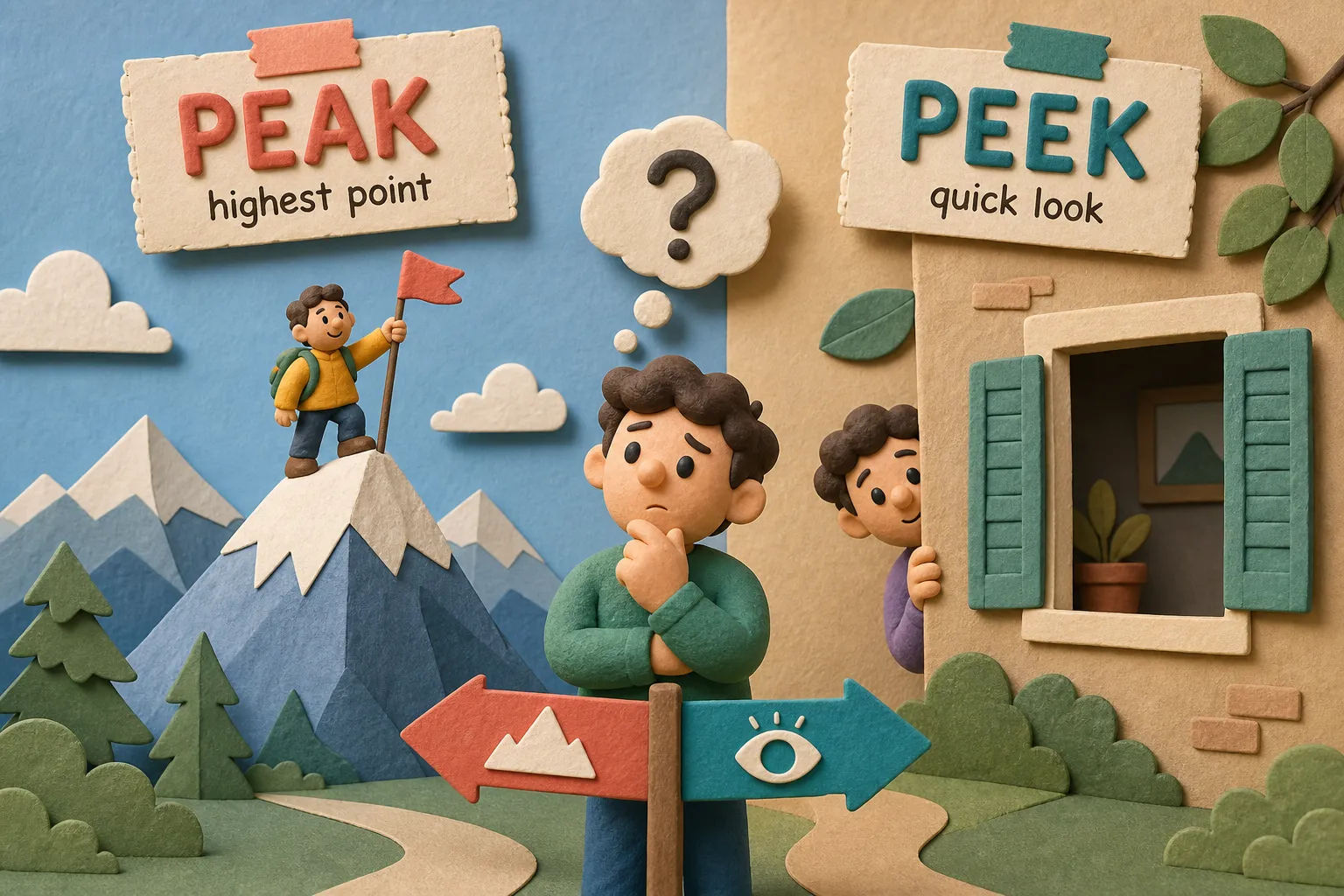
Peek means to look quickly or furtively, often at something you’re not supposed to see, or before you’re officially supposed to see it. It works as both a verb and a noun. As a verb: “She peeked through the window.” As a noun: “Take a peek at the menu.” Notice the peek spelling: two E’s in the middle. That detail matters, and we’ll come back to it in the memory tricks section. For a standard reference definition, see the Dictionary.com definition of peek.
Peak meaning: the highest point or maximum level
Peak refers to the highest point of something, either literally or figuratively. As a noun: “the peak of the mountain” or “sales hit their peak in December.” As a verb: “Interest peaked during the finale.” Peak doesn’t only apply to mountains. Americans use it constantly to describe the highest level of almost anything: performance, traffic, pricing, emotional impact. When something reaches its maximum, it peaks.
Pique definition: the one that trips up even advanced writers
Pique (pronounced exactly the same as the other two) means to arouse or stimulate curiosity or interest. It can also mean to irritate or offend someone’s pride. As a verb: “The trailer piqued my interest.” As a noun: “She left the room in a fit of pique.” This is the correct word in the phrase “piqued my interest”, not “peaked” and not “peeked.” Writing “the article peaked my interest” is a substitution error that editors and usage guides flag regularly, and it shows up even in otherwise polished professional writing.
How These Words Show Up in Everyday American Life
A definition is a starting point. These are the situations where the words actually live, the way native speakers use them in real conversations, which is what builds the automatic recognition you need for confident writing and speaking.
Where you’ll hear “peek” in daily conversation
Peek shows up constantly in casual American life. A parent covering their child’s eyes during a surprise birthday moment says, “No peeking!” A friend shopping online might say, “I peeked at the price and immediately closed the tab.” Someone showing you something new might say, “Come here, take a peek at this.”
The phrase “take a peek” is especially common as a warm, low-pressure invitation to look at something. It’s friendlier and more casual than “look at this” or “check this out.”
Where “peak” comes up beyond the mountains
Most learners first encounter peak in a geography context, but it’s far more common in figurative use in everyday American speech. You’ll hear things like, “Traffic is at its peak right now, take the back road,” or “She’s really at her peak as a designer this year,” or “That show peaked in season two and went downhill after that.” When Americans talk about the best version of something, the busiest period of a season, or the highest point of a career, they reach for peak.
Peak vs Peek on Social Media, and the Mistake That Keeps Spreading
“Sneak peak” is a common misspelling that style guides and editors flag regularly. Brands, influencers, and everyday users post it when they mean “sneak peek.” One reason it spreads so easily: spell-check doesn’t catch it, because peak is a real word, just the wrong one. The MLA Style Center has noted it as a misspelling that slips through automated checkers and lands directly in published posts and emails.
There are well-documented examples on social media of accounts dedicated to correcting the error, and major brands have occasionally made it in product launch posts, increasing its visibility and reinforcing the mistaken version for people who see it repeated.
Common misspelling: “sneak peak” (incorrect), use “sneak peek”
A “sneak peek” means a quick, secret look at something before it’s officially revealed. That’s the definition of peek: a furtive glance. Swap in peak and the phrase produces nonsense, “sneak highest-point” has no meaning in this context. Here’s what the corrected version looks like in a realistic social media caption:
Wrong: “Excited to share a sneak peak of our new collection dropping next week!”
Right: “Excited to share a sneak peek of our new collection dropping next week!”
The spelling change alters the word’s meaning; readers familiar with the difference will recognize the error. In a professional or branded context, that’s worth getting right.
Getting It Right in Professional and Workplace Writing
Homophone errors feel low-stakes in a casual text, but in a work email, a slide deck, or a quarterly report, they signal something about your attention to detail. Editors and professional communicators often treat homophone errors as indicators of inattentiveness, and for professionals writing in American English as a second language, getting these words right adds real credibility. Usage guides, including Grammarly’s guide to peak vs. peek, consistently flag it as a common substitution error. Here’s how each word fits naturally into professional contexts:
- “I wanted to give you a quick peek at the updated slides before the meeting.”
- “We expect demand to peak in Q4, based on last year’s patterns.”
- “Revenue peaked last quarter, and we’re analyzing what drove the increase.”
The phrase that catches professional writers off guard: “pique my interest”
“Peaked my interest” appears in professional emails and other writing, and it’s always the wrong word. Usage guides consistently flag it as a common substitution error. The correct version is “piqued my interest,” using the verb that means “aroused” or “stimulated.” Here’s how it looks as a before-and-after correction in a real workplace context:
Wrong: “Your proposal peaked my interest, and I’d love to schedule a call.”
Right: “Your proposal piqued my interest, and I’d love to schedule a call.”
The wrong version makes it sound like your interest reached its highest point and is now declining. That’s not the impression you want to give a potential client or partner.
Two Memory Tricks That Make the Difference Stick for Good
The best memory tricks connect a word to something visual or physical, something your brain can picture rather than just recite. These two work because they use the spelling of the word itself as the cue.
The “two E’s = two eyes” trick for peek
Peek has two E’s in the middle. Eyes come in pairs. Visualize those two E’s as two eyes peering through a crack in a door or between your fingers during a surprise. A common mnemonic puts it cleanly: you pEEk in order to sEE. Both words share those double E’s, and both are about seeing. Every time you write the word and feel unsure, picture two eyes inside it.
The “A = apex” trick for peak
Look at the letter A in peak. That capital A is shaped like a mountain with a pointed top. Peak, apex, altitude, achievement: these are all A-words that carry the idea of reaching the top. When you’re writing about the highest point of anything, the letter A in peak is your visual anchor. As a quick reminder for pique: both pique and provoke start with P, and both mean stirring something up in someone.
Try It Yourself: A Quick Self-Check Before You Go
Now let’s see if it actually stuck. Fill in the correct word for each sentence below, then check the answers underneath.
- “The documentary ________ my curiosity about deep-sea ecosystems.” (peek / peak / pique)
- “Don’t ________ at your Christmas presents before December 25th!” (peek / peak / pique)
- “Website traffic typically ________ between 9 a.m. and 11 a.m. on weekdays.” (peek / peak / pique)
Answers: 1. piqued / 2. peek / 3. peaks
If you got all three right, the lesson is working. If one tripped you up, go back to the memory trick for that word and run through a couple of your own example sentences. Writing your own examples is one of the fastest ways to move vocabulary from “I recognize this” to “I use this correctly without thinking.” For more examples and usage notes, see the Vocabulary.com article on peak, peek, and pique.
Vocabulary nuance like this is exactly what the lessons at Your Daily American are built around, not just definitions, but the cultural context, the professional stakes, and the real-world situations where these distinctions matter. If you want to keep building this kind of precision in your American English, explore the vocabulary and writing sections of the platform for more lessons grounded in how the language is actually used. Start with Essential Phrasal Verbs You Must Know, Your Daily American to strengthen your everyday usage.
The Short Version to Carry With You
Here’s the whole lesson in three lines: peek means a quick, secret look (picture two E’s as two eyes); peak means the highest point (the A looks like a mountain); and pique means to arouse curiosity or irritation (pique and provoke both start with P and stir something up). Getting these three words right is a small detail, but small details add up. Whether you’re writing a client email or a social media caption, choosing the precise word says something about how carefully you use the language. Remember: when in doubt, use the memory tricks above to choose between peak vs peek, and keep pique in your back pocket for when something sparks your curiosity. That precision is what Your Daily American is designed to help you build: not just grammar rules, but the vocabulary confidence that makes you sound exactly like you mean to. For related expressions and practice, check out Common American Expressions Every English Learner Should Know, Your Daily American.
Frequently Asked Questions
Is it “peek” or “peak” in “sneak peek”?
It’s always sneak peek, spelled with two E’s. “Peek” means a quick, secret look, which is exactly what a preview is. “Sneak peak” is a common misspelling that spell-checkers miss because peak is a real word, just the wrong one here.
What does “piqued my interest” mean?
“Piqued my interest” means something aroused or stimulated your curiosity. Pique is the correct word in this phrase, not “peaked” (highest point) and not “peeked” (looked secretly). If you wrote “peaked my interest,” it would suggest your interest hit a maximum and started declining, which is rarely what you mean. For more on common homophone issues, see Grammarly’s guide to homophones.
What’s the difference between peek vs peak vs pique?
Peek = a quick or secret look. Peak = the highest point of something. Pique = to arouse interest or cause mild irritation. All three are pronounced the same way in American English, which is exactly why the peak vs peek confusion is so widespread. If you’d like pronunciation and related pitfalls for non-native speakers, have a look at English Words Non-Native Speakers Mispronounce Most Often, Your Daily American.