Was vs were: many learners use these two forms without thinking twice, until they hit a sentence like “If I were you” and suddenly freeze. Why “were”? Isn’t “I” singular? That moment of confusion is actually a doorway into one of the most useful and misunderstood rules in English grammar, and once you understand it, a whole layer of American English clicks into place.
By the end of this lesson, you’ll know exactly when to write “was” and when to write “were,” including in the tricky subjunctive cases that trip up even advanced learners. You’ll also have a quick self-check you can use on your writing starting today.
Was vs Were: The Foundational Rule
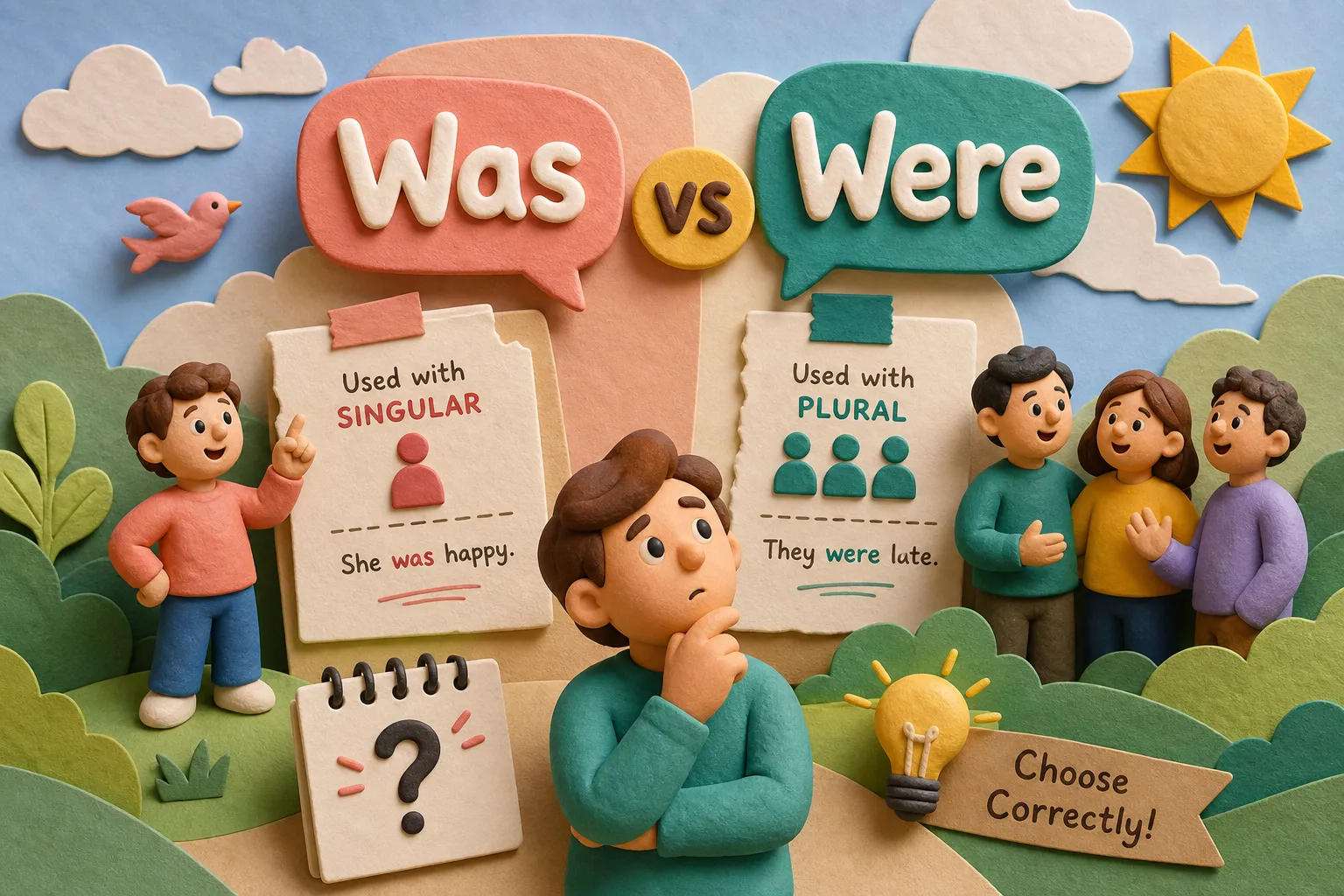
Was belongs to singular subjects
“Was” pairs with four singular subjects in the simple past: I, he, she, and it. That covers one person, one thing, any single noun you’d replace with he, she, or it, and that singularity is the signal to use “was.”
Here’s what that looks like in real situations:
- I was exhausted after the meeting.
- She was the last one to leave the office.
- He was late again on Monday.
- The report was already on your desk.
Were belongs to plural subjects and “we”
“Were” covers the plural side: we, they, and any plural noun as the subject. Think of a team finishing a project, a group of friends at a restaurant, or a couple talking about last weekend.
- We were the first team to submit the proposal.
- They were all waiting in the conference room.
- The deadlines were impossible to meet.
More than one person or thing? That’s “were.”
The one exception that confuses everyone: “you”
“You” always takes “were” in standard American English, whether you’re talking to one person or a hundred. This is a fixed rule, and it doesn’t change based on number. “You were great in that presentation” is correct whether you’re saying it to one colleague or a whole team.
“You was” does appear in some informal dialects, and you may hear it in casual speech. In writing, however, and in professional or academic contexts, “you was” is nonstandard and signals an error. Stick with “you were” every time.
Was vs Were and the Subjunctive: The Rule Behind “If I Were You”
What the subjunctive mood actually means
The subjunctive is the grammar of things that aren’t real right now. It’s the form English uses when a situation is imagined, wished for, or known to be untrue at the moment of speaking. Contrast it with ordinary statements of fact, where you’re simply reporting what happened. The subjunctive steps in when you’re describing a wish, a hypothetical, or a scenario you know isn’t currently the case.
American pop culture is full of subjunctive “were.” Beyoncé’s “If I Were a Boy,” the classic musical number “If I Were a Rich Man,” and everyday phrases like “I wish it were Friday already” all follow this same pattern. The “were” in all of these is not a plural signal. It’s a mood signal. It tells the listener: this isn’t real right now. For research into how the subjunctive functions in North American speech, see studies on the English subjunctive in North American speech.
Wishes, desires, and “I wish I were”
Whenever you express a wish about something that isn’t currently true, use “were” regardless of whether the subject is singular or plural. The unreality of the situation, not the number of the subject, drives the choice.
- I wish I were taller. (I’m not taller; it’s a wish.)
- I wish she were here. (She isn’t here right now.)
- I wish the meeting were shorter. (It isn’t short; that’s the whole problem.)
- He wishes it were already over. (It isn’t over yet.)
Notice that every one of these uses “were” with a singular subject. The subject didn’t change. The reality of the situation did, and that’s what matters.
Hypothetical “if” clauses and counterfactual conditions
This is the pattern most learners recognize but can’t always explain: “If I were you.” The reason “were” appears here is that the speaker knows the situation is not true. You are not me. That known impossibility triggers the subjunctive.
The same logic applies across different singular subjects:
- If he were the manager, things would run differently. (He isn’t the manager.)
- If she were here, she’d know exactly what to do. (She isn’t here.)
- If it were possible, I’d extend the deadline. (It isn’t possible.)
Here’s a short workplace exchange that shows how natural this sounds in professional English:
Colleague A: “What would you do about the budget?”
Colleague B: “If I were in charge of this project, I’d push for a two-week extension.”
Colleague B isn’t in charge, and that’s precisely why “were” is the right call.
“As if” and other patterns that trigger the subjunctive
The phrases “as if” and “as though” typically call for subjunctive “were” when they introduce a comparison the speaker knows to be imagined or untrue. When the speaker treats the situation as a real possibility, the indicative “was” can also appear, but when the comparison is clearly false, “were” is the more precise choice. Native speakers use these patterns regularly:
- He talks as if he were the CEO. (He isn’t.)
- She acted as though it were no big deal. (It clearly was.)
- They presented the idea as if it were already approved. (It wasn’t.)
Recognizing these constructions helps you understand native speakers more clearly and use the language the way they do.
When “If” Sentences Use “Was,” Not “Were”
Real conditions vs. imagined ones
Not every sentence with “if” requires the subjunctive. When the condition might actually be true, or when the speaker genuinely doesn’t know what happened, “was” is the right choice.
Compare these two sentences carefully:
“If she were late, I’d be worried.” (The speaker knows she isn’t late, hypothetical, so “were” is correct.)
“If she was late, she probably missed the announcement.” (The speaker isn’t sure whether she was late. It’s a genuine possibility, so “was” is natural and correct.)
The difference isn’t about grammar tricks. It’s about what the speaker actually knows. Imagined and untrue: use “were.” Uncertain but possibly real: use “was.”
A quick test to choose the right form
Before you write, ask yourself: “Is this situation something I know is not true, or is it something that might actually have happened?” If you know it’s impossible or clearly hypothetical, choose “were.” If you’re genuinely unsure whether it happened, choose “was.”
Try it on these three sentences:
- “If the meeting was rescheduled, nobody told me.” (You don’t know for certain, “was” is correct.)
- “If I were fluent in Spanish, I’d take that job in Mexico City.” (You know you aren’t fluent, “were” is correct.)
- “If the package was delivered yesterday, check the mailroom.” (You’re not sure, “was” is correct.)
Common Was vs Were Mistakes and How to Fix Them
Using “was” with plural subjects
This is the most common error, and it usually happens because learners overapply the “singular = was” rule without checking the subject first. Here are a few examples of the error alongside the correction:
- Error: They was waiting outside., Correction: They were waiting outside.
- Error: We was ready to start., Correction: We were ready to start.
- Error: The reports was on the table., Correction: The reports were on the table.
Before you finalize any sentence, identify the subject and check whether it’s singular or plural. That one habit catches most of these errors immediately.
Missing the subjunctive in professional and academic writing
This is the subtler error that holds intermediate-to-advanced learners back. Writing “If I was in your position” for a clearly hypothetical situation reads as informal and slightly imprecise in professional American English, a distinction reinforced by major style guides including The Chicago Manual of Style. In emails, performance reviews, and formal recommendations, the subjunctive “were” signals real command of the language.
Here are corrections for common professional situations:
- Informal: “If I was the hiring manager, I’d look for this skill.”, Professional: “If I were the hiring manager, I’d look for this skill.”
- Informal: “If this was my decision, I’d go in a different direction.”, Professional: “If this were my decision, I’d go in a different direction.”
- Informal: “If the client was satisfied, I believe they would have renewed.”, Professional: “If the client were satisfied, I believe they would have renewed.”
Why informal speech sometimes sounds different
Many native American English speakers say “If I was” in casual conversation, even in clearly hypothetical situations. Corpus-informed usage studies show that “if I was” is more frequent in everyday spoken American English, while “if I were” is more common in formal and edited writing. This doesn’t make “if I was” wrong in casual speech. It does mean that for writing, professional communication, and academic work, the subjunctive “were” is the more precise and widely accepted choice. When in doubt, “were” in writing is always the safer call for hypothetical situations.
Your Quick Checklist for Getting It Right Every Time
Three questions to ask before you write
First: what is the subject? Identify it clearly. Is it singular (I, he, she, it, a single noun) or plural (we, they, multiple nouns)? Remember that “you” always takes “were,” regardless of how many people you’re addressing. In the sentence “The team was divided on the decision,” the subject is “the team,” which functions as a singular unit in American English, so “was” is correct.
Second: is the situation real or imagined? Ask whether you’re describing something that happened or could have happened, or something you know is not true right now. “She was tired after the flight” describes a real past fact. “If she were here, she’d fix this immediately” describes something the speaker knows isn’t the case. That distinction determines whether you need the subjunctive.
Third: does the sentence use a trigger phrase? Words and phrases like “wish,” “if,” “as if,” and “as though” are strong signals to check for the subjunctive. They don’t automatically require “were,” but they tell you to apply question two before you write.
Practice: try these yourself
Fill in each blank with “was” or “were,” then check the answer and explanation below.
- “The conference _____ incredibly well organized.”, was. Singular subject (“the conference”), simple past fact.
- “All of the participants _____ given a name badge at the door.”, were. Plural subject (“all of the participants”), simple past fact.
- “I wish I _____ better at small talk.”, were. Wish about something not currently true; subjunctive required.
- “If she _____ the team lead, she would handle this differently.”, were. The speaker knows she isn’t the team lead; clearly hypothetical.
- “He speaks as if he _____ the only expert in the room.”, were. “As if” introduces an imagined, untrue comparison; subjunctive required.
Frequently Asked Questions About Was vs Were
Is “if I was” ever correct?
Yes. When you genuinely don’t know whether something happened, “was” is correct: “If she was at the meeting, I didn’t see her.” The speaker is uncertain, not imagining a false scenario. Reserve “were” for situations you know to be untrue or hypothetical.
Why do people say “if I was” even in hypothetical sentences?
Informal spoken American English frequently uses “if I was” even in hypothetical contexts, and many native speakers do this without thinking. It’s common in casual speech. In formal writing, however, the distinction matters: “if I were” is the preferred form for clearly unreal or hypothetical conditions. For a clear explanation of the difference and when each form is appropriate, see If I was vs If I were.
Does “you were” apply to one person or multiple people?
“You were” applies to both. Whether you’re addressing one person or a group, “you were” is always correct in standard American English. “You was” is nonstandard and should be avoided in writing.
What does “collective noun + was” mean in practice?
In American English, collective nouns like “the team,” “the committee,” and “the staff” are treated as singular units, so they take “was” in the past tense: “The committee was unanimous.” This differs from British English, where collective nouns can take plural verbs.
Putting It All Together
The was vs were decision comes down to two things: matching the verb to the subject in simple past statements, and recognizing when a situation is imagined or untrue, which calls for the subjunctive “were” regardless of the subject’s number. Both rules show up constantly in American English, from the texts you write every day to the conversations you have at work, and getting them right makes your language more precise and more natural-sounding.
Go back to something you wrote recently (a work email, a message, a quick note) and run each sentence through the three-question checklist. You’ll likely catch at least one spot where “were” should have been “was,” or the other way around. That kind of active review is how grammar rules move from something you understand to something you use automatically.
Mastering was vs were is one of those grammar wins that immediately improves how your writing reads and how confident you sound. If you want to keep building on this foundation, Your Daily American has a full library of grammar lessons built on exactly this approach: real usage, real contexts, and real corrections for the patterns that matter most in American English. Find your next lesson in the Daily Grammar section, try the 12 English verb tenses guide or our deep dive on Word Stress in American English, and keep going.