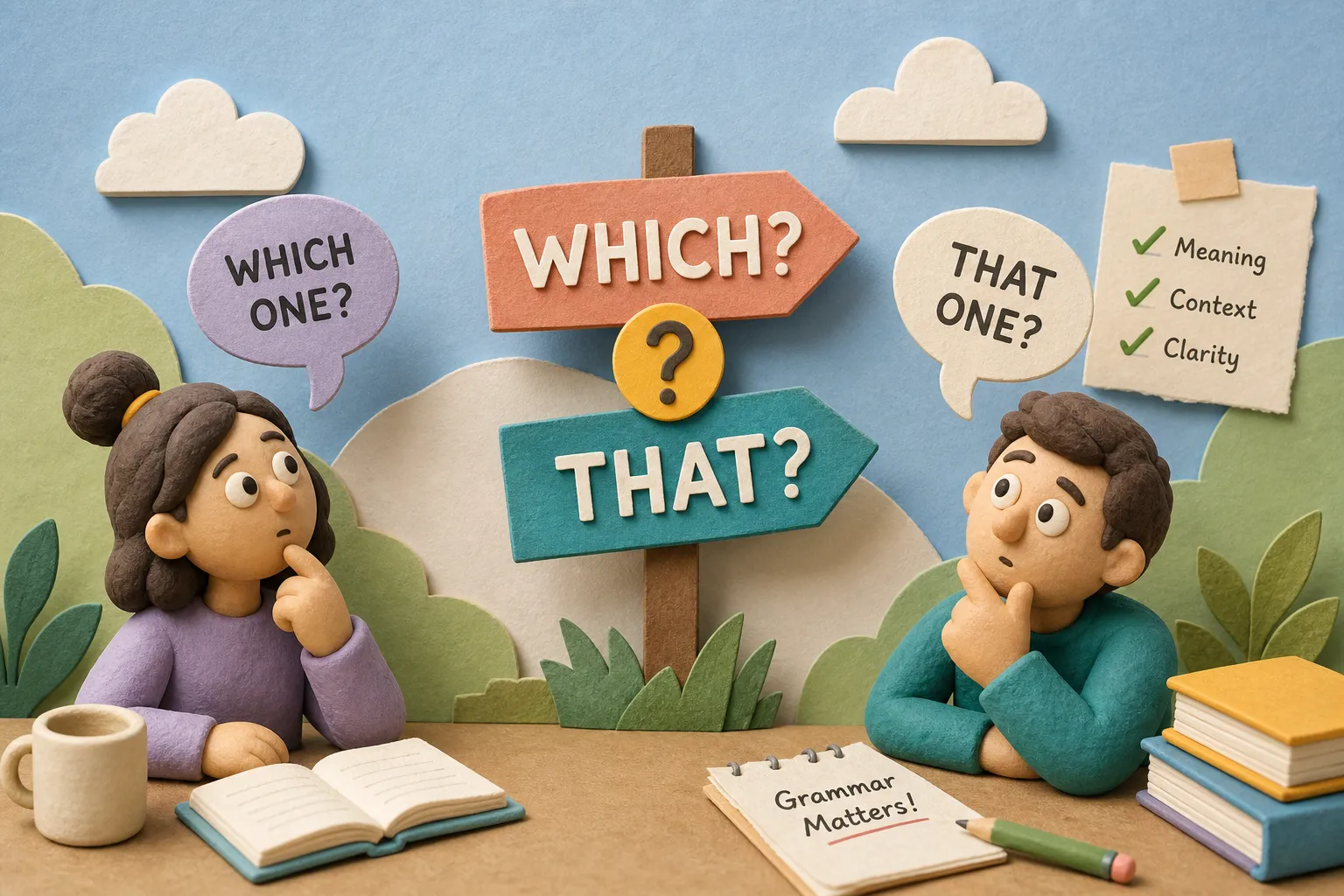
You’re writing an email to your manager. You type: “Please review the document which I attached.” Then you pause. Should that be that? You change it. Then you change it back. Then you just leave it and hope it’s right.
If that sounds familiar, you’re in good company. The “which vs. that” question trips up even advanced English learners, partly because some grammar resources contradict each other and partly because nobody ever explained the actual logic behind the rule. By the end of this lesson, you’ll be able to identify essential and nonessential clauses on sight, choose the right word every time, apply the comma rule correctly, and use a quick test whenever you’re not sure. This is American English grammar taught the way it actually works in professional writing, not as an abstract rule disconnected from real sentences.
The one concept that makes the whole rule click
Every confusion between which and that comes down to one question: is the information in your clause essential to identifying the noun, or is it just extra detail? Once you can answer that, the word choice becomes automatic.
What a restrictive (essential) clause actually does
A restrictive clause is a clause that identifies which one you’re talking about. Without it, the sentence either loses its meaning entirely or points to the wrong thing. Consider this sentence from a workplace context: “The report that I submitted on Friday needs one more revision.” Remove the clause and you get: “The report needs one more revision.” Now your reader has no idea which report you mean out of the five reports sitting in their inbox. The clause is doing real work. It’s essential. Notice there are no commas around it. That’s intentional, and it’s part of the rule.
What a nonrestrictive (nonessential) clause does instead
A nonrestrictive clause adds information about a noun that’s already fully identified. The noun is clear without the clause; the clause just adds context. Example: “The Q3 report, which I submitted on Friday, has already been approved.” Here, “Q3 report” already tells your reader exactly which document you mean. The clause is bonus detail, not identification. Pull it out and the sentence holds up perfectly. Notice the commas on both sides of the clause. Those commas are a signal: this is extra, not essential.
Which vs. That: When to Use “That” in Your Writing
In American English, “that” introduces restrictive clauses. When a clause is doing the job of identifying or limiting a noun, “that” is the standard choice. This is consistent across the major American style guides, including the Daily Grammar, the AP Stylebook, and Purdue OWL.
Recognizing an essential clause in a real sentence
Look at these two professional examples and notice what “that” is doing in each one. First, from a project report: “The policy that was revised last quarter does not apply to existing contracts.” Without the clause, you’d have “The policy does not apply to existing contracts,” which is meaningless on its own. Second, from a professional email: “Please review the version that I attached to this message.” Remove the clause and you’re asking someone to review “the version” with no indication of which one. In both cases, “that” leads a clause doing essential identifying work, and there are no commas.
Common ESL mistake: using “which” without a comma
Many learners write “which” for all relative clauses because grammar resources from British English or older textbooks allow it. In American English, that creates a problem. Compare: “The file which I sent you is updated” versus “The file that I sent you is updated.” The second is the standard American form. When American editors and managers read “which” without a comma before it, many read it as an error. If you’re writing for a U.S. company or a U.S.-based client, using “that” for essential clauses is the safe, professional choice.
Which vs. That: When “Which” Belongs and Why Commas Are Non-Negotiable
In American English, “which” introduces nonrestrictive clauses, and the comma before it is not optional. The comma tells your reader: what follows is extra information, not a defining characteristic. Think of “comma + which” as a parenthetical. You could lift the whole clause out and place it in parentheses, and the sentence would still be complete and clear.
The comma is doing important work here
Here’s an email example: “Our refund policy, which was updated in March, now covers digital purchases.” The reader already knows which policy you mean. The clause adds helpful context, but the sentence works without it. Now look at a report example: “The marketing team, which handles all social campaigns, will present on Thursday.” “The marketing team” is already fully identified. The clause is a side note.
How a missing comma changes meaning in professional writing
This is where the stakes get real for business writing. Compare these two sentences: “The offices which we renovated are on the second floor” versus “The offices, which we renovated, are on the second floor.” The first sentence, without commas, implies there are multiple groups of offices and only the renovated ones are on the second floor. The second sentence says all the offices are on the second floor, with renovation added as extra detail. Same words, different meaning. For someone writing reports or client-facing documents, a missing comma can genuinely confuse a reader or change the interpretation of a policy. For a clear guide to the comma rule before ‘which’, see a concise explanation on comma usage before “which”.
A quick test you can use on any sentence, right now
You don’t have to memorize clause types to get this right. Here’s a simple test you can apply to any sentence in under ten seconds, and it works every time.
The remove-it test
Here’s how it works:
- Find the relative clause in your sentence.
- Remove it entirely.
- Ask yourself: does the sentence still point clearly to the right thing?
- If yes, the clause is nonessential. Use which and add commas.
- If no, the clause is essential. Use that with no commas.
Test it on two sentences. First: “The software that the IT team installed is running slowly.” Remove the clause: “The software is running slowly.” Your reader doesn’t know which software out of many. The clause is essential, use “that,” no commas. Second: “Our main office, which is located in Chicago, will be closed Monday.” Remove the clause: “Our main office will be closed Monday.” Perfectly clear. The clause is nonessential, use “which” with commas.
Which vs. That: A memory phrase that keeps the rule clear
“That restricts; which adds.” That’s the whole rule in four words. “That” restricts the noun by identifying it. “Which” adds detail to a noun already identified. When you’re mid-sentence and unsure, run the remove-it test and then ask yourself: am I restricting or am I adding? The answer tells you the word and the commas.
The American English standard and when things get complicated
If you’ve studied English from multiple sources, you may have seen “which” used in essential clauses without a comma, and wondered if that was wrong. It depends on the variety of English the source was using.
Why American and British English disagree on this
British English is more tolerant of “which” in restrictive clauses. A British writer might say “The box which lies on the table is empty” without it being considered an error. American English doesn’t work that way. The Chicago Manual of Style states clearly that a restrictive clause “is properly followed not by ‘which’ but by ‘that.'” The AP Stylebook follows the same standard. For anyone writing in an American professional context, the rule is firm: essential clauses take “that,” and nonessential clauses take “which” with commas. For a general, usage-oriented explanation you can also consult Merriam-Webster’s guidance on “that” vs. “which”.
Common edge cases worth knowing
A few situations come up regularly and are worth flagging. First, the relative pronoun can often be dropped entirely in essential clauses: “The file I sent you is updated” is perfectly correct American English. The clause is still restrictive; you just left out “that.” Second, when you’re referring to a unique, already-identified noun, like a person’s name or a specific named document, the clause is always nonessential: “Paris, which is the capital of France, attracts millions of visitors.” Paris is already fully identified, so “which” and commas are correct. Third, after prepositions, “that” is typically avoided: “the principle in which he believes” is standard; “the principle in that he believes” is not.
Three sentences to test yourself right now
Read each sentence and decide: should the blank be that or which? Should there be a comma before it?
Sentence 1 (email): “Please send me the contract _____ the client signed last week.” Answer: that, no comma. The clause identifies which contract out of potentially many. Remove it and the request becomes too vague.
Sentence 2 (report): “The annual budget, _____ was approved in January, covers all department expenses.” Answer: which, with commas. “The annual budget” is already specific. The clause adds context; the sentence works without it.
Sentence 3 (meeting context): “The team _____ handles onboarding will lead the presentation.” Answer: that, no comma. There are multiple teams; this clause identifies the specific one. Removing it leaves “the team will lead the presentation” with no clarity about which team.
Now try writing your own version of each sentence using a situation from your own job. Writing your own examples is what moves a rule from “I looked it up” to “I just know it.”
Keep building grammar that works in real American contexts
The “which vs. that” rule is one of many places where American English has a specific professional standard that ESL learners don’t always encounter in generic courses. At Your Daily American, the grammar lessons focus exactly on this: how the language is actually used in American workplaces and daily life, with real examples and cultural context that make the rules stick. If this lesson clicked for you, our Daily Grammar, Your Daily American has more lessons built around the same approach, clear rules, real sentences, and writing you can use right away. For articles that connect grammar and workplace usage, see our Professional English, Your Daily American section, and for useful expressions and context for learners, check out Common American Expressions Every English Learner Should Know, Your Daily American.
The rule, clean and simple
“That” restricts and identifies, and it never takes a comma. “Which” adds extra information, and it always takes a comma. When you’re not sure which one to use, run the remove-it test: take out the clause and ask whether the sentence still points to the right thing. If it does, use “which” with commas. If it doesn’t, use “that” without.
Keep in mind that this is an American English standard. If your grammar resources come from British sources, you may have seen “which” used more broadly, and that’s not wrong in that context. But for American professional writing, editors and managers expect the distinction to be made clearly.
Now you can handle the “which vs. that” question confidently in any American professional context. With that rule in place, your emails, reports, and professional documents have one fewer uncertainty to slow you down. That’s not a small thing, and in professional writing, precision like this is exactly what sets polished writers apart.