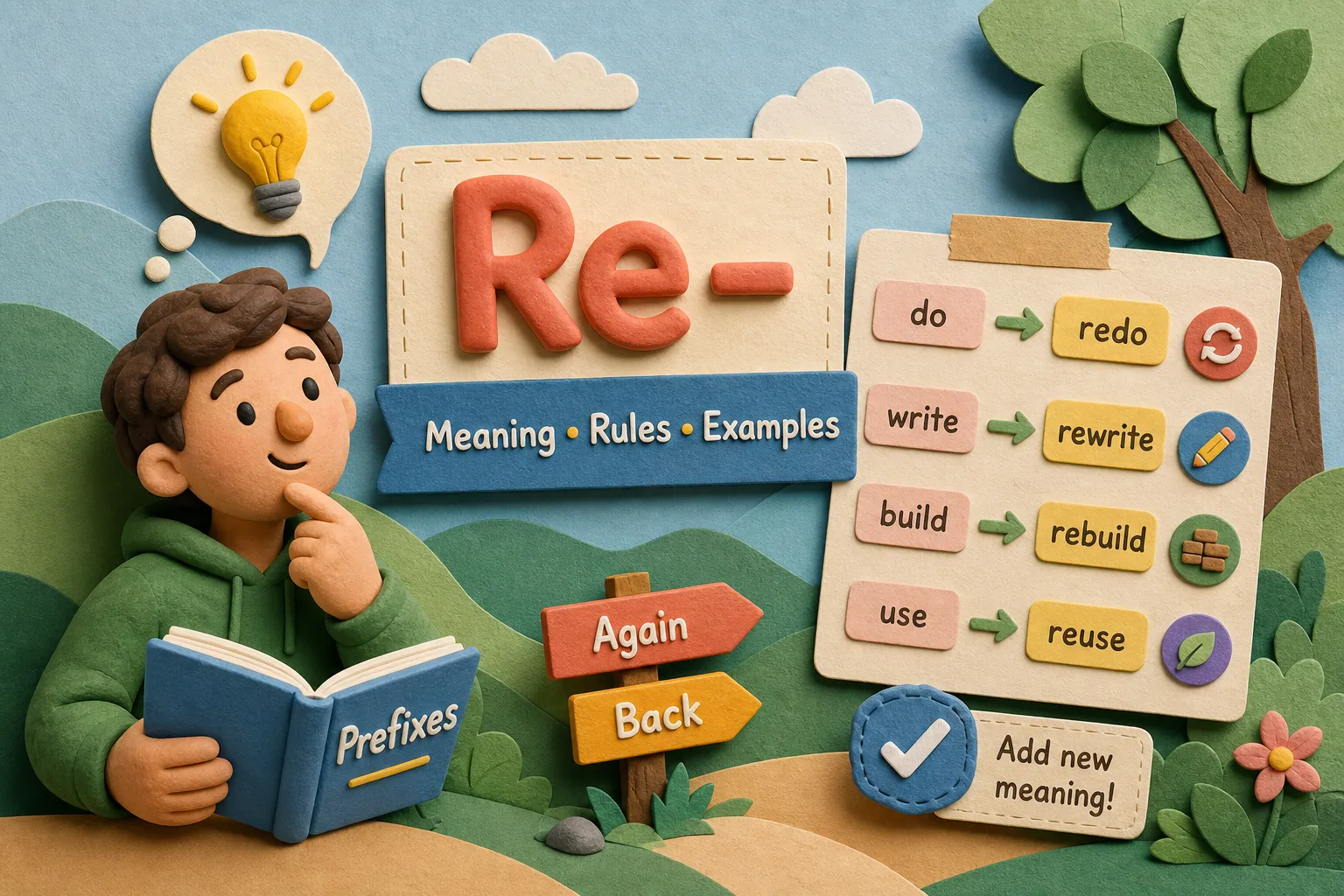
The re prefix (written re-) means “again” or “back” and shows up in hundreds of everyday English words. You redo a task. You reply to a message. You return something to the store. You rewrite a sentence until it sounds right. These are all re- words, and they all follow the same pattern.
Once you understand what re- means, you can figure out the meaning of hundreds of new English words on your own. At Your Daily American, we focus on teaching vocabulary through word patterns and structure, because understanding how a word is built helps you learn it faster and remember it longer. The re- prefix is a perfect place to start.
After reading this lesson, you’ll be able to define the re- prefix, tell the difference between its main meanings, apply correct spelling rules, and recognize when “re” at the start of a word is not actually a prefix at all.
What the re- prefix means: the core senses you need to know
A prefix is a short unit of meaning that you attach to the front of a word. It changes the word’s meaning in a predictable way. The re- prefix has two primary senses, “again” and “back/return”, and a related third sense of undoing or reversal that overlaps closely with “back.” Knowing all of them helps you decode new words without a dictionary.
The “again” sense: doing something one more time
The most common use of re- signals repetition. The action simply happens again. Here are some high-frequency examples in real sentences:
- Redo: “I made a mistake, so I need to redo the whole report.”
- Replay: “Can you replay that video? I missed the beginning.”
- Reheat: “I’ll reheat the soup; it got cold.”
- Rewrite: “She rewrote the email three times before sending it.”
- Recycle: “We recycle paper, plastic, and glass at this office.”
This “again” sense is the most common in modern American English. Re- is a highly productive prefix, meaning you can attach it to a wide range of verbs to signal that the action is repeated, and native speakers do this naturally, even forming new words like re-watch or re-share on the fly. So can you.
The “back” sense: returning to an earlier state
The second sense of re- means “back” or “moving to a previous position.” This is the original Latin meaning of the prefix. Think of it as reversing or undoing an action:
- Return: “He returned the book to the library.” (turned back)
- Retreat: “The team retreated to a smaller office.” (moved back)
- Revert: “The document reverted to an earlier version.” (went back)
- Reject: “The bank rejected my application.” (pushed back)
- Retract: “She retracted her statement after new information came out.” (pulled back)
In these words, the action moves backward or undoes something. The item, person, or idea goes back to where it was before. In some cases, like reject or retract, you can also see the undoing or reversal sense at work; linguists treat this as a close extension of the “back” meaning rather than a fully separate category.
When one re- word carries both meanings
Sometimes the same word can carry both senses, and context decides the meaning. Take the word renew. “I need to renew my subscription” means doing it again. “Exercise renews my energy” means restoring something to a previous state. Both are correct.
This shows you that re- is flexible, not a fixed formula. Pay attention to the surrounding words, and the meaning becomes clear.
Where re- comes from: a short history that helps you learn faster
Latin roots and the original meaning of re-
The prefix re- comes from Latin, where its original meaning was “back” or “backward.” In early Latin, when re- appeared before a vowel or the letter h, it sometimes became red- instead. That is why we have redeem and reduce today, rather than “reeem” or “reuce.” You do not need to apply this rule yourself; these words already exist in their final form. Etymological records trace this Latin prefix entering English around the 13th century, more than 800 years ago, which is why it appears in so many words you already know. For a concise etymology, see the Online Etymology Dictionary.
How re- became a highly productive prefix in English
As English absorbed thousands of words from Latin and French, re- spread into everyday speech. Over time, the “again” meaning grew stronger and became dominant. Today, native speakers create new re- words naturally: re-watch, re-share, re-open. Linguists call this a productive prefix, meaning speakers can attach it to new words whenever they need to. Studying prefixes like re- is one of the most efficient ways to build your English vocabulary, because a single pattern unlocks hundreds of words at once. For a practical explanation of using the re- prefix, see this guide to using the prefix re.
Re- words you already use: organized by meaning
Everyday “again” words: the ones you hear every day
These high-frequency words come up in daily conversation and casual writing. Notice how each one simply adds the meaning “again” to a familiar verb:
- Reread: “I reread the instructions twice before starting.”
- Reheat: “Just reheat the leftovers in the microwave.”
- Revisit: “Let’s revisit this topic at our next meeting.”
- Reopen: “The café reopened after the holidays.”
- Reuse: “She reuses the same bags when she goes shopping.”
Professional “back/return” words common in workplace English
These re- words appear constantly in emails, meetings, and professional conversations. Learning them well gives you real confidence in workplace communication:
- Review: “Please review the attached document before Thursday.”
- Revise: “We need to revise the proposal based on client feedback.”
- Respond: “I’ll respond to your email by end of day.”
- Resolve: “We resolved the issue in less than an hour.”
- Replace: “Can you replace the broken printer cartridge?”
A quick-reference list for study
Use this grouped list to build your vocabulary. These words are ideal for flashcard review or spaced repetition (reviewing words at timed intervals to move them into long-term memory). Note that some words, such as respond, resolve, and refer, can carry shades of both meanings depending on context; the groupings below reflect the dominant modern sense:
| “Again” sense | “Back / Return” sense |
|---|---|
| redo | return |
| replay | retreat |
| rewrite | revert |
| reheat | reject |
| recycle | retract |
| revisit | respond |
| reread | refer |
| reuse | resolve |
| reopen | replace |
| rebuild | reduce |
Spelling and hyphenation: when to add a dash and when not to
The default rule: no hyphen in most re- words
Modern American English style strongly prefers no hyphen for re- words. Write reenter, reelect, reestablish, reevaluate as one solid word. This reflects the standard guidance in American dictionaries and major style references, including Merriam-Webster, the AP Stylebook, and the Chicago Manual of Style. That said, a small number of publications and older house styles still use a hyphen in forms like re-enter, so you may occasionally see it. The current mainstream standard is closed. When in doubt, skip the hyphen. Most re- words do not need one.
Re- hyphenation rules: when a hyphen actually helps
The most common situation calling for a hyphen is when removing it would create a completely different word. These pairs are the clearest examples in American English:
- Re-cover (cover again) vs. recover (get better after illness): “I need to re-cover the sofa cushions.” / “It took her two weeks to recover from the flu.”
- Re-sign (sign again) vs. resign (quit a job): “He re-signed the contract after the changes were made.” / “She resigned from her position on Friday.”
- Re-lay (lay something again) vs. relay (pass a message): “The workers will re-lay the floor tiles tomorrow.” / “I’ll relay your message to the manager.”
The hyphen is a meaning signal. It tells the reader: “I mean the re- prefix here, not the other word.” Style guides including AP and Chicago treat this clarity-based hyphenation as the primary reason to add a dash. It is the most common and clearest situation where a hyphen is necessary, though you may also see hyphens used occasionally for readability with unusual or unfamiliar combinations.
Double letters and other quick spelling notes
When you add re- to a word that starts with the letter e, you get two e’s in a row. This is correct. Reenter has two e’s. Reelect has two e’s. The spelling of the base word never changes when you add re-. Simply attach the prefix directly to the front, and do not drop or change any letters. Some writers still hyphenate these forms, re-enter, for readability, but Merriam-Webster and the Chicago Manual of Style list the closed forms as standard. If reenter looks strange to you at first, trust the rule: it is the standard American English spelling.
Words that start with “re” but aren’t re- prefixes
How to spot a true re- prefix
Here is a useful test: remove “re-” from the front of the word. Is what remains a real English word or a recognizable root? If yes, re- is likely a prefix. If no, “re” is simply part of the base word itself.
- Rewrite → write (a real word) = true prefix
- Reheat → heat (a real word) = true prefix
- Reach → ach (not a word) = “re” is part of the root
- Real → al (not a word) = “re” is part of the root
- Rest → st (not a word) = “re” is part of the root
Keep in mind that this test is a practical starting point, not a perfect rule. Some words have base forms drawn from Latin roots that don’t survive as standalone English words, so the meaning test (does the word carry a sense of “again” or “back”?) is a helpful second check.
Common “re” words that fool learners
These words begin with the letters r-e, but “re” is not a prefix in modern English: red, read, real, rest, reach, remain, reside, result, respect, reveal. The word reveal often surprises learners because it looks like re- + veal. But “veal” is a type of meat, not a verb meaning “to cover.” According to etymological sources, reveal comes from a different Latin root entirely. Similarly, remind looks like re- + mind, and “mind” is a real English word. But remind does not mean “to mind again”, it has its own fixed meaning. When a word starts with “re” but its meaning does not match “again” or “back,” trust the meaning rather than the spelling.
Why learning prefixes builds your vocabulary fast
One prefix, many words: the return on every study session
The re- prefix appears in hundreds of common English words. When you understand what it means, you can decode new words without a dictionary. See renegotiate for the first time? You already know it means “negotiate again.” Restructure? Arrange again. Reintegrate? Bring back into a group. Studying one prefix gives you a tool that works across hundreds of words at once, far more efficient than memorizing words one by one.
Connecting prefix study to long-term retention
Vocabulary sticks better when you understand the structure of a word, not just its definition. Morphological awareness, understanding word parts like prefixes, roots, and suffixes, helps learners recognize and remember new words more effectively. ELL teaching resources also recommend combining morphological instruction with review systems. Spaced repetition works even better when you know the prefix. A flashcard for reconfigure becomes a review of the re- prefix and the base word configure at the same time. That is two pieces of vocabulary knowledge from a single study card.
How Your Daily American helps you study smarter
At Your Daily American, the study methods section covers vocabulary strategies designed for busy adult learners. You’ll find practical guides on how to study prefixes, how to use spaced repetition, and how to build vocabulary habits that produce real, lasting results. For explicit classroom and tutoring techniques focused on this prefix, see this skill explainer on explicitly teaching the prefix re. Now that you understand the re- prefix, you have a strong foundation. The next step is building a study system around that knowledge so new words stay with you long-term.
Putting it all together
The re prefix carries two core meanings: “again” (repetition) and “back” (returning to a previous state), with an overlapping sense of undoing or reversal. Spelling is straightforward, attach re- directly to the base word with no hyphen, except when a hyphen is needed to prevent confusion, as in re-cover vs. recover. And not every word that starts with “re” uses the prefix. Use the removal test as a first check: take away “re-” and see if a real English word or clear root remains, then confirm the meaning matches “again” or “back.”
This lesson also points to something bigger about vocabulary learning. One pattern, understood well, gives you access to hundreds of words. You do not need to memorize everything. You need to understand how the language is built. That understanding grows faster when you study with a clear system.
Head over to Your Daily American to explore more vocabulary lessons, prefix guides, and study method content. You already know re-. Now use it.
Frequently asked questions about the re prefix
When should I hyphenate re- words?
Hyphenate re- when leaving it out would create a different word, for example, re-cover vs. recover, or re-sign vs. resign. That is the clearest reason to add a hyphen. In most other cases, the current American English standard is to write re- words as one solid word with no hyphen.
Is re- always a prefix?
No. Many common words start with the letters r-e without using the re- prefix. Words like red, reach, real, and reveal are not built from the prefix re-. The quick test: remove “re-” and check whether a real English word or recognizable root is left. If nothing meaningful remains, “re” is just part of the base word.
How do I spell re- words that start with a vowel?
Attach the prefix directly, no hyphen needed. Reenter, reelect, reestablish are all correct. The double letter looks unusual at first, but it is the standard American English spelling confirmed by Merriam-Webster. Some writers still hyphenate these forms for readability, but the closed form is the current mainstream standard.
What is the difference between the “again” and “back” meanings of re-?
“Again” signals that an action repeats: redo, reheat, rewrite. “Back” signals a return to an earlier state: return, revert, retract. Some words, like renew, can carry both senses depending on context. When in doubt, look at the surrounding sentence to figure out which meaning fits.
How to spell re prefix words correctly
The general rule is simple: attach re- directly to the base word with no changes. Do not drop letters from the base word, and do not add a hyphen unless meaning would be unclear without one. The spelling of the base word stays exactly the same, heat becomes reheat, write becomes rewrite, enter becomes reenter.
Can re- attach to any verb?
Re- is highly productive, meaning it works with a very wide range of verbs. Native speakers regularly coin new re- words in casual speech and writing. That said, not every verb naturally takes re-, some combinations sound awkward, and certain words have fixed forms that don’t accept the prefix. If you’re unsure, check a dictionary or ask whether the resulting word carries a clear “again” or “back” meaning.