Picture this: it’s Friday afternoon and you’re leaving the office. Your coworker smiles and says, “Have a good time this weekend!” You smile back. But do you know what to say next? Or maybe a friend is about to fly to another city, and you want to send them off warmly. Do you say “have a good time”? “Have fun”? “Have a good one”? This article answers all of that.
By the end, you’ll be able to use “have a good time” and its most natural variations in real American conversations. You’ll also know how to respond when someone says it to you. This lesson covers five topics: meaning, situations, variations, delivery, and responses.
What “have a good time” actually means in American English
On the surface, this phrase just means “I hope you enjoy yourself.” But its real job in a conversation is much more social. When an American says “have a good time,” they’re sending a small, friendly message: “I care about you, and I hope your next few hours are enjoyable.” It’s not a deep emotional statement. It’s a warm, easy way to close a conversation.
This phrase works in casual settings, like talking with friends, and in semi-professional ones, like chatting with a coworker or neighbor. It’s not too formal and not too casual. That balance makes it very useful.
When it sounds sincere vs. automatic
Sometimes “have a good time” is said with real enthusiasm, like when a friend is leaving for a long-awaited vacation. Other times, it’s said quickly and automatically, like at the end of a customer service call. Both uses are correct. Americans use this phrase in both genuine and routine ways, and as an English learner, you can do the same, don’t overthink it.
Where Americans use “have a good time” most: farewells, small talk, and casual goodbyes
The phrase is most commonly used before a specific enjoyable activity or event when the speaker already knows about the other person’s plans. The speaker uses it as a friendly send-off tied to that activity. Here are the three most common situations.
Before a trip, event, or weekend plan
This is the most typical use. Someone mentions their plans, and you respond with a warm wish. Here are some short, real examples:
- “I’m going to the beach this weekend.” → “Oh, nice! Have a great time!”
- “We’re flying to Miami tomorrow.” → “Have a good time! I hope the weather is perfect.”
- “My daughter’s birthday party is tonight.” → “Aw, fun! Have a good time!”
- “We have tickets to a concert on Saturday.” → “That sounds so fun. Have a great time!”
Notice the pattern: the other person tells you something they’re looking forward to, and you respond with a short, warm wish. That’s the natural trigger for this phrase.
At the end of the workday or work week
On Friday afternoons or before a holiday, Americans often close conversations with a version of this phrase. “Have a good weekend!” and “Have a good time at your sister’s wedding!” are very common. These are quick, kind exits from a conversation. You don’t need to explain anything or add more words. Note that close variations like “Have a good one” and “Have a good weekend” tend to work as broader general farewells, while “have a good time” is most natural when you know what the other person has planned. For more on weekday-specific expressions and when to use them, see Days of the Week: Phrases, Slang & American Expressions.
During small talk with neighbors or acquaintances
When you don’t know someone very well, this phrase helps you end a conversation on a friendly note. You show warmth without needing to share personal details. That’s very natural in American culture: brief, pleasant exchanges that leave everyone feeling good. “Have a good one!” said with a smile is often enough. For more practical examples and prompts you can use in these moments, check out 25 Small Talk Phrases Americans Use Every Day, Your Daily American.
Natural variations that sound just as good
You don’t have to say “have a good time” every time. Americans use several related phrases, and each one fits a slightly different situation. Knowing the difference helps you choose the right one.
“Have a great time,” “have fun,” and “enjoy yourself”
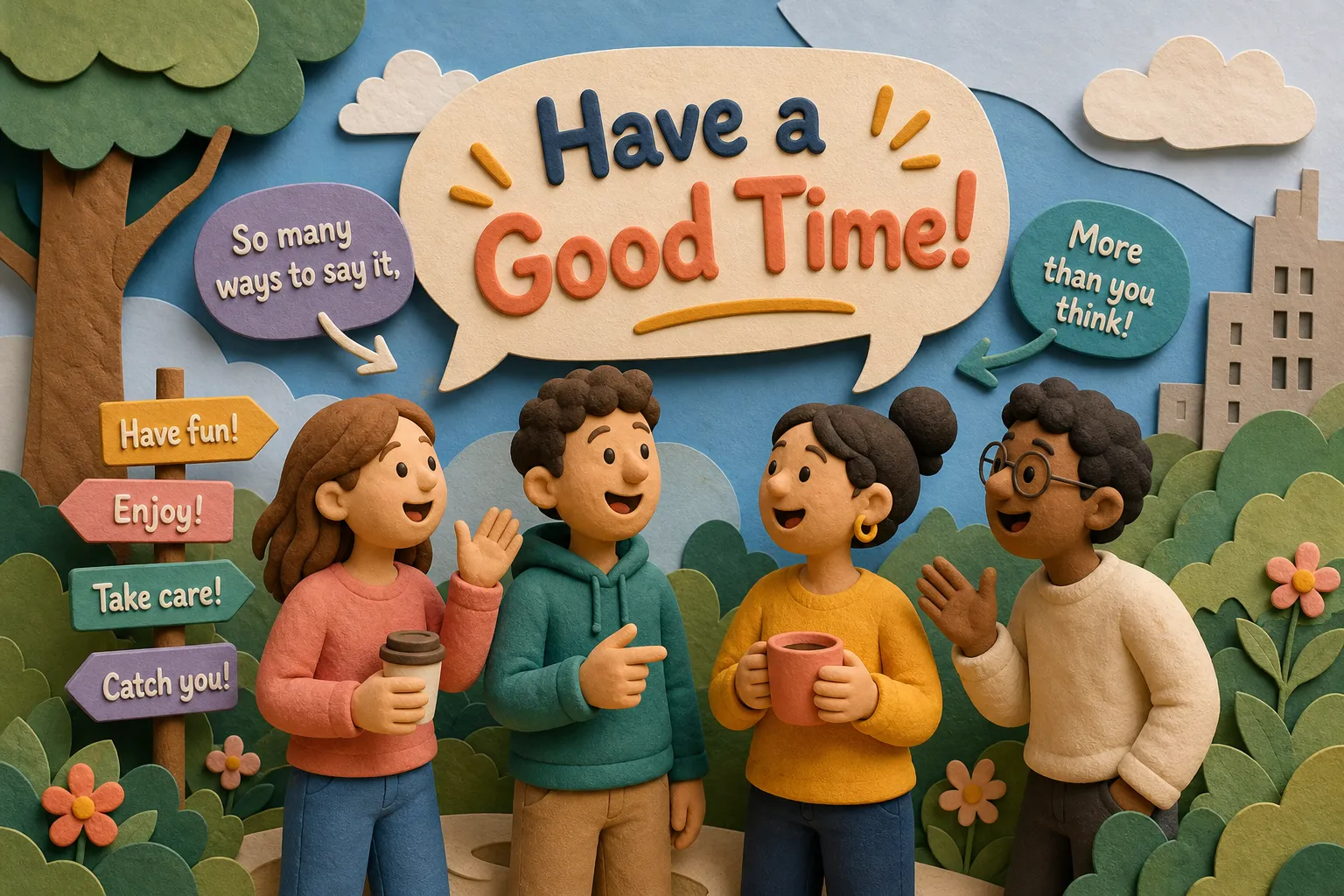
“Have a great time” is a little more enthusiastic than “have a good time.” Use it when the event sounds exciting, like a trip abroad or a big celebration. “Have fun” is very casual. Use it with friends or when talking to children. “Enjoy yourself” is a bit warmer and more personal. It works well with close friends or family.
- “Have a great time in Paris!” (excited, for a big trip)
- “Have fun at the birthday party!” (casual, with friends)
- “Enjoy yourself this weekend, you deserve it.” (warm, personal)
Shorter and more casual: “have a blast” and “have a good one”
“Have a blast” is very casual and enthusiastic. Use it with friends before parties or fun events. “Have a blast at the concert tonight!” sounds natural and energetic. “Have a good one” is one of the most common general goodbyes in American daily life. You’ll hear it from cashiers, coworkers, and neighbors. It functions as a flexible catch-all that can replace “have a good day,” “have a good weekend,” or “have a good night”, which is exactly why it shows up in so many everyday interactions.
Many ESL learners overlook “have a good one” because it sounds vague. But that’s exactly why Americans love it: it works in almost any situation. At Your Daily American, we cover phrases like this in depth because they’re the ones that make you sound natural in everyday life. Read our Filler Phrases Every American English Learner Should Know article for a longer list of compact phrases that function just like “have a good one.”
How to say “have a good time” and sound genuinely warm
Tone and timing make the difference
The words are only part of the lesson. A flat, monotone delivery sounds polite but cold. A warm version rises slightly on the word “good” or “great,” then comes back down on “time.” That small rise-and-fall signals friendliness and genuine care. In connected American speech, “have a” often sounds like “hav-uh,” and “good time” connects smoothly, almost like one word, “good-time”, with a clear stress on “good.”
Pronunciation note: In natural speech, the word “have” is reduced. In careful speech, the full phrase is approximately /hæv ə ˈɡʊd ˌtaɪm/. In relaxed, connected speech, “have” reduces to something closer to /hə/, making the whole phrase sound like “hav-uh-good-time” said in one smooth flow. Stressing both “good” and “time” keeps the wish sounding warm rather than mechanical. For additional pronunciation tips and practice, see the ASC English blog.
What to add before or after the phrase
Americans often add a short personal comment before the phrase. This makes the wish feel genuine rather than automatic. Here are two examples:
- “Oh, that sounds so fun, have a great time!”
- “I hope you get good weather. Have a good time!”
After saying it, Americans typically don’t wait for a long reply. They smile, wave, or start to walk away. Knowing this cultural rhythm helps you avoid the awkward pause of waiting for more conversation that isn’t coming.
Responding to “have a good time”: what to say back
Knowing how to respond is just as important as knowing how to use the phrase. Many ESL learners pause too long or say too much. Here’s what natural responses actually sound like.
The most common responses
“You too!” is the most common and versatile response. It’s fast, friendly, and almost automatic in American conversation. Other natural options include:
- “Thanks! Will do!”
- “Thanks, I will!”
- “Same to you!”
- “Thanks, you do the same!”
For ESL learners, building the habit of saying “you too” quickly and confidently is a small but real sign of fluency. Practice saying it until it feels automatic.
Why shorter is better here
Over-explaining your response sounds unnatural. Compare these two examples:
Too much: “Thank you so much, I really hope I will have a very good time, and also I hope you will have a good time too.”
Natural: “Thanks! You too!”
In American small talk, a short, warm response is always better than a long one. Less really is more.
Common mistakes ESL learners make and a quick practice challenge
A few small errors can make your English sound stiff or unnatural. Here are the most common ones, with natural fixes.
Phrases that sound too stiff or too literal
Mistake 1: Saying “I wish you a good time.” This is grammatically correct but sounds very formal. Americans don’t use this in casual conversation. Use “Have a good time!” instead.
Mistake 2: Responding with “Thank you, goodbye.” This misses the warmth of the moment. The natural response is “Thanks! You too!”, short and friendly.
Mistake 3: Saying “Have a nice time.” This construction sounds more at home in British English. In American English, “have a good time” or “have a great time” sounds much more natural.
For a broader list of common ESL communication pitfalls and how to fix them, see this practical guide on common ESL communication mistakes.
Try it yourself: 3 quick practice scenarios
Read each situation and say your response out loud. There’s no single right answer, but aim for something short and warm.
- Your coworker tells you she’s going to her daughter’s birthday party tonight. What do you say?
- A cashier at the grocery store says, “Have a good one!” What’s your response?
- You’re leaving a friend’s house after dinner. How do you say goodbye warmly?
Possible answers: (1) “Oh, fun! Have a great time!” (2) “Thanks, you too!” (3) “This was so fun, thanks for having me! Have a good night!” For more real-life phrases like these, with full cultural context and guided practice, Your Daily American is built exactly for that. The everyday English section covers dozens of phrases that make daily interactions feel easy and natural.
Frequently asked questions about “have a good time”
Is “have a good time” the same as “have a good day”?
Not quite. “Have a good day” is a general farewell you can use with almost anyone at any point in the day. “Have a good time” is typically used when you know the other person has a specific activity or event coming up, a trip, a party, a concert. If you’re not sure what someone has planned, “have a good one” is the more flexible all-purpose choice. For real-world community opinions on small phrasing differences like this, see the discussion thread “what should I say to have a nice day?” on Reddit: what should I say to have a nice day?
Can I use “have a good time” in a professional setting?
Yes, in most semi-professional contexts it works well, with coworkers, clients you know casually, or a manager you’re friendly with. In highly formal business situations, you might opt for “enjoy your weekend” or “have a good weekend” instead, but for everyday workplace conversation, “have a good time” is perfectly appropriate.
What’s the difference between “have a good time” and “have a great time”?
“Have a great time” adds a bit more enthusiasm. Save it for exciting plans, a big vacation, a milestone celebration, or anything the person is clearly thrilled about. “Have a good time” is the everyday, reliable version that fits most situations.
The takeaway: small phrase, big impact
“Have a good time” is a short phrase, but it carries real social warmth in American culture. When you use it naturally, and when you respond to it naturally, you’re showing genuine conversational fluency. That’s not a small thing.
To recap: the phrase works best when tied to a specific upcoming activity, and it fits casual and semi-professional settings alike. Variations like “have a great time,” “have fun,” and “have a good one” each suit slightly different situations. Delivery and tone matter as much as the words themselves. And when someone says it to you, a quick “Thanks! You too!” is always the right move.
Small phrases like this one are easy to practice every day. The next time a coworker mentions weekend plans, you’ll know exactly what to say. And if you want to keep building this kind of practical, real-world fluency, one friendly phrase at a time, Your Daily American is your next stop.