If you’ve ever heard an American say “I’m meeting the client tomorrow afternoon” and wondered why they’re using a present tense for a future event, you’re not alone. That moment of confusion is exactly what this lesson on the present continuous solves. By the end, you’ll know how to form it, when to use it, and how to avoid the mistakes that make English sound unnatural.
By the end of this article, you’ll be able to form the present continuous correctly in all three forms, use it in three real American English situations, avoid the most common mistakes, and sound more natural when you speak. At Your Daily American, grammar lessons like this one are built around real spoken English, not abstract rules. Here’s how it works.
How to Form the Present Continuous
The formula is simple: subject + am/is/are + verb-ing. The verb “be” changes depending on who you’re talking about. “I” uses “am,” she/he/it uses “is,” and you/we/they use “are.” The main verb always gets the -ing ending. You need three forms: affirmative, negative, and question.
The Basic Structure: am/is/are + verb-ing
Here are four affirmative sentences using everyday situations. Notice the contractions. Native speakers of American English commonly use contractions in spoken conversation, so practice them from the start:
- I’m eating lunch right now.
- She’s finishing the report.
- He’s talking on the phone.
- They’re working from home this week.
Forming Negatives and Questions
To make a negative sentence, add “not” after “be.” In natural speech, use contractions: “isn’t” or “aren’t.” To ask a yes/no question, move “be” to the beginning of the sentence.
- She isn’t coming to the meeting. (negative)
- Are you working from home today? (yes/no question)
- What are you doing right now? (WH-question)
Spelling Rules for Adding -ing
Most present continuous errors happen at the spelling stage, so it’s worth knowing these rules clearly. The three core changes are:
- Silent “e”: Drop the final “e” before adding -ing. make → making, write → writing. Exception: if the verb ends in -ee, -oe, or -ye, keep the final letters. see → seeing.
- Consonant-vowel-consonant (one syllable): Double the final consonant. run → running, sit → sitting. Note that verbs ending in w, x, or y do not follow this rule even in a CVC pattern: show → showing, mix → mixing.
- Verbs ending in -y: Simply add -ing with no changes. play → playing, enjoy → enjoying.
Two additional rules come up in everyday writing. Verbs ending in -ie change to -y before -ing: die → dying, lie → lying. For multi-syllable verbs, the consonant doubles only when the final syllable is stressed: begin → beginning, but listen → listening.
When Something Is Happening Right Now
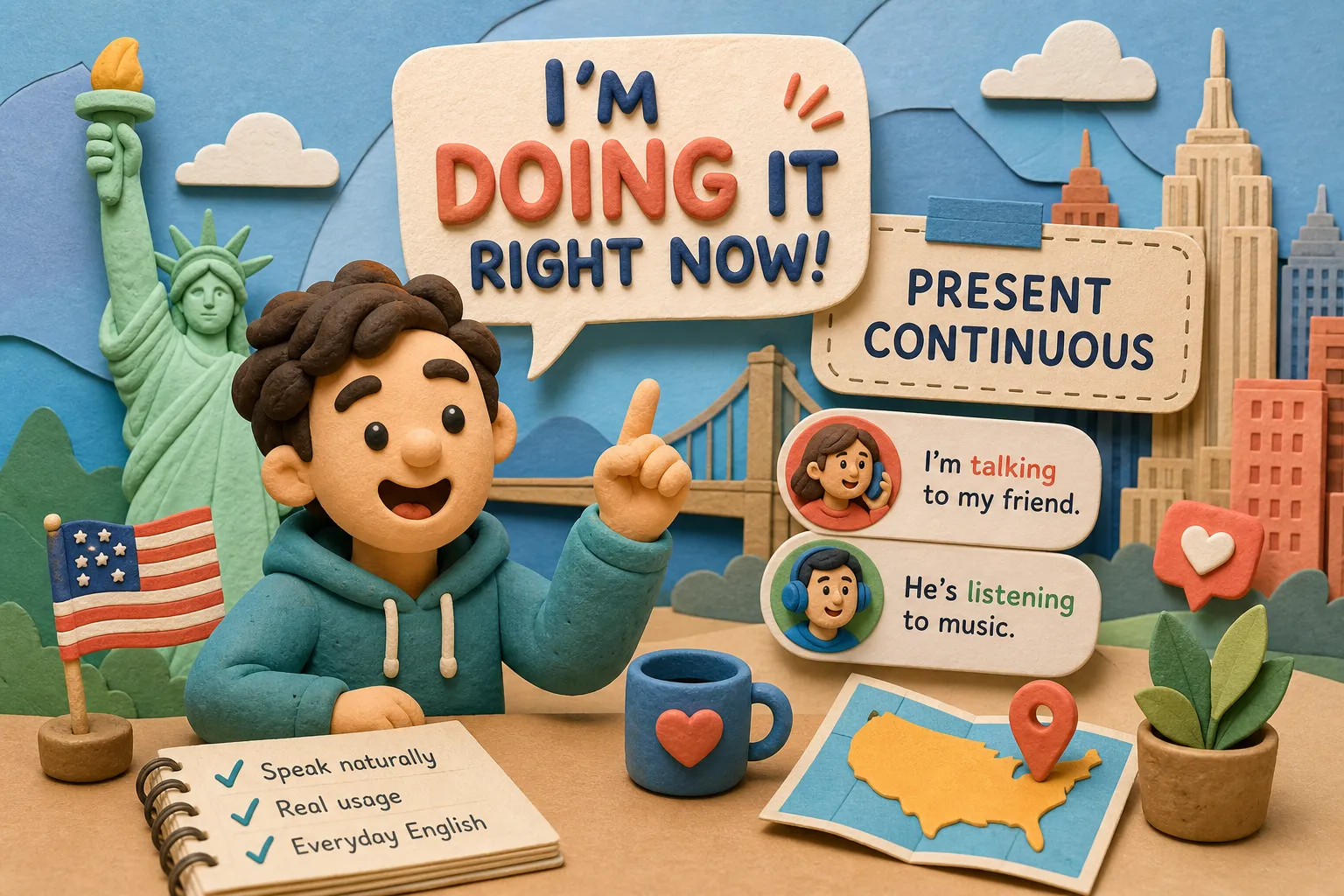
This is the most common use. Americans use the present continuous tense to describe what is in progress at the moment of speaking, not a habit, not something always true, just what’s happening now. Think of someone who gets a text message from a friend: “What are you up to?” The natural answer is, “I’m making dinner.”
Actions at the Moment of Speaking
Here are three short dialogues that show this in real American situations:
On a video call:
“Can you talk right now?”
“Not really, I’m presenting to my team.”
Texting a friend:
“Where are you?”
“I’m waiting outside the restaurant.”
At home:
“Are you busy?”
“A little. I’m watching something.”
One note worth keeping in mind: the action doesn’t have to be happening at that exact second. “I’m reading a great book this week” also works. The action is in progress during this time period, even if you’re not reading right now as you speak.
Time Expressions That Signal “Right Now”
These words often appear with the present continuous. When you see or hear them, the present continuous is usually the right choice:
- now / right now, “I’m on a call right now.”
- at the moment, “She’s reviewing the contract at the moment.”
- currently / at present, “He’s currently working on a new project.”
- these days / nowadays, “More people are learning English online these days.”
- this week / this month, “We’re working extra hours this week.”
For a clear, authoritative reference on the present continuous and its time expressions, see the British Council’s present continuous grammar reference.
Temporary Situations and Things That Are Changing
This use surprises many learners. The present continuous can describe situations that are true now but will not last forever. You don’t need to say “this is temporary”, the tense communicates that idea on its own.
Compare these two sentences: “She lives in Chicago” tells us this is her permanent home. “She’s living with her parents right now”&;/em> tells us this is a short-term situation. Same person, very different meaning, based only on which tense you use.
When Your Situation Isn’t Permanent
Here are some common scenarios where Americans use the present continuous this way:
- I’m staying at my sister’s place while my apartment is being renovated. <>
- He’s covering for his manager while she’s on leave.
- I’m taking a public speaking course this month.
- She’s using her roommate’s laptop until hers gets fixed.
Each of these describes a real situation that will change. The present continuous signals that without extra explanation.
Trends and Things That Are Developing
Americans also use this tense to describe things that are slowly changing over time. These aren’t habits or permanent facts, they’re ongoing shifts. “Remote work is growing fast.” “More companies are hiring globally.” “English is becoming an increasingly valued skill in international tech workplaces.” These sentences describe movement and change, not fixed reality.
Using the Present Continuous for Future Plans
Here’s the use that caused the confusion at the beginning of this lesson. Americans regularly use the present continuous to talk about future arrangements. The key condition: the plan is already decided and specific. It’s not a vague intention. It’s something confirmed, with a time attached, probably already on a calendar.
Arrangements You’ve Already Made
Notice how natural these sentences sound in American English:
- I’m flying to Austin on Friday.
- We’re having dinner with them Saturday night.
- I’m seeing the dentist Thursday morning.
- She’s meeting a client at 2 p.m.
- They’re moving into their new apartment next week.
All of these plans are fixed. The appointment is made. The flight is booked. That’s what makes the present continuous the right choice here.
For more examples and practical tips specifically about using the present continuous for future arrangements, read the lesson from Espresso English on present continuous for future arrangements.
How This Differs from Other Future Forms
“Going to” works when you have a personal intention but nothing is officially arranged yet. “I’m going to call him later” is a decision, not an arrangement. Simple present is used for fixed schedules: “The train leaves at 6:15.” The present continuous is the best choice when you’ve arranged something with another person or organization, and a specific time is set.
Present Continuous vs. Simple Present: The Key Difference
Here is the clearest way to think about it. Simple present = what you always do, or what is always true. Present continuous = what is happening now, temporarily, or as a confirmed plan. When you confuse these two tenses, your English sounds unnatural, even when the vocabulary is right.
Habits vs. Actions in Progress
Look at these pairs. The meaning changes completely with the tense:
- I work from home. (always, my normal routine) vs. I’m working from home this week. (just this week, not permanent)
- She drinks coffee every morning. (a daily habit) vs. She’s drinking coffee right now. (happening at this moment)
- He checks his email a lot. (a regular behavior) vs. He’s checking his email. (doing it right now)
Stative Verbs You Generally Can’t Use with -ing
Stative verbs, verbs that describe a state or condition rather than an action, are generally not used in the present continuous. They describe things that don’t move or change, so there’s no “action in progress.” Common stative verbs include: know, want, believe, need, love, own, understand, prefer, seem.
Don’t say: “I’m knowing the answer.” Say: “I know the answer.”
Don’t say: “She’s needing help.” Say: “She needs help.”
Keep in mind that some verbs can work both ways with a different meaning. “I have a car” describes possession (stative). “I’m having lunch”&;/em> describes an activity (dynamic). The verb “have” shifts meaning depending on how you use it. The same is true for “think”: “I think you’re right”&;/em> expresses an opinion, while “I’m thinking about changing jobs”&;/em> describes an ongoing mental process. Context determines which form is correct.
For a detailed list and explanation of common stative verbs and when they can (or can’t) take -ing forms, check this resource.
Present Continuous Rules: A Quick Summary
Before you move to practice, here’s a fast recap of the present continuous rules covered in this lesson:
- Form it with am/is/are + verb-ing.
- Use it for actions happening now, temporary situations, and confirmed future plans.
- Watch for time signals like right now, at the moment, this week.
- Avoid it with stative verbs like know, want, believe, unless the meaning shifts to dynamic.
- Don’t confuse it with simple present, which describes habits and permanent facts.
Try It Yourself: Quick Present Continuous Exercises
This is your chance to apply what you just learned. Read each situation below and write a sentence using either the present continuous or the simple present. Think about whether the action is happening now, is temporary, is a confirmed plan, or is a regular habit.
Build Your Own Sentences
- You arranged to have lunch with a friend tomorrow. How do you tell your coworker about it?
- Every Monday morning, you go to the gym. How do you describe this routine?
- You are sitting at your desk right now and reading this article. How do you describe what you’re doing?
- You moved in with a friend for three weeks while your apartment is being repaired. How do you explain this to someone?
- You have a doctor’s appointment on Tuesday. How do you tell your manager you’ll be out?
Common Mistakes to Watch Out For
Mistake 1: Using -ing with stative verbs. This is very common. “I’m understanding now” sounds unnatural. Say: “I understand now.” If you’re not sure whether a verb is stative, ask yourself: does it describe an action or a condition? Conditions use simple present.
Mistake 2: Forgetting to change “be” correctly. Spanish and Portuguese speakers sometimes say “I is working” or skip “be” completely. Every present continuous sentence needs the correct form of “be” (am, is, are) before the -ing verb. It’s not optional.
Mistake 3: Using simple present for something in progress. “I eat right now” is incorrect. If the action is happening at this moment, you need the continuous: “I’m eating right now.” The time expression “right now” is a strong signal that the present continuous is required.
What to Do Next
You now know the three main uses of the present continuous in American English: describing what’s happening right now, talking about temporary situations, and discussing confirmed future plans. You also know how to form it correctly, which time expressions go with it, and which verbs generally don’t work with -ing.
The present continuous is very commonly used in everyday spoken English. Getting it right makes your speech sound noticeably more natural, both at work and in daily life. That’s the kind of difference that matters most in daily conversation.
At Your Daily American, every grammar lesson connects directly to the English that shows up in conversations, meetings, and daily American life. If you want to keep building your skills, explore more grammar lessons on the blog, or review our 12 English Verb Tenses: A Pocket Guide for Non-Native Speakers to see where the present continuous fits among other tenses.
For a concise online overview of common issues learners face with this tense, you can also consult Grammarly’s present continuous guide.