Picture this: you’re at work, and your coworker turns to you and says, “If the meeting ends early, I’ll grab lunch with you.” You understand it. But do you know exactly how that sentence works? That’s the first conditional, and it’s one of the most useful grammar structures in American English.
Native speakers use this structure frequently, to make plans, give warnings, set conditions, and talk about what will happen in real, possible situations. By the end of this lesson, you’ll be able to build correct first conditional sentences in positive, negative, and question forms. You’ll also know when to use this structure instead of other conditional types, and how to avoid the mistakes most learners make.
How the first conditional is built
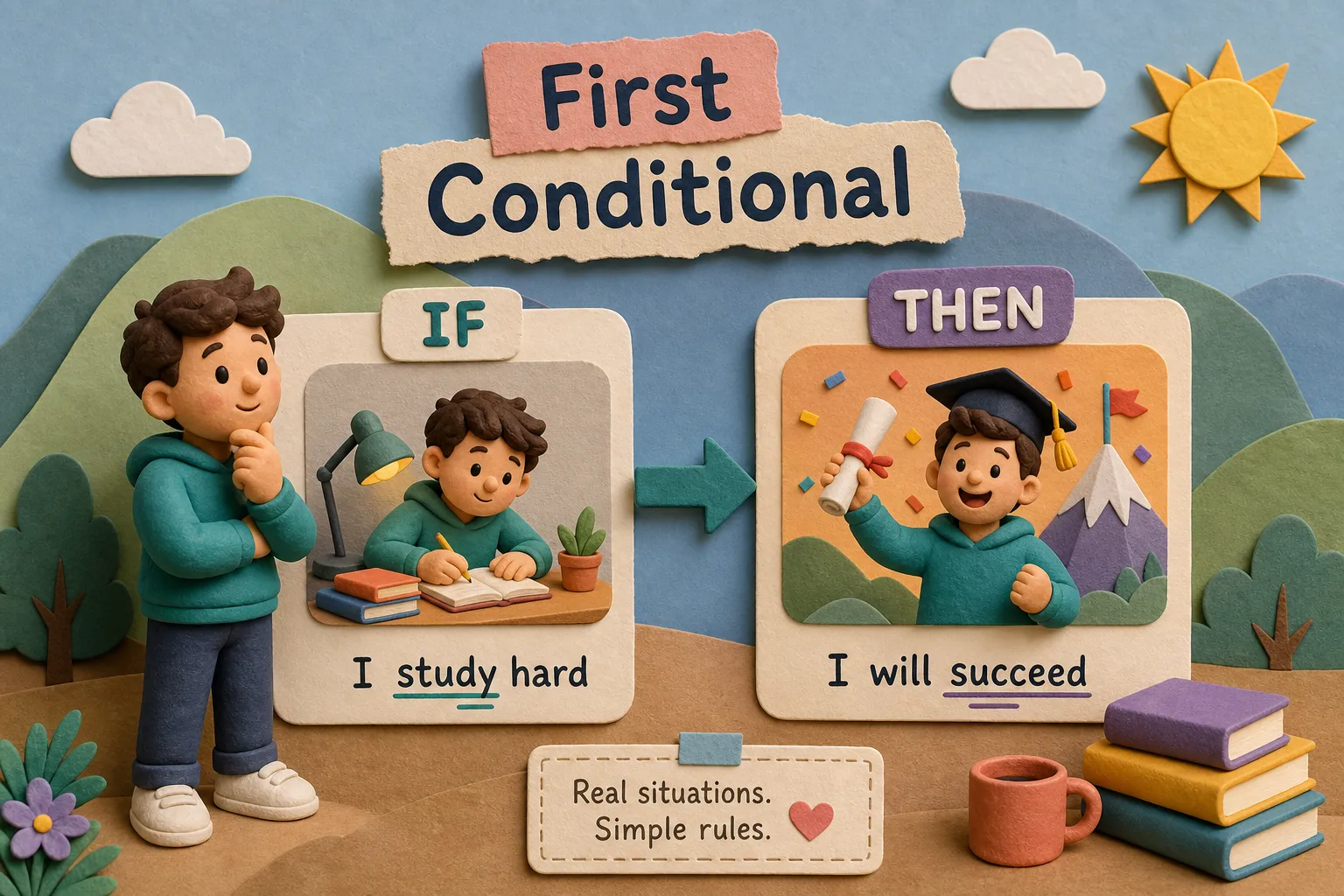
Every first conditional sentence has two parts. The first is the if-clause, which describes the condition. The second is the main clause, which describes the result. Look at this example: “If it rains tomorrow, I’ll stay home.” The if-clause is “If it rains tomorrow,” and the main clause is “I’ll stay home.” One part sets up the situation, and the other tells you what happens as a result.
The formula is simple: If + present simple / will + base verb. The if-clause uses the present simple tense, and the main clause uses will plus the base form of the verb. Notice that “I’ll” is just “I will” shortened with a contraction. In spoken American English, contractions like I’ll, we’ll, and you’ll are the norm rather than the exception.
There is one rule that trips up many learners: in standard first conditional sentences, avoid using “will” in the if-clause. Even though the sentence is about the future, the if-clause takes the present simple. This feels unusual at first, but it’s how English works. (Note: “will” occasionally appears in if-clauses to express willingness or politeness, for example, “If you will wait here, I’ll get the manager”, but that’s a specific, rare use rather than part of the standard conditional form and usage.) Also, notice that the comma disappears when the main clause comes first: “I’ll stay home if it rains.” Same meaning, same grammar, just a different word order.
First conditional in everyday American conversations
In day-to-day American life, this structure shows up in the most ordinary moments. At a coffee shop, you might hear: “If they’re out of oat milk, I’ll just get it black.” At the grocery store: “If the avocados aren’t ripe, I’ll skip the guacamole.” Making weekend plans: “If you finish work by six, we’ll catch the early showing.” These real conditional sentences feel immediate because the situations are genuinely possible.
The structure works equally well in professional settings. In meetings, project planning, and emails, the first conditional comes up frequently to connect actions with results. A few common examples from U.S. workplace communication:
- “If we submit the report by Friday, the client will review it over the weekend.”
- “If you have questions after the call, I’ll send a follow-up email.”
- “If we finish under budget, the client will be very happy.”
These conditional sentences for future planning set clear expectations and keep communication direct, which is exactly why they appear so often in American professional contexts. At Your Daily American, every grammar lesson is grounded in real workplace and daily life situations like these, because grammar clicks when you see it where it actually lives. Find more lessons in our Daily Grammar, Your Daily American.
Negative and question forms
You can make either part of the first conditional negative. To make the result negative, use won’t (will not) in the main clause: “If it doesn’t stop raining, we won’t go to the park.” To make the condition negative, use don’t or doesn’t in the if-clause: “If you don’t confirm by Monday, I’ll cancel the reservation.” You can also make both parts negative at once: “If you don’t call, I won’t wait.”
Forming questions is straightforward. You invert the subject and will in the main clause while the if-clause stays in the present simple. Here are two examples: “Will you call me if you’re running late?” and “What will you do if the flight is delayed?” Wh- questions, what, where, who, how, follow the same pattern and come up constantly in spoken American English. Practice saying them out loud so they start to feel natural.
First conditional vs. zero and second conditional
The zero conditional uses present simple in both clauses: If + present simple / present simple. It describes facts and situations that are always true, every single time, without exception. “If you heat water to 100°C, it boils” is a scientific fact, not a prediction. The zero conditional covers general rules and habits, not specific future events. For a clear comparison of zero, first, and second conditionals, see the British Council’s guide on conditionals: zero, first and second.
Type 1 conditional sentences, the first conditional, are different. They describe a specific, possible situation in the future where the result is likely but not guaranteed. The contrast becomes clear when you put them side by side: “If you eat too much sugar, you feel bad” uses the zero conditional because it’s a universal truth. “If you eat all that cake tonight, you’ll feel bad tomorrow” is a first conditional sentence about this particular moment.
The second conditional uses past simple in the if-clause and would in the main clause: If + past simple / would + base verb. You use it for imaginary or very unlikely situations, “If I won the lottery, I would travel the world.” That outcome isn’t expected. A side-by-side comparison makes the difference concrete: “If I get a raise, I’ll move to a bigger apartment” (first conditional: real and possible) vs. “If I got a raise, I would move to a bigger apartment” (second conditional: imaginary or very unlikely). The grammar itself signals how real the situation is.
Common mistakes to avoid
The most common mistake is using “will” in the if-clause. Here’s what that looks like: Incorrect: “If you will study hard, you’ll pass the test.” Correct: “If you study hard, you’ll pass the test.” This happens because it feels logical to use a future form when talking about something in the future. But in standard English conditionals, the if-clause takes the present simple, not will. No exceptions for the standard first conditional form. For more examples and explanations, you can read Perfect English Grammar’s first conditional page.
The second common mistake is using “would” in the main clause instead of “will.” Incorrect: “If it rains, I would stay home.” Correct: “If it rains, I will stay home.” “Would” belongs to the second conditional, for imaginary situations. “Will” belongs to the first conditional, for real and possible ones. A quick mental check before you speak or write: Is this situation real and possible? Use will. Is it imaginary or very unlikely? Use would. That single question will save you from this error every time.
Speakers whose first language is Spanish or Portuguese often make both of these errors. In those languages, both parts of a conditional sentence can take a conditional or future form, so the English rule, present simple in the if-clause, will in the main clause, requires deliberate practice to internalize.
Exercises: try it yourself
The best way to move grammar from a rule on paper to natural speech is to practice with real situations. Work through these exercises, then say your answers out loud. You can also try interactive practice on Espresso English’s first conditional lesson or download teaching activities from Teach-This first conditional activities.
Complete the sentence
Fill in the blank with the correct verb form:
- If I ________ (not / finish) my work on time, my manager ________ (be) unhappy.
- ________ you call me if you ________ (arrive) before 5?
- If the store ________ (close) early, we ________ (go) somewhere else.
- She ________ (not / come) to the party if she ________ (feel) tired.
Answer key: 1. don’t finish / will be. 2. Will / arrive. 3. closes / will go. 4. won’t come / feels.
Write your own sentences
Now try writing three original first conditional sentences. Use one of these situations for each: ordering food at a restaurant, a condition at work or in class, and your plans for the weekend. Write a full sentence for each one, then say it out loud. Hearing yourself use new grammar is one of the most effective ways to build real fluency.
You’re ready to use the first conditional
At this point, you have everything you need to use this structure correctly. You know the form, if + present simple / will + base verb, and you know how to apply it across real American contexts, from weekend plans to professional emails. You also know the two most common errors and how to avoid them.
This structure comes up frequently in American life, from casual plans between friends to professional emails between colleagues. The more you notice it in conversations, TV shows, and at work, the faster it will start to feel automatic. Also check our Common American Expressions Every English Learner Should Know, Your Daily American for related phrases and examples.
If you want to keep building your grammar skills in this same way, connected to real American situations and organized so you can progress step by step, Your Daily American offers structured lessons across grammar, pronunciation, vocabulary, and professional communication. Every lesson is grounded in how American English is actually spoken and used. The first conditional is one of the most practical structures in the language, and now you have the tools to use it with confidence. You may also find our Filler Phrases Every American English Learner Should Know helpful for sounding more natural in conversation.