You are watching an American TV show and two characters are talking. One says, “She’s dropping her album next Friday.” The other says, “Yeah, but he totally dropped the ball on the tour.” You understand every word, but the dropping meaning feels off. What does “dropping” have to do with albums? And why is a ball involved?
This is exactly the kind of confusion that comes up regularly in learner questions at Your Daily American. “Dropping” is one of those words that looks simple but carries very different meanings depending on the situation. It can describe a physical action, a release, a failed responsibility, or even animal waste, and those uses are not related at all.
By the end of this lesson, you will be able to identify which dropping meaning is being used, use it correctly in your own sentences, and avoid one specific mistake that can be embarrassing. Here is how the word actually works.
The core dropping meaning in everyday English
The word “dropping” comes from the base verb drop. The dropping definition, at its most basic, is the act of letting something fall or making something go lower. “Dropping” is the -ing form of that verb, and it works in three main grammatical roles.
As a present participle: describing an action in progress
A present participle is the -ing form used with “is,” “are,” or “was” to show that an action is happening right now or was happening at a specific time. Think of it as the “in progress” signal.
- She is dropping her daughter off at school right now.
- The temperature was dropping all night.
In natural speech, this sounds like: “Hey, where’s Maria?” / “She’s dropping the kids off. She’ll be back in ten minutes.” You can hear that the action is still happening.
As a gerund: when “dropping” acts like a noun
A gerund is an -ing verb that works as a noun, the subject or object of a sentence. The action becomes a thing you can talk about. This trips up a lot of English learners because the word looks like a verb but functions like a noun.
- Dropping the phone cracked the screen. (subject)
- I hate dropping important calls. (object)
In the first sentence, “dropping the phone” is the thing that caused the damage. It answers “what cracked the screen?” That is the noun job. If you want a deeper explanation of the difference between a gerund and a present participle, that guide is a clear resource for learners.
As a noun: talking about the act itself
You will also see “dropping” used as a pure noun, usually in an “of” phrase. This form is less common in everyday conversation but appears in formal writing and news.
- The dropping of the anchor signaled the end of the journey.
- There was a sharp drop in demand after the price increase.
This form names the event itself, like a thing that happened.
Phrasal verbs and common expressions with “dropping”
Native speakers use “dropping” inside phrasal verbs, a verb plus a preposition that creates a new, specific meaning, all the time. These phrases are very natural in American English, but the meaning is often hard to guess from the individual words alone. For a thorough guide to these combinations, see a practical guide to phrasal verbs.
“Dropping by” and “dropping in” for casual visits
Both of these phrases describe visiting someone informally. “Dropping by” often suggests a short, friendly visit. “Dropping in” can feel even more spontaneous, sometimes without warning.
- “Mind if I drop by your office after lunch?” (asking permission, polite)
- “She dropped in without calling first.” (unexpected visit)
Both phrases are informal and generally more appropriate for casual conversation than for formal settings. In a business context, “drop by” and “drop in” can sound too casual; you would more likely say “I’ll stop by” in conversation, or “I’ll come to your office at 2 p.m.” in a formal email or meeting request.
“Dropping off” for delivery, departures, and falling asleep
“Drop off” has two very common uses in American English, and they feel completely different.
The first use is about delivering or leaving someone or something at a place: “I’ll drop you off at the station.” / “Can you drop the package off at the front desk?”
The second use is informal and means to fall asleep without planning to: “He dropped off in the middle of the movie.” / “My grandfather always drops off during the afternoon news.”
Context makes the difference clear. If someone says “I dropped off,” check whether they are talking about a location or about sleep. The surrounding words will tell you. You can also check the dictionary entry for drop-off for usage examples and definitions that illustrate both senses.
“Dropping hints” and “dropping the ball”
“Dropping hints” means giving indirect signals about something without saying it directly. It comes up constantly in everyday American conversation. Example: “She kept dropping hints about wanting a birthday dinner at that new restaurant.” She never said “take me there” directly, but the hints were clear.
“Dropping the ball” is an idiom, a fixed phrase where the words together mean something different from their individual meanings. It means failing to do something important at a key moment. Example: “The team dropped the ball on the client presentation; nothing was ready.” The “ball” is not real. The phrase means someone failed to follow through when it mattered.
Dropping meaning in slang and American culture
In casual American conversation and on social media, “dropping” has taken on new meanings. These are especially common in music, fashion, and online culture. You will hear and read them frequently, so knowing them is important.
Dropping something new: albums, products, and collections
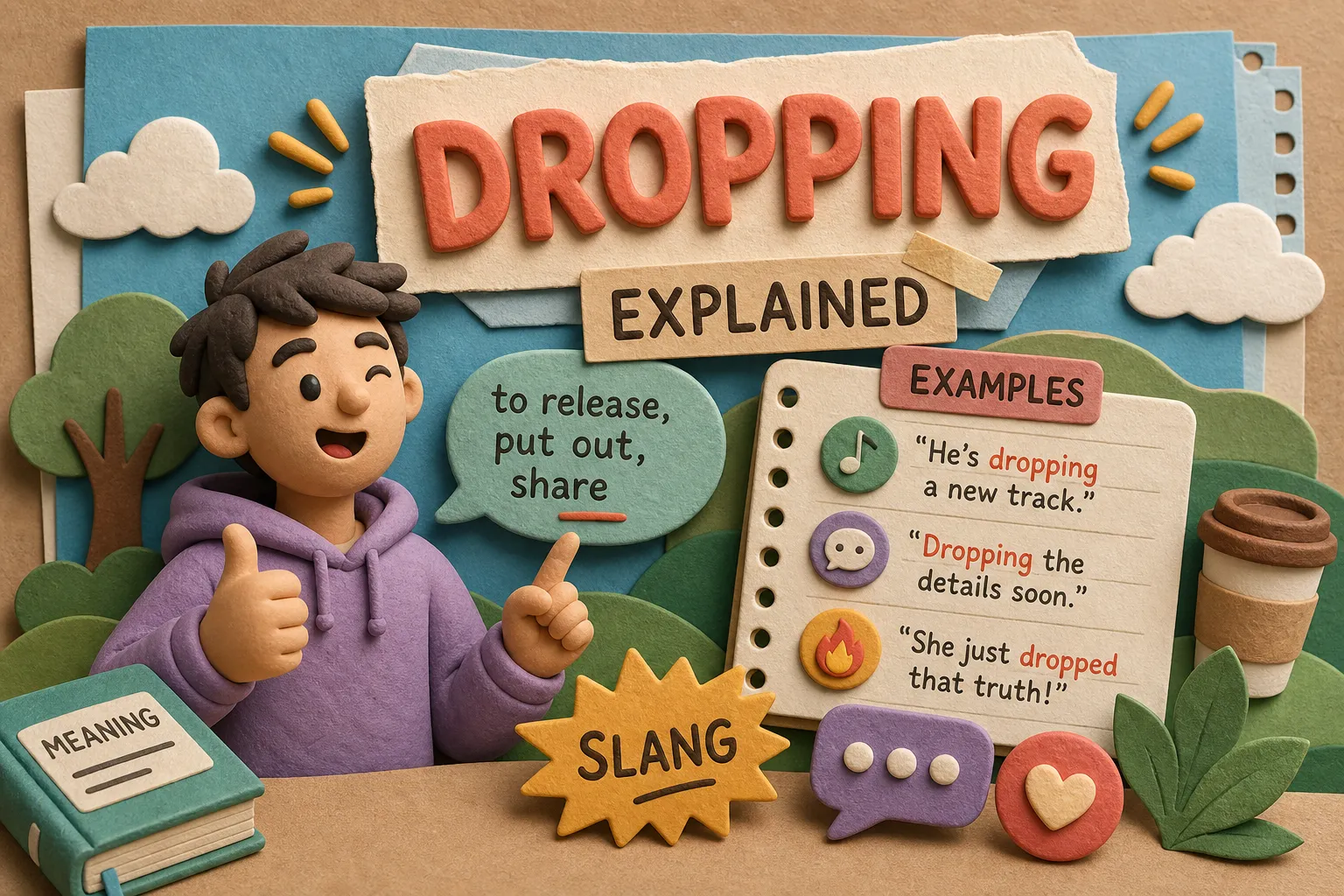
In pop culture, the dropping meaning shifts to releasing something new to the public. The term is documented in the record industry and retail distribution, the word traces back to trucks physically “dropping” bundles of newspapers or goods at stores, a usage that was later adopted by the music and retail industries and spread into broader cultural conversation.
- “Taylor Swift is dropping a new album this spring.”
- “The sneaker brand is dropping a limited collection on Friday.”
- “A new season of the show drops next week.”
You can use “drop” or “dropping” here interchangeably. This sense is now standard in music, streetwear, tech, and social media announcements. If you see a brand say “something is dropping,” it means new content or a product is coming out.
Dropping someone: ending a friendship or relationship
“Dropping someone” means deciding to cut contact with a person or stop being friends. It is direct and a little cold in tone.
- “She dropped him after the argument.”
- “He dropped those friends when he moved to a new city.”
This use is informal and most common among younger Americans and in social media conversations. In more formal situations, you would say “ended the friendship” or “stopped talking to.”
Dropping money: spending a large amount
To “drop” money informally means to spend a significant amount, usually in one purchase. “She dropped $500 on a new coat.” / “He dropped serious money on that vacation.”
The idea connects to the original verb: money leaves your hands. This use is casual and works in conversation with friends, not in formal writing.
“Dropping” vs. “droppings”: why one letter changes everything
“Droppings” (with an -s at the end) is a completely separate noun. It means animal waste or dung. It is almost always used in the plural form. Mixing up these two words can create a very embarrassing sentence.
What “droppings” means and when you’ll see it
“Droppings” appears in contexts like pest control, nature documentaries, and outdoor guides. It always refers to something an animal left behind. For a standard dictionary definition you can consult the Oxford Learner’s Dictionary entry for “droppings”.
- “We found mouse droppings behind the stove.”
- “The hikers saw bird droppings on the trail.”
- “The pest control company identified the droppings as rat waste.”
“Droppings” is almost never used as a verb, and the singular form “a dropping” to mean animal waste is very rare in standard usage. The standard form is the plural noun “droppings.” When you see it in print, it refers to what an animal left behind, full stop.
A quick check to avoid mixing them up
Use this simple rule: if the word refers to something an animal left behind, the correct word is “droppings.” If it refers to the action of dropping something, or to releasing or delivering something, use “dropping.”
| Situation | Correct word | Example |
|---|---|---|
| Animal waste | droppings | We saw rabbit droppings in the yard. |
| An action in progress | dropping | She is dropping her bag at the door. |
| Releasing something new | dropping | The artist is dropping a new single. |
The pronunciation is nearly identical in fast speech, so spelling is where the mistake usually happens. Pay attention to meaning before you write either word. If you want extra practice with similar pronunciation pitfalls, see our lesson on English Words Non-Native Speakers Mispronounce Most Often, Your Daily American.
How to identify dropping meaning in context
When you hear or read “dropping” and the meaning is not immediately clear, ask yourself three quick questions. Each one points toward a different sense of the word.
Three questions that resolve the meaning fast
1. Is there a direct object or a place word after “dropping”? If yes, it is likely a phrasal verb or a physical action. “She’s dropping her son off at practice.” The place (“at practice”) tells you this is a delivery, someone is being taken somewhere. That location clue reliably signals a phrasal verb.
2. Is the speaker talking about culture, music, fashion, or a product? If yes, the dropping meaning almost certainly refers to releasing something new. “The new collection is dropping next Thursday.” Cultural context shifts the word from physical to promotional.
3. Does “dropping” follow “is,” “are,” or “was”? If yes, it is a present participle describing an action in progress. “The temperature is dropping fast.” The helping verb is your signal that the action is ongoing right now.
Try it yourself: quick practice
Read each sentence and decide what “dropping” or “drop” means. The answers follow.
- “Can you drop me off at the library?”
- “The new collection is dropping Friday.”
- “Dropping the keys woke everyone up.”
Answers: (1) Deliver or leave someone at a place. (2) Release something new to the public. (3) Gerund, the act of dropping the keys is the subject of the sentence.
If you got those right, you are already reading context clues well. Your Daily American covers many more words like this one, words that shift meaning based on tone, context, and culture. The everyday vocabulary and Essential Phrasal Verbs You Must Know, Your Daily American sections are a great place to keep building this skill.
Putting it all together
“Dropping” works on three levels: its grammatical forms (present participle, gerund, noun), its role in common phrasal verbs (drop by, drop off, drop hints), and its slang meanings in American culture (releasing, ending a friendship, spending money). Understanding the dropping meaning in each situation comes down to reading the words and context around it. “Droppings” with an -s is a separate noun entirely, used almost exclusively for animal waste and never as a verb.
Context is always your best tool. Once you start noticing “dropping” in TV shows, podcasts, and everyday conversations, the different dropping meanings will become automatic. You will stop guessing and start understanding the word the way native speakers use it.
For more practical lessons on multi-meaning American words, phrasal verbs, and everyday expressions, explore the full vocabulary and conversation sections at Everyday American English, Your Daily American. Every lesson is built the same way: real language, real situations, and explanations that actually make sense.