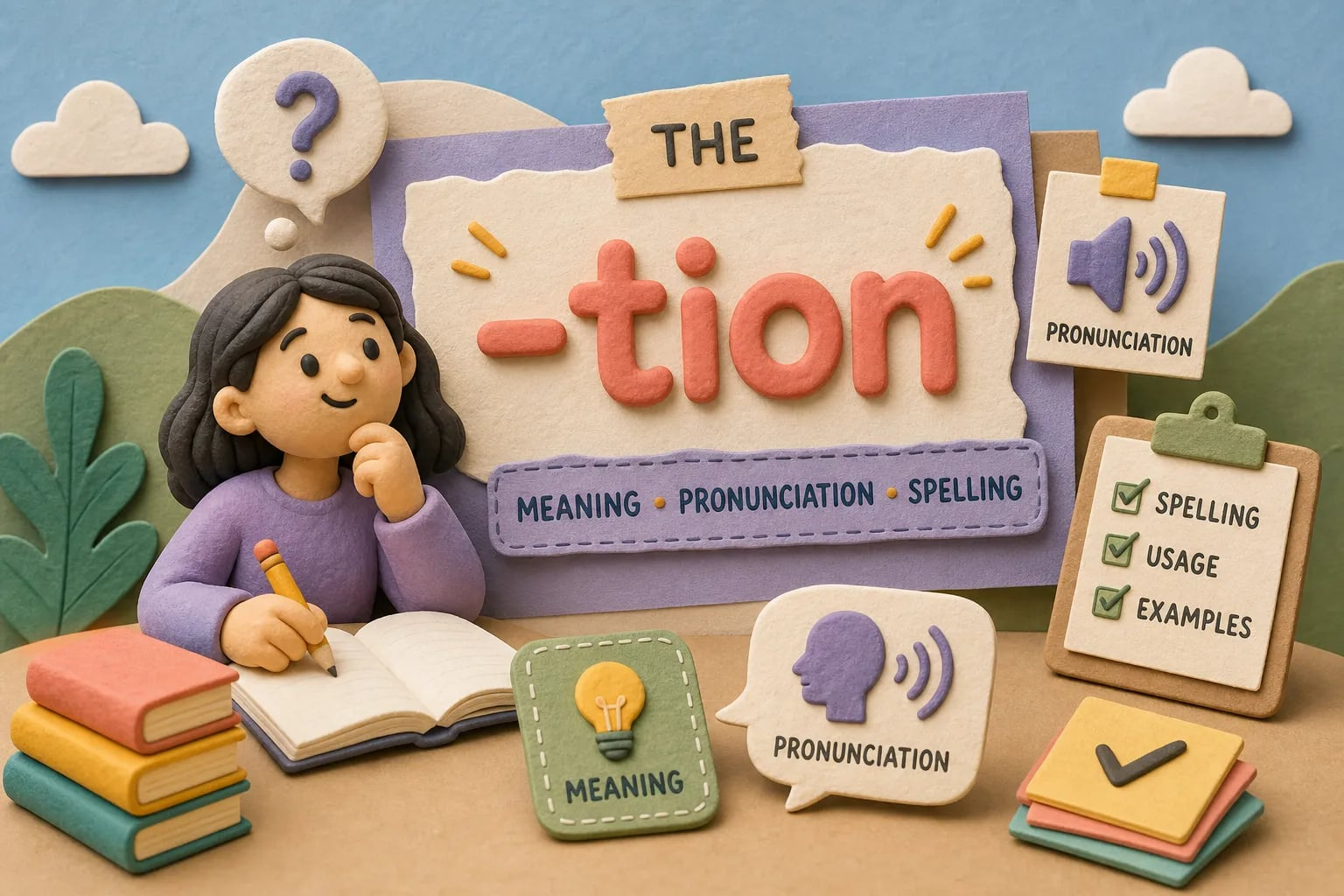
One suffix. Hundreds of words. The -tion suffix appears so often in American English that once you understand how it works, your vocabulary grows almost automatically. Words like action, education, information, and conversation all follow the same pattern, and mastering that pattern is far more efficient than memorizing words one by one.
By the end of this article, you’ll know exactly what the -tion suffix means, how to say it, and how to use it to recognize and build hundreds of English nouns on your own. At Your Daily American, this kind of pattern-based vocabulary work is exactly what we focus on, because knowing a pattern is more useful than memorizing a list.
What the -tion suffix means and where it comes from
The suffix -tion comes from Latin, specifically from a Latin ending called -tiō. Latin contributed a large portion of English vocabulary, mostly through French and through academic writing, and the -tion ending is one of the clearest signs of that Latin origin. This is why -tion words often carry a slightly more formal tone than everyday English words.
The -tion suffix has one job: it turns a verb into a noun. More specifically, it creates what grammar books call an abstract noun, a noun that names an action, process, or result rather than a physical object. The verb act becomes action, which names the process of acting. The verb educate becomes education, naming the process or result of educating. Understanding this helps you work out the meaning of any -tion word you encounter, even one you’ve never seen before.
When you know that -tion signals “a noun about an action or process,” you can make smart guesses about unfamiliar words. See realization for the first time? You can connect it to realize and understand that it describes the process or result of realizing something. That’s vocabulary-building through patterns rather than through isolated memorization.
How to pronounce the -tion suffix correctly every time
The -tion suffix is typically pronounced the same way in English: /ʃən/, which sounds like “shun” (rhymes with done and fun). In the sequence -tion, the letters ti produce the /ʃ/ sound, similar to the sh in shop, specifically in this Latin-derived morpheme and similar endings. (Note that ti doesn’t shift to /ʃ/ in all English words; compare tiger or tier, where the t keeps its regular sound.) The on becomes a relaxed /ən/, like the end of button.
Pronunciation examples
Take these words as a starting point for practice: nation becomes NAY-shun, action becomes AK-shun, information becomes in-for-MAY-shun, and education becomes eh-juh-KAY-shun. Say each one aloud and focus on the “shun” ending, it should feel consistent across all of them.
Stress patterns
In American English, the syllable directly before -tion is almost always stressed, said a little louder and slightly longer. In education, the stress falls on -ca-: “eh-juh-KAY-shun.” In suggestion, it falls on -ges-: “sug-JES-chun.” Worth noting: question and a handful of similar words have their own established pronunciations that don’t follow a simple predictable rule, so they’re best learned individually rather than derived from a formula.
For a deeper look at how suffixes interact with word stress, see word stress and suffixes. For a full guide to stress patterns in American English, check Word Stress in American English: A Complete Guide, Your Daily American.
In fast American speech, -tion words connect smoothly to the next word without a pause. “Pay attention to details” sounds closer to “pay uh-TEN-shun tuh DEE-tuhls.” The ending typically stays /ʃən/, though in very rapid speech it can reduce slightly to /ʃn/. Listening for that sound in conversations, podcasts, or workplace meetings is one of the fastest ways to train your ear to recognize these words.
For practical tips on how connected speech works and why words blend together, see How Linking Words Makes Your English Sound Natural. You can also find extra listening practice in our Pronunciation & Listening, Your Daily American section.
How verbs become -tion nouns: the main spelling patterns
Most verbs ending in -ate drop the final -e and add -tion, creating the very common -ation ending. This is the most frequent pattern you’ll see. When you encounter a long noun ending in -ation, there is almost always a verb ending in -ate behind it:
- create → creation
- operate → operation
- communicate → communication
- educate → education
Two other patterns appear often, especially in professional and academic English. Verbs ending in -ify typically shift to -ification: simplify becomes simplification, and qualify becomes qualification. Verbs ending in -ize typically shift to -ization: organize becomes organization, and realize becomes realization. These patterns hold in the majority of cases, though individual words can have spelling adjustments, so it’s always worth double-checking in a dictionary when the stakes matter.
Some verbs don’t follow the patterns above, and these are worth learning as a small group. Verbs ending in -duce or -mit change more significantly: produce → production, permit → permission. These are common in workplace English. Seeing them in context several times is the most reliable way to remember them, because there isn’t a simple rule to apply here.
For more on historical stem changes and how suffixes attach to Latin roots, see this primer on derived stems and suffixes.
Choosing between -tion and -sion: a practical rule
The clearest starting point for choosing between -tion and -sion is to look at the base verb. If the verb ends in -ate, -ute, or -it, -tion is usually correct: create → creation, execute → execution. If the verb ends in -d, -de, or -mit, -sion is typically the right choice: decide → decision, divide → division, admit → admission. This rule of thumb covers most cases you’ll encounter as an intermediate learner, though English has exceptions, so treating it as a strong starting guide rather than an absolute law will serve you well.
If you want a concise explanation of the rule of thumb idea and why it applies as a practical guideline rather than an absolute rule, that short overview is useful.
There is also a useful pronunciation shortcut. If the noun has a /ʒ/ sound (like the s in measure or vision), the spelling is always -sion: decision = “deh-SIH-zhun,” division = “deh-VIH-zhun.” If you hear a clear /ʃ/ (“shun”) sound, the word is usually spelled -tion. This sound-to-spelling connection is one of the rare cases in English where what you hear actually guides you to the correct spelling.
A short list of frequent -sion words helps you see the contrast clearly. Study them next to their -tion equivalents and the pattern will start to feel natural:
- discussion (from discuss)
- permission (from permit)
- decision (from decide)
- television (from televise)
High-frequency -tion words for daily life and work
Based on frequency data from large English corpora, certain -tion nouns come up constantly in everyday American English. Words like attention, question, information, situation, station, nation, direction, condition, option, and solution each connect to clear, real-life use. Can I ask you a question? Pay attention, please. What are my options? Practicing these in full sentences, rather than as isolated vocabulary items, is what moves them from passive recognition to active use.
Professional and workplace English also relies heavily on -tion nouns. These are the ones you’ll need in emails, meetings, and presentations: communication, organization, presentation, recommendation, application, collaboration, negotiation, promotion, evaluation, qualification. At Your Daily American, our pronunciation and vocabulary guides teach these words in context, the kind of context where they actually matter, like running a meeting, writing a professional email, or working through a job application. Hearing and using a word in the right situation is what makes it usable, not just familiar.
Here is a simple three-step exercise to try right now. Pick any five -tion nouns from the lists above. For each one, write the base verb, say the noun out loud using the “shun” sound, and use it in a sentence about your own life or job. For example: organize → organization → “I’m responsible for the organization of our team meetings.” This builds the connection between the verb, the noun, and a real context all at once, and that connection is what makes the word stick.
Put it all together and start noticing -tion everywhere
The -tion suffix is one of the most reliable patterns in American English. It consistently signals a noun, it typically sounds like “shun” (/ʃən/), and it almost always connects to a verb you already know or can figure out. That makes it one of the highest-value patterns to study as an intermediate or advanced learner.
Start by listening for -tion words in the conversations, podcasts, or shows you already follow. You’ll begin noticing them constantly. Then practice producing them using the verb-to-noun patterns from this guide until they feel natural. Over time, the -tion suffix won’t just help you recognize more words, it’ll help you sound more precise and more confident in both everyday and professional American English.
If you want to keep building on this kind of pattern-based vocabulary and pronunciation work, explore the study guides and lessons at Your Daily American, built around real language and real situations, the kind that lead to actual progress.