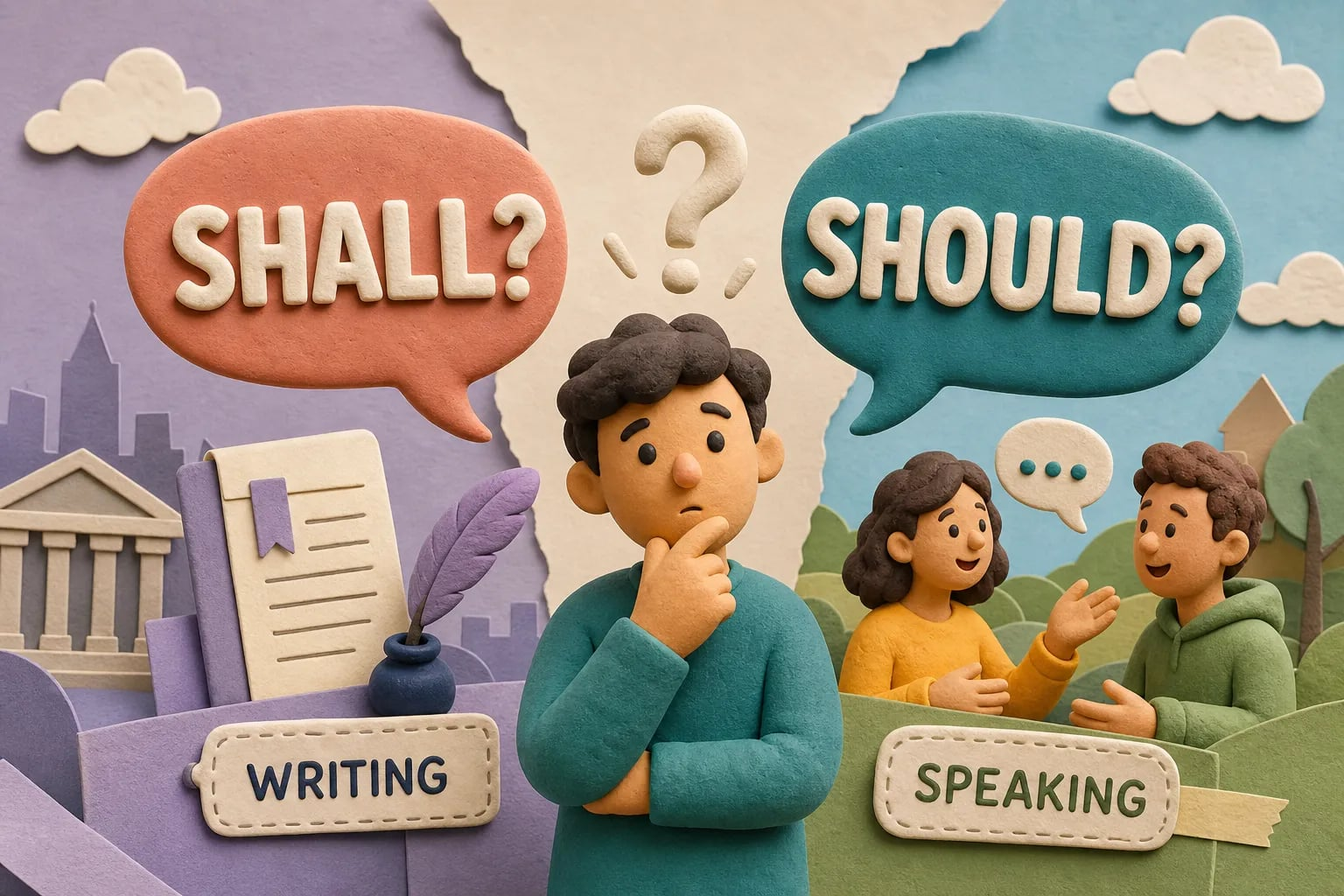
When learners ask about shall vs should, the answer comes down to one word: register. You write “Shall I send you the report?” to an American colleague. She reads it, pauses, and says, “Oh, sure, yeah, just send it over.” The message got through, but something felt off. You could see it on her face. What went wrong?
Nothing was grammatically incorrect. The problem was register: the level of formality your word choice signals. In American English, “shall” sounds stiff, old-fashioned, or even theatrical. Your colleague understood you, but it marked you as someone who learned from a different variety of English.
By the end of this article, you’ll know the real difference between “shall” and “should,” why Americans almost never use “shall” in daily life, and when each word actually belongs. At Your Daily American, the focus is on teaching American English as it’s actually used, in conversations, offices, and real situations, not just rules from a grammar book.
Shall vs Should: What they actually mean
Both words are modal verbs (helper verbs that change the meaning of the main verb). They both come before another verb to say something about obligation, advice, or the future. But they signal very different things to the reader or listener.
“Shall” traditionally expresses a strong obligation, a formal command, or something certain to happen. Think of it as a rule being stated out loud: “The law shall take effect on January 1.” “All visitors shall sign in at the front desk.” The tone is authoritative. It doesn’t ask, it declares. (For a concise dictionary explanation, see the Merriam-Webster definition of “shall”.)
“Should” expresses advice, a recommendation, or a strong expectation. It suggests rather than commands: “You should call her back.” “Applicants should submit materials before the deadline.” “Should” is softer. It tells you what is a good idea, not what is required.
Here is a side-by-side example that shows the difference clearly. “Employees shall submit reports by Friday” reads like a company rule, no negotiation. “You should submit your report by Friday” sounds like a helpful reminder from a colleague. Same deadline, very different tone.
Why “shall” sounds strange in everyday American speech
In British English, “shall” is used more naturally in everyday statements and questions, especially in the first person. A British speaker might say “I shall be there at noon” without it sounding unusual. An American speaker would simply say “I will be there at noon,” or more likely, “I’ll be there at noon.”
American speakers rarely hear “shall” in normal conversation. When they do, it sounds formal, dramatic, or like something from an old film. Even “Shall we go?”, which is grammatically fine, can feel slightly stiff at a work lunch in the U.S. Most Americans would say “Should we go?” or just “Ready to go?”
Corpus data from COCA (Corpus of Contemporary American English, a large database of real American English text and speech) confirms this. “Shall” has declined sharply in American usage over recent decades. In spoken American English, “will” is used about 14 times more often than “shall.” Meanwhile, “should” has stayed common and stable across all types of writing and conversation.
If you grew up using British textbooks or watching British television, you likely saw “shall” more often. That’s where the confusion comes from. The word is real and grammatically correct, it just belongs to a different variety of English than the one Americans speak today.
How “should” works in everyday American English
“Should” does two main jobs in American English, and both are extremely common. The first is giving advice or making a recommendation. This is the meaning most learners know: “You should follow up with the client.” “You should try the pasta here.” “Applicants should submit all materials by March 15.”
In each case, “should” tells someone what is a good idea. It’s softer than “must” and more polite than “have to,” which is exactly why Americans use it so often.
Should for probability
The second job is expressing probability, saying that something is likely or expected. This meaning surprises many ESL learners because they only learned “should” as advice. In American speech, “The package should arrive tomorrow” is very natural. It means the package is expected to arrive, but it’s not 100% guaranteed.
Here is how “should” compares to similar modal verbs for probability:
- “Might arrive”, possible, but uncertain (about 20, 40% confidence)
- “Should arrive”, expected, very likely (about 70, 85% confidence)
- “Will arrive”, certain (close to 100% confidence)
Look at this short exchange: “When do you think the client will respond?” “She should get back to us by Thursday, she said she’d review it today.” The second speaker isn’t giving advice. She’s expressing a strong expectation based on what she knows. That dual role, both advice and probability, is what makes “should” so useful in American English.
Shall vs Should in contracts and legal writing
There is one specific place where “shall” is still common in American English: formal legal documents. In contracts, regulations, and government specifications, “shall” signals a mandatory requirement. “The contractor shall complete all work by the agreed date.” “The vendor shall provide written notice of any delays.” In this context, “shall” means “is required to”; it creates a binding obligation.
Here is a simple example showing the contrast inside the same document:
“The supplier shall deliver goods within 30 days of the order date. Goods should be packaged in recyclable materials where possible.”
The first sentence is a requirement. The second is a recommendation. That contrast is intentional and meaningful in legal writing.
A shift away from “shall” in legal drafting
Even in legal documents, “shall” is becoming less common. Several authoritative sources recommend moving away from it:
- The Chicago Manual of Style recommends using “must” for mandatory requirements because “shall” has been interpreted inconsistently by courts.
- The U.S. Federal Rules of Civil Procedure removed “shall” entirely to eliminate ambiguity.
- The U.S. Supreme Court has noted that “shall” can sometimes be read as “may,” depending on context.
So even legal writers are moving toward “must” for obligations, “will” for future commitments, and “should” for recommendations. If you work in law, compliance, or corporate settings, you will see “shall” regularly. But if you are writing a professional contract yourself, “Professional English, Your Daily American” resources and modern drafting guides suggest “must” is the safer and clearer choice in modern American professional writing.
Simple rules for choosing the right word every time
The decision is simpler than it looks. Ask yourself one question: “Am I writing a legal contract or formal regulation?” If yes, “must” (or “shall” in older-style documents) may be appropriate for mandatory requirements. In every other situation, emails, conversations, presentations, social messages, Everyday American English, Your Daily American and professional writing, use “should” for advice and expectations, and “will” for future plans.
Before you move on, try these three sentences. Fill in “shall” or “should” and check the answers below:
- “You _____ drink more water, it really helps.”
- “All employees _____ complete the safety training by December 31.” (contract language)
- “The flight _____ land around 3 p.m.”
Answers: should (advice), shall or must (mandatory obligation in formal writing), should (probability/expectation).
Now, here are the most common mistakes ESL learners make with these two words:
- Using “shall” in casual questions: “Shall I help you?” sounds overly formal to most Americans. Say “Can I help you?” or “Do you need help?” instead.
- Using “shall” for first-person future statements: “I shall call you later” follows a British pattern. Americans say “I’ll call you later.”
- Treating “shall” as a formal version of “will”: In American English, “shall” is not simply a more polite “will.” It carries a specific meaning of obligation or requirement. Using it in regular conversation makes you sound out of place, not more professional.
At Your Daily American, lessons focus on the patterns that actually appear in American workplaces, classrooms, and conversations, not the older formal patterns that still show up in some textbooks. That’s how you learn not just what’s grammatically possible, but what sounds right in a real American context. Learn more about the project on the About, Your Daily American page.
Putting it all together
The shall vs should distinction is one of the clearest windows into how American English differs from other varieties. “Should” is the word Americans use every day, covering advice, suggestions, and strong expectations. “Shall” belongs in legal documents, formal regulations, or historical writing, and even there, “must” is increasingly preferred for clarity.
This distinction matters for a practical reason. Using “shall” in daily American conversation won’t cause a misunderstanding. People will know what you mean. But it will signal that your English was shaped by a different variety, British English, older textbooks, or formal study materials. Knowing the shall vs should difference lets you make a conscious choice about how you want to sound.
That gap between “technically correct” and “sounds like a real American” is exactly what Your Daily American is built to close. The platform covers the real patterns of American speech, the kind you hear in meetings, offices, and everyday conversations, with lessons organized so you can build steadily from where you are right now. Explore more American English lessons at Everyday American English, Your Daily American and start closing that gap today.