If you’ve ever typed “carefull” and wondered why spell-check flagged it, you already have a reason to learn about the -ful suffix (sometimes searched as “ful suffix”). This small ending shows up in hundreds of everyday English words, and once you understand how it works, a lot of spelling questions answer themselves.
Imagine you’re in a work meeting. Your American colleague just helped you finish a difficult report, and you want to say something kind. You reach for a word like “thoughtful” or “grateful,” and it sounds exactly right. But later, you wonder: why do so many English adjectives end in -ful? What does that ending actually mean?
By the end of this article, you’ll have three things squared away. You’ll understand what the -ful suffix means and where it comes from. You’ll apply the correct spelling rules with confidence. And you’ll have 30, 40 common -ful adjectives ready to use in real American conversations, at work, and in your writing. At Your Daily American, this kind of practical vocabulary work sits at the heart of everything: not just word lists, but words you can use immediately in real situations.
What the -ful suffix actually means
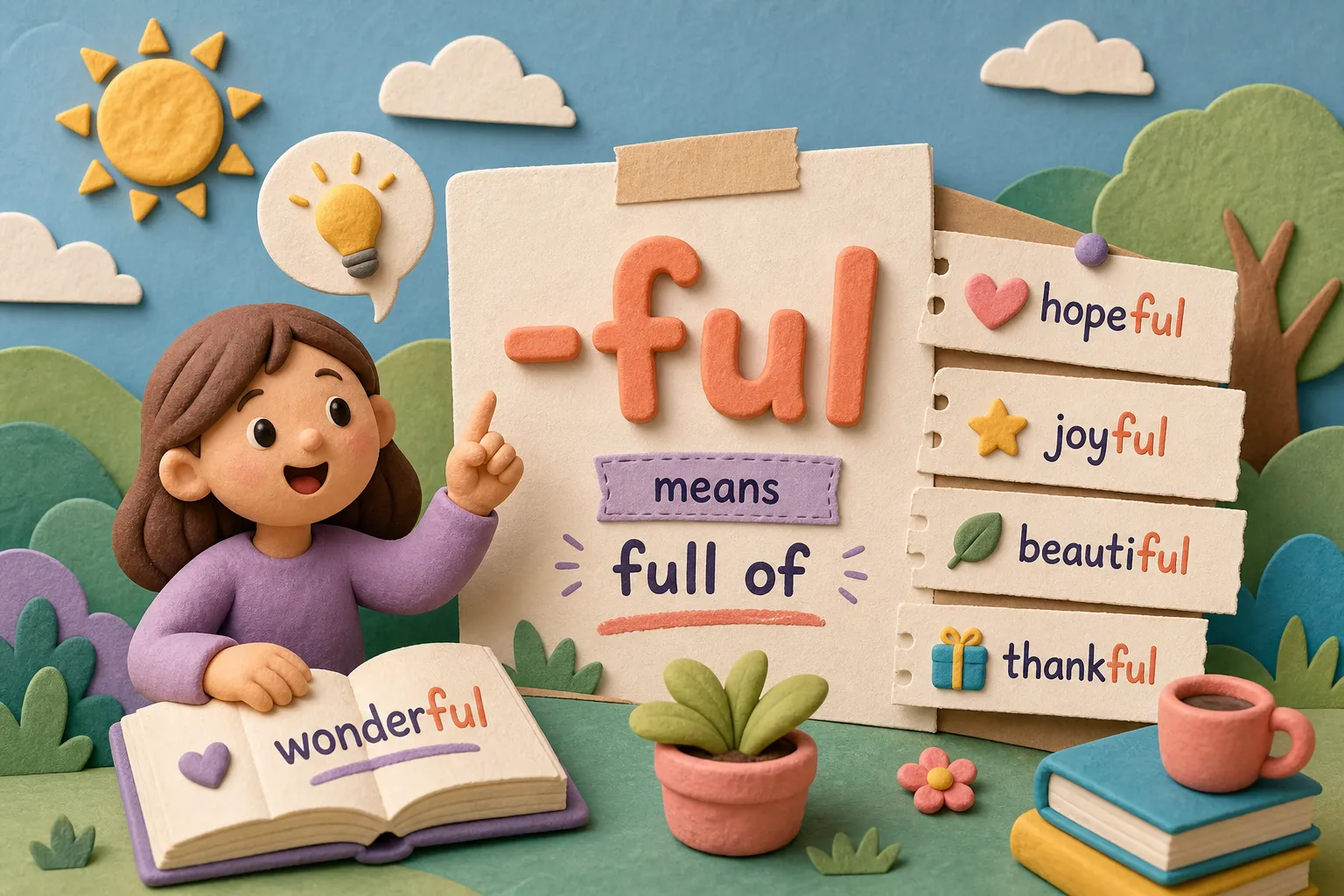
The core meaning: “full of”
The suffix -ful comes from the Old English word full, which meant exactly what you think. When someone in Old English said a cup was “ful,” they meant it was filled all the way to the top. Over hundreds of years, this word stopped being separate and joined directly to nouns to create new adjectives. Today, when you add -ful to a noun, you get an adjective that means “having a lot of” or “having the quality of” that noun. You can read more about the etymology of -ful for a concise history of this ending, and for a broader look at word endings see this overview of suffixes.
The pattern is logical. Care + ful = careful (full of care). Joy + ful = joyful (full of joy). Power + ful = powerful (full of power). Once you see this pattern, you can work out new -ful words you’ve never encountered before. If someone uses the word “sorrowful,” you don’t need to look it up. You already know it means “full of sorrow.”
How -ful changes a word’s job
The -ful suffix most commonly turns a noun into an adjective, though it also forms nouns of quantity (think handful or spoonful) and occasionally attaches to verb stems, as in wakeful. Beauty is a noun, but beautiful is an adjective. Help can be a noun or a verb, but helpful is always an adjective. This shift in word class means -ful words are well-suited for describing people, situations, feelings, and things. Many of the most common -ful adjectives, grateful, helpful, powerful, turn up frequently in everyday American speech, which is exactly why building fluency with them pays off quickly. These words do a lot of work in a small package.
Spelling rules for the -ful suffix: what changes and what doesn’t
Keep the silent e and the y after a vowel
Because -ful starts with a consonant (the letter f), you do not drop the silent e when you add it to a base word. This is different from suffixes like -ing or -ed, which start with a vowel and do cause the silent e to drop. With -ful, the base word stays intact: hope → hopeful, care → careful, grace → graceful.
The same idea applies to words ending in vowel + y. When the base word ends in a vowel followed by y, such as “joy,” you keep the y: joy → joyful. There is no change to the base word at all. This makes adding -ful one of the more predictable suffix rules in English spelling.
The single l rule and when it doubles
The suffix -ful has only one l, not two. This is one of the most common spelling mistakes ESL learners make. The correct spelling is “careful,” not “carefull.” It is “helpful,” not “helpfull.” The reason people make this mistake is understandable: they picture the standalone word “full” and want to keep both l’s. But when “full” became a suffix, it lost one l.
The main exception to watch for is when the base word itself ends in a double l. In those cases, the double l carries over into the new word. For example, skillful keeps both l’s from “skill” (skill + ful = skillful), and willful keeps both l’s from “will.” The verb fulfill also retains the double l in American English, per Merriam-Webster. As a practical rule: if the base word ends in -ll, expect the spelling to stay doubled. For every other common -ful word, one l is correct. For classroom-friendly summaries of common spelling patterns, see this brief guide to spelling rules.
Forty common -ful words you can use right now
Words for everyday conversation
These -ful adjectives appear regularly in daily American life. They feel warm and natural in casual speech, and you’ll hear them in conversations with friends, neighbors, and coworkers.
- Beautiful, cheerful, colorful, playful: “The weather is beautiful today.” / “She’s always cheerful in the morning.”
- Helpful, useful, hopeful, peaceful: “This tool is really useful.” / “The park was peaceful and quiet.”
- Wonderful, thankful, grateful, harmful, painful: “That’s a wonderful idea.” / “I’m so grateful for your help.”
These words slot easily into short, clear sentences. A direct sentence with a well-chosen -ful adjective often sounds more natural than a long, complicated one.
Words for describing people and emotions
These adjectives help you talk about character and feelings. They’re common in personal conversations and in writing. Learning them gives you a richer way to describe the people around you.
- Thoughtful, faithful, respectful, truthful: “He remembered my birthday, that’s so thoughtful.”
- Boastful, doubtful, willful, resentful: “She was doubtful about the plan at first.”
- Sorrowful, joyful, fearful, shameful, merciful: “The children were joyful at the end of the school year.”
A short example exchange: “He sent me flowers after the rough week I had.” / “Really? That’s so thoughtful of him.” / “I know. He’s always been faithful and kind.” Notice how these -ful adjectives make the conversation feel specific and real.
Words that work in professional and workplace settings
These -ful adjectives show up in emails, meetings, and performance reviews. Knowing them helps you sound professional and confident in American workplace environments.
- Successful, resourceful, skillful: “The project was successful.” / “She’s incredibly resourceful under pressure.”
- Tactful, insightful, meaningful: “That was a tactful way to handle the situation.” / “Thank you, this feedback is really insightful.”
- Powerful, mindful, stressful: “His presentation was powerful.” / “This week has been really stressful.”
One quick note on tone: “tactful” and “insightful” are generally positive choices when you want to compliment a colleague, though context always matters. “Stressful” describes a situation, not a person. You say “the deadline was stressful,” not “you are stressful.”
How native American English speakers actually use -ful adjectives
Natural phrases you’ll hear every day
Native speakers combine -ful adjectives with common sentence patterns in natural ways. These examples show you what real American speech sounds like, not just what individual words mean.
- “That was so thoughtful of you.”
- “This week has been really stressful.”
- “I’m grateful for your help.”
- “She’s incredibly resourceful.”
“Thankful” and “grateful” are similar in meaning, but they’re not interchangeable. “Thankful” tends to be more immediate and situational, you feel thankful when something good happens or when you avoid something bad. “Grateful” carries more emotional weight. You feel grateful for someone’s lasting kindness or long-term support. In professional settings, “grateful” often sounds more sincere.
-ful vs. -fully: adjective or adverb?
Here’s a distinction worth knowing. The suffix -ful creates adjectives. The suffix -fully creates adverbs. This matters because the two forms do different jobs in a sentence.
- She was careful. (adjective, describes the person)
- She spoke carefully. (adverb, describes how she spoke)
- He’s a hopeful person. (adjective)
- He smiled hopefully. (adverb)
A common ESL mistake is using the adjective where the adverb belongs: “She handled it careful” should be “She handled it carefully.” If you’re describing how an action is done, reach for the -fully form. If you’re describing what someone or something is like, -ful is correct.
-ful adjectives in workplace small talk and emails
A quick exchange before a meeting might sound like this: “Hey, thanks for covering for me yesterday.” / “Of course! No problem at all.” / “You’re always so helpful. I really appreciate it.” In an email, a line like “Thank you, this feedback has been really insightful” sounds professional and warm at the same time.
Using -ful adjectives well makes you sound specific and natural, not stiff or overly formal. If you want to practice these words in full conversations rather than just reading them in a list, consider practicing with common filler phrases that make small talk flow more naturally. Also, if pronunciation matters to you, check our guide to word stress in American English to make sure those -ful adjectives sound native in phrases and sentences.
Making these words part of your everyday speech, on the phone, in meetings, or during casual conversations, helps them stick much faster than memorizing lists alone.
Common mistakes ESL learners make with -ful
Adding -ful to the wrong base word
Not every noun or adjective can take -ful. Some combinations simply don’t exist in English. Here are three errors that ESL learners commonly produce:
- “Kindful” is not a real word. Use “kind” or “kindhearted” instead.
- “Tiredful” is not standard. Use “tired.”
- “Angryful” is not real. Use “angry.”
The safest rule is straightforward: if you’ve never seen or heard a word ending in -ful, look it up before using it. A quick dictionary check takes five seconds and saves you from a confusing moment in conversation. For a community-built list of established -ful forms and usage notes, see Wiktionary’s -ful entry.
Confusing “full” and “-ful”
Full is a standalone adjective that means “not empty”: “The glass is full.” The suffix -ful is a different thing entirely. It attaches to a base word and means “having the quality of.” When people write “carefull” or “usefull” with two l’s, it’s usually because they’re picturing the word “full” in their mind.
A simple way to remember this: when “full” became a suffix, it lost one l. One concept, one l. Say it to yourself a few times and it will stick. The suffix -ful ends in a single l for nearly every word, with the exception of bases that already end in -ll, such as skillful, willful, and the verb fulfill (the American English standard per Merriam-Webster).
Frequently asked questions about the -ful suffix
How do you spell “careful”, is it one l or two?
One l: careful. The base word “care” does not end in -ll, so the suffix stays as -ful. Writing “carefull” is a common mistake, but it’s always incorrect.
When does the -ful suffix keep a double l?
When the base word ends in a double l. Skill → skillful. Will → willful. Because the double l belongs to the base, not the suffix, it carries over. For every other base word, use a single l.
What is the difference between -ful and -fully?
-ful forms adjectives (careful, hopeful, peaceful). -fully forms adverbs (carefully, hopefully, peacefully). Use -ful to describe what something or someone is like; use -fully to describe how something is done.
Can -ful attach to any word?
No. English has a set list of established -ful words, and not every noun produces a natural combination. When in doubt, check a dictionary like Merriam-Webster before using an unfamiliar -ful form.
Try it yourself: a quick practice with -ful
Three sentence prompts to complete
Read each sentence starter below and choose a -ful word to complete it. There are multiple correct answers for each one. After you write your answer, say the sentence out loud, speaking a word reinforces it far better than reading alone.
- “After a long week, I feel __________.”
- “My coworker is always __________ when I need help.”
- “The presentation was __________ and the client was very impressed.”
Some possible answers: peaceful / hopeful / grateful (1), helpful / cheerful / resourceful (2), insightful / powerful / meaningful (3). Did you come up with your own words? Even better, any correct -ful adjective that fits the sentence is a win.
One spelling check
Look at the five words below. Fill in the blank with one l or two l’s to make the correct spelling:
- hope___ul
- skil___ul
- care___ul
- ful___il
- peace___ul
Answers: hopeful (one l), skillful (two l’s, from “skill”), careful (one l), fulfill (two l’s, American English standard), peaceful (one l). If you got all five correct, you’ve already mastered the trickiest part of this suffix.
You now have a real tool for American English
The -ful suffix means “full of” or “having the quality of,” and it traces back to the Old English word full. The spelling rule is reliable: one l for almost every word, keep the silent e in the base, and remember that bases ending in -ll carry their double l into the new word (skillful, willful, fulfill). You also now know the adjective-versus-adverb split, -ful for describing things, -fully for describing actions, and you have dozens of -ful adjectives ready for conversations, meetings, emails, and everyday small talk.
These words are not grammar exercises. They come up every single day: when a friend does something kind, when a work project goes well, when a situation feels difficult. The more you notice -ful adjectives in American TV shows, podcasts, and conversations around you, the more natural they’ll feel. You’ll start to hear them everywhere, and then use them without thinking.
If you want to keep building this kind of practical, real-world American English fluency, visit Your Daily American. Every lesson is built to help you use the language with confidence, not just recognize it on the page.