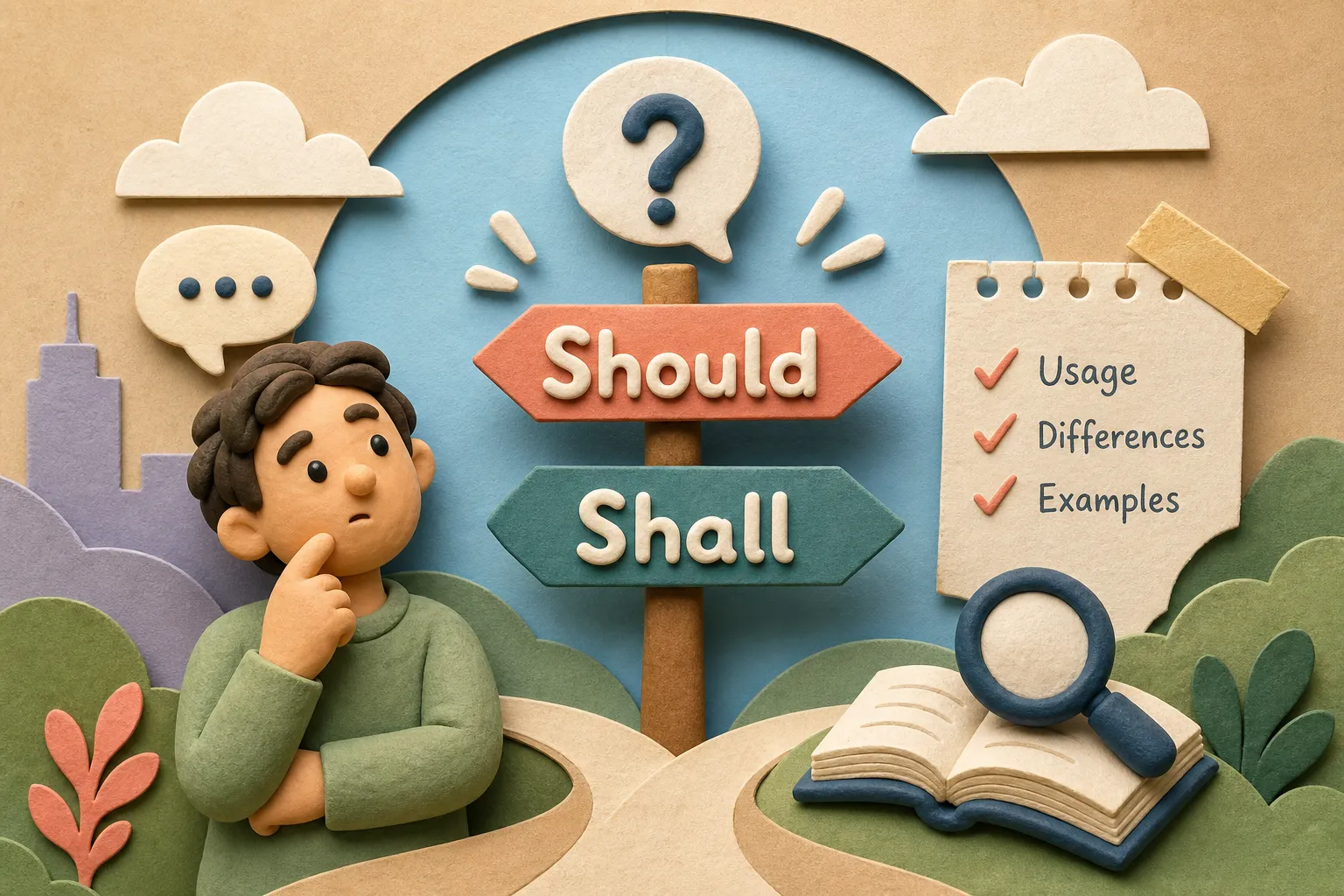
Picture this: you’re watching an American TV show, and a character dramatically says, “You shall not pass!” It sounds powerful, almost theatrical. Then the next day, your coworker says, “You should send that email before the meeting.” That sounds completely normal. Same kind of helping verb, but one feels like it belongs in a movie and the other fits right into daily life. Why? This lesson breaks down the should vs shall distinction in American English so you know exactly which word to use, and when.
By the end of this lesson, you’ll know what both modal verbs mean, why Americans almost never use “shall” in conversation, and which word to choose in any situation, from a casual chat to a formal contract. At Your Daily American, the goal is to teach you not just grammar rules but how real American speakers actually talk. This lesson is a perfect example of that.
What “should” and “shall” actually mean
Both words are modal verbs, helping verbs placed before a main verb to add meaning like obligation, advice, or probability. Think of them as volume controls on a stereo. “Shall” is turned up high: it signals something that must happen, particularly in formal or legal contexts. “Should” is softer: it signals advice, a recommendation, or a reasonable expectation. For a clear comparison of the two, see this concise explanation of the difference between “shall” and “should”.
The meaning of “shall”
“Shall” expresses a strong obligation or a definite future action. When a person in authority says, “You shall submit the report by Friday,” the intent is a mandatory requirement, though it is worth noting that courts sometimes interpret “shall” differently depending on context, which is part of why modern legal writers are moving away from it. Historically, “shall” also expressed firm intention in the first person, as in the famous wartime phrase, “We shall fight on the beaches.” That kind of strong, certain tone is exactly why “shall” sounds dramatic to modern American ears.
The meaning of “should”
“Should” is far more flexible. It carries the meaning of advice, suggestion, or probability, and it leaves the final decision with the listener. Consider how Americans use it: “You should drink more water” (advice), “The bus should arrive in five minutes” (probability), “You should try the pasta here” (recommendation), or “Should I call him now?” (asking for a suggestion). In every case, “should” opens a conversation rather than closing it with a command.
Why “shall” sounds strange to American ears
This is the most important section for anyone learning American English. Linguistic evidence and usage surveys consistently indicate that “shall” is now rare in American everyday speech. When Americans hear it outside of a movie or a legal document, it registers as old-fashioned, overly formal, or out of place.
A short history of the shift
British English kept “shall” in casual use much longer than American English did. Over the past century, American speakers replaced “shall” with “will” for future actions and “should” for advice and recommendations. Usage guides and linguistic commentary note that “shall” became effectively absent from popular American speech decades ago, surviving mainly in legal documents and regulatory texts. The U.S. government began replacing “shall” with “must” in official rules, a trend that picked up speed in the 2000s and became formal federal policy in April 2025 when Executive Order 14275 directed the replacement of “shall” with “must” in major federal procurement regulations.
What Americans say instead
Here is a direct comparison showing the natural American replacements:
| Formal “shall” version | Natural American version |
|---|---|
| “Shall I open the window?” | “Do you want me to open the window?” / “Should I open the window?” |
| “We shall meet at noon.” | “We’ll meet at noon.” |
| “You shall complete this form.” | “You need to complete this form.” |
| “Shall we begin?” | “Ready to start?” / “Should we get started?” |
Replacing “shall” with “will,” “should,” or “need to” is not informal or incorrect. It is simply how American English works.
How British English uses “shall” more naturally
If you learned English from British textbooks or watched a lot of British TV, you have seen “shall” used in ways that sound natural and polite there. That is not wrong for British English. But because American English took a different path, the same sentences can sound slightly out of place in an American setting, so understanding that divide is genuinely useful.
Should vs shall in British questions and offers
In British English, “shall” is still common in first-person questions, especially when offering help or making suggestions. “Shall I carry that for you?” or “Shall we get started?” are perfectly normal in a British office. In an American workplace, those same sentences would sound unusually formal, almost as if you were reading from a script. Americans would simply say, “Want me to carry that?” or “Ready to get started?”
Why this matters for your fluency
Understanding the British versus American difference is part of building real fluency. Knowing that a sentence is grammatically possible is only half the story. You also need to know whether real American speakers actually say it. That kind of practical, cultural knowledge sits at the core of every lesson at Everyday American English, Your Daily American, because grammar rules alone cannot tell you how a language lives and breathes in real conversations.
How “should” works in everyday American speech
“Should” is among the most common modal verbs in American English, one you will reach for constantly. It does a lot of work. Its two most important functions are giving advice and expressing probability, and the distinction between them is worth understanding clearly.
“Should” for advice and recommendations
“Should” is the natural choice whenever Americans give advice or share an opinion about what someone else ought to do. It works equally well in a casual chat with a friend and in a professional setting. “You should bring an umbrella, it’s supposed to rain” is everyday advice. “I think you should talk to your manager about that” fits a workplace conversation. “You should try restarting the app; that usually fixes it” works as tech support. What all of these have in common is that “should” gives a recommendation without forcing a decision. The other person still has a choice, and that softer tone is exactly right for most everyday American exchanges.
“Should” for probability and expectations
“Should” also expresses that something is likely to happen, a use that trips up many learners. When Americans say, “The package should arrive by Thursday,” they mean they expect it, but they are not 100% certain. Compare “You should take more breaks” (advice) with “She should be at her desk by now” (probability). The structure looks the same; the meaning shifts based on context. Pay attention to whether the speaker is talking about a person’s choice or about a likely outcome. That single distinction unlocks a lot of natural-sounding American conversation.
When “shall” still appears in formal American writing
Even though “shall” has nearly disappeared from American conversation, you will still encounter it in certain written documents. Knowing where it appears helps you read contracts and official texts with confidence.
“Shall” in legal contracts and official documents
In American law, “shall” has traditionally signaled a mandatory obligation. If a contract says, “The tenant shall pay rent on the first of the month,” the intent is that this is required, not optional. This use is specific to written legal language, you will not hear it in a normal business conversation. Typical contract examples include: “The contractor shall deliver the completed project by June 30” and “Each party shall keep the other’s information confidential.” Legal commentators have written at length about the problems caused by using “shall” in contracts; see this discussion of whether to use “shall” in contracts for a practical overview.
Why “must” is replacing “shall” in modern writing
Many legal and professional style guides now recommend “must” instead of “shall” in contracts and official documents. The reason is straightforward: “shall” can be interpreted differently by different readers and courts, and that ambiguity creates confusion. In some cases, it has led to legal disputes. The U.S. Supreme Court has noted that “shall” can sometimes be read as “may,” depending on context. Authorities and style resources such as the Chicago Manual of Style address usage concerns, and standards organizations provide guidance on clearer wording as well, for example, see this overview from ASQ on “shall” vs “should” in standards. Bryan Garner, one of the most respected authorities on legal writing in the United States, has argued for years that “must” is the clearer, safer choice. For learners, the practical takeaway is simple: in formal American writing, “must” signals a requirement with far less room for misreading than “shall” allows.
Practice: choosing the right word in American situations
Here is a simple decision guide for choosing the right word in American English, followed by a short exercise to test your instincts.
A simple decision guide
- Giving advice or making a suggestion? Use “should.”
- Talking about what will probably happen? Use “should.”
- Talking about a future action or plan? Use “will” or “going to.”
- Writing a formal contract or requirement? Use “must” for clarity.
- In casual or professional American conversation? Skip “shall”, it will sound out of place in almost every context except formal legal writing.
Try it yourself
Read each situation below and decide which word fits best. Then try rewriting the sentence the American way.
- Your friend looks tired. You want to suggest they rest. “You _____ take a break.”
- You ordered a pizza 30 minutes ago. You think it is almost ready. “The pizza _____ be here soon.”
- You want to offer to help a coworker carry boxes. “_____ I help you with those?”
- A contract says a company is required to send a report every month. “The company _____ send a monthly report.” (Use the clearest formal word.)
- You and a friend are planning to meet. “We _____ grab lunch on Friday.”
Answers: (1) should, (2) should, (3) Should, (4) must, (5) will / are going to. For more practice with modal verbs in real American situations, Common American Expressions Every English Learner Should Know, Your Daily American has grammar lessons built around exactly these kinds of everyday scenarios, drawn from real conversations, not abstract grammar charts.
The core takeaway
When weighing should vs shall in American English, the pattern is clear. “Should” carries most of the work that “shall” once shared, covering advice, recommendations, and probability. “Shall” is not wrong, but it is rare, formal, and sounds unnatural in everyday American speech. The most natural approach is to reach for “should” for advice and probability, “will” for future actions, and “must” for clear written obligations.
Learning these real-world patterns is what separates learners who sound grammatically correct from those who sound genuinely natural. A grammar book can tell you that “shall” exists. Knowing when real Americans use it, and when they avoid it completely, is the kind of practical knowledge that builds lasting fluency. That is the work Your Daily American does in every lesson, one real-life example at a time. If you want short, practical phrases to sound more natural in conversation, check out our lesson on Filler Phrases Every American English Learner Should Know.