Many learners study American English for years but still feel their pronunciation is “off.” They understand the words, but they don’t quite match the rhythm, the speed, or the way sounds connect. The shadowing technique is one of the most direct ways to fix that gap. It trains your ears and mouth to work together by copying real American speech in real time.
By the end of this guide, you will know exactly what shadowing is, how to do it step by step, what to shadow, and how to track your results. At Your Daily American, our program emphasizes pronunciation as a core focus, and shadowing fits naturally into the approach we use to help learners sound more American, not just more correct.
What the shadowing technique is and why it works
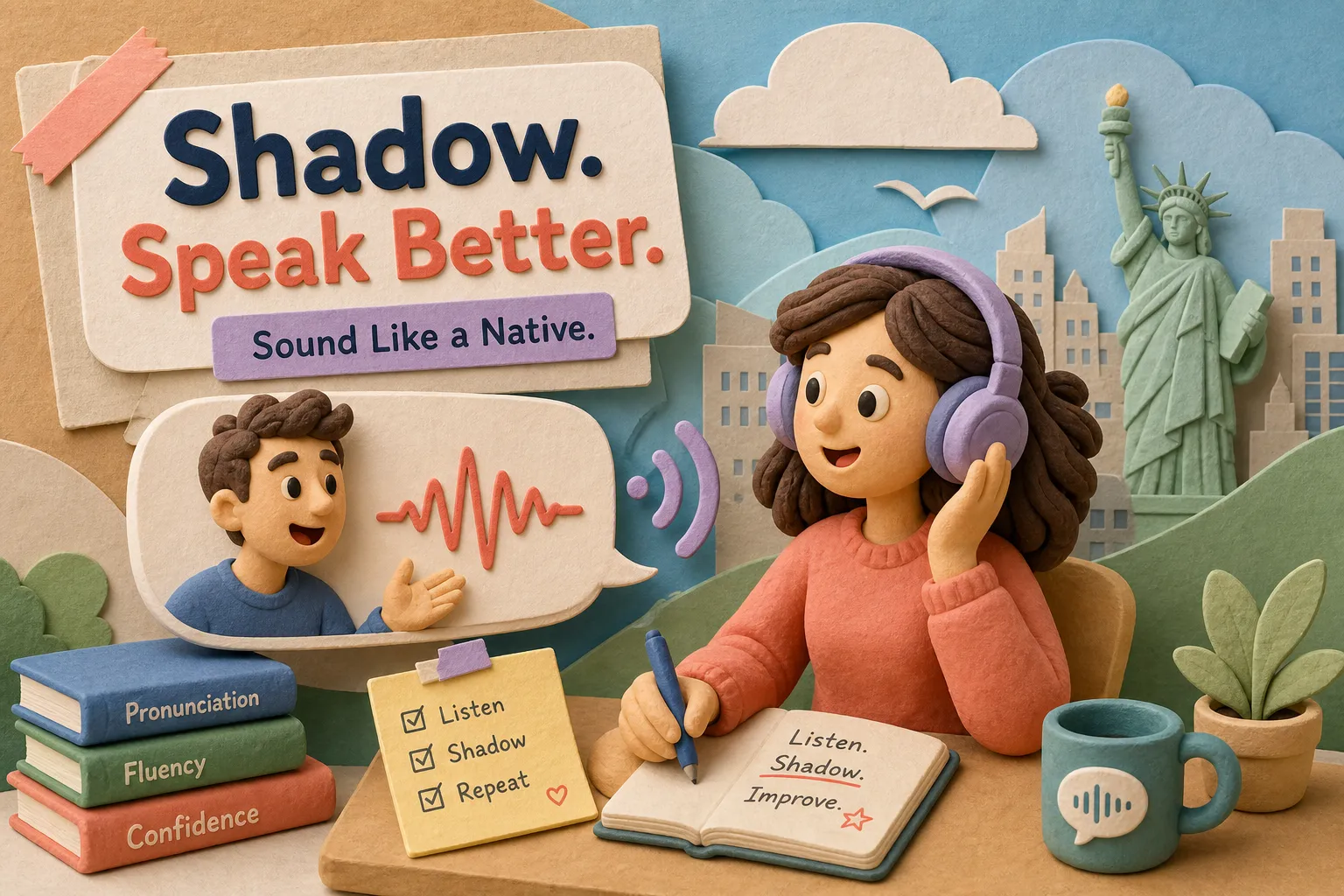
Shadowing means you listen to spoken audio and repeat it out loud at almost the same time. You try to match the speaker’s pronunciation, rhythm, and pace as closely as possible. This is different from simple listen-and-repeat practice because you speak while the audio is still playing, not after it stops.
That near-simultaneous repetition forces your brain to process sound and speech at the same time. This builds a stronger connection between what you hear and what you produce. Learners who practice speech shadowing consistently report clear gains in stress pattern accuracy, improvements in pronunciation and prosodic features such as natural pacing, and a better feel for how sounds connect in real speech.
American English has strong rhythm patterns, reduced vowels, and connected speech features like “wanna,” “gonna,” and “didja” that are very hard to learn from written text alone. Shadowing exposes you to these patterns directly, through your ears and mouth, rather than through grammar rules. Reading aloud trains your mouth but not your listening. Passive listening trains your ears but not your speaking. Shadowing trains both at the same time, which is why teaching reports consistently show it produces faster pronunciation gains than listening-only or reading-alone practice.
How to use the shadowing technique correctly: step-by-step
Start with a short clip, between 10 and 30 seconds. On the first pass, just listen without speaking. Absorb the rhythm, the stress, and the way words connect. Do not try to repeat anything yet.
On the second pass, start speaking with as little delay as possible. Don’t wait for a full sentence to finish. Start speaking before the sentence ends, and try to stay with the speaker the whole time. The goal is a near-zero delay between what you hear and what you say. This is the core of delayed versus simultaneous shadowing, and near-simultaneous is where the real muscle-building happens.
On the third pass, compare what you said to the original. Record yourself if you can. Listen for where your version sounds different. For each short chunk, repeat it 3 to 5 times before moving on. Use a transcript in your first few sessions if the audio is new to you. Once you can follow the words on paper, remove the transcript and try again. This is called moving from supported shadowing to open shadowing. For a practical, step-by-step shadowing technique guide, many learners find concrete tips and exercises helpful as they make that transition.
Keep your sessions short and focused. Don’t try to shadow a 10-minute podcast all at once. Take one 30-second clip and work it until it feels natural. Short, focused oral shadowing practice done well will outperform longer sessions where your attention drifts, quality of repetition matters far more than quantity of minutes.
Choosing the right audio for your level
Your starting material matters a lot. If the audio is too fast, you fall behind, lose the rhythm, and end up guessing. If it’s too easy, you won’t build new habits. Match the audio to where you are right now.
If you are a beginner, start with slow, clear speech that comes with a transcript. Graded reader audio (recorded stories written at your level), learner podcasts, and short scripted dialogues work well. The pace lets you keep up, and the transcript gives you support. Once you can follow along on paper, try it without reading.
At the intermediate level, move toward natural-speed podcasts, short interviews, and simple YouTube dialogues. If you want a broader overview of language shadowing techniques and why different materials work for different levels, this language shadowing guide provides useful context and examples. At the advanced level, news broadcasts, TV sitcoms, and unscripted conversations are excellent because they include fast speech, reductions, and real connected speech patterns. If a new clip feels too fast at first, you can experiment with slower playback, around 80% speed in a podcast app or through YouTube’s speed settings, until the rhythm clicks.
If your specific goal is an American accent, the specific source makes a real difference. Your Daily American’s pronunciation and connected speech guides are built around exactly the features that make shadowing so effective: reduced sounds, linking, stress patterns, and natural intonation. Using these guides as your shadowing material means every session teaches you two things at once. The content explains the sound feature, and the audio gives you a real American model to copy, a combination that is much harder to replicate with general podcast shadowing when your goal is to sound natural in American English. For curated ideas on the best shadowing materials to improve English speaking skills, check that resource for recommendations across levels and genres.
A daily practice plan you can follow
Most language coaches recommend 15 to 30 minutes of daily shadowing to see measurable gains. Even 10 to 15 minutes a day is enough to see real change if you are consistent. Short, daily practice works better than one long session once a week. Think of it like physical training: a little every day builds habits that last. For complementary strategies aimed at rapid fluency, see the fastest way to become fluent in American English.
Here is a simple weekly structure you can start with:
- Days 1 and 2: Work on a single 30-second clip. Shadow it, record yourself, compare.
- Days 3 and 4: Try a new clip at a slightly faster pace. Same process: shadow, record, compare.
- Day 5: Combine both clips into one session and do a longer comparison recording.
- Weekly habit: Keep a voice memo on your phone. Listen back to your recordings from week one at the end of the month.
Learners who commit to daily shadowing exercises for pronunciation over 8 weeks typically report measurable improvements in stress accuracy and pronunciation clarity. You will not sound like a native speaker in 8 weeks, but your rhythm and vowel reductions will shift noticeably, especially if you use material focused on American connected speech.
Common mistakes that slow your progress
The biggest mistake is repeating sounds you don’t understand. You may copy the rhythm correctly, but if you don’t know what the words mean, your brain cannot build the connection between meaning and sound. Always know what you are shadowing before you shadow it. Read the transcript and look up any unknown words first.
Many learners also jump straight to fast, native-speed podcasts. When the audio is too fast, you fall behind and start guessing at words instead of copying sounds. Start with material that is slightly below your comfortable speed. You can always increase the pace once the rhythm feels natural.
The most common missed step is not recording yourself. Without a recording, you cannot hear the gap between your version and the original. Even a basic voice memo on your phone is enough. Record yourself once per session, play it back, and listen for one specific thing: are your stressed syllables matching the speaker’s?
One more mistake is shadowing silently or whispering. If you don’t speak out loud with full voice, your mouth doesn’t get the real workout it needs. Shadowing is a physical skill. Your mouth, jaw, and throat need to move the same way a native speaker’s do. If your neighbors can hear you, you’re probably doing it right. Speak up.
How to know the shadowing technique is working
Progress with shadowing is not always sudden. At first, you will fall behind the speaker. After a few weeks, your delay will get smaller. Then you will start matching the rhythm even on new clips you have not practiced before. That is the sign that the pattern has moved beyond just the material you practiced. For a concise definition and background on the method, see this overview of speech shadowing.
A useful self-check is to test yourself periodically, for example, every two weeks. Shadow a clip you have never heard before and record it. Compare it to your recording from two weeks earlier. Listen for three things: how quickly you start speaking after the audio begins, how well your stress patterns match, and how natural your connected sounds feel. These three markers give you a clear, honest picture of your progress.
Shadowing for fluency is very effective for pronunciation and rhythm, but it does not replace free conversation. To build full speaking confidence, pair your shadowing sessions with real speaking practice: answering questions out loud, retelling what you shadowed in your own words, or having a short conversation. Shadowing builds the sounds; conversation builds the confidence to use them freely.
Start today with one short session
This method is one of the most direct tools for improving American English pronunciation. It trains your ears, your mouth, and your sense of rhythm at the same time. The key is to use the shadowing technique correctly: short clips, near-zero delay, consistent daily practice, and audio that matches your level.
Your Daily American’s pronunciation and connected speech guides give you focused, American-accent-specific material that makes each shadowing session more effective. The guides explain the sound feature, and the audio gives you a real model to copy. That combination is hard to find in one place. For additional reading and practical tips about shadowing in English, this resource about shadowing in English offers classroom-tested suggestions and sample exercises.
Start with one 15-minute session today. Pick a short clip, listen once, then shadow it five times. Record yourself on the last pass. You may be surprised by how quickly your ear and voice start to connect. For ongoing practice and examples of connected speech to shadow, check out our Pronunciation & Listening category for lesson ideas and materials.