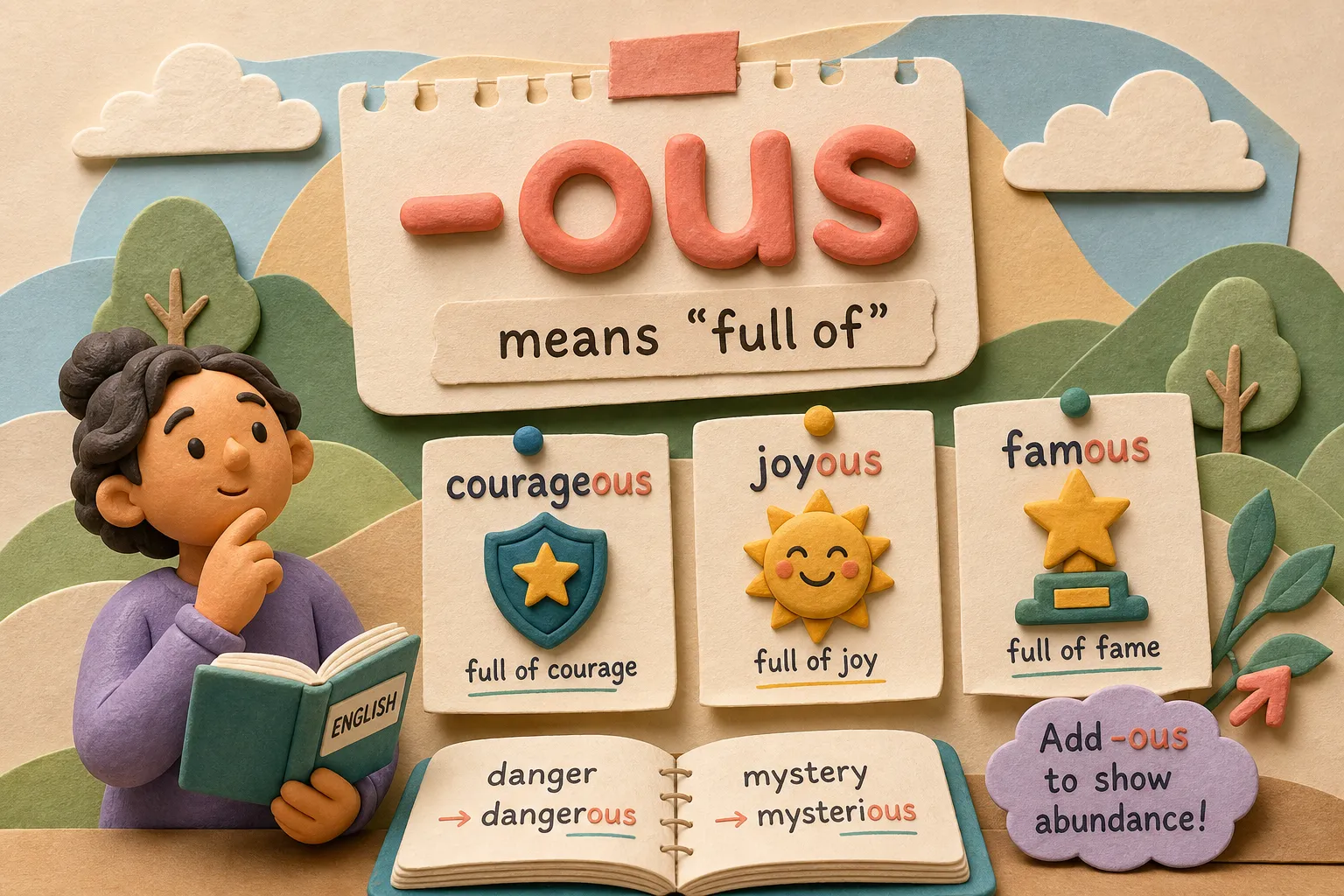
You’ve seen the word “nervous” before a job interview, “serious” in a work email, and “famous” in everyday conversation. But have you noticed what all three words share? They all use the -ous suffix, the same ending that turns nouns into adjectives across hundreds of English words. Once you understand what this ending does, a large group of English adjectives starts to make sense. In this lesson, you’ll learn exactly what the ous suffix means, how to spell it correctly, how to say it with natural American stress, and which words to use in real situations.
This approach connects directly to how vocabulary is taught at Your Daily American: words in context, not in isolation. By the end, you’ll have a clear strategy for remembering these adjectives longer and using them with confidence.
What the ous suffix means and where it comes from
The suffix -ous comes from the Latin ending -ōsus, which means “full of” or “having the quality of.” It passed through Old French before entering English, and it has kept that core meaning ever since. When you add -ous to a noun, you create an adjective that describes something as having that noun’s quality.
Look at how the transformation works: danger (noun) becomes dangerous (adjective), fame (noun) becomes famous, and courage (noun) becomes courageous. This is called a derivational suffix, a suffix that changes a word’s meaning and part of speech. Knowing this pattern helps you figure out the meaning of new -ous words you haven’t studied yet. If you see “hazardous,” you can work out that it means “full of hazard,” or dangerous, just from the root.
You already know many -ous adjectives. Here are some of the most common ones: famous, serious, nervous, dangerous, various, obvious, generous, curious, ambitious. Each follows the same pattern, noun or Latin root plus the -ous suffix, creating an adjective that describes a quality.
One quick note on a common point of confusion: the -ous suffix and the -us ending are not the same thing. Words like campus, status, and cactus end in -us but are nouns borrowed directly from Latin. The -ous suffix, by contrast, always creates adjectives. If a word ending in those letters describes a noun, it uses -ous. If it is the noun, it likely ends in -us.
Spelling rules for the ous suffix
Even strong English learners sometimes stumble when spelling -ous words, because the suffix interacts differently with different root endings. There are three main rules that cover most cases you’ll encounter. For a practical overview of common patterns and tips, see these rules for adding suffixes.
Rule 1: Drop the silent e
When a root word ends in a silent e, you usually drop that e before adding -ous. The reason is straightforward: -ous starts with a vowel, so the extra e isn’t needed. Fame becomes famous, not fameous. This rule applies to most common -ous words.
Rule 2: Keep the e when the root ends in -ge or -ce
This is the most common spelling mistake learners make. When a root word ends in -ge or -ce, you keep the e before adding -ous. The e keeps the g or c soft. Without that e, the g in “courageous” would sound hard, like the g in “go.” So courage becomes courageous, and outrage becomes outrageous. Keep the e, keep the soft sound.
Rule 3: The y-to-i change
When a root word ends in y after a consonant, change the y to i before adding -ous. So glory becomes glorious, and mystery becomes mysterious. When y comes after a vowel, keep it: joy becomes joyous.
One more thing worth knowing: some -ious words like curious and various come directly from Latin roots. They weren’t built by adding -ous to an English word, so don’t try to apply these rules to them. Learn them as complete words. If you’d like extra practice exercises, these student practice activities for teaching suffixes are helpful.
How to say -ous words correctly in American English
The -ous suffix is always pronounced /əs/, the same sound as the word “us.” It is always unstressed, meaning you never put extra force on it. Think of it as the quietest part of the word. For more detail on syllable stress across English words, see our guide to Word Stress in American English: A Complete Guide.
In most -ous adjectives, the main stress falls on the syllable right before the suffix. Here are three examples with phonetic respellings:
- famous → FAY-mus
- serious → SIR-ee-us
- generous → JEN-er-us
This stress pattern holds across most -ous words, which makes pronunciation more predictable once you learn it.
A very common mistake is stressing the -ous ending itself. Many learners say “fa-MOUS” or “ner-VOUS,” which sounds unnatural to American ears. Keep the suffix light and fast. Practice saying the word as if -ous is almost disappearing: FA-mus, not fa-MOUS. That one small adjustment makes a noticeable difference in how natural you sound. For a quick list of English words non-native speakers mispronounce most often, check that article for common pitfalls you can avoid.
High-frequency words with the ous suffix in American English
Knowing the suffix is useful. Knowing which words to use, and when, is what builds real fluency. Here are three groups based on where these adjectives actually appear in American life.
Words you need for job interviews
The adjectives nervous, serious, ambitious, previous, and obvious come up often in interview settings. Interviewers use them, and candidates use them to describe themselves and their experience. Two examples you can adapt:
“I was a little nervous before the interview, but I felt confident once I started talking.”
“My previous manager described me as ambitious and serious about my work.”
Words that appear in professional emails
In American business writing, adjectives like various, cautious, obvious, numerous, and previous give your writing a more professional tone. They appear regularly in formal emails and reports. Try using them in sentences like these:
“Please review the various options attached to this email.”
“We want to be cautious before making a final decision.”
Words for everyday conversation
American speakers use -ous adjectives to express strong reactions and feelings in casual speech. Words like hilarious, ridiculous, gorgeous, fabulous, curious, and furious carry a lot of expressive energy. You’ll hear them constantly in exchanges like these:
“That movie was hilarious. I laughed the whole time.”
“Are you serious? That’s ridiculous.”
These words carry expressive energy and help you sound natural and engaged, exactly the register casual American conversation calls for.
A smarter way to remember -ous words: grouping by theme
When you study words in a random list, your brain has nothing to connect them to and they fade quickly. Grouping words by theme gives each word a context and a connection, which makes them easier to store and recall later. This strategy is called semantic clustering, organizing vocabulary by meaning and situation. It is one of the core study methods at Your Daily American, where lessons group words by real-life topic so what you learn actually sticks.
Group 1: Emotions and feelings
These -ous adjectives describe how people feel: nervous, anxious, furious, jealous, curious, suspicious. Each one names a specific emotional state. Study them together by matching each word to a situation, for example: “Which word describes how you feel before a big presentation?” (Answer: nervous or anxious.) Writing your own answers makes the words easier to remember.
Group 2: Describing people and their qualities
These words are useful for talking about yourself, a colleague, or a friend: generous, ambitious, cautious, serious, courageous, humorous. They work well in job interviews and professional conversations. Practice with this prompt: “How would you describe yourself using three words from this group?” Write full sentences with each word you choose.
Group 3: Describing situations and places
These adjectives describe events, conditions, and places: dangerous, obvious, ridiculous, disastrous, tremendous, various. Notice the range of intensity here, from neutral (various) to very strong (disastrous, tremendous). Grouping them together helps you see that difference and choose the right word for the right moment.
What to do next
The ous suffix forms adjectives that mean “having the quality of” or “full of” something. It follows clear spelling patterns: drop the e in most cases, keep it before -ge or -ce, and change y to i after a consonant. The suffix is always pronounced as the unstressed /əs/ sound, and the main stress falls on the syllable before it. For a concise reference on the general idea of suffixes, see the suffix entry on Wiktionary, and for a short audio summary of common English suffixes consider this suffix summary podcast episode.
The most useful step you can take right now is to pick one of the three theme groups above and focus on those words this week. Write a sentence for each word using a situation from your own life, a job interview, a recent conversation, or a work email. That kind of active practice will do more for your vocabulary than reading a word list ever will. If you’d like a short guide to practice and lesson ideas, check these student practice activities for teaching suffixes (also linked above).
If you want to keep building your American English vocabulary with the same structured, real-world approach, explore the lessons at Your Daily American. To compare other common adjective endings, see our article on The -ic Suffix: Meaning, Spelling Rules, and Examples.