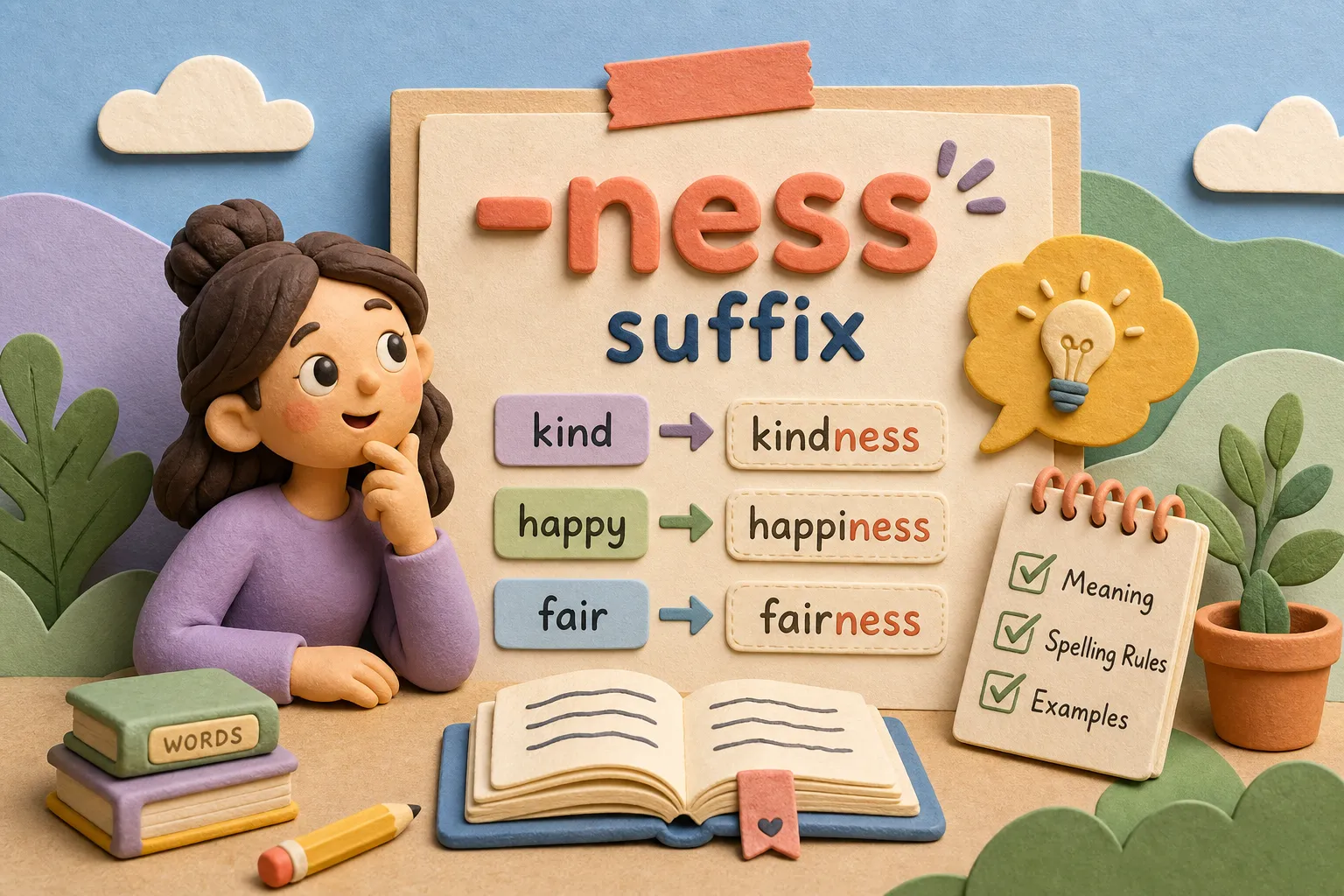
You already know the word “kind.” You probably know “happy” and “dark” too. But do you know why “kindness,” “happiness,” and “darkness” are spelled the way they are? The answer is one small pattern: the ness suffix. Once you understand how it works, hundreds of English words become easier to read, spell, and use in real conversation.
This article will teach you exactly what the -ness suffix does, how to spell these words correctly, and which ones you’ll hear most often in everyday American life. By the end, you’ll be able to form nouns from adjectives, avoid the most common spelling mistakes, and understand why words like “awareness” and “loneliness” appear so often in American movies, podcasts, and daily conversation. That connection between grammar and real speech is exactly what we focus on at Your Daily American.
What the -ness suffix does to a word
The suffix -ness turns an adjective (a word that describes something) into a noun (a word that names a thing or idea). Think of it as a switch. You start with a describing word, add -ness, and suddenly you have a name for that quality.
Here are four simple examples:
- kind → kindness
- happy → happiness
- dark → darkness
- weak → weakness
The meaning stays consistent across all these words. It always signals “the state or quality of being” something. So “loneliness” is the state of being lonely. “Awareness” is the quality of being aware. “Softness” is the condition of being soft. One meaning, hundreds of words.
Here’s something useful to know: -ness comes from Old English, not Latin or French. That’s why it attaches so naturally to the most common, everyday words in American English. Suffixes like -ity and -tion often come from Latin roots, so they pair with more formal or academic vocabulary. But -ness works with the simple, everyday words that native speakers use all the time. This means you can trust the pattern, though not blindly. Many common adjectives form nouns with -ness, but some pair naturally with -ity, -tion, -hood, or take a completely different noun form. When in doubt, a quick dictionary check confirms which form sounds right.
Three spelling rules for adding -ness
Rule 1: Change the y to i (for most multi-syllable adjectives)
When a two-syllable (or longer) adjective ends in a consonant followed by the letter y, change the y to i before adding -ness. You already know this rule from comparative adjectives: “happy” becomes “happier,” not “happyer.” The same change happens here. For more on adjective patterns and forms, consult a reliable reference on adjective forms.
- happy → happiness
- heavy → heaviness
- lonely → loneliness
- friendly → friendliness
This is the most important spelling rule to practice, so keep working with it until it feels automatic.
One important note: not every adjective ending in y follows this pattern. One-syllable adjectives like “shy,” “dry,” and “sly” keep the y, you’ll see why in the exceptions section below.
Rule 2: Most adjectives just add -ness directly
For the large majority of adjectives, you simply add -ness with no changes at all. No letters removed, no letters doubled. Just attach -ness to the end. When an adjective ends in a silent e, keep the e before adding -ness, for example, “aware” becomes “awareness” and “late” becomes “lateness.” For a clear explanation of how suffixes affect final letters (like keeping or dropping that silent “e”), see this practical guide on the suffixing (dropping‑e) rule.
- kind → kindness
- aware → awareness
- calm → calmness
- soft → softness
- bright → brightness
This is the most common case, and when you’re not sure what to do, adding -ness directly is almost always the right move. That covers the vast majority of adjectives you’ll encounter.
Rule 3: One-syllable adjectives with a short vowel (rare)
A small number of one-syllable adjectives end in a short vowel followed by a single consonant and produce a doubled consonant when -ness is added, not because of a general spelling rule, but because the base word ends in the same letter that starts the suffix. The most common example is “thin → thinness” (two n’s). This applies to very few adjectives that form nouns with -ness, so don’t spend too much time on it. Just keep it in mind in case it comes up. For general spelling tips about adding suffixes like -ly and similar changes, this guide to suffix spelling rules is a helpful resource.
Common -ness words in everyday American life
The rule is easy to learn. What matters just as much is hearing these words in real situations. The examples below are words you’re likely to encounter when you watch American TV, listen to podcasts, or talk with native speakers.
Words for feelings and personality
These words come up constantly in emotional conversations, storytelling, and everyday talk about people.
- Kindness: “Her kindness made everyone feel welcome at the party.”
- Happiness: “Money doesn’t guarantee happiness.”
- Sadness: “There was a lot of sadness in the room after the news.”
- Loneliness: “Moving to a new city can bring a feeling of loneliness at first.”
- Shyness: “His shyness made it hard for him to speak up in class.”
- Bitterness: “She tried not to let the bitterness show.”
- Calmness: “The calmness in his voice helped everyone relax.”
Words for everyday physical qualities
You’ll hear these when Americans describe objects, places, food, and weather.
- Darkness: “We waited in the darkness until the power came back.”
- Brightness: “The brightness of the screen was hurting my eyes.”
- Softness: “I love the softness of this blanket.”
- Thickness: “The thickness of the walls kept the noise out.”
- Heaviness: “There was a heaviness in the air before the storm.”
- Sweetness: “The sweetness of the dessert was perfect.”
Words that come up at work and in social situations
These words appear in meetings, news articles, and everyday conversations with Americans. If you work with U.S. colleagues or clients, you’ll hear them regularly.
- Awareness: “The campaign raised awareness about the issue.”
- Readiness: “We need to check our readiness before the product launch.”
- Weakness: “Admitting a weakness shows self-awareness, not failure.”
- Effectiveness: “The team questioned the effectiveness of the new process.”
- Toughness: “She showed real toughness under pressure.”
- Sickness: “He missed three days of work because of sickness.”
The exceptions worth knowing
Why “business” surprises learners
“Business” looks like “busy” + “-ness,” but it’s actually a fused root from Old English. Over many centuries, the word changed in both spelling and pronunciation until the -ness part became inseparable from the rest of the word. Today, “business” is pronounced “BIZ-ness,” which sounds nothing like “busy” + “ness.” Do not try to apply this as a pattern. It is a single fixed word, not a formula you can use.
When the y stays: shy, dry, sly
Earlier, you learned that two-syllable adjectives ending in consonant + y change the y to i before -ness. For example, “happy” becomes “happiness.” But one-syllable adjectives with a long vowel sound before the y work differently: shy → shyness, dry → dryness, sly → slyness.
The practical distinction comes down to syllable count and vowel sound. Words like “shy” and “dry” have a long vowel sound before the y and are only one syllable. Words like “happy” and “lonely” have a short vowel before the y and two or more syllables. For one-syllable adjectives with a long vowel, keep the y. For two-syllable adjectives ending in consonant + y, change to i. You don’t need to memorize a complex rule. Just remember: shy → shyness, happy → happiness. Those two examples cover most situations you’ll face.
When Americans use -ity instead of -ness
You may have noticed that some adjectives pair with -ity instead of -ness. Active → activity. Curious → curiosity. Pure → purity. These words tend to feel more formal or academic, that’s because -ity comes from Latin and French, and it attaches to adjectives with Latin roots.
A useful guideline: if the adjective comes from everyday English (kind, soft, calm, happy), -ness is the natural choice. If the adjective has a Latin root and a well-established -ity form already exists (active → activity, curious → curiosity), use that. When both forms exist, the -ity version is often more common in formal writing, while the -ness version frequently sounds warmer and more conversational, though usage varies by word and context.
A simple decision guide: if a recognized -ity form already exists, use it. If no -ity form sounds natural, -ness is almost certainly correct. You rarely need to choose between two competing forms for the same word.
How to start using these words naturally
Notice -ness words when you listen and read
Start paying attention to these words in American content you already enjoy. TV dramas use them constantly in emotional scenes. News articles use them in analysis and commentary. Podcasts use them in storytelling and personal reflection. When you hear one, pause and ask yourself: what adjective is this built from? That small habit builds your pattern recognition fast, and pattern recognition is what separates learners who feel stuck from learners who keep growing. If you’re curious about common pronunciation pitfalls, check our guide to English words non-native speakers mispronounce most often to avoid frequent mistakes.
You can also practice forming these nouns yourself. Pick any adjective you know and try building the noun form. Then check if it’s a real word. You’ll be surprised how often it is.
How Your Daily American helps you go further
Understanding the -ness suffix is a solid grammar win. But the bigger goal is using these words the way Americans actually use them: with the right tone, in the right situations, and with the right natural rhythm. Knowing that “awareness” exists is different from knowing how to say “She brought a lot of awareness to the meeting” in a way that sounds natural and confident.
At Your Daily American, the everyday expressions and professional English content are built around exactly this. You’ll find words like “kindness,” “readiness,” and “awareness” woven into authentic conversations and real-world contexts, not isolated grammar exercises. We also cover related topics like word stress to help you sound more natural when you speak. That’s where knowing the pattern starts to feel like actual fluency.
Putting it all together
The -ness suffix is one of the simplest and most powerful patterns in American English. It means “the state or quality of being” something. It turns adjectives into nouns. And it follows a manageable set of spelling rules: change y to i for two-syllable adjectives, keep the y for one-syllable adjectives like “shy,” and add -ness directly in most other cases.
Recognizing this one pattern opens up hundreds of words you’ll encounter in American movies, podcasts, books, and daily conversation. That’s the real value: not just spelling correctly on a test, but understanding the language more clearly every time you listen or read.
Ready to practice using these words in real American contexts? Head over to Your Daily American and explore the everyday expressions section. You’ll find these words exactly where they belong: in real speech, real situations, and authentic American English.