You are in a meeting at work. Your manager says the company needs a more strategic approach to growth. The quarterly report mentions economic trends. A colleague asks for a more systematic process. You understand each sentence, but something is not quite clear: why do all these words end in -ic? And when should you say historical instead of historic ? That pattern you keep noticing is the -ic suffix at work.
This type of question comes up often in professional English. At Your Daily American, -ic adjectives appear throughout workplace lessons, from meeting phrases to business writing guides and presentation vocabulary. Once you understand how this ending works, a large part of professional English suddenly becomes easier to read, write, and say.
This article covers four things: what the suffix means, how to spell it correctly, how to choose between confusing pairs like economic and economical, and where to put the stress when you say these words out loud.
What the -ic suffix actually means
Where -ic comes from
The suffix -ic has a long history. It started in Ancient Greek as -ikos, meaning “pertaining to” or “characteristic of.” From Greek, it moved into Latin as -icus, then into Old French as –ique, and finally into English as -ic. Many of these words entered English through formal written channels, science, law, and religion, which is why Latinate words ending in -ic tend to feel educated and professional. They are common in reports, presentations, and formal conversations rather than in casual everyday speech. For a concise overview of the word’s origins, see the Online Etymology Dictionary entry for -ic.
The core meaning: “relating to” or “having the quality of”
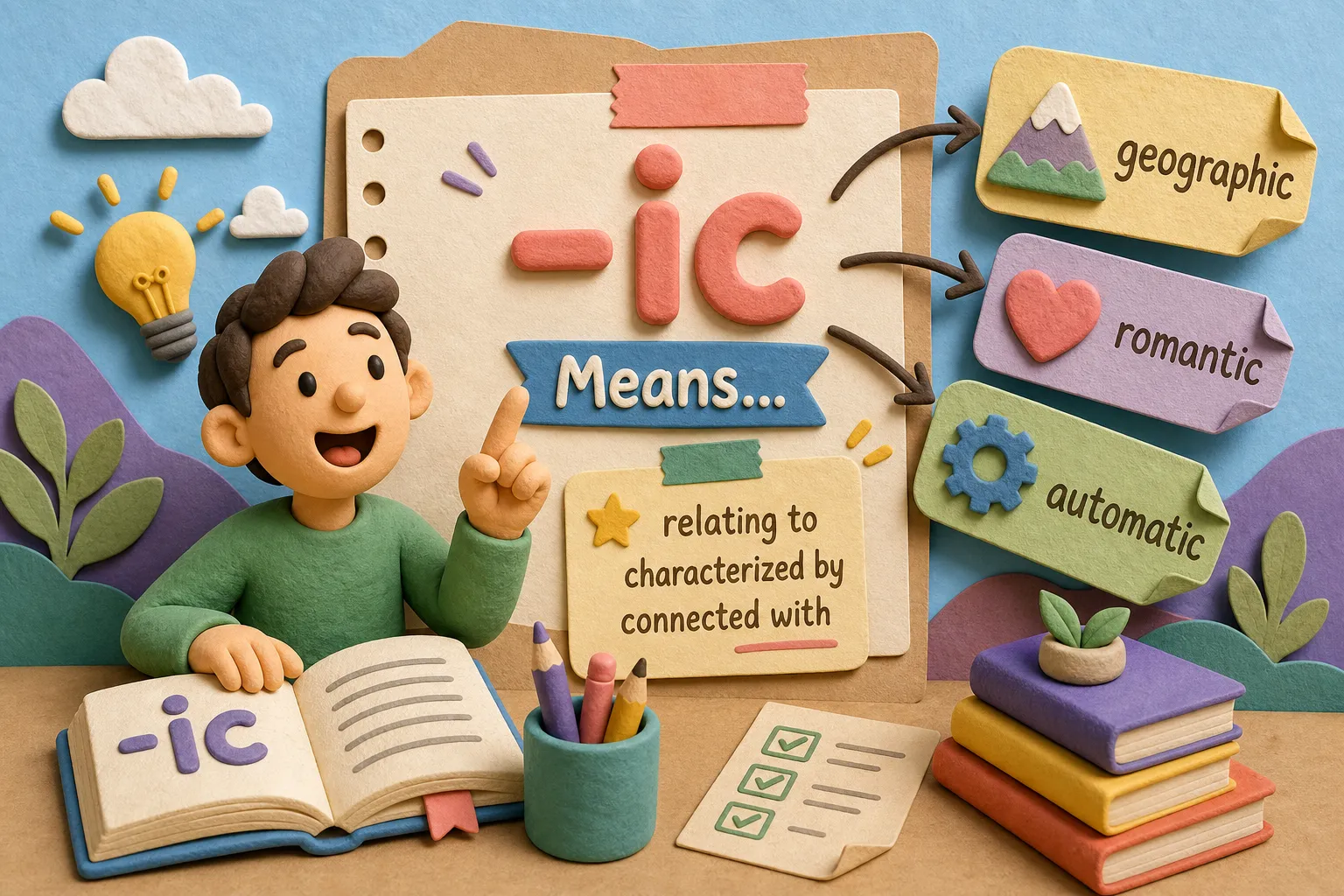
The adjectival suffix -ic means “of, relating to, or having the nature of” the base word. It turns a noun into an adjective. Look at these examples:
- atom → atomic : relating to atoms
- strategy → strategic : relating to strategy
- economy → economic : relating to the economy
- drama → dramatic : having the quality of drama
- organ → organic: relating to living organisms or natural systems
In each case, the -ic ending connects the adjective back to its source noun. “She gave a strategic presentation to the board” means her presentation was built around strategy. The suffix does that work for you.
Spelling rules when you add -ic
Three spelling patterns cover almost every case you will encounter. For practical guidance on general spelling rules for suffixes, see the Colorado Department of Education’s spelling rules.
Rule 1: Drop the final -e
When a base word ends in a silent -e, drop the -e before adding -ic. Since the suffix starts with a vowel sound, the -e is not needed. A straightforward example: cube → cubic . In practice, many -ic adjectives you use at work come from familiar nouns like strategy or economy , so learning the adjective as a connected pair, strategy / strategic, economy / economic, is often faster than applying the rule each time.
Rule 2: Change final -y to -i
When a base word ends in -y after a consonant, change the -y to -i before adding -ic. So melody becomes melodic, and energy becomes energetic (with a small stem change). If the -y follows a vowel, keep the -y as it is. This is the same pattern English uses for other suffixes, so it is worth remembering as a general rule.
Rule 3: Consonant doubling
Double the final consonant before -ic only when the base word ends in one vowel plus one consonant and the stress falls on that final syllable. This follows the same pattern as other vowel-initial suffixes in English.
Two examples without doubling show the contrast clearly: planet → planetary (stress is not on the final syllable, so no doubling); cube → cubic (ends in a consonant cluster after the vowel, no doubling needed). In practice, most common workplace -ic adjectives come from familiar nouns, so learning them as pairs remains the most efficient approach.
-ic adjectives in professional and academic English
The words you need for meetings, reports, and presentations
These are the -ic adjectives that come up most often in professional settings. Learning them in groups helps you remember them faster.
Business and workplace English:
- strategic , relating to long-term planning: “We need a more strategic approach to hiring.”
- economic , relating to the economy or finances: “The economic data shows slow growth this quarter.”
- systematic , organized and methodical: “A systematic review of the process found three weak points.”
- dynamic, active, changing, and energetic: “She is a dynamic speaker who keeps the room engaged.”
- realistic, based on real conditions: “We need to set realistic goals for the next six months.”
- specific, clearly defined and exact: “Please give specific examples in your report.”
- organic, natural or developing without being forced: “The team achieved organic growth through customer referrals.”
Technology and academic English:
- analytic , using careful analysis: “The team took an analytic approach to the data.”
- algorithmic, based on a set of rules or steps: “The platform uses algorithmic recommendations.”
- empirical, based on observation and evidence: “The report presents empirical results from the user study.”
- thematic, organized by theme: “The presentation used a thematic structure.”
- periodic, happening at regular intervals: “Periodic reviews help teams stay on track.”
If you want a broader list of common descriptive words to expand this vocabulary, see the Duolingo adjectives list, which includes many practical adjectives learners use every day.
How Your Daily American teaches these words in context
Seeing a word in a list is not the same as knowing how to use it naturally at work. At Your Daily American, professional English lessons are built around real situations: actual meeting conversations, business email templates, and presentation tasks. That means you practice strategic , economic , and systematic inside the sentences where these words actually appear. For more learning approaches and lesson formats, check our Study Tips & Methods section.
This moves you from passive recognition, knowing the word when you see it, to active use, where you reach for the right word confidently in your next meeting or report.
-ic vs -ical: how to choose the right form
The pairs that confuse most English learners
Some nouns produce two adjective forms: one ending in -ic and one ending in -ical. Choosing the wrong form can make a sentence sound odd or change the meaning completely. Here are the four pairs that matter most in professional and academic English.
Historic vs historical: Use historic for an event that was important or famous. “The company signed a historic agreement with its largest client.” Use historical for anything connected to history as a subject or time period. “The report includes historical data from the past ten years.”
Economic vs economical: This is one of the most common errors in professional English. Economic relates to the economy, finance, or the field of economics. “The economic outlook for next year looks positive.” Economical means thrifty or cost-saving. “This printer is economical because it uses less ink.”
Classic vs classical: Classic means excellent, typical, or a model example. “This is a classic mistake that new managers make.” Classical refers to ancient traditions or formal art and music styles. “She studied classical music at university.”
Comic vs comical: Comic relates to comedy as a genre. “He has a natural comic style that works well in presentations.” Comical describes something that is funny in a strange or unexpected way. “The situation became comical when the projector stopped working mid-speech.”
A simple test for choosing between -ic and -ical
Ask yourself one question: does the -ical form carry a separate, specific meaning? If yes, the two forms are not interchangeable, use the one that matches your meaning. If the -ical form does not exist or has no clear distinct meaning, use the -ic form. In American English, -ic tends to serve as the core form when both versions exist and share a meaning, though it is always worth checking a reliable dictionary when you are unsure. Most word pairs you meet at work, such as economic , historic , and systematic , follow predictable patterns once you learn them as vocabulary pairs.
Stress and pronunciation when you say -ic words
How the stress shifts when -ic is added
This is one of the most useful pronunciation patterns in professional English and it is rarely taught in vocabulary lists. When you add -ic to a word, the stress regularly moves to the syllable right before the -ic ending. Look at these before-and-after examples using American English pronunciation:
- economy /ɪˈkɑnəmi/ (ih-KON-uh-mee) → economic /ˌɛkəˈnɑmɪk/ (ek-uh-NOM-ik)
- atom /ˈætəm/ (AT-um) → atomic /əˈtɑmɪk/ (uh-TOM-ik)
- strategy /ˈstrætədʒi/ (STRAT-uh-jee) → strategic /strəˈtiːdʒɪk/ (struh-TEE-jik)
- drama /ˈdræmə/ (DRAM-uh) → dramatic /drəˈmætɪk/ (druh-MAT-ik)
The pattern is consistent: the -ic suffix pulls the stress to the syllable directly before it. This holds true across many hundreds of English words, though some older, well-established forms are exceptions, so when in doubt, confirm with a dictionary. For a focused discussion on stress differences between -ic and -ical forms, see this note on stress and pronunciation rules for -ic and -ical.
Why this matters for speaking at work
When stress lands on the wrong syllable, listeners notice. It pulls attention away from what you are saying and toward how you are saying it. Saying STRA-te-gic instead of stra-TEE-jic in a meeting can make your English sound less natural, even if every other word is correct. You can compare common pronunciation challenges in our article on English Words Non-Native Speakers Mispronounce Most Often to see typical patterns learners face.
The fix is straightforward: when you learn a new -ic adjective, say it out loud, mark the stressed syllable, and then use it in a full sentence. Connecting pronunciation to real use is the fastest way to make the stress pattern automatic. At Your Daily American, every vocabulary lesson includes this kind of spoken practice so that new words move from your notes into your natural speech.
Practice: try it yourself
You now know four things about the -ic suffix: what it means, how to spell it correctly, how to choose between -ic and -ical pairs, and where to place the stress when you speak. These are not just grammar facts, they are practical tools that sharpen how you read, write, and speak professional English.
Try these three short exercises to check your understanding:
- Choose the correct form: “She gave a [historic / historical] speech at the company event.” (Answer: historic , because the speech was important and memorable.)
- Write one sentence using an -ic adjective from the professional English list above. Use it in a workplace context, such as a meeting or a report.
- Say the word analytic out loud. Which syllable is stressed? (Answer: the syllable before the ending, so an-uh-LIT-ik.)
Understanding how the -ic suffix works is one of the fastest ways to grow your professional vocabulary. Instead of learning each word in isolation, you start to see the system behind the language, and one pattern opens up dozens of new words at once. If you want to practice these adjectives in real workplace situations, including meetings, emails, and presentations, Your Daily American has the lessons to help you use them with confidence every day. For additional study methods and structured practice, see our Study Tips & Methods resources.