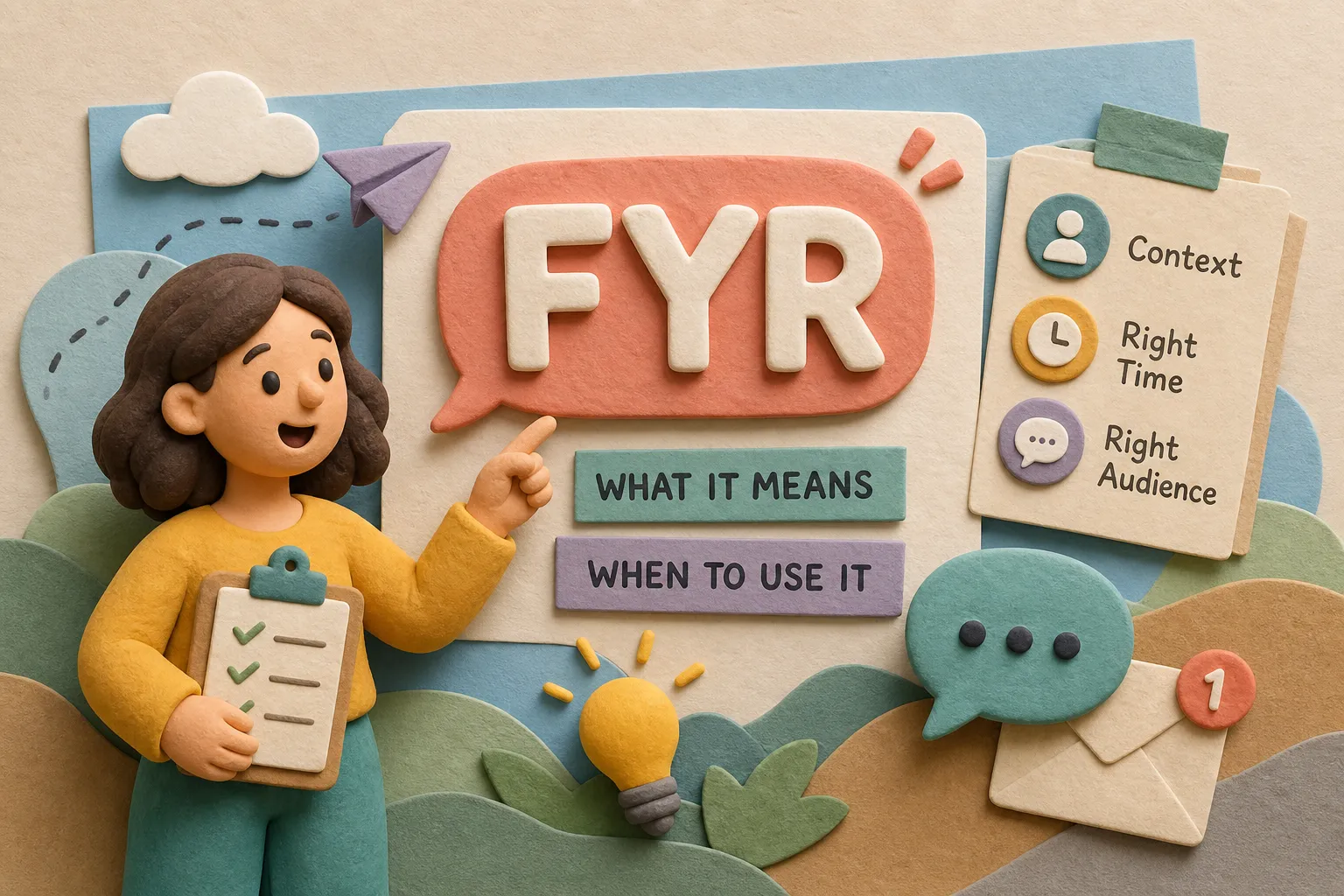
By the end of this article, you will understand the FYR meaning, its two main interpretations, and how to use it correctly in a professional email. Abbreviations are common in American workplace written communication, think FYI, ASAP, and EOD, so missing one can turn a simple subject line into a guessing game. You open the message and ask yourself: do I need to do something? Is this urgent?
Imagine this: a new email arrives in your inbox with the subject line “FYR: Updated Contract Terms.” You don’t recognize the abbreviation. You’re not sure if your boss expects a response or if you just need to read it. That small moment of confusion is exactly what this lesson fixes. Decoding real workplace expressions like this one is the kind of practical English knowledge that Your Daily American is built around, real language, real situations, and real confidence.
FYR meaning: what it stands for
FYR most commonly stands for “For Your Reference.” In plain language, it means: “I’m sharing this information with you. You don’t need to reply or take action. Just keep it handy.” It shows up in email subject lines, in document names, and sometimes at the start of an email body when someone wants to signal that the content is purely informational.
The primary meaning: For Your Reference
When someone writes “For Your Reference” in an email, they are giving you something to keep, check later, or use as background context. No response is expected. A subject line like “FYR: Q3 Budget Summary” tells you that someone is sharing a document for you to look at when needed, not asking you to approve or comment on it.
The second meaning: For Your Records
“For Your Records” is a recognized secondary meaning of FYR. The difference is in emphasis: “For Your Reference” means you might want to look at this later, while “For Your Records” means you should save this as official documentation. You might see “For Your Records” when someone sends a receipt, a signed contract, or a completed form. Example: “FYR: Signed NDA, please save for your records.”
Less common uses of the abbreviation
In some editorial or quality-control settings, FYR can mean “For Your Review,” but this usage is much less common. You may also come across “FYR” used for “Financial Year” in certain reports, though most professionals use “FY” for that. In most business email contexts, FYR will mean “For Your Reference.” Be aware that alternate meanings, such as “For Your Records” or “For Your Review”, do exist in niche settings, so context always helps.
FYR meaning vs. FYI: the difference that actually matters
Many readers will already be familiar with FYI, so the real question becomes: what separates it from FYR? Understanding that distinction will help you read emails more accurately and write them more clearly.
What FYI signals in a professional email
FYI stands for “For Your Information.” It tells the reader: you should know this. It is used for updates that affect decisions, schedule changes, or announcements relevant to someone’s work. FYI is more common than FYR in North American workplaces, and depending on context, it can even imply that the reader may need to act.
What FYR signals differently
FYR is often perceived as less urgent than FYI. It says: here is some background material or supporting information. No response is expected, and no action is required. It works well when forwarding documents, past email threads, or reference materials. The reader understands right away that this email is not asking them to do anything.
A simple side-by-side example
Here is the same situation written two ways. Notice how each abbreviation sets a different expectation:
- FYI: The client meeting has been moved to Thursday., You should know this. It may affect your schedule or plans.
- FYR: Notes from last month’s client meeting., Here is some background material. No action needed.
The simple rule: FYI means “you should know this.” FYR means “keep this for reference.” When you’re not sure which to use, ask yourself: does the reader need to do something or know something? If yes, use FYI. If you’re just sharing background material, use FYR.
How to use FYR in professional emails
Knowing what FYR means is a good start. Being able to use it correctly in your own writing is even better. Here is what you need to know: where to put it, how to write the subject line, and what to say in the body.
Putting FYR in the subject line
As a best practice, follow FYR with a colon (or dash) and a specific description, punctuation style can vary by workplace, but clarity is the constant. A subject line that says only “FYR” gives the reader no context before they open the email. Here are two clear examples:
- FYR: Updated Employee Handbook
- FYR: Previous Thread on Project Timeline
FYR meaning in email: using it in the body
You can also use FYR at the start of a sentence in the email body. It works especially well when you want to be explicit that no reply is needed. Pairing it with “no action required” removes any ambiguity. Here is a short example:
Hi Marcus, FYR, I’ve attached the vendor comparison document we discussed last week. No action is needed at this time. Best, Elena.
For step-by-step templates, subject-line tips, and broader guidance on professional messages, see How to Write a Professional Email in American English, Your Daily American.
Three real workplace scenarios
These examples show how FYR works in three common situations:
Sharing a document: Subject: FYR: Q2 Sales Report Hi Priya, attached is the Q2 sales report for your reference. Please keep it handy for the planning meeting next week.
Forwarding meeting notes: Subject: FYR: Notes from Client Review Meeting Hi Team, I’ve shared today’s meeting notes for your reference. The key decisions and next steps are included in the document.
Sharing a policy update: Subject: FYR: Updated Travel Policy Hi Team, the updated travel policy is attached for your reference. No immediate action is needed, but please use this version for future trips.
Common mistakes to avoid when using FYR
Using FYR correctly is straightforward once you know the rules. Two mistakes come up often, particularly for ESL learners who are still building confidence with professional email writing.
Using FYR when a response is actually needed
FYR tells the reader to relax, it signals that no reply is expected. If you use FYR in an email that actually needs someone to sign, approve, or respond, you will create confusion. The reader may see FYR and decide not to reply, which is the opposite of what you wanted. When you need action, use a direct subject line with a clear verb. Examples: “Please approve: Updated Budget” or “Action needed: Contract Signature by Friday.”
For guidance on common grammar mistakes that often lead to confusion in emails, see this short guide on common grammar mistakes in emails.
Keeping the subject line too vague
A subject line that says only “FYR” gives the reader no useful information. They don’t know what to expect before they open the email, which looks unprofessional and wastes their time. Follow FYR with a specific label so the reader knows exactly what they’re opening. Also worth noting: FYR works well in professional emails between colleagues, but it is generally too informal for official documents, cover letters, or formal reports. In those situations, prefer the full phrase: “For your reference, please find the attached document.”
Other email abbreviations common in American workplaces
FYR and FYI are just two of many abbreviations you will encounter in American professional emails. Grouping them by what they signal, information only versus action required, makes them easier to remember.
Abbreviations that signal information only
These abbreviations tell the reader that no reply is needed:
- FYI, For Your Information. Signals that you should be aware of something.
- FYR, For Your Reference. Signals that the content is background material to keep.
- FYA, For Your Attention. Despite sounding passive, this one often does require acknowledgment or action, so read the email carefully when you see it.
- EOM, End of Message. Means the entire message is in the subject line; no body text is needed.
Abbreviations that signal action is required
These abbreviations tell the reader something needs to happen:
- ASAP, As soon as possible. Signals urgency.
- LMK, Let me know. Signals that a response is expected.
- TBD, To be determined. Indicates a decision is still pending.
- PFA, Please find attached. Flags that an attachment is included and should be reviewed.
For a comprehensive reference, you can consult this list of email subject abbreviations.
Where to keep learning professional American English
Email abbreviations are one small part of workplace communication in the United States. There are also standard phrases for meetings (such as “circle back” or “take this offline”), professional tone adjustments for different audiences, and cultural patterns, like keeping subject lines concise or using “Please” for requests, that shape how emails land. Your Daily American covers all of this in one place: from email phrases to meeting vocabulary to pronunciation tips that help you sound natural and confident at work. If you want to move from understanding American English to actually using it on the job, that’s exactly where to start.
Start with our broader guide: Professional English for the Modern Workplace, and then check the practical email-focused guide here: How to Write a Professional Email in American English, Your Daily American.
For a concise external comparison of FYI vs. FYR usage, see this FYI vs FYR comparison.
FYR meaning: a quick recap
In short, FYR meaning “For Your Reference” tells the reader that the information is shared for background or future use, no reply needed. That is the key distinction from FYI, which signals awareness and can sometimes imply action. Once you internalize that difference, both abbreviations become reliable tools in your professional writing.
You can now spot FYR in your inbox without confusion, write a subject line that uses it clearly, and sidestep the two most common errors: reaching for FYR when you actually need a response, and leaving the subject line empty of context. Small details like these signal professional fluency, they show that you understand both the language and the setting.
Here’s a quick practice prompt: think of one real document, policy, or piece of information you might share with a colleague or classmate. Write one subject line using FYR. The more you practice these expressions in real situations, the more natural they will feel.
Frequently asked questions about FYR
What does FYR mean?
FYR most commonly means “For Your Reference.” It signals that information is being shared for background or future use, and no reply is required. A less common secondary meaning is “For Your Records,” used when sending receipts, signed contracts, or official documentation.
Is FYR formal or informal?
FYR sits in the middle, it is appropriate for professional emails between colleagues, but it is generally too informal for formal reports, cover letters, or external official documents. In those cases, write out the full phrase: “For your reference.”
When should I use FYR instead of FYI?
Use FYR when you are sharing background material that requires no action or response. Use FYI when you want to make sure the reader is aware of something that may affect their decisions or schedule. If the reader needs to do anything at all, FYI, or an even more direct phrase, is the safer choice. For further reading on FYI usage, see FYI meaning: How to Use It in Professional English.