By the end of this article, you will be able to recognize the mis prefix (written mis- ) in any English word, understand exactly what it signals, and use it correctly in everyday and professional American English. You will also be able to make sense of dozens of new words you have never studied, just by knowing one small prefix.
Here is something interesting: you already know this prefix. Words like misunderstand , mispronounce, and miscommunicate are already part of your vocabulary. You have heard them. You have probably used them. You just have not noticed the pattern yet.
Once you see that pattern, something useful happens. One prefix unlocks dozens of words at once. Two of the most common communication challenges English learners face, mispronunciation and miscommunication, have this prefix right in their name. That is not a coincidence. It is a sign of how central this prefix is to real American English, and it is exactly the kind of thing the lessons at Your Daily American are built around.
What the mis prefix actually means
The core meaning: wrongly or badly
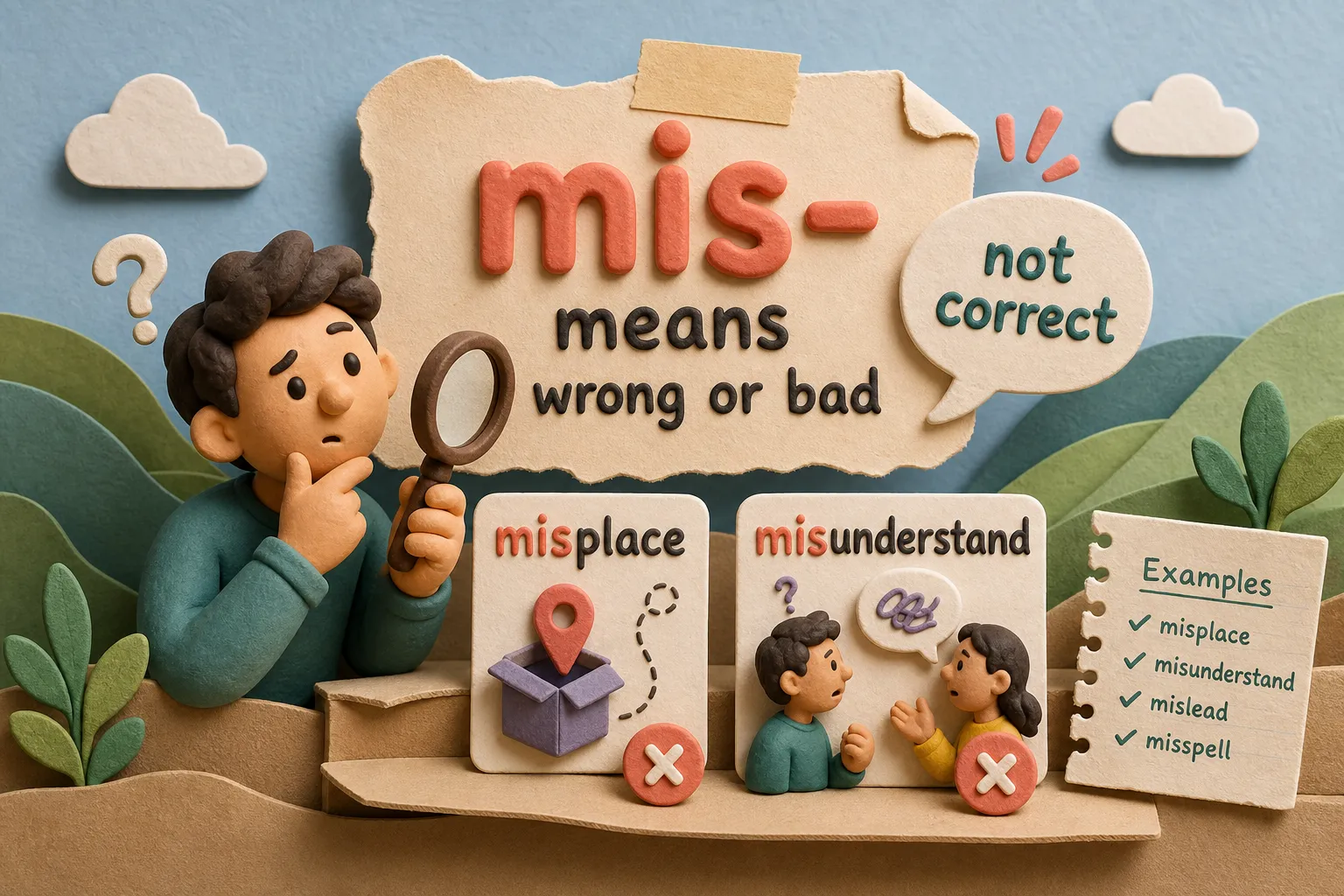
The prefix mis- means “wrongly,” “incorrectly,” or “badly.” That is the whole idea. The meaning is simple and it stays consistent across hundreds of words. When you see mis- at the start of a word, it almost always tells you that something was done the wrong way.
Look at how it works in action. The word understand becomes misunderstand , which means “to understand incorrectly.” The word spell becomes misspell , which means “to spell wrongly.” The structure is the same every time: place mis- in front of a base word and you get the action done incorrectly.
Where this prefix comes from
The prefix mis- has two roots. The older form comes from Old English and traces back to a Proto-Germanic word that also meant “wrongly” or “badly.” English later borrowed a parallel prefix, mes-, from Old French, which carried the same basic meaning. Over centuries, both forms merged into the single modern English prefix mis- . That shared history explains why it appears across such a wide range of vocabulary, from casual everyday speech rooted in Germanic words to more formal terms borrowed from French and Latin.
You do not need to remember the history to use mis- correctly. But understanding where it came from helps explain why the prefix shows up in so many different types of words, from casual conversation to professional writing.
Why its meaning has stayed the same
Some English prefixes have shifted in meaning over hundreds of years. The mis- prefix has not. From Old English to modern American English, it has consistently meant “wrongly” or “badly.” Words like misinformation, miscommunication , and misfire are very current examples, all three carry the same core idea that something went wrong. That stability is actually good news for learners: once you know what the prefix means, that knowledge transfers cleanly to almost every word that uses it.
How the mis prefix joins with words: formation and spelling rules
Why verbs come first
The prefix most often attaches to verbs. The pattern creates a new verb meaning “do this action wrongly”: misjudge, mislead, misread, mispronounce. This is the most common and most useful pattern in everyday speech. It can also attach to nouns, as in misfortune and misuse , but the verb pattern is the one you will encounter and use most often.
The double-letter rule and other spelling notes
In standard American English, you do not use a hyphen. Write misread , not mis-read. The prefix always connects directly to the base word. There is one spelling trap worth knowing: when the base word starts with the letter s , you end up with a double ss. So mis + spell = misspell (two s’s). This double-s construction is a frequent source of spelling errors, even for native speakers, so it is worth slowing down and double-checking whenever you write it. In modern English, the form is consistently mis- regardless of what word follows, making it one of the more predictable prefixes to work with.
False mis- words to watch out for
Some words start with the letters mis but do not actually use the prefix. Mister, misery, and mission are good examples. In those words, mis is simply part of the root, it does not mean “wrongly.” A useful rule of thumb: remove mis- and ask whether what is left is a real English word that makes sense on its own. Misplace works because place is a real word. Misery does not work because ery is not. Keep in mind this is a heuristic rather than a hard rule, some words are trickier. Mistake, for instance, comes from Old Norse and the base (take ) looks like a real word, yet the meaning of mistake has drifted far from “to take wrongly.” When in doubt, checking a reliable etymological dictionary like Merriam-Webster or Etymonline will give you a clearer answer.
The most common mis- words in everyday American English
Words you will hear in daily conversations
The words below are practical, high-utility examples selected for how often they come up in spoken and written American English. Study the base word alongside each one so you can see the structure clearly.
- misplace (place → misplace): “I misplaced my phone again.”
- misunderstand (understand → misunderstand): “Sorry, I misunderstood your question.”
- misbehave (behave → misbehave): “The kids misbehaved at the restaurant.”
- misread (read → misread): “I misread the sign and took the wrong exit.”
- mishap (hap → mishap): “A small mishap made us late.” (Note: hap is an old word for luck or chance.)
- misjudge (judge → misjudge): “I misjudged how far the parking lot was.”
- mistreat (treat → mistreat): “It is wrong to mistreat animals.”
- misguide (guide → misguide): “The wrong address misguided us completely.”
Words that come up at work and in professional settings
The words below appear regularly in business emails, workplace meetings, and professional conversations. Knowing them helps you sound natural in a U.S. work environment.
- miscommunication (communicate → miscommunicate): “A miscommunication led to the wrong deadline.”
- mismanage (manage → mismanage): “The project failed because it was mismanaged.”
- mislead (lead → mislead): “The report misled investors.”
- misinterpret (interpret → misinterpret): “She misinterpreted the client’s feedback.”
- miscalculate (calculate → miscalculate): “We miscalculated the budget.”
- misquote (quote → misquote): “The journalist misquoted the manager.”
- mishandle (handle → mishandle): “The complaint was mishandled by the support team.”
Mis- vs. dis- vs. mal-: what is the real difference?
Mis- means wrong; dis- means opposite or apart
Mis- and dis- are not the same, even though both carry a negative feeling. The key difference is this: mis- describes an action done incorrectly; dis- describes something that is removed, reversed, or simply not happening.
Look at these pairs. Misuse means to use something the wrong way. Disuse means something is no longer used at all. Misinform means to give someone incorrect information. Disinformation refers to false information spread deliberately to deceive. The prefix is doing different work in each case. If a mistake or error is involved, mis- is usually the right choice. If something is simply absent, reversed, or opposed, dis- is more likely correct.
Where mal- fits in
The prefix mal- comes from Latin and means “bad” or “harmful.” It shows up mostly in formal, medical, or technical vocabulary: malfunction (to function badly), malpractice (improper professional conduct), malnutrition (bad nutrition), malicious (having harmful intent). In everyday American English conversation, mal- is far less common.
A practical way to remember all three: mis- means the action was done incorrectly, dis- means something is not happening or is being reversed, and mal- means something is bad, harmful, or defective. In most daily conversations and workplace writing, mis- is the one you will use and hear the most. For a clear, practical overview of confusing prefixes (un-, dis-, im-, mis-), see this helpful guide from EC English: Prefixes: un-, dis-, im-, mis- (EC English).
Why knowing this prefix helps you speak and write better English
How one prefix unlocks dozens of new words
Once you know that mis- means “wrongly,” you can often work out the meaning of an unfamiliar word built on it, even without a dictionary. Take the word misconstrue . You may not know it yet. But if you know that construe means to interpret something, you can reasonably infer that misconstrue means to interpret something incorrectly. That inference will not always be perfect, some mis- words have shifted in meaning over time, so a quick dictionary check is still a good habit, but the prefix gives you a strong starting point.
Vocabulary specialists sometimes call this kind of skill prefix literacy: the ability to read unfamiliar words by recognizing their parts. It is one of the most practical vocabulary-building habits you can develop in English. One prefix, dozens of words unlocked. To expand this skill further, read our guide Prefixes and Suffixes: Unlock Thousands of English Words, and for classroom-focused resources on teaching the prefix directly see the Reading Universe primer on explicitly teaching prefixes: Explicitly Teaching the Prefix mis (Reading Universe).
The connection to your biggest communication challenges
Two of the most commonly cited problems English learners face both carry the prefix right in their name: mispronunciation and miscommunication . Mispronouncing words is one of the leading reasons learners feel misunderstood in real conversations. Miscommunication at work can damage professional relationships and slow down projects.
This is exactly the focus of Your Daily American. Every lesson on the platform is built around real-world American English situations, including pronunciation training that targets specific sounds and workplace communication guides that show you how native speakers actually phrase things. For common pronunciation pitfalls, see our article English Words Non-Native Speakers Mispronounce Most Often, Your Daily American. Building vocabulary around how mistakes are named, starting with the mis- prefix, is a solid first step toward clearer, more confident communication.
Spotting mis- words in the wild
Start noticing these words in American media: news headlines, work emails, TV shows, podcasts. When you spot one, pause and ask two questions: “What base word is this built on?” and “What mistake does this word describe?” That kind of active, curious practice builds vocabulary faster than studying word lists in isolation. You are training your brain to recognize patterns rather than just memorize items.
Quick practice: test yourself with these exercises
Three ways to practice right now
Build-it exercise: Take these base words and add mis- to form a new word, then write a sentence using it: lead, judge, place, spell, interpret, communicate. Check your spelling carefully, no hyphen, and watch for double letters if the base word starts with s . If you want a short, example-rich explanation to review before you try this, Study.com’s guide on using the prefix mis- is a helpful companion: Using the prefix mis (Study.com).
Spot-the-prefix exercise: Read a short email or news article today and highlight every word that starts with mis- . Write the base word next to each one. This takes about five minutes and shows you how often this prefix turns up in real, everyday English.
Correction exercise: Write three sentences about a real mistake you made recently, using a different word built with mis- in each sentence. Writing about real situations helps the words stick in your memory.
A self-check before you move on
Try to answer these four questions in your head. What does mis- mean? Which is spelled correctly: misspell or mispell? What is the difference between misuse and disuse? Can you name two words with this prefix that come up regularly in American workplaces? If you can answer all four, you have a solid understanding of how the prefix works and you are ready to use it with confidence.
Keep building from here
The mis- prefix is simple, consistent, and very common in American English. In most cases it signals something done wrongly or badly, and that one idea opens up a large portion of the vocabulary you need for daily life and for the workplace.
Recognizing words built with this prefix makes you a faster reader, a more accurate writer, and a clearer communicator. It also helps you understand what went wrong in any situation, whether it was a misread email, a miscalculated budget, or a simple misunderstanding in conversation.
If mispronunciation or miscommunication is something you want to work on directly, explore the pronunciation and professional English content on Your Daily American. You can also read our guide Word Stress in American English: A Complete Guide, Your Daily American. Each lesson is built around real situations, exactly like the ones this prefix describes. The more clearly you understand how the language works, the more confident you become every time you use it.