You are writing your resume or getting ready for a job interview. You notice some words feel more professional and precise than others, words like proactive , effective , creative , decisive . What do they all have in common? They all end in -ive. This ive suffix is a productive and common word-building tool in formal and professional English, and you will find it constantly in job descriptions and business writing. By the end of this lesson, you will know exactly how it works and be ready to use it confidently in interviews and professional writing. At Your Daily American, practical, career-ready English like this is exactly what we focus on every day.
What the -ive suffix actually means
The core definition
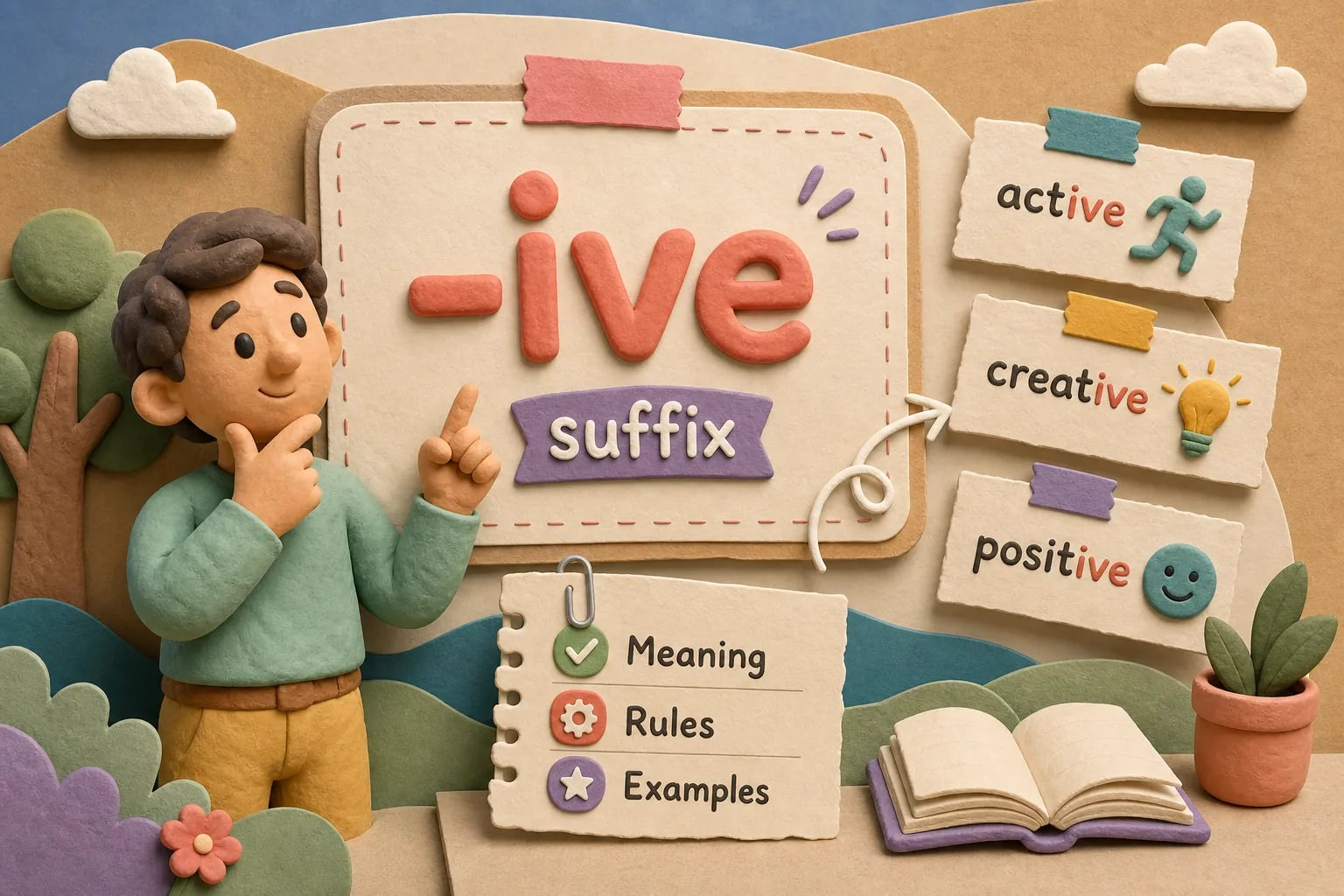
A suffix is a group of letters added to the end of a word to change its meaning. The suffix -ive means “having the nature of,” “tending to,” or “performing the action of.” It works like this: act becomes active (“tending to act”), create becomes creative (“having the nature of creating”), and decide becomes decisive (“tending to decide”). The connection between the base word and the meaning is often clear and direct, though some derivatives are less transparent, always check a dictionary when you are unsure of a specific form.
How it changes the word’s job
The suffix -ive is a derivational suffix, meaning it changes a word’s part of speech. Specifically, it turns verbs into adjectives. This is different from suffixes like -ed or -s, which only change tense or number without changing the word’s category. Some -ive words also work as nouns: native, executive, and representative are good examples. The key idea is description: these adjectives describe a quality, tendency, or capacity related to the original action.
Where -ive comes from
The Latin root: -īvus
The suffix -ive goes back to the Latin suffix -īvus , which meant “belonging to” or “having the nature of.” You can see this in Latin words that became modern English words: activus became active , passivus became passive, and sensitivus became sensitive. Latin was the language of science, law, and religion in Europe for hundreds of years, a historical reality well documented in the study of etymology and the development of English vocabulary. That long dominance is why so many formal English words still carry Latin patterns today.
How it traveled from Latin into English
The suffix did not come directly from Latin into English. After the Norman Conquest in 1066, French speakers ruled England. French had already absorbed Latin’s -īvus as -if (masculine) and -ive (feminine). English then borrowed hundreds of French words and kept the -ive form. This is why so many business, legal, and academic words follow this pattern. When you learn this suffix, you unlock an entire category of words rather than learning them one at a time.
Ive suffix spelling rules: how to form words correctly
Drop the silent “e” and watch for consonant changes
The main spelling rule is straightforward. When a verb ends in a silent e , drop the e before adding -ive. So create becomes creative and decide becomes decisive . When there is no silent e , you usually add -ive directly to the base: act becomes active and express becomes expressive. Some verbs go through a historical root change in the consonant, a pattern inherited from Latin and Old French. For example, permit becomes permissive (the Latin stem miss- replaces mit-). Note that admit follows the same root pattern, but the standard adjective in modern American English is admissible, not an -ive form. When in doubt about a specific word, check a trusted dictionary. Focus on the patterns you see most often and look up exceptions as they come up.
Common mistakes and what to watch for
ESL learners make a few common mistakes with this suffix. First, some learners keep the final e and write createive instead of creative . Second, some confuse the noun form with the adjective form: production is a noun, but productive is the adjective. Third, learners sometimes are unsure whether to use -ive or -ative. The best habit is to learn the whole word family together. For example: create , creative , creatively, creativity. When you learn one form, you build vocabulary for all the others at the same time.
High-frequency ive suffix words in American business English
Words that appear on resumes and in interviews
These words appear regularly on American resumes, LinkedIn profiles, and in job interviews. Some describe personal traits:
- Proactive: taking action before problems happen (“She is proactive with every client.”)
- Assertive: speaking up with confidence (“He is assertive in meetings without being aggressive.”)
- Decisive: making clear decisions quickly (“A decisive manager helps the team move forward.”)
- Innovative: bringing new ideas (“The company is known for innovative solutions.”)
- Creative: thinking in original ways (“We need creative thinkers for this role.”)
- Collaborative: working well with others (“A collaborative attitude is essential here.”)
- Persuasive: able to change minds through strong reasoning (“She wrote a persuasive proposal.”)
Others describe the quality of your work: effective (producing the results you want), productive (getting a lot done well), constructive (helpful and focused on improvement), comprehensive (covering everything that is needed), and communicative (sharing information clearly and often).
How these words work in meetings and professional writing
The same words show up constantly in everyday workplace communication. “We need a more effective approach to this project.” “Her constructive feedback helped everyone on the team.” “He’s known for being proactive with clients.” Notice how each word signals something specific about behavior or quality, rather than just a general positive feeling. Learning to use them precisely is what separates fluent professional communication from approximate communication.
How -ive compares to -ative, -ous, and -ful
-ive vs. -ative: one pattern, not two
Many learners wonder about -ative. It is not a completely different suffix. In most cases, -ative is simply the verb ending -ate combined with -ive . When a verb ends in -ate , the adjective almost always ends in -ative: communicate becomes communicative , innovate becomes innovative , and narrate becomes narrative. Notice that create loses the full -ate ending, so it becomes creative , not *createative. This -ative pattern is especially common in business and academic English, so recognizing it gives you a strong advantage when reading or writing formal documents.
-ive vs. -ous and -ful: different roots, different meanings
The suffixes -ous and -ful work differently. Both usually attach to nouns, not verbs, and they signal “fullness” or “quality” rather than action or tendency. So active means “tends to act” (from the verb act ), while dangerous means “full of danger” (from the noun danger), and careful means “full of care” (from the noun care). A useful general guideline: if you can trace a word back to a verb, -ive is often the right choice. If the base is a noun, -ous or -ful is more likely. Keep in mind this is a tendency, not a hard rule, English has exceptions, so verify unfamiliar words in a dictionary. Still, this distinction helps you avoid word-choice errors in formal and professional writing.
Practice: put -ive words to work right now
A short self-check
Try these prompts on your own. You can answer in your head or write them out.
- Name three -ive adjectives you would use to describe yourself in a job interview.
- Turn this verb into an -ive adjective: produce.
- Which is correct: communicateive or communicative ? Why?
- Choose the better word: “The new plan is very ___.” ( effective or efficient) Remember: effective means the plan produces results. Efficient means the plan uses time and resources well. Which fits your sentence?
What to do next
Open a real job posting or look at your own resume. Count every -ive adjective you find and notice what each one signals about the person or the role. This trains your eye to spot how often these words appear in real workplace writing. Then visit Your Daily American’s vocabulary and professional English sections to keep building your word bank in a structured way. The goal is not to collect words, it is to use them in the right context, at exactly the right moment.
What you now know about -ive
The -ive suffix appears constantly in formal, professional, and academic writing. Knowing what it means, where it comes from, and how it works lets you recognize and use a whole category of words with greater confidence. Most -ive words are predictable once you understand the pattern, though some forms are irregular, when you encounter an unfamiliar one, a quick dictionary check will confirm it.
The next time you read effective , innovative , or constructive in a job description, you will know exactly what it signals and how to use it yourself. That is not just vocabulary knowledge. That is real fluency, and that is what we build together at Your Daily American.