You’re reading in English and you stop at the word “impolite.” You look it up. A few minutes later, you stop again at “immature.” You look that up too. Then you see “impossible,” and suddenly you wonder if these words have something in common. They do. They all start with the same small piece: im-.
The im- prefix is a short word part added to the beginning of a word to change its meaning. Once you know what it means, you can figure out dozens of new words without a dictionary. Words like “impatient,” “imperfect,” and “improper” all follow the same pattern. When you recognize the prefix, you already know the basic meaning before you finish reading the word.
This article explains what the im- prefix means, why it looks the way it does, how it compares to similar prefixes like in- and un-, and what to watch out for. By the end, you’ll have a practical tool that helps you read and use new vocabulary much faster.
What the im- prefix actually means
The primary meaning: “not”
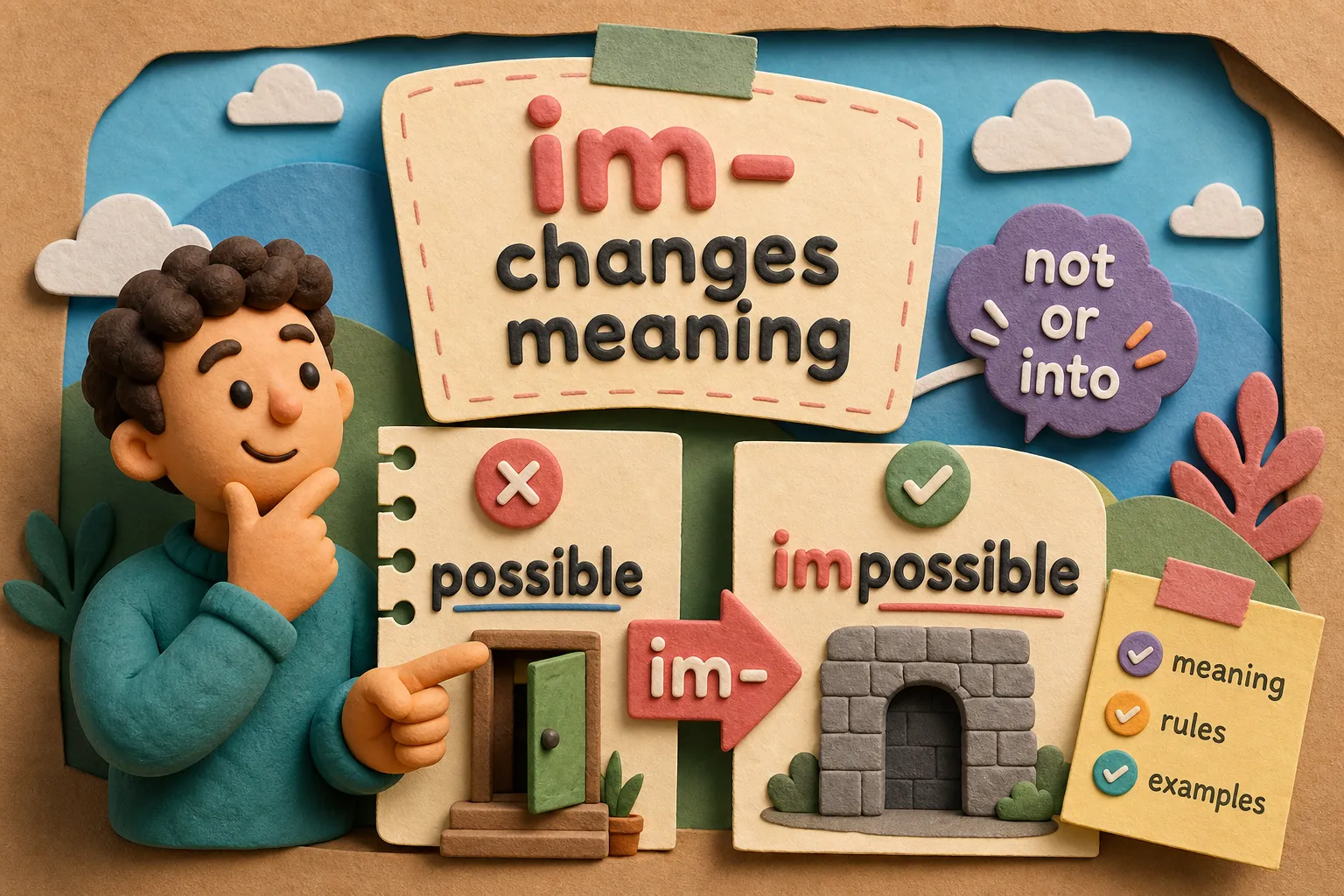
The most common meaning of im- is “not.” When you add im- to an adjective or noun, it flips the meaning to the opposite. The base word stays the same; you just add im- to the front. Here are three clear examples:
- possible → impossible (not possible)
- mature → immature (not mature)
- polite → impolite (not polite)
That one meaning gives you access to a large number of words that follow this pattern. Recognizing the prefix and identifying the base word gets you most of the way to the meaning immediately. Keep in mind, though, that many common im- words, “important,” “imagine,” and “immense,” for example, are not negatives at all. The pattern is a strong first guess, not an absolute rule.
A second meaning: “in” or “into”
The im- prefix also appears in words where it means “in” or “into.” This comes from Latin and is less common in everyday conversation, but you will see it. The word “implant” means to place something into something else. The word “immigrate” means to move into a new country. In these cases, im- is not making anything negative; it is showing direction or movement.
Knowing this second meaning prevents confusion. If you see an im- word and it doesn’t seem to mean “not,” it may belong to this second group. A word like “implant” has a clear directional sense, something going into something else, while “impossible” has an obvious opposite meaning. The context will usually make the distinction clear.
The spelling rule: why “in-” changes to “im-“
How your mouth shapes the rule
The Latin prefix that English inherited was in-, which carried both a “not” sense and an “in/into” sense. So why does it become im- in some words? The answer comes down to how sounds are made in your mouth. Try saying “in-possible” slowly. Now say “impossible.” The second version is easier. That’s because n is made with the tongue at the ridge just behind your upper teeth, while p is made with the lips. Switching between them quickly is awkward. When the following word starts with a b, m, or p sound, your mouth shifts the n to an m naturally, because m is also a lip sound. This process is called assimilation: when one sound changes to match a nearby sound.
All three letters, b, m, and p, are produced with the lips. Replacing n with m before any of them keeps everything at the lips, and the word flows easily.
Where this rule came from
English borrowed this pattern directly from Latin, where the prefix in- followed the same assimilation rule. The Latin word for “not possible” was already written as impossibilis. English kept the spelling when it borrowed the word. So im- before b, m, and p is not a new invention; it’s a pattern that dates back to classical Latin, more than two millennia ago.
The same logic applies to other prefixes in the same family. Before the letter l, in- becomes il- (illegal, illogical). Before the letter r, it becomes ir- (irregular, irresponsible). Once you see the bigger system, English spelling starts to look much less random.
How to pronounce im- correctly
The prefix im- is a short, unstressed syllable. In IPA, it’s written as /ɪm/, which sounds like the “im” in the word “him.” In everyday speech, it blends right into the root word. The stress almost always falls on the root, not the prefix, im-POS-sible, im-MA-ture, im-PA-tient, though the exact pattern can vary by word. Say the prefix lightly and keep moving to the stressed syllable.
Common im- words in real sentences
Everyday words you’ll use right away
Here are useful im- words with short definitions and one example sentence each. For every word, notice the base word and what im- does to it.
- impossible (not possible), “It’s impossible to get a reservation this weekend.”
- impolite (not polite), “It’s impolite to check your phone during a meeting.”
- immature (not mature), “That comment was immature and unprofessional.”
- imperfect (not perfect), “The product was imperfect, so they sent a replacement.”
- impatient (not patient), “She got impatient waiting in line for 20 minutes.”
- immobile (not able to move), “After the injury, he was completely immobile.”
- improper (not proper or correct), “That kind of language is improper in a work email.”
Each sentence places the word in a realistic situation: a restaurant, a meeting, a line, a workplace. These are conversations you might actually have.
Words you’ll find in professional and academic settings
As your English moves into more formal environments, you’ll also encounter these words. They follow the same im- pattern but appear more often in written English and workplace conversations. Impractical means not realistic or usable: “That plan is impractical for our current budget.” Imprecise means not exact: “The instructions were imprecise, so the team made errors.”
One word that needs a special note is immense. It means very large, not “not mense.” The word “mense” doesn’t exist in modern English, so this is not a standard negative im- word. “The immense crowd filled the entire stadium.” Not every word that starts with im- is a negative, a point that becomes important in the next section.
How im- compares to in-, un-, il-, and ir-
A clear decision guide
Negative prefixes in English can be confusing because the form you use depends on the first sound of the root word. Here is the full system:
- im- before b, m, p: impossible, imbalance, immature
- il- before l: illegal, illogical
- ir- before r: irregular, irresponsible
- in- before most other consonants and vowels: indirect, incomplete, invisible
- un- for many common adjectives, especially from everyday English: unhappy, unable, unkind
The key rule to remember: if the root word starts with b, m, or p, use im-. This is a sound-based rule, those three letters are all produced with the lips, so a small number of words are historical exceptions and must simply be memorized. You don’t need to master the whole system today. Start with that one rule and the others will become familiar over time.
A tricky pair: “inpatient” vs. “impatient”
These two words look similar but mean completely different things. Impatient (im- + patient) means not patient: “She was impatient with the slow process.” Inpatient (in- + patient) is a medical term for a person who stays overnight in a hospital: “He was admitted as an inpatient for three days.” Both words are correct, and each uses a different prefix. This is a useful reminder that some words are exceptions and need to be learned individually.
Mistakes ESL learners commonly make with im- words
When im- does NOT mean “not”
Several very common English words start with im- but are not negatives at all. “Imagine,” “imply,” “improve,” “impact,” and “important” all begin with im-, but none of them mean “not” something. They come from the “in/into” form of the prefix, or the original Latin meaning has shifted so much over time that the prefix is no longer recognizable.
Here is a quick check you can use: does the word have a clear base word that im- could negate? “Impossible” = not possible. “Impolite” = not polite. But “important”? There is no common English word “portant” that im- is negating. When the check doesn’t work, the word is not a simple negative. Treat it as its own vocabulary item.
The word “infamous”: a common trap
“Infamous” does not mean “not famous.” It means well-known for something bad or wrong. “The infamous criminal was finally arrested.” If im- meant “not” here, the word would mean “unknown,” but that’s not how it’s used. “Infamous” has developed its own fixed meaning over hundreds of years.
A similar case is “invaluable.” This word means extremely valuable, not worthless. The prefix “in-” here intensifies the meaning rather than negating it. These two words are useful reminders: patterns are powerful tools, but the meaning of a specific word always wins over the general rule. When in doubt, check the full word in context.
A simple way to practice and remember im- words
Turn the pattern into a daily habit
When you read or hear a new im- word, stop for three seconds and ask two questions. First: what is the base word? Second: does im- flip its meaning to “not”? That short pause draws on a technique called active recall, pulling an answer from memory rather than passively re-reading. Research in vocabulary learning consistently points to retrieval practice as one of the most reliable ways to make new words stick.
Once a week, write down three new im- words in a notebook. Next to each word, write the base word and one sentence from your own life. “I feel impatient when the internet is slow.” Personal sentences are easier to remember because they connect the word to something real for you. This habit builds faster than reviewing word lists.
Go deeper with structured vocabulary guides
The im- prefix is one piece of a much larger system. English has dozens of prefixes and suffixes that work the same way. Once you learn to use them, your vocabulary grows more efficiently because you’re not memorizing words one by one; you’re learning patterns that apply to hundreds of words at once.
At Your Daily American, the vocabulary and grammar guides are built around exactly this approach. They show you not just what words mean, but when and how native speakers use them in real conversations, emails, and meetings. Knowing a word is different from being able to use it, and that gap is where the guides focus. If you’re ready to build that kind of vocabulary, it’s a great place to start.
Key takeaways
The im- prefix is a shortcut. When you see it before a word that starts with b, m, or p, your first guess should be “this probably means not [base word].” That single pattern covers a large number of common English words. The prefix traces back to the Latin in-, which carried both “not” and “in/into” senses. The n shifted to m through assimilation, matching the lip position of the following b, m, or p sound, and that pattern has been in place since classical Latin.
Keep in mind the three main points: im- usually means “not,” it appears before b, m, and p because of how those sounds are made at the lips, and not every im- word is a negative (imagine, improve, and important are not negatives). Use the quick check, does the word have a clear base word being negated?, to stay on track.
The next time you see a word starting with im-, take three seconds to find the base word and check whether im- is flipping the meaning. Do that consistently, and your vocabulary will grow without any extra effort.