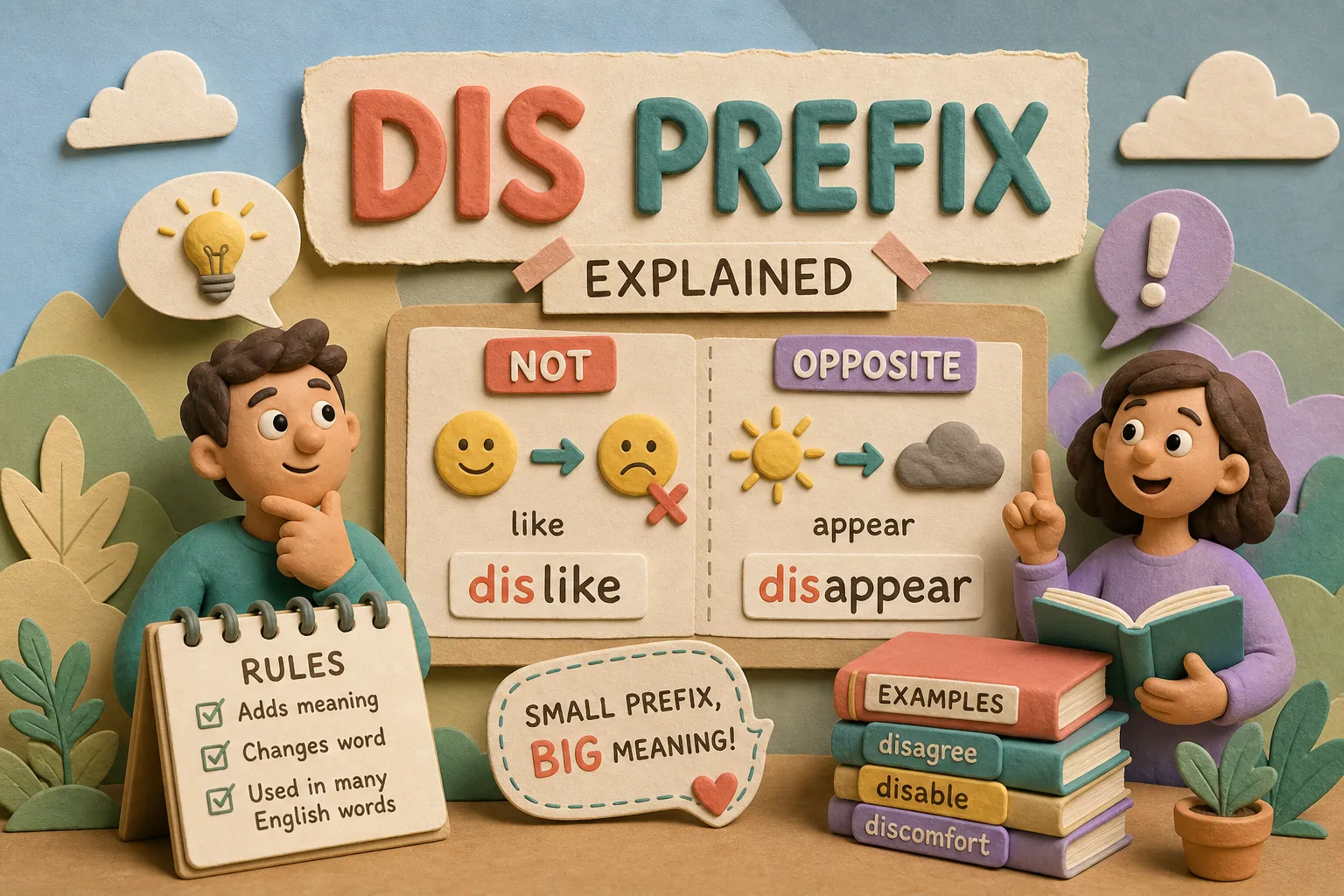
Think about how many times you’ve seen words like disagree, disconnect, disappoint, and dismiss in English. These words look very different on the surface, but they all start with the same two letters. That shared beginning is the dis prefix, and it carries meaning every time it appears. Once you understand what it signals, you can decode hundreds of unfamiliar words without reaching for a dictionary.
Research on morphological instruction shows that learners who study word parts like prefixes tend to expand their vocabulary much faster than those who memorize one word at a time. The reason is straightforward: one pattern opens the door to many words.
By the end of this article, you will be able to define what dis- means, recognize it in new words, and use the most common examples in real conversations and at work. You’ll also know how it differs from similar prefixes like un-, in-, and mis-, one of the most practical distinctions in English vocabulary.
What the Dis Prefix Actually Means
The prefix dis- has three main senses in modern English. You don’t need to memorize all three separately. Context almost always tells you which one applies, so your job is to recognize the prefix and think about what the base word means.
For a concise dictionary definition, consult Merriam-Webster’s entry for “dis-“.
The most common sense: “not” and “opposite of”
When dis- is added to an adjective or noun, it usually means “not” or “the opposite of.” This is the most common use, and it works in a very predictable way. Dishonest means not honest. Disadvantage means the opposite of an advantage. Note that disapprove is a verb example rather than an adjective or noun, but the negating logic holds: it means to be against something, to withhold approval.
Here’s how this helps you in practice. If you see an unfamiliar word like disloyal, you can break it apart: dis- + loyal = not loyal. You get the meaning without a dictionary. That kind of word-decoding skill builds your reading speed over time.
A second sense: “reverse” or “undo”
When dis- is added to a verb, it often means “to reverse an action” or “to undo something”, essentially canceling what the base verb describes. Disconnect means to undo a connection. Disarm means to remove weapons. Disengage means to pull away from something.
This sense appears often in workplace and technical English. Phrases like “please disconnect from the network” or “the manager disengaged from the project” are common in professional settings, particularly in IT and business communication.
A third sense: “remove” or “take away”
This sense is less common, but worth knowing. Here, dis- means “to deprive of” or “to remove something from a person or place.” Disqualify means to remove someone from a competition. Displace means to remove someone from a position or location, for example: “The flood displaced thousands of families.”
This sense tends to appear in formal or news-style writing. The core logic stays consistent: something is separated or taken away from the subject.
Where the Dis Prefix Comes From, and Why That Helps You
You don’t need a history lesson to use dis- correctly. But knowing one key fact about its origin makes the prefix easier to remember and apply.
The Latin root
The prefix dis- comes from Latin, where it meant “apart” or “in two directions.” The original idea was separation: something splits apart, moves away, or goes in the opposite direction. That core idea of separation became the foundation for all three modern senses. For a concise etymology, see Etymonline’s entry on “dis-“.
The word dismiss is a clear example. It comes from the Latin word meaning “to send away.” When you dismiss someone, you send them away from the group. You can also review the root meaning summarized by Membean’s “dis- = apart” root page for a learner-friendly explanation.
Why old spelling forms still show up today
You may notice that some words use dif- or di- instead of dis-. Examples include different and diffuse. These are not spelling mistakes. They are fixed word forms that came into English directly from Latin and kept their original spelling through a process called assimilation.
The practical rule of thumb: when you add dis- to a base word today, you will almost always spell it dis-, without any changes. The dif- and di- forms appear only in established words already spelled that way in the dictionary, lexicalized exceptions rather than productive patterns. You don’t need to think about them when building new words.
Dis- vs. un-, in-, and mis-: Choosing the Right Prefix
This is one of the most useful things to understand at the intermediate level. Many learners treat dis-, Un- prefix: The Simplest Way to Expand Your Vocabulary, in-, and Mis- prefix: Meaning and the Key Words to Know as if they all mean the same thing. They don’t. Each one does a slightly different job, and choosing the wrong one can change your meaning.
Dis- vs. un-: similar, but not always the same
Both dis- and un- can mean “not” or “the opposite of,” but they are not always interchangeable. Sometimes the two versions of a word carry different meanings entirely.
Consider disused and unused. Disused means “no longer in use, abandoned.” Unused means “not used yet.” Both use a negative prefix, but they describe different situations, and the distinction matters. The same applies to disinterested and uninterested. Disinterested means “impartial, not taking sides.” Uninterested means “not interested at all.” Using the wrong one changes your message significantly.
The safest approach is to check which form is standard for the specific word you want to use. English often connects one prefix to one base word by habit and convention, not by a strict grammar rule. For a practical comparison of dis- and un-, see Grammarly’s guide to dis- vs. un-.
What mis- and in- do that dis- doesn’t
The prefix Mis- prefix: Meaning and the Key Words to Know does not mean “not.” It means “wrongly” or “badly.” This is an important distinction. Misunderstand doesn’t mean you didn’t understand something; it means you understood it in the wrong way. Misplace doesn’t mean you didn’t place something; it means you placed it in the wrong location.
The prefix in- is a more formal way to say “not,” common in words from Latin: inactive, incomplete, inaccurate. It also changes spelling depending on the next letter, becoming im- before p or m (as in impossible), il- before l (as in illegal), and ir- before r (as in irregular).
Think of these as rules of thumb rather than absolute laws, since English usage often determines the preferred prefix for a given root. That said, a reliable starting point: use dis- for reversed actions, mis- for something done badly or incorrectly, and in- for formal “not” adjectives with Latin roots.
High-Frequency Dis- Words You’ll Actually Use
The examples below represent words that appear frequently in everyday and professional English. Each appears in a full sentence so you can see it working in context.
In everyday conversation
These words come up regularly in casual speech and daily life. Notice how naturally they fit into real situations.
- Disagree: “I disagree with your decision, but I understand your thinking.” (Stress falls on the last syllable: dis-a-GREE.)
- Disappear: “My keys always disappear when I’m running late.”
- Dislike: “She dislikes crowded places, so she avoids the subway.”
- Disappointing: “The movie was disappointing; the trailer looked much better.” (Stress: dis-a-POINT-ing.)
- Disturb: “Please don’t disturb me during the first hour of work.”
- Discover: “He discovered a great coffee shop near his apartment.”
- Disconnect: “I felt a real disconnect between what she said and what she did.”
In workplace and professional English
These words appear regularly in emails, meetings, and professional conversations. Pay attention to the formality notes, since some fit certain contexts better than others.
- Discuss: “Let’s discuss the project timeline in tomorrow’s meeting.” (Neutral; works in any professional setting.)
- Disclose: “The company is required to disclose its financial results each quarter.” (Formal; common in legal and compliance writing.)
- Dismiss: “The manager dismissed the idea without giving it a fair chance.”
- Disapprove: “The board disapproved the budget request and asked for revisions.”
- Dispute: “The two departments have a dispute about who owns the project.”
- Distract: “Constant notifications can distract you from focused work.”
- Discourage: “Negative feedback shouldn’t discourage you; it should guide your next step.”
How Recognizing the Dis Prefix Builds Your Vocabulary Faster
When you learn what dis- means, you don’t just learn one word. You gain a pattern that applies across a large group of words. That’s what makes prefix study one of the most efficient vocabulary strategies for intermediate learners.
Why one prefix unlocks many words
Once your brain recognizes what dis- signals, it can make a reasonable guess about a new word before you look it up. Try decoding these three words using what you just learned:
- Disenchant: dis- + enchant (to charm or delight) = to no longer feel excited or charmed by something.
- Dismantle: dis- + mantle (a structure or covering) = to take something apart piece by piece.
- Disorient: dis- + orient (to find your position or direction) = to make someone confused about where they are or what is happening.
You decoded three words using one rule. Instead of adding vocabulary one item at a time, you add it by pattern, and each new pattern you learn gives you access to a whole group of words at once.
A simple way to practice right now
Choose five words from this article. Write one original sentence for each, then say them out loud, paying attention to where the stress falls. After that, look for these words in the English content you already use: emails, news websites, podcasts, or TV shows. Seeing a word in multiple real contexts is what moves it from “I recognize this” to “I can use this.”
If you want a more structured approach to building vocabulary this way, the Prefixes and Suffixes: Unlock Thousands of English Words section at Your Daily American covers techniques like this in detail. The resources are designed specifically for English learners who want lasting results, not passive memorization.
What You Now Know About the Dis Prefix
You’ve covered the three main senses of dis-: negation (“not” or “the opposite of”), reversal (“undo” an action), and removal (“take away” from someone or something). You’ve also seen how it compares to un-, in-, and mis-, three prefixes that are easy to confuse but each serve a different purpose.
Most importantly, you now have a tool you can apply to new words. The next time you encounter a word beginning with dis-, you don’t need to reach for a dictionary right away. Break the word apart, identify the base, and make a strong guess about the meaning. That kind of active decoding is what helps learners grow faster and feel more confident in real English situations.
Here’s your practice prompt for today: think of one word with the dis prefix that you haven’t used before. Write a sentence with it and say it out loud at least twice. Small, consistent steps like this are what turn vocabulary study into real fluency.