You write “I seen him at the store” and your American colleague looks confused. Or you type “I have saw that movie” and many spellcheckers won’t flag it, because both saw and seen are valid words, but something still feels off. These two mistakes are among the most common errors ESL learners make with the verb see, and the frustrating part is that some resources simply mark them wrong without any explanation of why.
By the end of this lesson, you’ll know exactly when to use saw and when to use seen, how look vs. seen (and look vs. see) work differently in everyday American speech, and what the casual phrase “look-see” means and how Americans actually use it. These are the kinds of real-usage grammar points that Your Daily American is built on: not just rules, but the reasons behind them, explained the way the language is actually spoken.
Why “Saw” and “Seen” Are Not Interchangeable
The Irregular Verb “See” and Its Three Forms
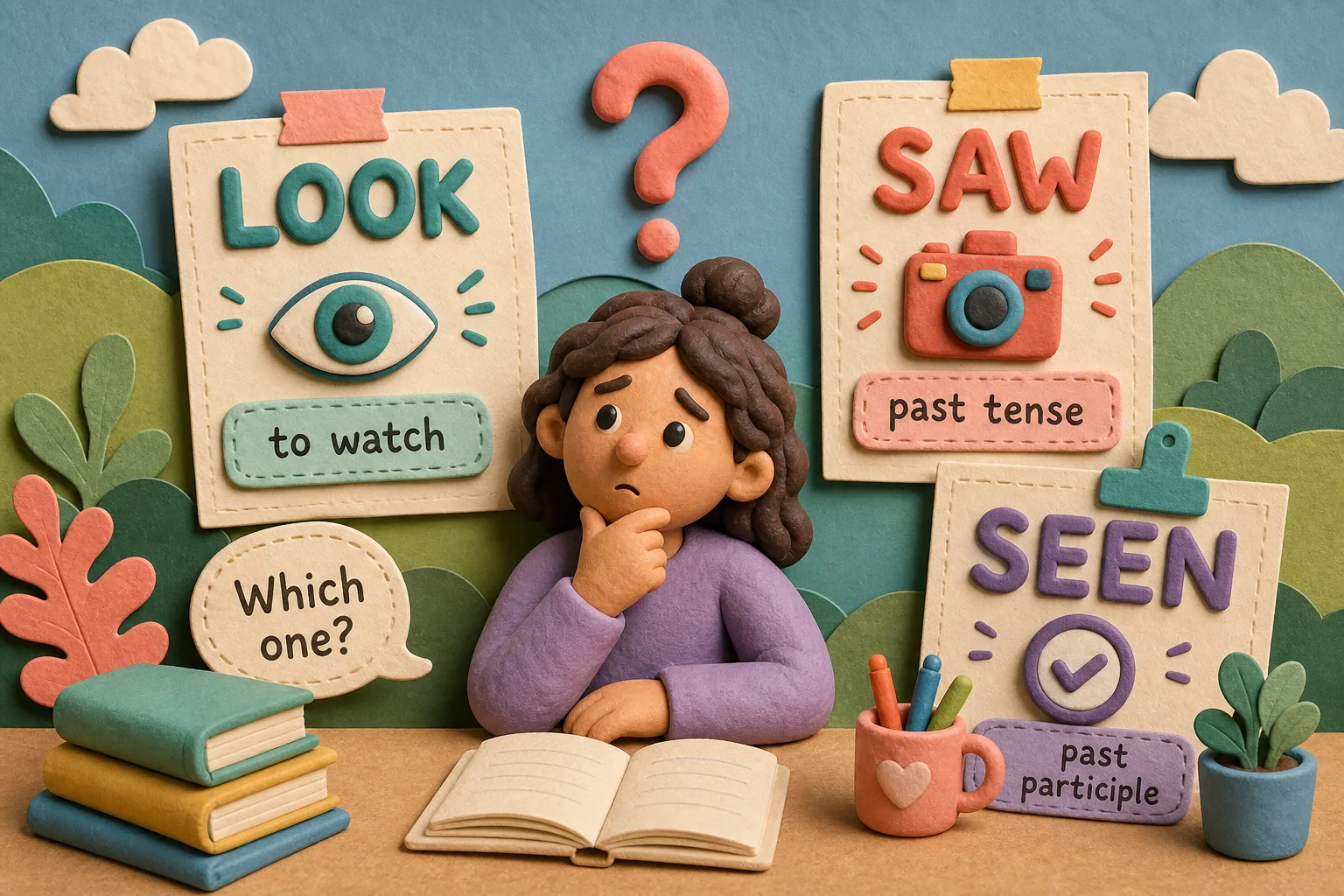
The verb see is irregular, which means its past forms don’t follow the regular -ed pattern. It has three main forms you need to know. The base form is see, as in “I see a dog.” The simple past is saw, as in “I saw a dog yesterday.” The past participle is seen, as in “I have seen that dog before.”
A past participle is the form you use with a helper verb (also called an auxiliary verb) such as have, has, or had. This is the key rule the whole lesson builds on. Once you understand it, the difference between saw and seen becomes easy to apply.
When to Use “Saw”
Use saw when the action is finished and you are not using a helper verb. It stands on its own as the main verb in the sentence. For example: “I saw a great film last night.” “She saw him at the grocery store on Tuesday.” In both sentences, the action is complete, it happened at a specific time in the past, and there is no helper verb before saw.
Look vs. Seen: When “Seen” Needs a Helper Verb
In Standard American English, seen is a past participle and requires an auxiliary verb before it. It always needs have, has, or had to do its job. “I have seen that movie three times.” “She has seen this error before.” “We had seen the warning signs, but we ignored them.” You can also use seen in passive voice, which is a sentence structure where the subject receives the action rather than performs it: “The car was seen by several witnesses.”
Worth mentioning: some regional dialects in the United States do use “seen” as a standalone past-tense form in spoken conversation, you may hear “I seen him” in certain parts of the country. But in standard written English and most professional or academic settings, seen always pairs with a helper verb.
Look vs. See: The Difference in Everyday American Speech
“Look” as an Active, Intentional Action
Look means you choose to direct your eyes somewhere on purpose. It is an active verb: you decide to do it. A useful comparison is the pair listen and hear. When you listen, you make a choice to pay attention. When you hear something, it just reaches your ears. The same logic applies to look and see.
Notice that look usually needs the preposition at when it is followed by an object. “She looked at her notes before the meeting.” “He looked at the map carefully.” You direct your eyes at something. This small grammar detail also helps you choose the right word.
The Difference Between “Look” and “Watch”
While look refers to a quick or single act of directing your eyes, watch suggests sustained attention over time. You look at a photo, but you watch a movie or a game. Think of it this way: looking is a moment, watching is a duration. “She looked at the painting as she walked past” vs. “He watched the game for three hours.” Both are intentional, but watch implies you’re following something as it unfolds.
“See” as Automatic Visual Perception
See is a stative verb in its basic meaning. A stative verb describes a state or condition, not an action. Because of this, see is not normally used in the -ing form when it means simple visual perception. You say “I see a bird outside,” not “I am seeing a bird outside.” The bird appears in your field of vision without you trying.
See does not need a preposition before its object. You see something directly: “I see the mountains from here.” “Can you see the board?” The object follows the verb with no preposition in between.
For more on stative vs. dynamic verbs and why see behaves like a state in many contexts, see this stative verb overview.
A Quick Side-by-Side Example
Here is one sentence that uses both words correctly: “When I looked at the sky, I saw a shooting star.” In that sentence, looked at tells you the action was intentional, you chose to turn your eyes toward the sky. Saw tells you what appeared in your vision as a result: the shooting star. You did not choose to see it; it was just there.
A quick caveat: see has other meanings in English beyond visual perception. “I see what you mean” uses see to mean understand. “I’m seeing a doctor on Friday” uses see to mean meeting someone. In these other meanings, see can behave differently, including in the -ing form. For simple visual perception, though, the rule above holds.
The Most Common Mistakes ESL Learners Make with These Words
Mistake 1: Using “Seen” Without a Helper Verb
The most common error is “I seen him yesterday.” As noted above, some American regional dialects do use this form in casual spoken conversation. However, it is not standard written English, and it will mark you as a non-native speaker in most professional and academic settings. The two correct versions are: “I saw him yesterday” (simple past, no helper verb) or “I have seen him” (past participle with a helper verb).
Mistake 2: Using “Saw” in a Perfect Tense
The second error goes in the other direction: “I have saw that movie.” The rule here is clear. When you use have, has, or had, you must follow it with the past participle seen, not the simple past saw. The correct sentence is “I have seen that movie.” Another example: “She has saw this before” should be “She has seen this before.” If a helper verb is present, saw has no place in that sentence.
Mistake 3: Using “See” in the Wrong Progressive Form
Many learners say “I am seeing the board” when they mean they can look at it right now. Because see is a stative verb for visual perception, the correct version is “I can see the board” or simply “I see the board.” The -ing form is not used for simple, automatic perception. However, “am seeing” is completely correct when see means something else. “I am seeing a specialist next week” is fine because here see means meeting someone, not perceiving something with your eyes.
This kind of real-usage detail, showing when and why a rule applies, not just what the rule is, is exactly what the lessons at Your Daily American focus on. Grammar only sticks when you understand the logic behind it.
What “Look-See” Means and When Americans Actually Say It
The Meaning and Register of “Look-See”
“Look-see” is an informal noun. It means a quick look or brief inspection. Merriam-Webster defines it as “a general survey; inspection,” and Cambridge calls it simply “a quick look.” Both sources agree on one important point: this word is informal. Use it in casual conversation with friends or colleagues you know well. Avoid it in a formal email, a business report, or a job interview.
Here are two natural examples of how Americans use it: “Let me have a look-see at that contract before you sign it.” “Why don’t you take a look-see around the apartment before we talk price?” In both cases, the speaker is suggesting a quick, informal inspection. The tone is relaxed and friendly.
How It’s Spelled: Look-See, Looksee, or Looksie?
The standard spelling is look-see with a hyphen. The variant looksee without a hyphen is also acceptable. You may see looksie in informal writing online, but it is not the preferred form. The spelling looksy is generally considered nonstandard and is best avoided.
Where This Phrase Came From
Most authorities treat “look-see” as borrowed from Chinese Pidgin English, with the Oxford English Dictionary citing an early attestation from around 1876, though some researchers note that an internal English formation is also possible. Linguists compare it to the Mandarin word kànjiàn, which means “to see” and is itself made up of two parts: kàn (look) and jiàn (see). The phrase essentially joins two related verbs together to create a noun meaning a combined action: looking and seeing. Knowing this history helps you remember the word’s structure. It is no accident that both “look” and “see” appear in it.
A Cheat Sheet to Keep All Three Words Straight
Seen vs. Saw vs. Look: One-Line Rules You Can Use Right Now
- Saw: Use it alone for a finished past action. No helper verb needed. “I saw her at the airport.”
- Seen: Always pair it with have, has, or had. Never use it alone in Standard English. “I have seen that show.”
- Look vs. see: Use look when you choose to direct your eyes somewhere, and use see when something appears in your vision on its own.
- Look-see: An informal noun for a quick inspection. Fine to say to a friend or coworker, but not in a formal document.
These rules cover most everyday situations you will meet in Standard American English, though dialectal or specialized contexts can create exceptions. You do not need to memorize grammar charts. Just ask yourself: “Am I using a helper verb?” If yes, use seen. If no, use saw. And if you are talking about directing your eyes intentionally, use look. If something just appears in your vision, use see.
Try It Yourself: A Quick Practice Check
Fill in the blank with the correct word. The answers are in parentheses. Try each one on your own before you look.
- Yesterday I ______ a great movie at the theater. (saw)
- Have you ______ this show before? (seen)
- She ______ at the menu for a long time before ordering. (looked)
- Let me have a ______-______ at that before we decide. (look-see)
If you got all four correct, these rules are already starting to work for you. If you missed one, go back and read that section again. A single short review is often all it takes for a rule to stick.
Putting It All Together
The verb see has three forms, and each one has a specific job. Saw works alone in the past. Seen needs a helper verb beside it, every single time. Look is active and intentional, while see is perceptual and automatic. And “look-see” is a casual, friendly American phrase you can keep ready for relaxed conversations.
These differences take a little practice, but once you start noticing them in American speech and writing, they become natural quickly. You will hear “have you seen” in conversations, on TV, and in podcasts all the time. Every time you catch it, that pattern gets stronger in your memory.
If this kind of practical, real-speech grammar feels useful to you, there is a lot more waiting at Your Daily American. Every lesson is built the same way: clear rules, the logic behind them, and examples drawn from the English people actually speak. Explore the grammar section to keep building your American English from the ground up, and check out our related lessons on look vs. see, verb tenses, and common ESL mistakes for even more practice.
Frequently Asked Questions
When do I use “seen” vs. “saw”?
Use saw when there is no helper verb and you are describing a finished past action: “I saw him yesterday.” Use seen when you have a helper verb such as have, has, or had before it: “I have seen that movie.” The two are not interchangeable in Standard American English.
Can I say “I am seeing” in English?
It depends on the meaning. For simple visual perception, no, “I am seeing the board” is incorrect. The right form is “I see the board.” But when see means meeting someone or has another non-perceptual meaning, the -ing form is fine: “I am seeing a specialist on Thursday.”
What does “look-see” mean?
“Look-see” is an informal American English noun meaning a quick look or brief inspection. It is casual, appropriate with friends or familiar colleagues, but not in formal writing or professional documents.
Is “I seen him” ever correct?
In Standard American English, no. “I seen him” is nonstandard. The correct forms are “I saw him” (simple past) or “I have seen him” (present perfect). Some regional American dialects do use “I seen” in casual speech, but it is not accepted in written or formal English.
What is the difference between “look” and “watch”?
Look refers to a brief, intentional act of directing your eyes at something. Watch implies sustained attention over a period of time, following something as it unfolds. You look at a photo; you watch a movie or a sports game. For a concise explanation of these distinctions, see the VOA Learning English explainer linked above.