Imagine your friend says, “We all had to double up at the hotel.” You understand the individual words, but you’re not sure exactly what they mean. Did they share a room? Work twice as hard? Something else entirely? That moment of confusion is very common for English learners, and it happens because doubling up, using the phrasal verb “double up”, can mean several different things depending on context.
Native speakers of American English switch between these meanings naturally, using context to guide them. But if you don’t know all the senses, the right one won’t be obvious. By the end of this article, you’ll be able to recognize all five meanings of “double up,” choose the right one for any situation, and start building natural sentences on your own. At Your Daily American, we teach phrases like this with full context, because knowing a word is not the same as knowing how to use it.
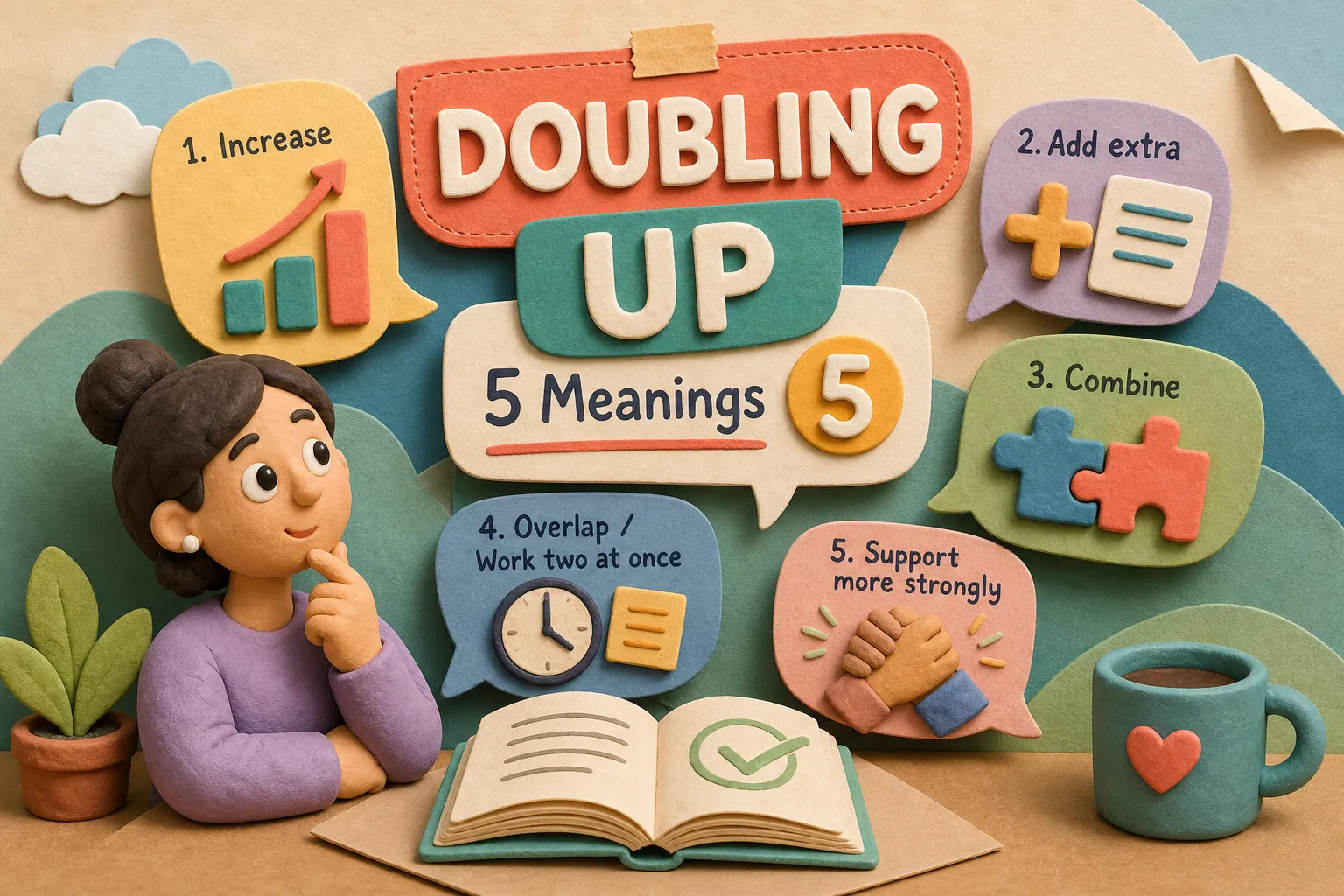
The five senses covered here are: sharing a space, serving a second purpose, adding more of something, bending over from pain, and bending over with laughter.
1. Doubling Up to Share a Room or Space
This is the meaning most American English speakers think of first. To “double up” means two or more people share a space that is normally meant for one person or a smaller group. You’ll hear this in hotels, college dorms, hospital rooms, and even cars on a long road trip.
The most common sentence structures are “double up in [a place]” or “double up with [a person].” Both patterns are natural and widely used.
Here are some examples:
- “The conference was sold out, so my colleague and I had to double up in one hotel room.”
- “All four kids doubled up in the two spare bedrooms.”
- “During the semester, freshmen often double up with a roommate they’ve never met.”
- “We doubled up in the back seat so everyone could fit in the car.”
Here is a short dialogue showing the phrase in conversation:
A: “Did you get your own room at the conference hotel?”
B: “No, the hotel was full. I had to double up with Marcus.”
Learners sometimes invent forms like “share up” or say “we duplicated the room”, these are non-native usages. Native speakers commonly use “double up” for this idea, though they also say things like “share a room” or “share a bed.”
2. When One Thing Does Two Jobs
The second meaning is about an object, person, or space that serves two different purposes. The structure is simple: “[something] doubles up as [something else].” This sense is common in everyday spoken American English and in writing. The phrase double up is listed in major learner dictionaries with this usage.
Think about a small apartment where the couch also serves as a guest bed. You would say, “The couch doubles up as a bed.” The object has one primary use, but it also performs a second job when needed.
Here are some examples across home and work settings:
- “Our dining table doubles up as a home office during the day.”
- “The conference room doubles up as a lunch area for the team.”
- “The storage closet doubles up as a darkroom when we need it.”
- “She doubles up as the company’s copywriter and social media manager.”
Notice the last example, this sense applies to people as well as objects. When someone takes on two distinct roles in a workplace or organization, “doubles up as” describes that overlap naturally and without awkwardness.
3. Doubling Up on Something: Adding More
The third meaning uses the fixed structure “double up on [something].” It means to use more of something, apply extra effort, or increase the amount of something you are already doing. The preposition typically used for this sense is “on”, for example, “double up on sleep”, rather than “double up with” or “double up for.”
This meaning is very common in health advice, sports, fitness, and study contexts. When the first amount is not enough, or when a goal requires stronger focus, people “double up on” their approach.
Here are examples from four different areas:
- Health: “During flu season, the doctor told me to double up on sleep and vitamins.”
- Sports: “The coach decided to double up on defense in the second half.”
- Work: “We need to double up on customer follow-up this quarter.”
- Study: “I doubled up on practice the week before my presentation.”
Here is a useful contrast to keep the meanings clear. “I doubled up on studying” means you studied more than usual. “We doubled up in the library” means two people shared a study space. It is the same phrasal verb, but it carries a completely different meaning depending on the preposition and context.
4. Doubling Up in Pain or Laughter
The fourth and fifth meanings both describe a physical reaction: bending sharply at the waist. The image is of the body folding forward, almost in half. This happens when someone feels strong pain, bad cramps, or receives a hard hit to the stomach. The structure here is “double up in [pain, cramps, agony]” or “double up with [pain, laughter].” For the physical-bending sense, see how learner dictionaries treat the phrase double up.
“She doubled up in pain after the cramp hit.” This sentence captures the sharp, involuntary way the body folds under sudden pain, it is direct and easy to picture.
The laughter sense works the same way, but the cause is emotional, not physical. When something is very funny, a person may laugh so hard that they bend forward and lose control of their posture. This is informal and very common in spoken American English.
- “He doubled up in pain after the tackle.”
- “I doubled up with cramps during the race.”
- “We were doubled up laughing by the end of the story.”
- “She told a joke that had everyone in the room doubled up.”
Here is a short dialogue for context:
A: “What happened at the party last night?”
B: “Tom told this story about his dog and we were all doubled up. I couldn’t breathe.”
Pronunciation note: In fast American speech, “doubled up” is often reduced. The second syllable of “double” becomes a quick, soft sound. It sounds like “DUB-uhld UHP” in careful casual speech and even more compressed in rapid conversation. The stress always stays on the first syllable: DUB-uhld up.
5. “Doubling Down” and “Double Over”: How They Are Different
ESL learners often mix up “double up,” “double down,” and “double over.” They look similar, but they mean very different things.
“Doubling Down”: Commitment, Not Sharing
“Double down” means to commit more strongly to a position or action, often after receiving criticism or when the stakes are high. The phrase comes from the game of blackjack, where a player doubles their bet to get one more card. In modern American English, it is common in business, politics, and news. It almost always signals determination or stubbornness. For a concise dictionary definition, see double down, and for a short discussion of the phrase’s history and usage, this write-up explains the origin in more detail: the origin of “double down”.
- “After the criticism, she doubled down on her original plan.” (She committed to it even more strongly.)
- “After the setback, the coach doubled down on his strategy and refused to change course.” (Firm resolve under pressure.)
“Doubling down” is about attitude and resolve. Doubling up is about sharing a space, using something for two purposes, increasing your effort, or a physical reaction. They are not interchangeable.
“Double Over” vs. “Double Up”: A Small but Useful Difference
“Double over” and “double up” both describe the body bending forward. In the pain and laughter sense, they are very close and often work in the same sentence. However, “double over” is primarily used for the physical bending reaction, while “double up” has multiple senses, sharing, serving two purposes, increasing effort, and the physical reaction. So “double over” stays in one lane, while “double up” travels several.
Here are two comparison sentences:
- “He doubled over when the ball hit him.” (Physical meaning only.)
- “He doubled up when the ball hit him.” (Also physical, and equally natural here.)
Quick tip: If your sentence is only about a body reaction, both “double over” and “double up” work. If your sentence is about sharing a space or adding extra effort, use “double up.” “Double over” does not carry those other meanings.
Try It Yourself: Practice Doubling Up Today
Reading about a phrase is a good start. Using it yourself is how you make it yours. Try these three short writing prompts and write one sentence for each.
- Think of a time you shared a room or space with someone. Write one sentence using “double up.”
- Name one object in your home or office that serves two purposes. Describe it using “doubles up as.”
- Describe a situation where you worked or studied more than usual. Use “double up on” in your sentence.
Mini Self-Check: Which Meaning Is It?
Read each sentence below and decide which sense of “double up” is being used.
- “The two interns had to double up in one office all summer.”
- “My small bedroom doubles up as a recording studio on weekends.”
- “He doubled up laughing at the end of the video.”
Answers: 1. Sharing a space. 2. Serving a second purpose. 3. Bending over from laughter.
Phrasal verbs like “double up” are a central part of how native speakers communicate every day. Doubling up on your exposure to these expressions, hearing them, reading them, and practicing them in context, is what turns passive recognition into active use. At Your Daily American, you can explore the full range of these expressions with the cultural context and real examples that help you actually use them, start with our Essential Phrasal Verbs You Must Know, Your Daily American and our guide to Common American Expressions Every English Learner Should Know, Your Daily American. A free proficiency test on the site can also help you identify exactly where to focus your practice. For extra reading on related phrases, see our piece about Doubling Down: Meaning, Origin, and How to Use.