Imagine you’re at work and a colleague says, “The call starts at nineish.” You search for “nineish” in your dictionary. It isn’t there. You try “nine-ish.” Still nothing. Yet your American colleagues use forms like this all the time, and they understand each other perfectly. That small word ending is the ish suffix, one of the most common features of informal American spoken English.
The ish suffix attaches to times, colors, numbers, and personality words, and it changes meaning depending on how it’s used. It’s often under-emphasized in textbook-based courses, which is exactly why it trips up so many learners. That’s the kind of real, unscripted language pattern that Your Daily American is built to teach: the English that native speakers actually use, not just the English in textbooks.
By the end of this article, you’ll know where the ish suffix comes from, how it works grammatically, and how to use it correctly in both casual conversation and careful writing. You’ll also be able to form your own examples right away.
Where the ish suffix actually comes from
Old English roots: from -isc to -ish
“-ish” is not a modern invention or slang. It comes from Old English -isc, a suffix (a word ending added to change meaning or form) used to build adjectives meaning “of the nature of” or “belonging to.” Spelling and pronunciation changed over many centuries, but the core function stayed the same. Linguists trace it back to Proto-Germanic -iskaz, the same ancestor that gave German -isch and Dutch -isch. This means the ish suffix is deeply built into the Germanic language family, not borrowed from Latin or French.
How the -ish suffix grew beyond nationality words
The suffix first appeared in nationality and origin adjectives. Words like British, Swedish, Spanish, Finnish, and Danish all carry this old suffix. Over time, English speakers extended it to describe colors, personality traits, and eventually numbers and time expressions. That expansion, from formal adjective formation to casual spoken approximation meaning “roughly” or “kind of”, is what makes the ish suffix so useful for learners to study.
The two main jobs of the ish suffix in English
Forming real adjectives: the derivational use
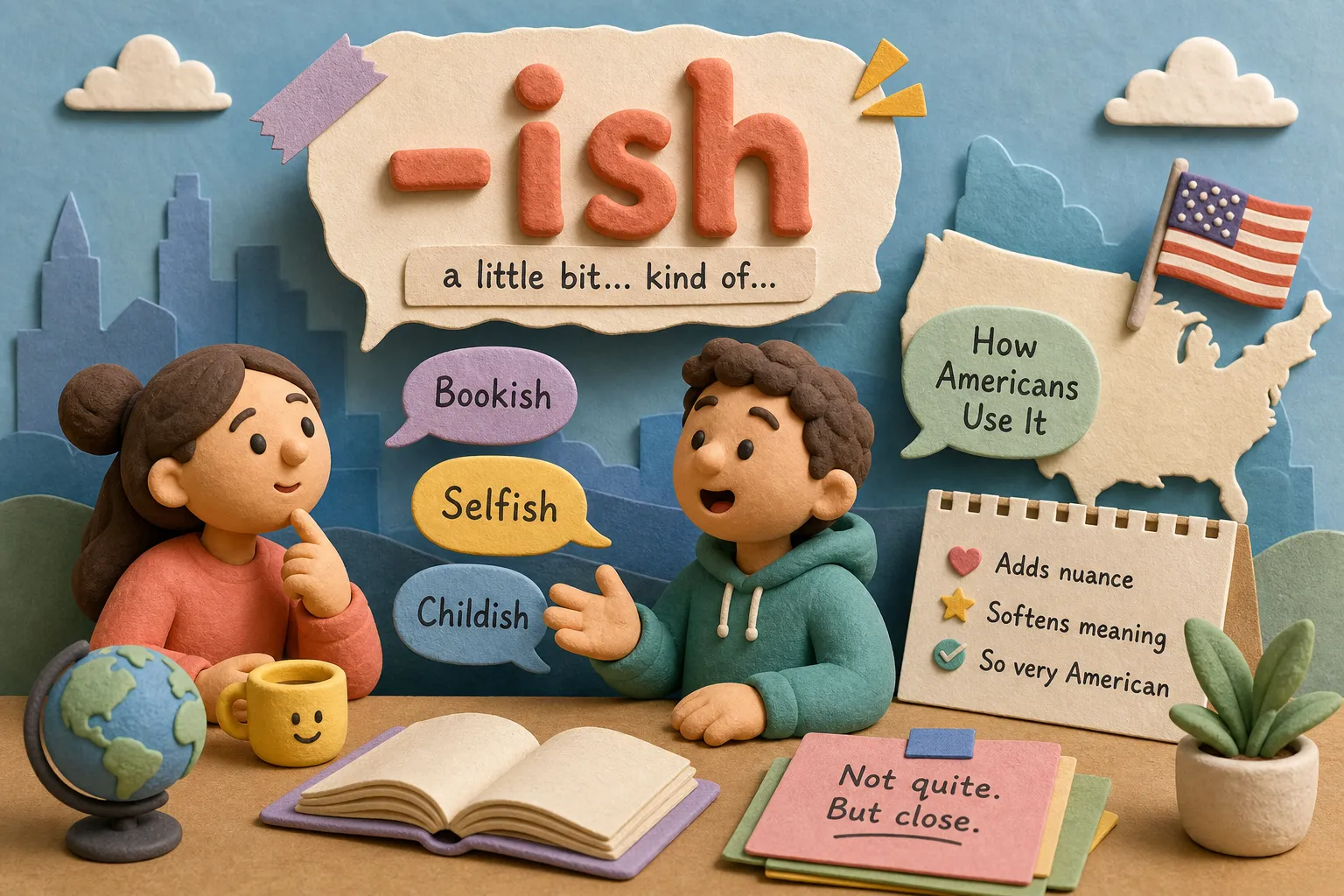
In its traditional role, “-ish” attaches to a noun or adjective to build a new word with a fixed dictionary meaning. These are called derivational words (words formed from a base word that appear as standard dictionary entries). Examples include childish (behaving like a child), foolish (acting without good judgment), bookish (fond of reading), reddish (somewhat red), and smallish (somewhat small).
The spelling rule is simple: add “-ish” directly to the base word. If the base word ends in a silent -e, drop it first, so large becomes largish and white becomes whitish. In some cases, a double consonant is retained in the base: fat, for instance, can become fattish, though many such coinages are rare and usage can vary.
Adding “approximately” or “somewhat”: the approximator use
The second function is where American informal speech gets interesting. In this use, “-ish” signals approximation; it means “around” or “kind of.” Sevenish means “around seven o’clock.” Thirtyish means “about thirty years old.” Greenish means “kind of green, but not quite.” Unlike derivational words, these forms are not fixed dictionary entries, the speaker builds them in the moment. For a quick reference on the modern dictionary sense of “-ish,” see the Cambridge Dictionary entry for “ish”.
In writing, this approximator form is commonly treated with a hyphen, especially with numerals: 30-ish, nine-ish, five-ish. Standard color adjectives like bluish or reddish, on the other hand, are normally written as one closed word. That hyphen in numeral-based forms signals to the reader that the word is built on the spot, not a standard dictionary entry. Derivational words like childish or reddish never need a hyphen. For general guidance on hyphenation and when to use a hyphen, consult resources on hyphens and hyphenation.
How Americans use the -ish suffix in real conversation
Vague times and numbers
One of the most common uses you’ll hear is “-ish” attached to clock times and numbers. Americans use it to mean “roughly” without committing to an exact figure. You’ll hear things like “The meeting starts at nineish, so don’t be late” or “She’s thirtyish, maybe a little younger.”
The cultural context matters here. In American informal speech, using “-ish” is a socially smooth way to signal approximation, a hedge that tells the listener “this is a rough number, not a firm commitment”, without sounding overly rigid when exact precision isn’t needed.
Softening color and description words
Native speakers also attach “-ish” to description words to show that something is close to a quality but not fully there. “The walls are kind of yellowish.” “He has a brownish beard.” “The soup was lukewarm-ish.” This use lets the speaker stay accurate without overstating.
It’s especially common in spoken descriptions when the speaker doesn’t have the perfect word. Instead of forcing an exact description, they soften it with “-ish” and keep the statement honest.
“Ish” as a one-word answer
In casual American speech, “ish” can stand completely alone as a reply. If someone asks “Did you finish the report?” a native speaker might simply say “Ish.” It means “kind of, sort of, not a firm yes, not a firm no.” This one-word use surprises many learners because it functions like a full sentence. If you want quick practice with short replies and informal answers, check out our guide on Short answers in English to Sound Like a Native Speaker.
This standalone “ish” signals partial agreement or a hedged (uncertain, careful) confirmation. Use it only in very informal settings with people you know well. It would sound out of place in a formal meeting or a professional email.
Fifteen real “-ish” examples to use right away
Time and schedule expressions
These five sentences show how the ish suffix works with times and quantities in everyday situations:
- “The party starts at eight-ish, so we don’t need to rush.”
- “I’ll be at the office by nine-ish, traffic is unpredictable this morning.”
- “There were twenty-ish people at the meeting, maybe a few more.”
- “Give me five-ish minutes and I’ll be ready to go.”
- “She called around noonish, right before lunch.”
Color, size, and appearance
These five sentences show “-ish” describing how something looks or feels:
- “The shirt is bluish, not quite navy, not quite sky blue.”
- “The conference room felt smallish for a group of ten people.”
- “His hair has a reddish tint in the sunlight.”
- “The weather was warmish for a March afternoon in Chicago.”
- “The paint on the walls looked yellowish after so many years.”
Personality, mood, and behavior
These five sentences show “-ish” with words that describe character and behavior, from fixed dictionary adjectives to fresh, informal coinages:
- “Stop being so childish, we need to find a solution.”
- “She acted selfish during the group project and nobody was happy about it.”
- “He seemed standoffish at first, but he became friendlier as the meeting went on.”
- “I felt feverish all morning but was better by noon.”
- “She was a little shy-ish at the party, but she had a good time.”
When the ish suffix fits and when to leave it out
Casual speech vs. formal writing
The approximator use of “-ish” belongs in conversation and informal writing. As a general rule, avoid it in academic papers, business emails, job applications, or formal reports, writing “The report will be ready at nineish” in a professional document would read as careless and imprecise. When in doubt, consult your house style guide.
Derivational “-ish” words are welcome in any register. Words like reddish, smallish, and childish appear in formal writing without any problem. The line to remember: if the word is in the dictionary, it’s fine anywhere. If you’re building it on the spot to mean “approximately,” keep it for casual conversation and informal writing only.
How “-ish” compares to -esque, -like, and -y
Four common English suffixes do similar jobs, but each signals a different level of formality and precision. Knowing the difference helps you choose the right one for the right moment:
- -ish: vague or approximate, very common in speech. “The color was greenish.”
- -like: resemblance, neutral and safe in any register. “It had a dreamlike quality.”
- -esque: stylized resemblance, more literary or evaluative. “The situation felt almost Kafkaesque.”
- -y: possessing a quality, informal and descriptive. “The sky was cloudy and dark.”
A quick side-by-side: “The color was greenish” is casual and vague. “The color was green-like” sounds slightly more careful and neutral. “The color was verdigris-esque” would fit a literary review or an art description. Choose the suffix based on your audience and the level of formality you need. For a broader look at common English suffixes and how they function, see this guide on 12 common suffixes and what they do.
Now you can use the ish suffix with confidence
You now know where this suffix comes from, how it works in two different ways, and when to use each one. The ish suffix traces back to Old English -isc, a native part of the Germanic language family. It works as a derivational suffix that builds fixed adjectives like childish and foolish, and as a casual approximator that means “around” or “kind of,” as in sevenish or greenish. The approximator use belongs in conversation and informal writing, while standard derivational forms are welcome in any register.
Understanding the ish suffix helps you follow fast, natural American speech more easily. The next time a colleague says “Let’s meet at sixish,” you won’t miss a beat, and you’ll know exactly how to use it yourself.
Here’s a short practice to try right now. Write three sentences and say them out loud: one using “-ish” with a time (“The class starts at…”), one with a color (“The jacket is…”), and one with a personality word like foolish or standoffish. Speaking them aloud matters, this is spoken American English, and your mouth needs the practice, not just your eyes. If you want more practice with common conversational phrases, try our article on Filler Phrases Every American English Learner Should Know.
Real American English is full of small patterns like this one. At Your Daily American, we cover exactly these kinds of details: the suffixes, the reductions, the cultural context that helps you sound natural instead of just correct. Explore the rest of the blog and keep building your fluency one piece at a time; for more everyday speaking help, see 25 Small Talk Phrases Americans Use Every Day, Your Daily American.