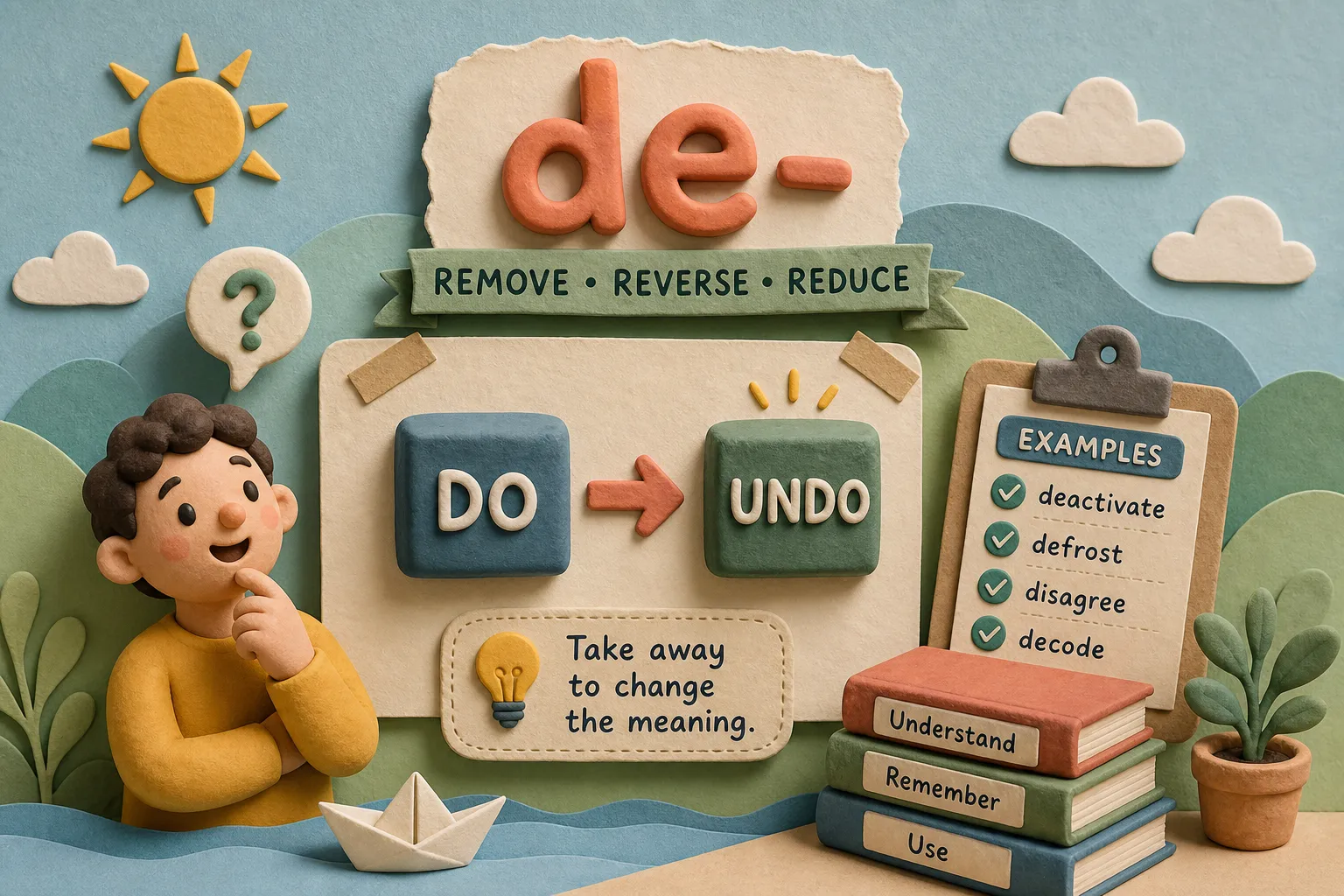
Imagine you see the word decontaminate for the first time. You have never studied it. But you look at the front of the word and think: de- signals removal, and contaminate means to make something dirty or dangerous. So decontaminate must mean to remove the contamination. And you are right. That split-second reasoning is exactly what knowing the de prefix gives you.
A prefix is a word part added to the front of a root word that shapes its meaning. The de prefix appears often in formal and technical vocabulary and in many everyday words, you will find it in workplace communication, tech writing, and the news. At Your Daily American, understanding how words are built is a core part of how we teach practical vocabulary, because it helps you learn faster and retain more.
By the end of this lesson, you will be able to explain the three core meanings of de-, understand where it comes from, recognize it in everyday and professional English, and use it as a tool to decode unfamiliar words on your own.
The three core meanings of the de prefix
The de prefix does not have one single meaning. It has three main senses, and knowing all three gives you a strong mental model for reading new words. Most de- words fit into one of these categories: removal, reversal, or reduction. The boundaries between those senses sometimes overlap, but the shared direction, away from, down from, or back to an earlier state, is what ties them together.
What “removal” looks like in de- words
One important common sense of de- is removal: taking something away from what the base word describes. Think of it as a stripping-out process. Dehydrate and decaffeinate both remove a substance, water and caffeine, respectively. Deforest removes trees from a landscape, while debug removes errors from software code.
Here are two real examples in context. “The doctors told him he was dehydrated and needed to drink more water.” “The tech team spent hours trying to debug the app before the launch.” In both sentences, de- signals that something has been taken out or needs to be taken out.
What “reversal” means with de-
The second sense, and the one linguists consider the most productive in modern English, is reversal, or what scholars call the privative sense: undoing an action or returning something to an earlier state. Defrost reverses freezing. Deactivate reverses activation so something stops working. Consider a real IT scenario: a sysadmin who needs to deactivate a compromised account the moment a breach is detected. That urgency is built right into the word. De-escalate walks a tense situation back toward calm, and decode reverses encoding so a hidden message becomes readable.
These reversal words are common in professional and technical American English. “We need to de-escalate the situation with the client before it gets worse.” “Can you deactivate that old user account?” You will hear both of those in meetings and IT conversations regularly.
When de- signals a reduction or downward shift
The third sense of de- is reduction, something is lowered, weakened, or moved to a smaller state. Devalue reduces the worth of something. Demote lowers someone’s rank at work. Degrade reduces quality, and deflate reduces air inside something or, figuratively, reduces a person’s enthusiasm.
All three senses (removal, reversal, and reduction) share the same underlying direction: de- moves something away from its current state, downward, or backward. That shared direction is your anchor whenever you meet a new de- word in the wild.
Where the de prefix comes from
A small amount of etymology, the study of word origins, helps these meanings stick. You do not need to study Latin to benefit from this. A basic understanding of where de- comes from will make its modern uses feel logical rather than random.
Its Latin roots and original meaning
The de prefix traces back to the Latin word dē, a preposition meaning “down from,” “off,” or “away from.” The original sense was physical and spatial: if you moved dē something, you were moving down from it or away from it. English absorbed most of its de- words through Latin and Anglo-French borrowings over many centuries, a process that accelerated significantly after the Norman Conquest in 1066 brought French into wide use across English society.
Because of this Latin lineage, many de- words carry a formal or professional feel. Words like decommission, debrief, and decelerate belong to a more formal register compared to simpler everyday words, a useful thing to keep in mind when you are drafting emails or speaking in meetings.
How the core meanings evolved into modern English
As Latin de- moved into English over the centuries, its spatial sense became more abstract. Linguists call the dominant surviving meaning the privative sense, from the Latin privare, meaning to deprive, which describes taking something away or undoing it. This is why new English words are still formed with de- today: de-escalate, debunk, defriend. The prefix remains productive, meaning English speakers actively use it to coin new words.
Even when you encounter an unfamiliar de- word in American media, tech writing, or a workplace email, it almost always carries one of those three core meanings. The prefix gives you an immediate starting point for understanding.
De- words you already use in everyday and professional English
Seeing the prefix in context helps it become automatic. Below are real de- words grouped by situation so you can see the pattern across different parts of your life in English.
De- words in everyday American English
“I need to defrost the chicken before dinner.” “Don’t forget to delete those old emails.” “She felt completely deflated when the event was canceled.” Those three sentences show the de prefix doing its work in ordinary, everyday situations, reversal, removal, and reduction, one per sentence.
A few other common everyday words: dehydrate (lose water, often in hot weather) and delay (push something to a later time). A word like depend is worth a separate note. Over centuries of use, depend has fused into a fixed unit, the de- is no longer recognizable as a prefix in everyday speech, because the word is fully lexicalized and does not feel like a prefix-plus-root combination anymore. This happens with many older Latin borrowings, and it is completely normal.
De- words in workplace and professional American English
Professional English leans heavily on Latinate vocabulary, which is exactly why de- words cluster in workplace settings. Emails, project updates, and business meetings are full of them. Here are some you will encounter regularly, note that a word like delegate is a historical Latin borrowing where the de- element is no longer transparently a prefix in modern use, so it is included here as vocabulary rather than a prefix example:
- Deactivate: to stop an account or system from working. “Please deactivate the old user account.”
- Debug: to find and remove errors in software. “The engineering team is still debugging the new feature.”
- Decommission: to officially take equipment or a system out of service. “They decommissioned the old servers last quarter.”
- De-escalate: to reduce tension in a difficult situation. “The manager worked to de-escalate the conflict between the two teams.”
- Debrief: to review what happened after a meeting, event, or project. “Let’s debrief after the presentation.”
- Delegate: to give a task or responsibility to someone else (historical borrowing; the de- is not productively a prefix here). “She learned to delegate more as her team grew.”
Start paying attention to de- words in your next work email or news article. You will notice the pattern quickly, and recognition will come faster each time.
How de- is different from dis- and un-
Three prefixes, de-, dis-, and un-, can all suggest something negative or reversed. This is one of the most common points of confusion for ESL learners. They are not interchangeable, and knowing the difference will help you choose the right word.
What dis- typically signals
Dis- often means “not,” “the opposite of,” or “apart,” with a focus on separation or opposition. Disconnect means to separate a connection. Disagree means to hold the opposite view. Disorganized means not organized. Compare deactivate and disable: both can mean stopping something from working, but deactivate emphasizes the process of removing activation, while disable emphasizes the resulting state of not functioning.
What un- typically signals
Un- is usually the simplest of the three. As an adjective prefix it means “not”, unhappy, unclear, unfair. As a verb prefix it means to reverse an action, unlock, undo, untie. One key difference: un- attaches mostly to common, everyday English words, while de- and dis- usually attach to words with Latin roots.
A simple decision guide for learners
Here is a quick way to decide which prefix fits:
- Un- for everyday words: “not” or “reverse.” Unhappy, unlock, undo.
- Dis- for separation, opposition, or “not” with Latinate roots: disconnect, disagree, distrust.
- De- for removal, reversal of a process, or reduction: dehydrate, de-escalate, defrost.
These prefixes do overlap, and some words could reasonably use either de- or dis- depending on nuance. When you are not sure, check a dictionary, in the end, convention is the final rule: what native speakers actually say. For a concise comparison of dis- and un-, see Grammarly’s guide to dis- vs. un-.
Using the de prefix as a tool to remember new words
Knowing the prefix is one thing. Using it as an active memory tool is another. This section shows you how to turn prefix knowledge into a real vocabulary strategy.
How knowing one prefix unlocks many words
Think of the prefix as an anchor. When you see an unfamiliar word like decelerate, decongest, or demoralize, the de- at the front gives you an immediate clue about the word’s direction of meaning. Something is being removed, reversed, or reduced. From there, you only need to figure out the root.
This reduces cognitive load, the mental effort required to process new information. Instead of treating every new word as a separate, unconnected item, you work with a pattern, and patterns are far easier for the brain to store and retrieve than random lists. One strong strategy: keep a personal de- words list. When you find a new de- word, write down the root and decide what the prefix is doing, removal, reversal, or reduction. That active habit builds long-term retention far more reliably than passive reading.
A de- words list to get you started
Here are 24 common de- words grouped by sense. Use this list as a starting point for your own collection:
Removal: dehydrate, decaffeinate, deforest, debug, defrost, detox, declutter, debone, descale, degrease, deplete, defuse
Reversal: deactivate, decode, de-escalate, decriminalize, debunk, defriend, decompress, demystify
Reduction: devalue, demote, degrade, deflate
For a longer collection of examples, see this list of words with the prefix de.
How Your Daily American builds vocabulary through real English patterns
Your Daily American teaches vocabulary through the patterns that real American English actually follows, and the de prefix is one of the clearest examples of that approach in action. Rather than presenting long word lists to memorize, the platform helps you understand how words are built, so you can recognize and use new vocabulary with confidence, even in situations you have never studied directly. See our overview, Prefixes and Suffixes: Unlock Thousands of English Words, for more on this method.
Here is a practical exercise to try today. Pick five de- words from this article. For each one, write down the root word and decide which sense of the de prefix is at work: removal, reversal, or reduction. The exercise takes about five minutes and builds the habit of reading words analytically, a habit that will serve you well beyond this single lesson.
What you can do with this knowledge right now
The de prefix has three core meanings, removal, reversal, and reduction, and they all share the same underlying direction: away from, down from, or back to an earlier state. It comes from Latin dē, meaning “down from” or “away from,” and it entered English through Latin and Anglo-French borrowings over many centuries. Because of that origin, de- words appear frequently in formal, professional, and technical American English, though you will find them in casual conversation too.
The most important idea from this lesson is that prefix knowledge changes how you read. When you spot a new de- word, you do not start from zero, you already know the direction of its meaning. Use the de prefix as a shortcut whenever you meet an unfamiliar word, and over time these patterns add up to real, lasting vocabulary growth.
Mini practice prompt: Write three sentences using three different de- words from this article. Use one from everyday English (like defrost or delete) and one from professional English (like debrief or deactivate). For each sentence, note which sense of the de prefix you used: removal, reversal, or reduction. Your Daily American covers vocabulary-building strategies like this across all levels and topics, explore the Study Tips & Methods, Your Daily American to find more lessons on how American English actually works.