You’re typing a message to a friend or finishing an email at work. Everything is going well. Then you pause: “Is it one word or two?” Many learners, and sometimes native speakers, find this distinction tricky. That small gap in confidence is exactly what this lesson is designed to close.
At Your Daily American, we focus on exactly these kinds of fine-grained details. The gap between “grammatically correct” and “sounds like a native speaker” is often built from small choices like this one. By the end of this lesson, you’ll know the difference, you’ll have a quick test to check yourself in real time, and you’ll see eight real examples you can use right away.
What “a while” and “awhile” actually mean
“A while” is a noun phrase, and a while meaning explained
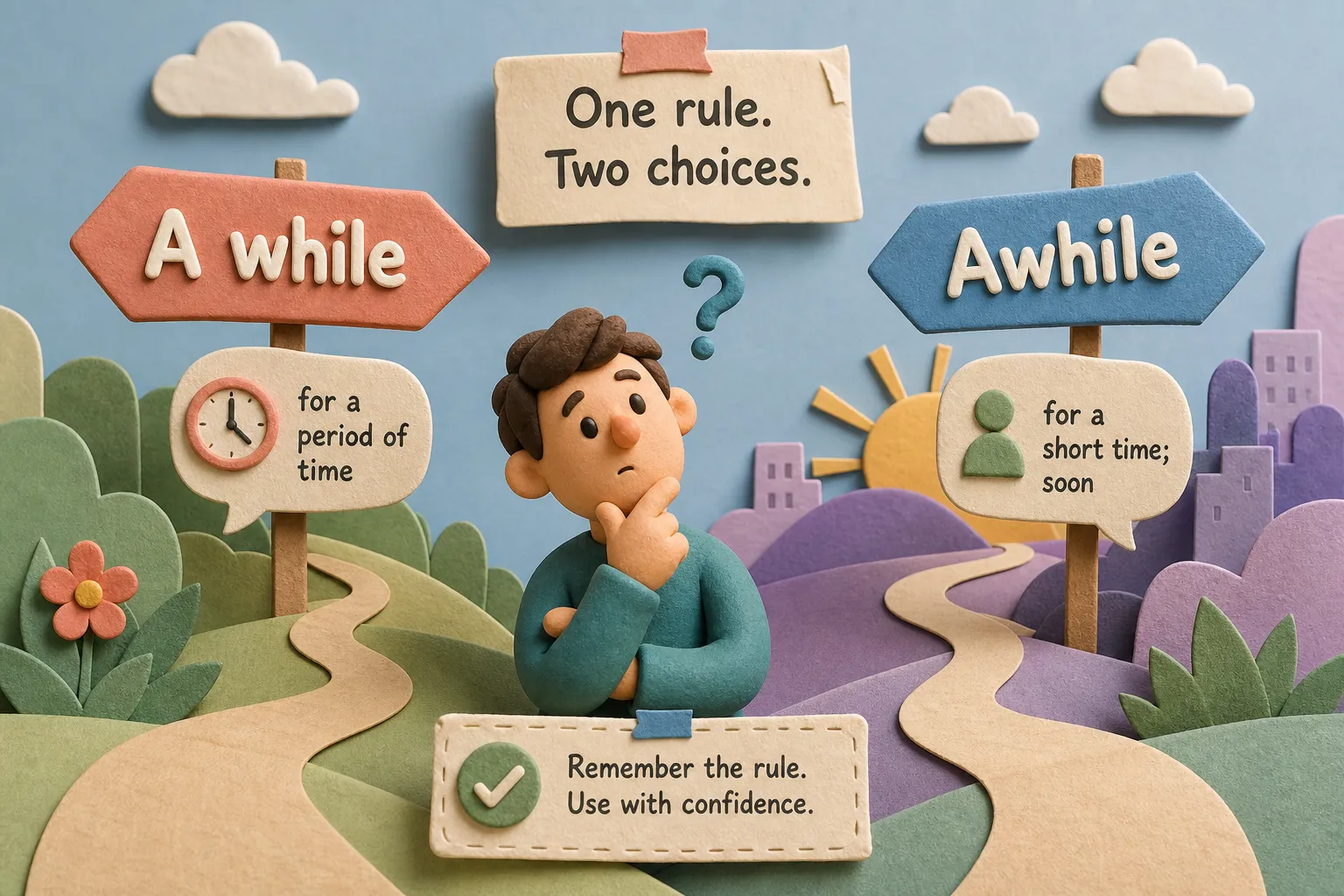
“A while” (two words) is a noun phrase that refers to a period of time. It works as a subject, object, or the target of a preposition. Consider: “It’s been a while” and “We waited for a while.” In both cases, the two-word phrase names something, a stretch of time, and does the work a noun does in that sentence.
In “We waited for a while,” the word “for” is a preposition. Prepositions must be followed by a noun or noun phrase, never by an adverb. That’s the structural reason the two-word form is required here.
Awhile meaning: it’s an adverb, not a noun
“Awhile” (one word) is an adverb meaning “for a short time.” In “She rested awhile” and “Stay awhile,” the one-word form connects directly to the verb with no preposition in front of it. It works exactly like “quietly” or “briefly”, describing the action itself.
So the core difference is clean: the two-word form names a period of time; the one-word form describes how an action happens.
A while or awhile, the single rule that separates them
When to use “awhile” in a sentence
If the word follows a verb directly and no preposition precedes it, use the one-word adverb. Compare “He talked awhile ” and “He talked quietly.” Both work the same way, the word after the verb describes the action, and no preposition is involved. Notice that adverbs like “quietly” or “slowly” follow the same pattern, which is a useful way to confirm you’re using the form correctly.
When to use “a while” after a preposition or as a noun
When the phrase follows a preposition, “for,” “in,” or “after”, use the two-word form. Prepositions cannot take an adverb as their object, so “for awhile” is considered nonstandard and is generally avoided in careful writing. Major style guides, Merriam-Webster, Chicago Manual of Style, and AP Style, all prefer “for a while” over “for awhile” after a preposition.
The same logic applies when the phrase acts as a subject or object: “It took a while.” “That was a while ago.” Both are noun phrases doing noun jobs, so two words is standard.
A quick test you can use right now
How the “for a time” swap works
Here is a simple substitution test. Replace the phrase in your sentence with “for a time.” If the result still sounds natural, the one-word form is likely the right call. Try it: “She rested awhile ” becomes “She rested for a time.” That reads fine, so the one-word adverb works. Now try “It’s been a while “: swap in “for a time” and you get “It’s been for a time.” That sounds off, which confirms the two-word form belongs there.
This test handles most everyday sentences quickly. Keep in mind that it works as a shortcut, not a substitute for understanding the rule itself.
When the test has its limits
The swap is not foolproof. If the sentence already contains “for,” substituting creates an awkward double preposition, “for for a time”, and the test breaks down. In those cases, return to the main rule: any preposition before the phrase means two words. For sentences involving fixed expressions like “in a while” or “after a while,” the rule is more reliable than the test. Use the substitution method as a first pass, not your only tool.
Eight example sentences in real American English
Casual conversation examples
These are the kinds of sentences you might text a friend or say out loud. Each pair shows the preferred and nonstandard form, with a brief explanation.
- Preferred: “Hey, stay awhile ! We haven’t talked in forever.” / Nonstandard: “Hey, stay a while !”, The one-word adverb modifies the verb “stay” directly, with no preposition before it.
- Preferred: “It’s been a while ! How are you?” / Nonstandard: “It’s been awhile !”, The two-word phrase follows “been” as a noun phrase, not as an adverb modifying a verb.
- Preferred: “Can you wait for a while? I’m almost ready.” / Nonstandard: “Can you wait for awhile?”, The preposition “for” must be followed by a noun phrase.
- Preferred: “She sat awhile on the porch before going in.” / Nonstandard: “She sat a while on the porch before going in.”, The one-word form directly modifies the verb “sat” with no preposition before it.
Writing and formal context examples
These four examples come from emails, short messages, and narrative sentences. The same grammar rules apply in writing as in speaking.
- Preferred: “I worked awhile before taking a break.” / Nonstandard: “I worked a while before taking a break.”, The one-word adverb modifies “worked” with no preposition before it.
- Preferred: “She hadn’t heard from him in a while.” / Nonstandard: “She hadn’t heard from him in awhile.”, The preposition “in” requires a noun phrase.
- Preferred: “They talked awhile after the meeting ended.” / Nonstandard: “They talked a while after the meeting ended.”, The one-word form modifies “talked” with no preposition in front of it.
- Preferred: “It took a while to finish the report.” / Nonstandard: “It took awhile to finish the report.”, The two-word phrase is the object of “took,” functioning as a noun phrase.
Fixed phrases native speakers always say one way
Always two words: expressions to memorize (for a while vs. for awhile, and more)
Some expressions in American English are fixed collocations, set combinations that native speakers use the same way every time. The following all take two words because each involves a preposition or functions as a noun phrase. Style guides and standard usage strongly favor these two-word forms; the one-word version does not appear in any of them.
- It’s been a while, “It’s been a while since we caught up!”
- A while ago, “I sent that email a while ago.”
- A while back, “We met a while back at a conference.”
- In a while, “I’ll be ready in a while.”
- After a while, “After a while, the noise stopped.”
- For a while, “We lived in Chicago for a while.”
Memorize these six expressions as complete units. The two-word form is the standard choice for all of them in American English.
Always one word: common verb + awhile patterns
These verb patterns take the one-word adverb form when no preposition comes before it. They can sound slightly more formal or literary than the “verb + for a while” alternative, and both versions are correct, they just work differently.
- Stay awhile, “Please stay awhile after dinner.”
- Wait awhile, “Wait awhile before you decide.”
- Sit awhile, “Come sit awhile and rest.”
- Rest awhile, “She rested awhile before continuing.”
- Talk awhile, “They talked awhile after class.”
Note: in casual American speech, many people say “stay for a while” or “wait for a while” instead. Both versions are correct, but they work differently. The version with “for” uses a preposition and a noun phrase; the version without uses a direct adverb. You can choose either, just don’t mix the forms in the same construction.
Try it yourself: a short practice
Fill-in-the-blank sentences, a while one word or two?
Choose the right form for each sentence. Check the answers below when you’re ready.
- We haven’t spoken in ___. We should catch up soon.
- He rested ___ after his long walk.
- Can you wait for ___? I need five more minutes.
- She finished the project ___ ago.
- They sat ___ and watched the sunset together.
Answers:
- a while , “in” is a preposition, so the noun phrase is needed.
- awhile , the adverb modifies “rested” directly, with no preposition before it.
- a while , “for” is a preposition, so the two-word noun phrase is the standard form here.
- a while , “a while ago” is a fixed expression that takes two words.
- awhile , the adverb modifies “sat” directly, with no preposition before it.
If you got four or five right, you already have a strong feel for the rule. If one or two were tricky, go back and re-read the main rule section. The pattern becomes clear quickly with a little practice.
Where to keep building this kind of precision
Details like this one are exactly what separates correct English from English that sounds natural to a native speaker. One small choice, made consistently right, adds up over time. Your Daily American publishes lessons focused on these kinds of practical, real-world language points, grammar, everyday usage, pronunciation, and more. The content is organized so learners at any level can find the right starting point and build steadily from there.
The short version to remember
“A while” (two words) is a noun phrase that names a period of time. “Awhile” (one word) is an adverb that describes a verb. The main rule: if “awhile” comes right after a verb with no preposition in front of it, use one word. If a preposition like “for,” “in,” or “after” comes before the phrase, or if the phrase acts like a noun, use two words.
The substitution test (replace with “for a time”) is a useful shortcut, but it’s not perfect. When it produces a double preposition or an awkward sentence, fall back on the main rule. Trust the grammar over the shortcut. For additional perspectives on usage, see the ProWritingAid explanation of “a while” vs. “awhile” and the Grammarly guide on this topic.
Mastering small details like this is how learners move from sounding okay in English to sounding confident and natural. Every time you pause over a while or awhile and get it right, you’re building the kind of precision that native speakers notice, even when they can’t explain why.