You write 06/07/2026 on a document and send it to your American coworker. They read it as June 7. You meant July 6. One small formatting choice, and the meaning is completely different.
Knowing how to write dates in English correctly matters more than most ESL learners realize. The rules shift depending on whether you are writing for an American audience, a British one, or an international one. This guide covers every format you need, when to use each one, and the date-writing mistakes ESL learners make most often.
By the end, you will be able to choose the right date format for any situation and write it correctly every time.
How to write dates in American English: month first
Why the US puts the month before the day
Americans say “March 15th” in conversation, so they write the month first in dates too. This feels natural to native speakers, but it is the opposite of what most other countries do. It is simply a different standard, and you need to follow it when writing for a US audience.
The full written form looks like this: March 15, 2026. The numeric short form looks like this: 3/15/2026 or 03/15/2026. Both are correct in American English. For more background on US date conventions, see Date and time notation in the United States.
What the numeric date format looks like in practice
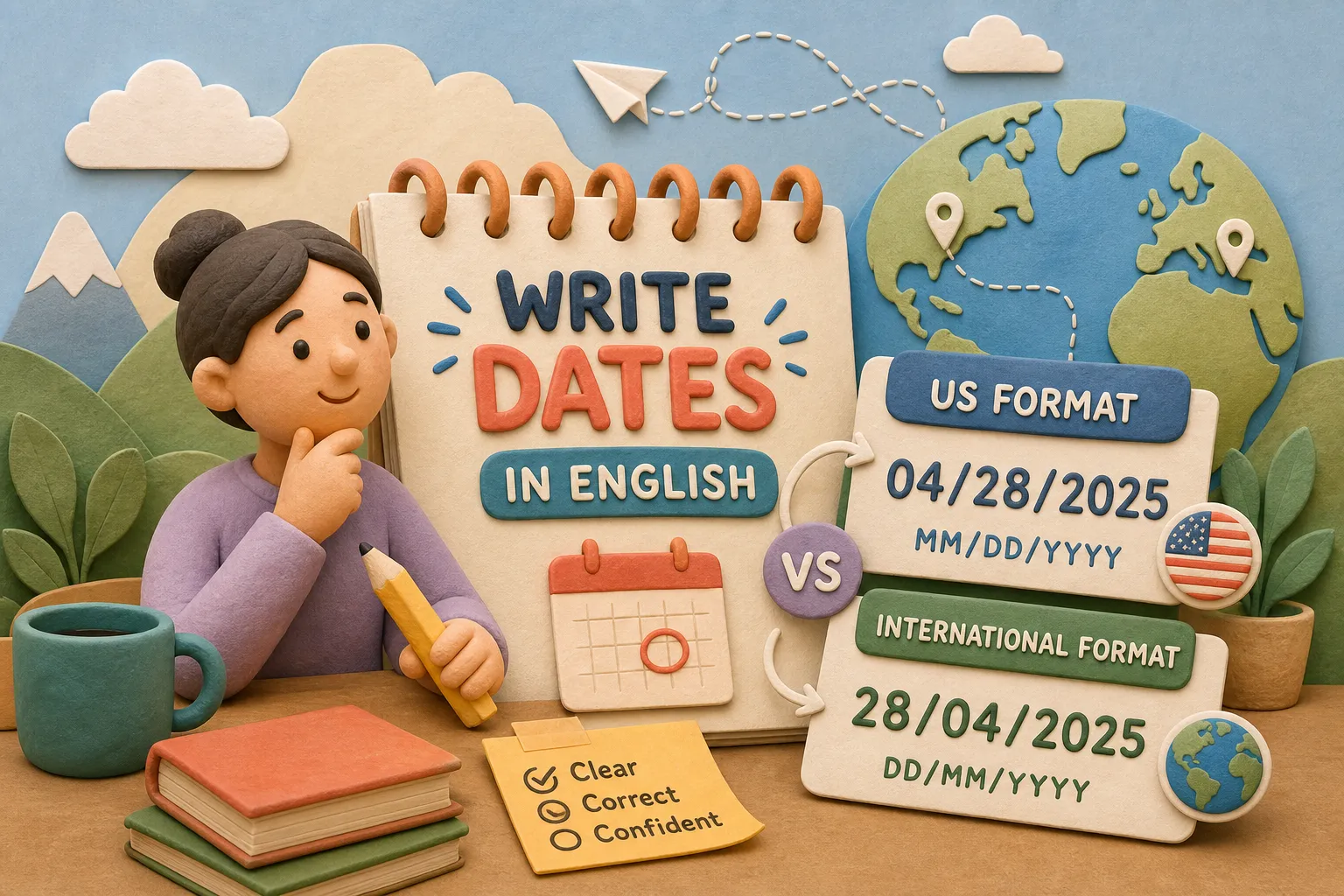
The standard US numeric date format is MM/DD/YYYY. Americans use a shorter version, like 6/10/26 , in casual situations: quick notes, texts, and informal forms. For clarity on official documents, forms, and applications, the full four-digit year version is the safer choice: 06/10/2026. For anything formal or legal, spelling out the month name is generally preferred.
Here are four real examples from 2026 to make this clear:
- January 5, 2026 → 01/05/2026 (formal numeric) or 1/5/26 (casual)
- March 20, 2026 → 03/20/2026 (formal numeric) or 3/20/26 (casual)
- July 4, 2026 → 07/04/2026 (formal numeric) or 7/4/26 (casual)
- November 11, 2026 → 11/11/2026 (formal numeric) or 11/11/26 (casual)
How to write a date in full: commas, months, and capitalization
The comma rule in American English dates
Among all date punctuation rules, this one trips up ESL learners the most. In American English, when you write a date with the month spelled out and the year included, put a comma between the day number and the year. Example: March 15, 2026. Without the comma, the date looks wrong to a native reader. For a clear overview of comma usage in dates, see this guide on commas in dates.
When you add the day of the week, put a comma after it too. Example: Saturday, March 15, 2026. When there is no year, no comma is needed, “On March 15” is correct as written.
One more rule to know: when a full date appears in the middle of a sentence, you need a second comma after the year. For example: “The meeting is on March 15, 2026, at 9 a.m.” Two commas are required here because the date sits inside the sentence, not at the end.
Capitalization and spelling out the month
Month names are always capitalized in English: January, February, March. This differs from Spanish, Portuguese, and many other languages, where month names are lowercase, making it an easy error for learners from those language backgrounds.
Abbreviations like Jan., Feb., Mar. are fine in informal writing. For formal letters, legal documents, or academic work, spelling out the full month name is generally preferred by major style guides. The difference looks like this: formal is January 15, 2026, informal is Jan. 15, 2026.
Including the day of the week
Formal letters and invitations often include the full weekday name. Everyday writing usually leaves it out. Both formats below are correct: June 10, 2026 works for most situations, and Wednesday, June 10, 2026 is used when the day of the week adds important context. When the weekday is included, always follow it with a comma before the month.
Formal vs. informal date writing in American English
How to write the date in business letters and formal emails
In a formal letter or professional email, write the full date with the month spelled out: June 10, 2026 . Avoid numeric-only dates in formal documents because they can be misread. The date usually appears at the top of the letter, on its own line, before the recipient’s address.
A correct date line for a US business letter looks like this: June 10, 2026 , placed flush left or flush right depending on your template. Avoid abbreviated forms like 6/10/26 in business correspondence, they can appear careless and create ambiguity for the reader. For more on writing effective professional emails in American English, see How to Write a Professional Email in American English, Your Daily American.
How to write dates in academic papers and legal documents
Many US academic style guides recommend a written-out, unambiguous date format. APA style commonly uses Month day, year in references and running text; Chicago style varies by context; and MLA generally uses day, month, year for manuscript information. Check the specific guide required for your document. For legal documents, spelling out the month, for example, June 10, 2026 , is strongly recommended to reduce any risk of misreading. The key rule for academic writing is consistency: choose one format and use it throughout the entire document.
For legal purposes, June 10, 2026 is much safer than 6/10/2026 because there is no ambiguity about which number represents the month and which represents the day. When clarity is required by a contract or jurisdiction, the fully written form is generally the better choice, though always follow the specific convention your document or governing body requires.
Dates in casual writing, texts, and quick notes
In texts, informal emails to friends, or quick notes, the numeric short form is fine. 6/10/26 is clear enough in a casual context between people who both understand US date order. Compare that with a job application or signed contract, where the same shorthand would look out of place and risk being misread. Context determines the appropriate format.
Ordinals in dates: when to say “first” and when to write “1”
How ordinals work in spoken American English
In spoken English, Americans almost always use the ordinal form of the date. They say “March fifteenth” or “the fifteenth of March,” not “March fifteen.” This is natural and correct in speech. Many ESL learners carry that habit into writing and type March 15th, 2026, which is not the standard formal written form. Spoken: “March fifteenth.” Written: March 15, 2026.
The rule for written dates
In formal written American English, use the plain number without a suffix: March 15, 2026, not March 15th, 2026. The ordinal suffix (st, nd, rd, th) is acceptable in informal writing, but it looks out of place in formal documents, academic papers, and professional letters.
Learners from many language backgrounds, and even some British English contexts, treat ordinals in writing differently, which makes this a common source of confusion. The rule to remember: in American formal writing, the number alone is enough. April 1, 2026 is cleaner and more correct than April 1st, 2026 in any professional or academic context.
International formats and when Americans use them
British and international day-month-year format
Outside the US, most countries use day-month-year: 15 March 2026 or 15/03/2026. This is the reverse of the American format. When writing for a British or international audience, follow their convention. Notice that in British English, there is no comma between the day and the year in the written form.
The contrast is easy to see side by side: US format is March 15, 2026, with a comma. UK format is 15 March 2026 , with no comma. If you work with colleagues in both countries, recognizing this difference helps you write correctly for each audience. For a quick country-by-country comparison of date formats around the world, check this date format by country resource.
ISO 8601: the format for filenames, data, and global documents
ISO 8601 (International Organization for Standardization) is an international standard for writing dates in a clear, unambiguous order: year-month-day, written as YYYY-MM-DD. Example: 2026-06-10 . This format is especially useful for filenames, spreadsheets, databases, and any document shared across countries. Note that while ISO 8601 eliminates ambiguity in technical and international contexts, most everyday US writing still follows the standard month-day-year convention. Learn more from the official ISO 8601 date and time format page.
The format solves the ambiguity problem effectively. 2026-06-10 can only mean June 10, 2026, regardless of the reader’s country. It also sorts correctly in alphabetical order, which makes it ideal for naming files. A folder of reports named 2026-01-05_report.pdf, 2026-03-20_report.pdf, and 2026-06-10_report.pdf will always appear in the right order, no matter what software you use.
Common date-writing mistakes ESL learners make
Mixing up day and month in numeric form
This is the most serious mistake when writing dates in English for a US audience. Writing 06/07/2026 means June 7 in the US but July 6 in most other countries. To avoid this problem, spell out the month whenever there is any chance of confusion. Write June 7, 2026 or use ISO format: 2026-06-07. Learners from Spanish-speaking and Portuguese-speaking countries naturally use day-month-year order, so this reversal is a very common error when writing for US audiences.
Missing commas or adding them in the wrong place
Two errors come up again and again. The first is forgetting the comma before the year: writing March 15 2026 instead of March 15, 2026. The second is forgetting the second comma when a full date appears in the middle of a sentence. Correct: “The contract was signed on March 15, 2026, at the main office.” Both commas are required because the date is in the middle of the sentence, not at the end.
Writing ordinals in formal documents
Many learners write April 1st, 2026 in a formal letter or cover letter because it looks more complete. In American formal writing, April 1, 2026 is the correct and cleaner form. A style rule rooted in standard American writing practice governs this: the suffix adds nothing to the meaning, and removing it makes the date look more professional.
Write dates with confidence from now on
The core rules are clear. In American English, the standard format for how to write dates is month-day-year. When you write a date in full, spell out the month, use a comma before the year, and skip the ordinal suffix in formal writing. For international documents or filenames, ISO 8601 (YYYY-MM-DD) removes all ambiguity.
Understanding which format to use and why is exactly the kind of practical knowledge that makes your written English more professional. A small formatting error in a date can change the meaning of a document, delay a meeting, or create real confusion in a legal contract.
At Your Daily American, we cover these real-world writing rules alongside grammar, professional communication, and the everyday language patterns that help you sound natural in English. If this lesson was useful, explore our writing and grammar lessons for more practical guides built around how American English actually works (see the Professional English, Your Daily American category).