Imagine a friend texts you: “I don’t know what time I’ll be free, let’s just play it by ear.” If you didn’t understand that, you’re in the right place. This idiom is a common fixture in American English, and once you learn it, you’ll start hearing it everywhere, at work, in movies, in everyday texts.
Stick with this article and you’ll walk away knowing exactly what the phrase means, where it came from, how to use it in casual and professional situations, and which synonym to reach for when you need a different word.
What “play it by ear” actually means
The core meaning is simple: you don’t have a fixed plan. You watch how things develop and decide as you go. Cambridge Dictionary defines it as “to decide how to deal with a situation as it develops, rather than acting according to plans made earlier.” Merriam-Webster puts it more briefly: “to do something without special preparation.”
One important thing to understand: using this phrase does not mean you’re careless or disorganized. It signals that you’re staying open and flexible. Americans use it when conditions are uncertain or when locking in a plan too early doesn’t make sense.
Casual use
In everyday life, the expression fits naturally among friends, family, and anyone you’re comfortable with. It’s a polite way to say “I’m not sure yet” without sounding uncommitted or difficult.
Professional use
The phrase also works in semi-formal settings, say it to a coworker or a manager you know well. Skip it in formal reports, legal documents, or emails to a senior executive you’ve never met. Usage guidance from learner dictionaries consistently recommends keeping colloquial idioms out of formal written communication.
Origin and history
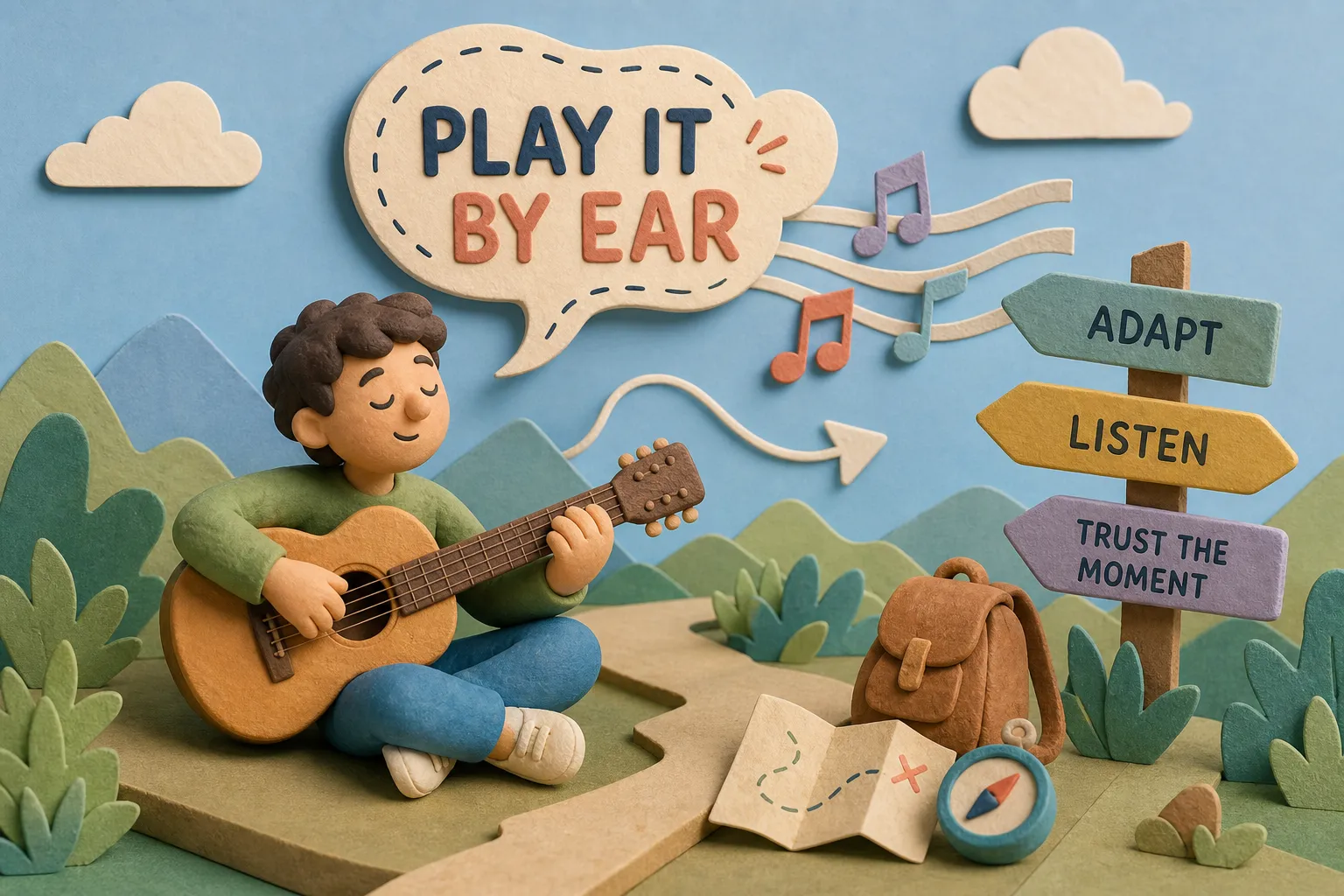
The phrase started in music. “Play by ear” originally meant to perform a piece without reading sheet music, a musician would listen, rely on memory, and follow the sound. John Playford wrote in his 1658 book A Brief Introduction to the Skill of Musick: “He that doth not play by Ear, as well as by Book, cannot be esteemed a good Musitian.” (Playford, A Brief Introduction to the Skill of Musick, 1658.) The broader idea of using your “ear” in music reaches back even further, to the 16th century.
Over time, people began applying the expression outside of music. If you could perform without a set script, you could also make decisions without a fixed plan. By the 1930s, the figurative meaning was well established in everyday American English. A sports story in The New York Times (October 24, 1935) used it in exactly this modern sense: “I play it by ear only.”
For a detailed exploration of the phrase’s history and usage, see Grammarphobia’s write-up on “play it by ear”.
Many speakers today use the phrase with no thought of its musical roots, the connection has faded for most people. The expression now stands on its own as a way to describe flexibility and deciding as things unfold, which makes it a useful bridge into the next section on everyday use.
Everyday examples in conversation
This is where the idiom comes to life. Americans use it commonly for weekend plans, social invitations, travel decisions, and family events. Here are two short dialogues that show how playing it by ear sounds in real conversation:
Weekend plans:
- “Are you coming to the barbecue on Saturday?”
- “I’m not sure yet. I might have to work. Can we leave it open for now?”
- “Of course! Just let me know.”
Travel:
- “Do you want to book a restaurant for when we arrive?”
- “Let’s play it by ear. The flight might be late, and I don’t want to rush.”
One mistake learners make is dropping the word “it” and saying “play by ear” when talking about plans. In casual conversation about scheduling or decisions, native speakers almost always say “play it by ear.” The shorter form, “play by ear,” is mostly reserved for the original musical meaning. Stick with the full version in non-music contexts.
Also watch out for these grammar errors. Don’t say (incorrect) “I will plays it by ear” or (incorrect) “I will play it by the ear.” The correct form is simply “I will play it by ear” or “Let’s play it by ear.” No extra article before “ear,” and no change to the verb form after “will.”
Using this phrase in professional situations
Many ESL learners wonder whether idioms belong at work. The answer depends on the idiom and the situation. This expression works well in the workplace when the context is genuinely flexible: a meeting with an open agenda, a client call where outcomes are uncertain, or a project where conditions are still changing.
In American professional culture, adaptability is widely valued as a practical strength, a view reflected across workplace communication guides and management literature. Saying “let’s play it by ear” can show that you’re practical and not rigid. It works best in spoken conversations with coworkers or managers you already have a comfortable relationship with.
Team meeting:
- “Should we prepare a full agenda for the client call?”
- “Not necessarily. Their situation changes a lot, so let’s stay flexible and respond to what they bring up.”
Project timeline:
- “Are you setting hard deadlines for the beta launch?”
- “For now, we’ll play it by ear. We need to see how the testing goes first.”
If the situation calls for more formal language, replace it with “we’ll adapt as needed” or “we’ll adjust based on how things develop.” These phrases carry the same idea but fit formal writing better. A quick rule: use the idiom in spoken professional English with people you know well. For written communication with senior executives or external stakeholders, go with the more formal alternatives.
Synonyms and when to use them
Once you know this phrase, it helps to understand the related expressions so you can recognize them and choose the right one.
“Wing it” is the most informal option. It often suggests no preparation at all: “I forgot to prepare for the presentation, so I just winged it.” Use it among friends or close coworkers. It would sound too casual in most professional settings. (See winging it for related synonyms.) Also, if you want to study common verb patterns that sometimes pair with idiomatic behavior, check out Essential Phrasal Verbs You Must Know, Your Daily American.
“Improvise” is the neutral, reliable choice. It works in both casual and professional contexts, and you can use it in writing and speech without any problem: “We didn’t have a plan, so we improvised.” If you want a word that works everywhere, improvise is the safe, dependable option.
Playing it by ear sits between these two. It sounds more natural and conversational than “improvise” but a bit more considered than “wing it.” Based on corpus data from American English, it’s the most common of the three in everyday spoken conversation.
“Ad-lib” comes from performance contexts: theater, radio, comedy, and public speaking. Use it when someone speaks or performs without a script: “The speaker forgot her notes and ad-libbed the whole presentation.” It doesn’t fit general planning situations well, so stick to the idiom or “improvise” when you’re talking about decisions and schedules. For thesaurus entries and related terms for “ad-lib,” see ad-lib.
Here’s a quick way to choose:
- Formal writing: improvise / we’ll adapt as needed
- Casual speech: play it by ear / wing it
- Performance or speaking context: ad-lib
If you want to go deeper on expressions like these, Your Daily American organizes idioms into thematic lists by real-life situation, grouped by context so you can find the right expression for casual conversations, the workplace, travel, and more. It’s a practical way to learn the way native speakers actually use the language. See the collection Common American Expressions Every English Learner Should Know, Your Daily American for idioms organized by situation.
Practice: try it yourself
The best way to make any new phrase stick is to use it right away. Try these short practice exercises now:
- Write a text message to a friend using the idiom to respond to an invitation for this weekend.
- Say this sentence out loud: your manager asks about a project deadline. How would you work this expression into your answer?
- Rewrite this sentence using a synonym: “We’ll play it by ear at the conference.” Try “improvise,” then try “adapt as needed.” Which fits better in a formal email?
These small steps make a real difference. Writing a sentence, saying it aloud, and comparing synonyms all help your brain store the language for active use, not just recognition.
Keep building your idiom vocabulary
To pull it all together: “play it by ear” means to decide as things happen, without a fixed plan. It started as a musical term in the 17th century and became a general idiom by the 1930s. It works well in casual situations and many professional ones. When you need more formal language, “improvise” or “we’ll adapt as needed” are your best alternatives.
The most important thing now is to start using it. Listen for the phrase when you watch American TV shows or follow everyday conversations, it appears more frequently than most learners expect. And when a friend asks about your weekend plans and you’re not sure yet, you’ll know exactly what to say. For a useful practical guide and extra examples, check out Quillbot’s guide to “play it by ear”. For related colloquial vocabulary lists, see Most Common American Slang Words Used in Daily Life, Your Daily American.
When you’re ready to go further, Your Daily American offers full thematic idiom lists so you can learn expressions grouped by situation and context, the way native speakers actually encounter them. That kind of organized, practical learning is what moves you from understanding English to using it with confidence.