By the end of this article, you’ll be able to spot the -ist suffix in new words, understand what it means, use common -ist words correctly, and say them with the right stress. These are practical skills that will help you understand more of what you read and hear in American English every day.
You’ve already seen this suffix many times. Think about words like artist, scientist, journalist, and optimist. You probably know these words already. But did you notice they all share the same ending? That ending is doing real work in each word.
Words ending in -ist appear in professional titles, political conversations, and everyday small talk. Once you recognize the pattern, you can predict the meaning of hundreds of new words. This article, part of the vocabulary series at Your Daily American, walks through the suffix’s meaning, key vocabulary by category, and pronunciation tips.
What the -ist suffix means and where it comes from
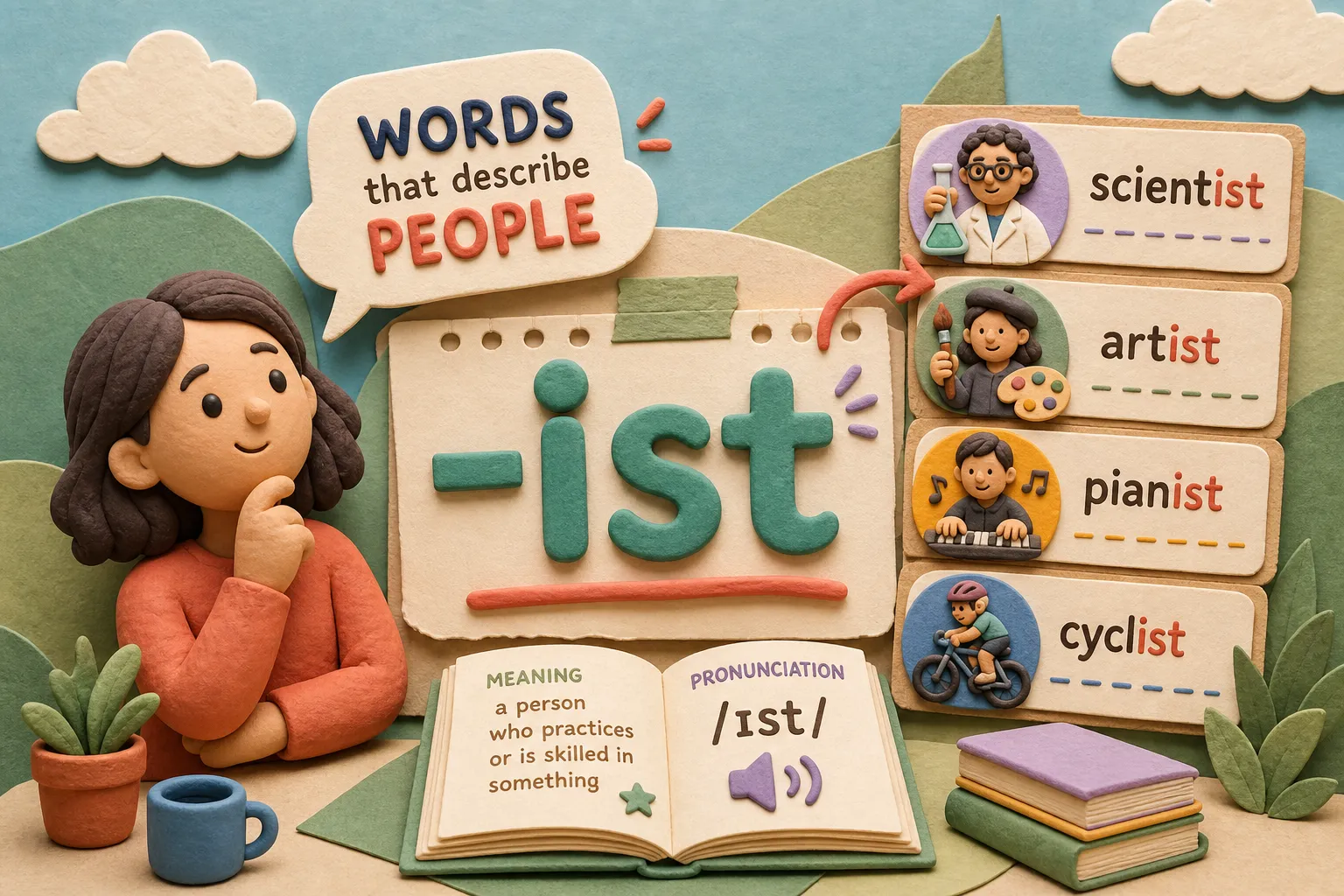
The -ist suffix forms a noun. More specifically, it creates a type of noun called an agent noun, a word that names a person who does something, represents something, or is connected to something. In plain terms: the suffix tells you this word names a person.
The pattern is easy to follow. Add -ist to a base word and you name a person connected to that base. Journal becomes journalist (a person who writes for a publication). Piano becomes pianist (a person who plays piano). Science becomes scientist (a person who studies science).
Where this suffix came from
The suffix has a long history. It came to English from Ancient Greek -istēs, which passed through Latin as -ista, then into Old French as -iste, and finally into English as -ist. Because it came from Greek and Latin, it tends to appear in formal and professional vocabulary rather than casual slang. For a concise history of the ending, see the etymology of -ist.
This history is useful for learners. When you see an unfamiliar word ending in -ist, you can usually predict that it refers to a person with a specific field of knowledge or belief. The Greek and Latin roots give the suffix a sense of expertise and specialization, which is why you see it so often in job titles and academic fields.
Professional titles that use the -ist suffix
Many of the most common job titles in American workplaces end in -ist. Words like specialist, analyst, economist, therapist, pharmacist, and journalist appear in job postings, meetings, and emails every day. Knowing these words helps you follow professional conversations and write more natural work emails.
These show up in real workplace conversations like: “We need a specialist to review this before the deadline.” “She works as a financial analyst at a tech company in Austin.” Those are exact phrases a hiring manager or colleague would use.
One quick note: technician ends in -ian, not -ist. Both suffixes can name a person in a professional role, but -ian is a different ending with a different pattern. When you see -ist, the word almost always names a person defined by a skill, field, or belief, not just someone who performs a task.
How recognizing ist suffix words helps you at work
When you hear an unfamiliar word ending in -ist in a meeting or email, the suffix gives you an immediate clue: this is a person connected to something. You don’t need to know the full word to grasp its general meaning. That kind of pattern recognition is what separates learners who feel lost in meetings from those who follow along confidently.
For deeper practice, the Professional English section at Your Daily American shows words like specialist, analyst, and economist used in complete emails, meetings, and interview dialogues. Seeing a word in a full conversation is far more useful than seeing it in a list.
Political and cultural -ist vocabulary in American English
Political and social conversations in the United States are full of -ist words. You’ll hear terms like activist, feminist, nationalist, socialist, capitalist, environmentalist, realist, and idealist on the news, on social media, and in everyday conversation. These words come up constantly, so recognizing them quickly matters. For related reading on the broader family of -ism vocabulary in American English, see -ism Words in American English: Culture, Work, and Daily Life.
The pattern works the same way: base word plus -ist equals a person who supports or identifies with that idea. Active connects to activist (a person who takes action to create change). Similarly, social connects to socialist (a person who supports socialist ideas). A natural example: “She’s an activist who works on climate issues in her community.”
Why these words can feel tricky for ESL learners
Many of these words carry strong opinions in American culture. Knowing the suffix helps you understand the word form, but the cultural meaning is a separate layer. An activist and a nationalist both follow the same pattern, but they represent very different values in American public life.
Worth keeping in mind: the suffix itself is neutral. It’s the base word that carries the meaning and the emotion. Optimist and pessimist both end in -ist, but they describe opposite attitudes. Realist and idealist do the same. Once you understand the base word, you understand the person the -ist word names.
Everyday -ist words you’ll hear in American life
You’ll run into -ist words in many situations outside of work and politics. Some of the most common, grouped by setting:
- At the doctor or pharmacy: dentist, pharmacist, therapist, specialist
- Travel and transportation: tourist, motorist
- Arts and hobbies: artist, pianist, guitarist, novelist
- Personality and attitude: optimist, pessimist, realist, perfectionist
Two short examples show how naturally these words appear in everyday conversation: “My dentist told me I need to come in more often.” “She’s a real perfectionist, she checks her work three times before sending it.”
A quick note on spelling
Adding -ist to a word is simpler than adding -ing or -ed. You don’t double consonants, and you don’t drop a silent e before adding the suffix. In most cases, you just add -ist directly to the base word and you’re done.
Piano and cello are the two exceptions worth noting: both drop the final o before the suffix, giving you pianist and cellist. For almost every other -ist word, just add the ending and move on.
How to pronounce -ist words correctly
In almost all -ist words, the stress falls on the syllable before the suffix. The suffix itself is not stressed. Listen to these examples: JOUR-nal-ist, SPE-cial-ist, OPT-i-mist. The stress lands before -ist, and the ending is said quickly and lightly. If you want more practice on stress patterns, check Word Stress in American English: A Complete Guide.
One word surprises many learners: pianist. In American English, the stress goes on the first syllable: PI-an-ist. If you’ve been saying “pi-AN-ist,” you’re not alone. It’s one of the most common stress errors with this suffix, for more common pronunciation pitfalls see English Words Non-Native Speakers Mispronounce Most Often, Your Daily American.
How -ist sounds in connected American speech
The suffix is pronounced /ɪst/. The vowel is a short, relaxed “ih” sound, the same vowel you hear in bit or sit. A simple way to remember it: -ist sounds like “ihst.” In fast American speech, the final t may sound softer or nearly disappear before a word that starts with a consonant. “She’s a journalist. She covers local news.” The t at the end of journalist may sound more like a quick stop than a clear /t/. This is completely normal in everyday connected speech. For a practical guide to stress placement rules that can help with connected speech, see Grammar Monster’s guide to stress placement in English.
Try it now: Say artist, activist, and specialist out loud. Notice where the stress lands naturally, you’ll feel it on the first stressed syllable in each word, never on the -ist ending.
-ist vs. -er, -or, and -est: endings that confuse learners
These four endings look similar on the page, but they work very differently. The table below shows the key distinctions at a glance.
| Suffix | Main use | What it means | Example |
|---|---|---|---|
| -ist | noun | a person connected to a skill, belief, or field | pianist, activist |
| -er | noun | a person or thing that performs an action | teacher, driver |
| -or | noun | a person who performs an action (often in formal words) | actor, inventor |
| -est | adjective | the highest degree of comparison (“most”) | fastest, largest |
Notice that -est is completely different from the others. It doesn’t name a person at all. It marks the superlative form of an adjective: fastest, largest, smallest. If you see -est at the end of a word, the word is describing a degree of quality, not a person. Don’t confuse it with the person-naming suffixes.
How to choose between -ist and -er or -or
If the word names a person defined by a skill, ideology, or professional field, -ist is almost always the right choice. If the word simply names “someone who does an action,” -er or -or is more natural. A guitarist is defined by the instrument. A player just plays something.
Sometimes both suffixes can describe the same person in different ways. A specialist and a worker can both describe the same employee, but specialist says more about the person’s expertise. Context will usually make the best word clear, and recognizing both patterns helps you read and listen with greater precision.
ist suffix: quick summary
The -ist suffix forms nouns that name people connected to a skill, field, or belief. Spelling is straightforward, just two exceptions worth memorizing. Stress falls on the syllable before the suffix, the ending sounds like “ihst,” and it functions differently from -er, -or, and -est. That’s the full picture. For a quick reference definition of suffixes, see the Cambridge Dictionary entry for “suffix”.
The next time you hear an unfamiliar word ending in -ist, whether in a meeting, on the news, or in a conversation, you now have a tool to predict its meaning right away. You know the pattern, the pronunciation, and the exceptions. That kind of pattern recognition builds real fluency over time.
To put it into practice: pick three -ist words from this article and write one original sentence for each. Then say the sentences out loud and pay attention to where the stress falls. Even three minutes of targeted practice like this helps vocabulary move from recognition to real use. When you’re ready to go deeper, visit the Professional English section at Your Daily American to see words like specialist, analyst, and economist in complete, realistic conversations, emails, and interview prep. That’s where these words stop being vocabulary items and start being tools you actually use.