You are reading an article and you see the word “speechless.” Then “effortless.” Then “fearless.” You notice something: they all end the same way. Once you see that pattern, a whole group of English words becomes easier to understand. That pattern is the less suffix, written -less, one of the most recognizable building blocks in American English.
A suffix is a small word part added to the end of a word to change its meaning. As a derivational suffix, -less turns a noun into an adjective. Learning it is not just about memorizing one word at a time. It is about recognizing a system. When you understand the system, every new -less word you meet becomes easier to learn and remember. At Your Daily American, this kind of pattern-based vocabulary learning is central to how we teach, because research in vocabulary acquisition consistently shows that learners who study words in meaningful groups retain them more effectively than those who study lists.
In this article, you will learn what the less suffix means, how to pronounce it correctly, how to spell -less words without making common mistakes, and which -less words are most useful in daily and professional life. You will also get three short practice exercises to help you use these words, not just recognize them.
What the less suffix means
Where -less comes from
The -less suffix comes from Old English -lēas, which meant “without” or “free from.” It is part of a Germanic language pattern. German uses -los and Dutch uses -loos in the same way. So if you know a bit of German or Dutch, you already know this pattern in a different form.
How -less changes a word’s meaning
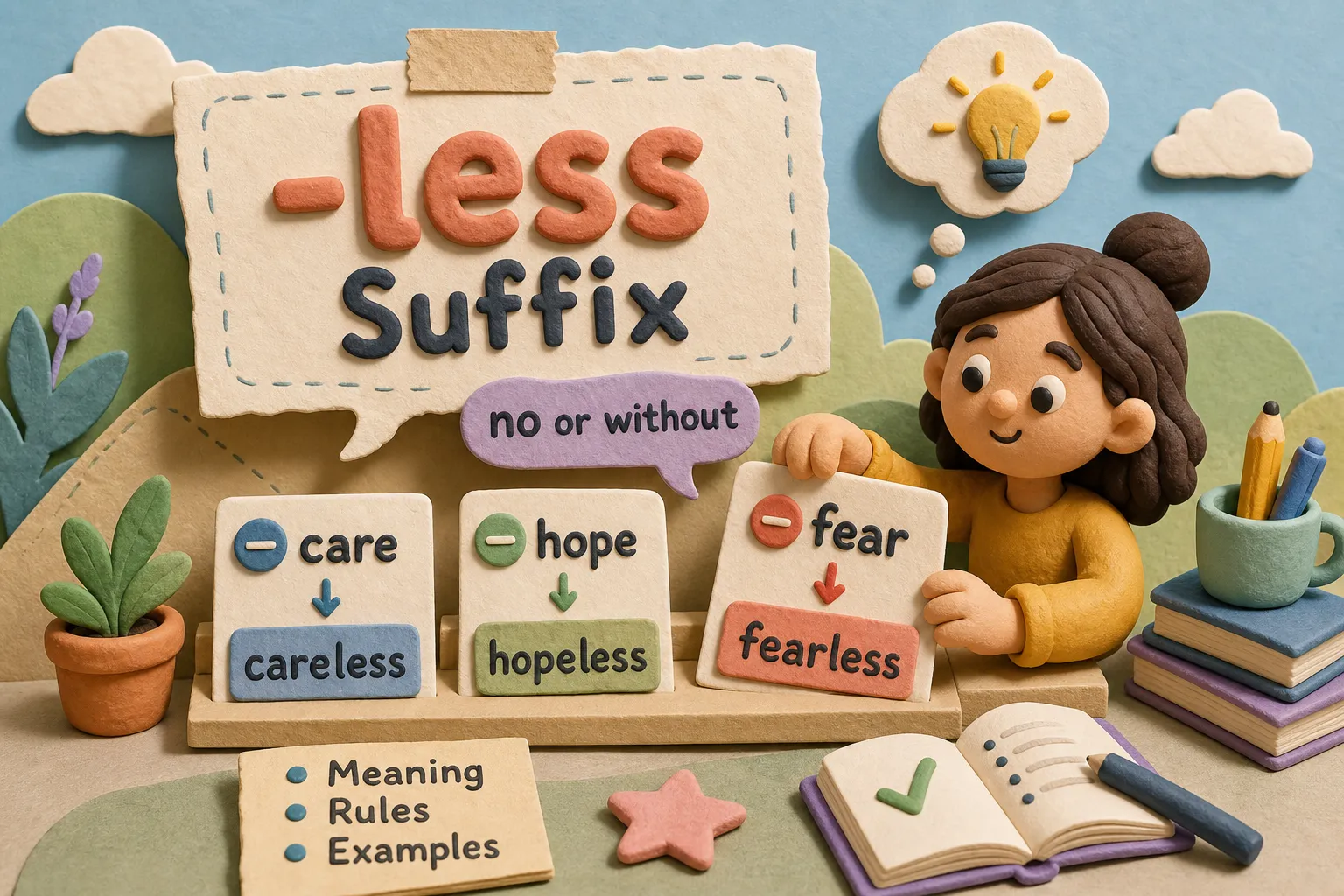
The core function of -less is straightforward: it attaches to a noun and turns it into an adjective meaning “without [that noun].” Here is the formula with three examples:
- hope + less = hopeless (“without hope”)
- care + less = careless (“without care”)
- speech + less = speechless (“without speech”)
This is different from prefixes like “un-” or “non-.” Those prefixes create an opposite. The -less suffix describes an absence or lack, not just an opposite. “Unkind” means the opposite of kind. “Kindless” would mean without kindness. The feeling is slightly different, though in practice many -less words do function as opposites in everyday speech.
When -less goes a step further than “without”
Some -less words carry a stronger sense than just “without.” For example, “powerless” does not simply mean without power, in context, it often implies an inability to act regardless of effort. Similarly, “helpless” can suggest a situation where no available assistance exists, not merely the absence of help in a general sense. Check dictionary definitions and context to get the precise force of these words, since the exact shade of meaning can shift depending on the sentence.
How to pronounce the less suffix in American English
The standard pronunciation
The -less suffix is most commonly pronounced /ləs/, which you can think of as “lus” (it rhymes with “bus”). In North American speech, you will also frequently hear /lɪs/, which sounds closer to “liss.” Both realizations are natural in American English and both are understood by American listeners. The vowel is short and quiet in either case because the suffix is always unstressed.
Stress stays on the base word
Here is a key rule: stress always falls on the base word, never on the -less ending. This matters because it helps you sound natural. Many ESL learners over-pronounce the suffix, which can sound a little awkward. For other common pronunciation traps and guidance for learners, see English Words Non-Native Speakers Mispronounce Most Often, Your Daily American. For a complete guide to stress placement in American English, consult Word Stress in American English: A Complete Guide.
Words to practice out loud
Say the base word first, then add -less. This builds the sound step by step. Here are eight common words to practice with approximate phonetic respellings (for precise IPA transcriptions, consult a dictionary such as Merriam-Webster):
- effortless → EF-fert-lus
- helpless → HELP-lus
- wireless → WY-er-lus
- fearless → FEER-lus
- endless → END-lus
- careless → KAIR-lus
- useless → YOOS-lus
- painless → PAYN-lus
In fast, natural American speech, the suffix vowel gets even shorter and quieter. Do not worry about making it perfect. Focus on keeping your stress on the base word. For more on how vowels and syllables shorten in rapid speech, see a practical guide to pronunciation in fast and slow speech. If you want extra practice materials specifically on saying -less, try this short guide: How to Pronounce the Suffix -less.
Spelling rules for the less suffix
The general rule: attach and leave the base word alone
The -less suffix begins with a consonant, which means it does not trigger the spelling changes you may know from vowel-starting suffixes. Two questions ESL learners ask often:
- Do I drop the silent e? No. The word stays as it is. It is “hopeless,” not “hopless.”
- Do I double the final consonant? No. It is “fearless,” not “fearrless.”
The general rule is to attach -less directly to the base word without changing it. For a fuller look at common rules for suffix spelling and helpful examples, see this overview of English spelling rules for suffixes. For classroom-friendly spelling tips and rules you can use when teaching or studying, review these suffix spelling rules.
No hyphen needed
The -less suffix is written as one solid word with the base. You do not need a hyphen. Write “harmless,” not “harm-less.” Some compound adjectives in English do use hyphens, but -less words are not in that group. When you see a -less word in edited American writing, it will almost always appear as a single solid word.
When the base word no longer exists on its own
A few common -less words have base words that dropped out of modern American English. “Reckless” comes from reck, which meant “to care,” but no one says “reck” today. “Ruthless” comes from ruth, which meant “pity”, also gone from everyday use. “Feckless” follows a similar pattern, rooted in the Scots word feck meaning “effect” or “value.” These words are memorization cases. Do not try to build them from a formula. Learn them as fixed, complete words.
The most useful -less words, grouped by theme
Instead of a long, random list, this section groups common words ending in -less by theme. Words grouped by topic are easier to remember and easier to use.
Emotions and personal states
These words describe how a person feels or their general condition:
- hopeless, speechless, fearless, restless, helpless, blameless, shameless, cheerless, listless, heartless
Example 1: “After waiting three hours with no news, she felt completely helpless.” Example 2: “The audience was speechless after his announcement.”
Describing people and character
These words are common when talking about someone’s behavior or personality:
- careless, selfless, thoughtless, reckless, ruthless, tireless, tactless, spineless, guiltless, faultless
A note on register: “ruthless” and “reckless” tend to appear in formal written contexts, professional writing, news articles, and business conversations. “Careless” and “thoughtless” are everyday words you will hear in casual speech just as often. Knowing the register of a word helps you use it at the right time.
Everyday objects and situations
These -less words describe things and situations in daily life:
- wireless, cordless, endless, pointless, useless, harmless, effortless, painless, tasteless, nameless
Example 1: “The new software update made the process completely effortless.” Example 2: “My phone has a cordless charger now, which is very convenient.”
Workplace and professional English
These -less words come up often in business writing, presentations, and meetings:
- flawless, seamless, clueless, groundless, countless, priceless, powerless, limitless
“Seamless” and “flawless” are especially common in professional settings. You will see them in presentations (“a seamless transition”), in emails (“the delivery was flawless”), and in performance reviews. If you work with American colleagues, these two words are worth learning well.
Practice exercises for the less suffix
Reading about a pattern is one step. Using it in sentences is where real learning happens. These three short exercises help you move from recognition to active use.
Exercise 1: Fill in the blank
Choose the correct -less word for each sentence. The base word is given in parentheses as a hint.
- “The instructions were ________. Nobody could understand them.” (use)
- “She worked ________ hours to finish the project before the deadline.” (count)
- “The new office layout created a ________ transition between departments.” (seam)
- “He made a ________ mistake by sending the wrong file.” (care)
- “The feedback was ________; it had no specific examples.” (point)
- “After the accident, she felt completely ________ and needed help with everything.” (help)
Exercise 2: Build the word yourself
For each noun below, form the -less adjective. Write one sentence using the word. Then check: did the spelling of the base word change? It should not have.
- power
- harm
- home
- worth
- end
Exercise 3: Spot and correct the error
Each sentence below has a problem with a -less word. Find the problem and suggest a correction.
- “The meeting was completeless, we didn’t finish anything.” (Is “completeless” a real word?)
- “He spoke careless during the presentation.” (What part of speech is needed here?)
- “The report was written in a pointless way.” (Is the intended meaning really “without a point”? What might work better?)
- “She is tireless worker in our team.” (Check the sentence structure.)
How to keep building vocabulary beyond one article
Why learning word-by-word does not last
When you learn words one by one, without any connection between them, they slip away quickly. Vocabulary retention is much stronger when you understand patterns, and that understanding compounds over time. Knowing the less suffix means that every new -less word you encounter becomes easier to decode and remember. That is suffix-based learning working in your favor, and it scales to every suffix you add to your toolkit.
Using spaced repetition with suffix families
Spaced repetition is a study method where you review words at increasing time intervals, which moves new vocabulary into long-term memory more efficiently than reviewing everything every day. When you create your vocabulary review sets, group -less words together. Reviewing them as a family reinforces the pattern each time and makes each new word easier to absorb. If you also want to prioritize vocabulary, consider studying high-frequency word lists such as this set of 250 high-frequency words to focus on words you will meet often.
Where to go next
The -less suffix is one part of a larger system. English has many other suffixes and prefixes that work the same way. If you want a complete, structured approach to vocabulary building, the vocabulary-building strategies section at Your Daily American walks you through exactly that. You will find retention techniques, study habit frameworks, and methods for efficient, long-term learning that go well beyond any single suffix. If you’re also unsure about count vs. mass distinctions, read Less or Fewer? How to Choose the Right Word for clear guidance.
What you now know
Here are the core takeaways from this lesson:
- The less suffix (-less) means “without” and functions as a derivational suffix that turns nouns into adjectives.
- Pronunciation is most commonly /ləs/, and frequently /lɪs/ in North American speech, with stress always on the base word, never on -less.
- Spelling stays the same: attach -less directly to the base word without changing it.
Start noticing -less words in articles, podcasts, and conversations this week. Each time you spot one, the pattern gets a little stronger in your memory. Try the exercises above again in a day or two, you will find them easier the second time, and that experience of getting easier is exactly how vocabulary retention works.
One suffix is a starting point, not a finish line. At Your Daily American, there is a full path from foundational patterns like this one to complete fluency in American English. Pick your next suffix and keep building.