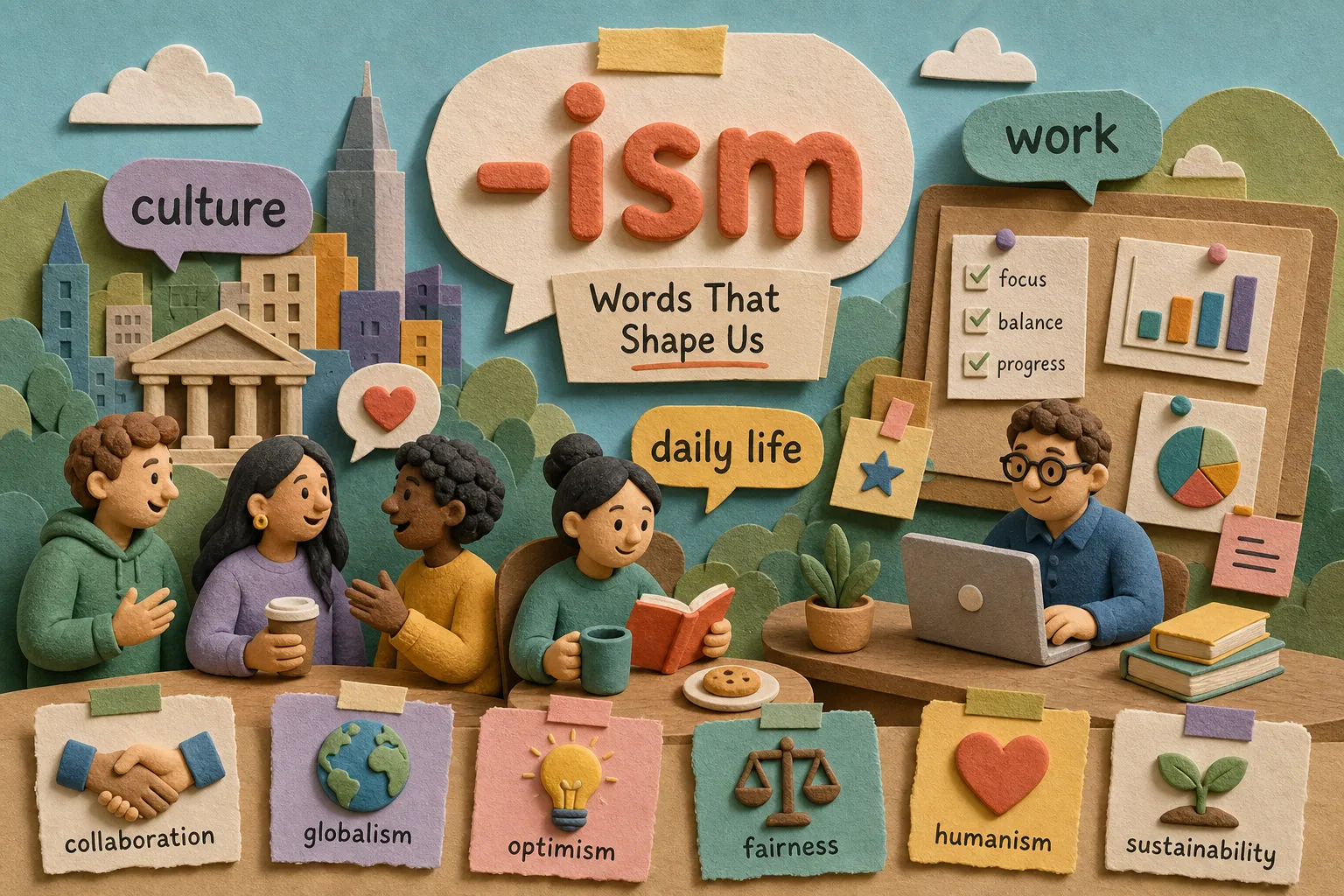
You’re watching an American news podcast. The host says something about nationalism. Then a guest mentions activism. A few minutes later, you hear optimism, racism, and capitalism in the same conversation. You know what each word means, but you haven’t yet seen what connects them. That connection is the ism suffix, one of the most common and culturally salient word patterns in American English.
By the end of this article, you’ll know where the -ism suffix comes from, what it means grammatically, how it differs from related suffixes like -ist and -ic , and why some -ism words feel neutral while others carry strong emotional weight. At Your Daily American, we teach vocabulary as a cultural skill, and -ism words are a perfect example of why that approach matters.
Where the ism suffix actually comes from
The suffix -ism has a long journey behind it. It starts in ancient Greek, where -ismós was used to form nouns for actions, states, or conditions. From Greek, it moved into Latin as -ismus, and then into French. English picked it up through scholarly and written language, mainly through contact with Latin and French texts during the late Middle Ages and the Renaissance.
Because of this history, -ism words tend to sound formal or academic. They entered the language through books, universities, and religious writing rather than through everyday spoken English, which is why capitalism is more at home in a news article than in casual conversation. That said, -ism words do appear in speech when the topic calls for them; the register just tends to shift when they do.
Worth noting: -ism is a productive suffix, which means English speakers can use it to build new words, not just borrow old ones. New -ism words are still being created today. Ableism (unfair treatment of people with disabilities) is a well-documented recent example of the suffix naming a newly recognized social problem, and informal coinages like lookism (judging people by appearance) show how the pattern keeps expanding in social and activist contexts.
The main types of -ism words and what they name
The -ism suffix creates abstract nouns, nouns for ideas you can’t touch or see. It names several different kinds of ideas, and the category a word belongs to often tells you a lot about how emotionally charged it will feel in conversation.
Political and social belief systems
The first and largest group covers political and social belief systems, meaning organized ideas about how society should work. Capitalism is an economic system based on private ownership and profit. Communism is a system where property is owned collectively. Feminism is the movement for equal rights for women. These terms are commonly discussed in American news and political discourse, you’ll encounter them regularly in op-eds, debates, and podcasts, though the frequency varies widely by outlet and topic.
Philosophical ideas and ways of thinking
A second group covers philosophical ideas and ways of thinking. Pragmatism means focusing on practical results. Stoicism means staying calm under pressure. Realism means seeing things as they actually are. Optimism means expecting good outcomes. Terms like optimism and pragmatism, in particular, show up in workplace contexts when people describe their attitude or approach to a challenge, you might hear them in a performance review or a strategy meeting.
Everyday, low-stakes words
A third group is everyday and low-stakes. Tourism simply means traveling for pleasure. Criticism means pointing out faults or strengths. Heroism means brave or courageous behavior. These words rarely carry political weight in most everyday contexts, though, as with any word, tone and situation still matter.
Why some -ism words feel negative (and others don’t)
The suffix -ism is not negative by itself. The word optimism is positive. The word tourism is neutral. But a specific group of -ism words carries strong negative meaning because they name social prejudice, unfair treatment of a group of people. Racism is discrimination based on race. Sexism is discrimination based on sex or gender. Ageism is unfair treatment based on a person’s age. Ableism is discrimination against people with disabilities.
In this category, the -ism suffix signals “a system of unfair treatment,” and American English speakers tend to respond seriously to these words. Using them in a conversation is rarely casual, they signal that something consequential is being named, even when the speaker intends to discuss the topic calmly. That weight is worth keeping in mind as an ESL learner, because misjudging the register can send an unintended message.
There’s also a historical reason why -ism words can feel loaded. In 19th-century American English, the phrase “the isms” was used as a negative label for reform movements that conservative groups disagreed with, including abolitionism (the movement to end slavery) and early feminism. Political opponents used this label to dismiss these movements as extreme or dangerous. That history left a mark on the suffix, so today, encountering a new -ism word can prompt a moment of wariness in listeners, even before the meaning registers.
The key point: the negative or positive feeling of an -ism word comes from its history and use in society, not from the grammar of the suffix itself. Capitalism and racism use the same suffix, but they feel completely different in conversation.
How the ism suffix works with -ist and -ic
Once you understand -ism, you’ll get more value by learning it alongside two related suffixes. These three suffixes form a useful pattern that you can apply to many words:
- -ism names the system, belief, or movement
- -ist names the person who follows or practices it
- -ic creates the adjective that describes something related to it
Here’s how that looks with three common words:
| System (-ism) | Person (-ist) | Adjective (-ic) |
|---|---|---|
| realism | realist | realistic |
| capitalism | capitalist | capitalistic |
| pragmatism | pragmatist | pragmatic |
This pattern means you can often guess the meaning of a new word without looking it up. If you already know realism , you can figure out that a realist is someone who practices it, and that something realistic relates to that way of thinking.
Here’s how these three forms sound in real American speech: “She’s a realist. She believes in realism, so she’s not going to support a plan that isn’t realistic.” Notice how all three forms appear naturally when you describe a person, their belief, and a quality at the same time. The -ist and -ic forms often appear together in the same sentence, especially in professional settings.
One common mistake ESL learners make: using the -ism form where the -ist form is needed. If someone asks “Are you a capitalism?”, that doesn’t work. The correct sentence is “Are you a capitalist?” Similarly, you wouldn’t say “She’s a tourism”, you’d say “She’s a tourist.” The rule holds across the board: use -ism for the idea, and -ist for the person who holds or embodies it.
-ism vocabulary in American news, work, and everyday life
Knowing which -ism words appear in different settings will help you use them with the right tone and level of confidence.
In American news and political discussions, words like racism , nationalism , activism , liberalism, conservatism, and populism (a political style that appeals to ordinary people against powerful elites) commonly appear. These are semi-formal or formal words. They sound natural on a news program, but they can create tension in personal conversations because many of them connect to strong political opinions. Here are two examples of how they appear in context:
- “The senator was accused of nationalism after his speech about immigration policy.”
- “Several community groups have increased their activism around housing costs in the city.”
In American workplaces, you’ll hear a different set of -ism words. Professionalism means behaving in a mature, skilled way at work. Skepticism (a doubtful attitude toward a claim) comes up in meetings when someone questions a plan. Optimism and pessimism describe attitudes toward outcomes. Criticism is very common too, but note a cultural point: in many U.S. workplaces, feedback is often delivered with balancing positive comments rather than as straight critique. A manager might say “I have some criticism of the report, but I also want to say the data analysis was excellent.” Understanding this pattern will help you interpret workplace feedback and give it more naturally.
How to build your -ism vocabulary the right way
A dictionary definition is a starting point, not the finish line. Knowing that capitalism means “an economic system based on private ownership” is useful. But knowing when Americans use that word, in what tone, and in what kinds of discussions, is what lets you actually use it in conversation without hesitation.
Try this quick self-check to test your real understanding of some common -ism words. Ask yourself these questions:
- Could you use skepticism in a work email without sounding rude?
- Would you say racism casually in small talk with a new colleague?
- Could you explain the difference between realism and optimism in a job interview?
If you’re not sure about any of those, that’s a sign that you need cultural context, not just vocabulary lists. These are real communication questions, and they require practice in realistic situations.
That’s the gap Your Daily American is built to close. The platform teaches American English in real cultural context, from the vocabulary you hear in workplace meetings to the words that show up in political podcasts. If you want to keep building your -ism vocabulary and understand how these words actually sound and feel in real American conversations, take the free proficiency test at Your Daily American. It measures your reading, listening, writing, and speaking skills, then gives you a personalized study plan so you know exactly where to focus next.
Put it all together
The ism suffix is a pattern, not a mystery. Once you recognize it, you can immediately get a general sense of any new -ism word you encounter, whether it names a political ideology, a philosophical approach, an art movement, a social bias, or something as simple as tourism . The suffix itself is neutral. The feeling of a word comes from its history, its social use, and the context around it.
Now take what you’ve learned and put it to use right away. Pick three -ism words from this article and write one sentence for each one, using it the way a native speaker would in a real situation. Write one in a news context, one in a workplace setting, and one in everyday conversation. That single exercise will do more for your fluency than reading the definitions one more time.